
As trees face the axe in city after city across India, residents of these cities have stood up in protest against the wanton act and to safeguard the greens. The proposed action in KBR National Park in Hyderabad even led to a few FIRs being filed against tree activists this week; hundreds of trees have been marked for cutting and translocation to pave the way for the H-CITI project flyovers and underpasses. Nothing could be more stirring than the action that reached city news from the forests of Sijimali and Kantamal, in Odisha, throughout April to save the forests from mining operations by Vedanta-owned companies. Thousands of tribals protested, stayed in water and covered themselves in mud to draw attention, and even clashed with the police force to protect ancestral land (Maati) and the forests.
People from Hyderabad to Sijimali (Odisha), Pune to Jaipur, Delhi to Mumbai, Goa’s Mollem to Thane and beyond have understood the importance and value of trees in their neighbourhoods and cities–both for themselves and the ambient ecology. The cool shade of a tree on a brutally hot summer afternoon has its value that no cooling shelter can replace. Senior citizens, activists, students, and environmentalists have engaged with their local bodies—mainly municipal corporations and Tree Authority within them—to stall the tree cutting and challenge the very need for it. They have taken on-ground action, keeping vigil and protesting continuously, in nearly every location where trees and entire forests have been marked for cutting.
The role of trees in cooling the ambient atmosphere has been well documented. Among the latest research is the study that finds trees almost halve how much heat is trapped by the urban heat island effect – a significant relief during extreme heat.[1] This has been known but largely ignored by planners and governments in their desire to make cities densely concretised in the ‘development’ spree. Planting more trees, it is known, can cut air temperatures by up to 5 degrees Celsius.[2]
Question of Cities takes stock of a few cities that have seen people’s action to question development projects and save trees.
Pune: The green fades into an inheritance of loss
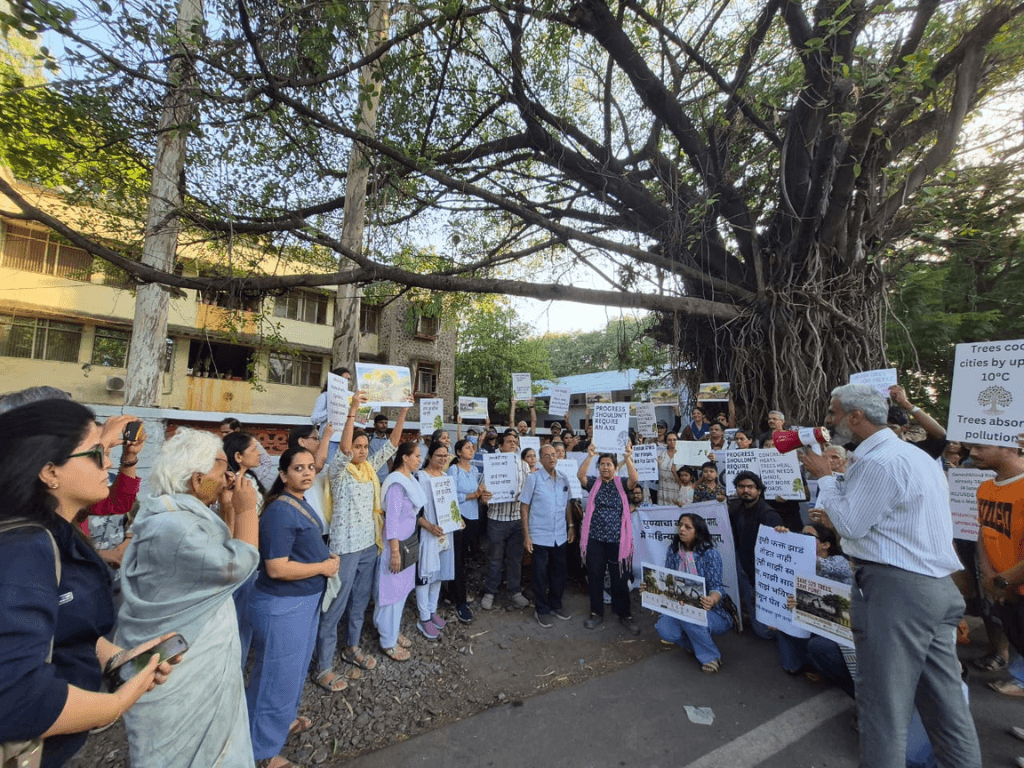
A total of 529 trees – most of them heritage trees — on Ganeshkhind Road in Pune are slated to be chopped to widen the road to 45 metres between Sancheti Hospital and Savitribai Phule Pune University. Visuals of residents opposing the move and protesting to save the old trees have flooded social media. This is only the latest tree cutting proposal on the back of several that includes chopping down the hill, Vetal Tekdi. The Pune Metro’s earlier phases saw 557 trees hacked; the expansion will cause the felling of 2,576 trees and disturbing of another 465 trees.
On May 11, even as tree-saving measures brought people outdoors, the city recorded a maximum of 43.8 degrees Celsius—its hottest-ever day in May.[3] Activists and tree lovers know the role of trees in bringing down the temperature but the officials in the Pune Municipal Corporation in charge of trees seem to be ignorant, wilfully so.
Every tree matters now in Pune because in the past two and a half decades, the tree cover in the city has declined by a staggering 95 percent, with the maximum tree loss between the late 1990s and mid-2000s. This picked up momentum in the past few years as new infrastructure projects were announced. Tree activists are not against the projects but question the sacrifice that trees—once Pune’s pride—are asked to make. The lost canopy cover cannot be replaced easily because mature trees take decades to grow and some indigenous species like banyan, peepal, nandruk are irreplaceable.
Today, 63 percent of Pune’s 350 square kilometre area is covered in concrete “as the authorities are against all tree cover in Pune because they want urban densification,” says Ameet Singh, economist who has taken on the administration on the issue, “Pune needs around 100 crore trees to address the pollution problem. It needs 100 trees per person but has one tree for two persons.” The dismal number will worsen if more green cover is lost. Passionate activists like Singh rely on hardcore information to question the need to cut trees.
Only between the Wakad bypass and Sangvi Bridge section of the Mula Mutha river, as part of the riverfront development project, the Pune Municipal Corporation proposes to cut 689 trees. The entire project, according to the PMC, would affect at least 3,110 trees but the number could rise to a shocking 22,150 by the time it is done. Green zones such as Vetal Tekdi face threat roads are planned across it to cut travel time.
Hundreds of activists like Singh refuse to give up. There’s hope in more people and community groups coming together, and in people not giving up the good fight. “We have given away our heritage. This is our inheritance of loss. Build what you want but do not touch our trees,” says Singh.
Hyderabad: Save trees, get named in FIRs
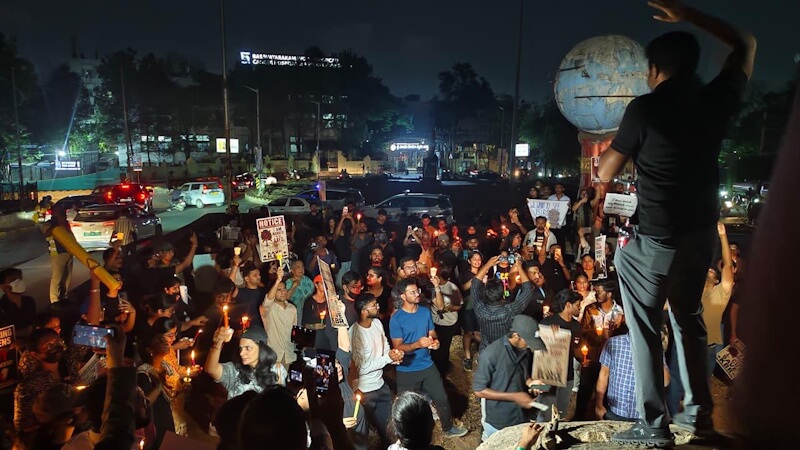
Photo: Save KBR Movement
Groups of residents were protesting against cutting of trees around outside the Brahmananda Reddy (KBR) National Park, located in the posh and densely concretised Jubilee Hills. The Hyderabad City Innovative and Transformative Infrastructure (H-CITI) project plans axing trees in the 390-acre KBR National Park to create a signal-free road network around the Park to incorporate seven steel flyovers and seven underpasses to ease traffic congestion.[4] That day, April 23, the Jubilee Hills recorded 43 degrees Celsius — an increase of 6 degrees Celsius from 2023 on the same day.[5]
This concretised area needs trees all the more and “the park is the only relief,” says public policy expert and environmental activist Dr Narasimha Reddy Donthi. The 390-acre open land serves as a microclimate controller, enables wind flows, and generates oxygen. Its role in cooling the area is important for Hyderabad which has seen a rise in minimum and maximum temperatures in the past few years.[6]
Telangana has recorded days of heatwaves this year. Adilabad ranked at the top but Hyderabad was no better at around 40.6 degrees Celsius, with the IMD and state data showing localised spikes up to 45 degrees. As the protests to save the trees in KBR gains momentum, environmentalists warn that the felling of thousands of trees and the use of asphalt-concrete will affect the park’s microclimate, resulting in an ‘urban heat-dome’ and raising temperatures in surrounding areas by 2–5 degrees Celsius.[7]
In April last year, when the government started cutting trees in the 400-acre Kancha Gachibowli – part of the Deccan scrub forest ecosystem — to build an IT park, environmentalists voiced strong concerns about the impact the move would have on the already warming city. Around 1,500 trees were felled overnight even as students, activists and environmentalists rallied to save them. It turned into a national issue. Later, the Supreme Court took suo motu notice and directed the Congress government to halt the activity.
The increased construction and massive tree-felling means Hyderabad has become an urban heat island; the extreme heat causes a lot of rain and results in urban floods, says Dr Donthi. This is a far cry from the city being recognised, in 2021, as the ‘Tree City of the World’ by the Arbor Day Foundation and the Food and Agriculture Organization of the United Nations (FAO).[8] It repeated the honours the following year.[9]
The cluster of old banyan trees in Chevella, 20 kms from Hyderabad, was saved because of the citizens’ tireless protests and the National Green Tribunal rapped the National Highways Authority of India on it. As people girded up at KBR, the Hyderabad Police filed FIRs against 10 of them on May 13.[10]
Thane showed 5.4 degrees C above normal this March
Photos: Shreelata Menon
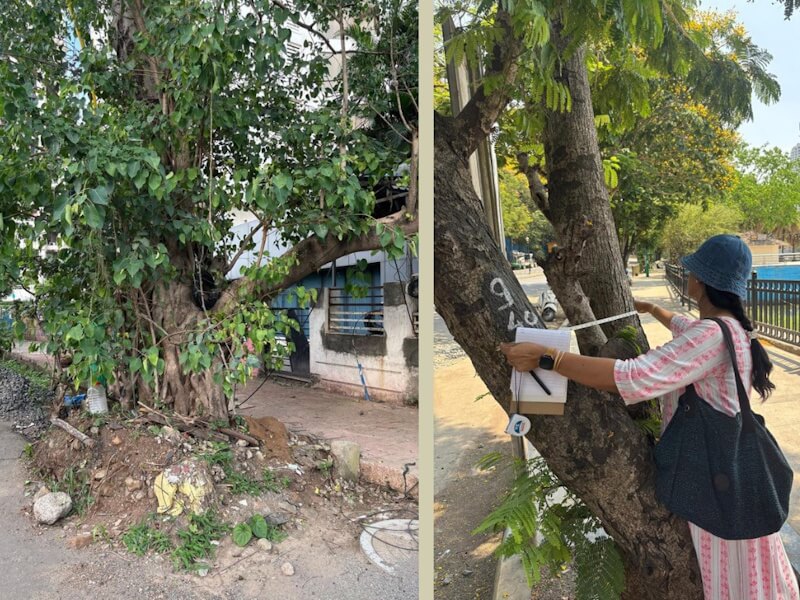
In early May, citizens opposed the Thane Municipal Corporation’s plan to remove a century-old banyan tree from Balkum and invited objections to relocate it to Kolshet.[11] This is only the latest in a series of continuing protests in one of India’s fastest-growing cities to preserve its green cover. The TMC Tree Authority’s plans to cut or transplant 3,224 trees for the 29-km Internal Ring Metro has also got Thanekars up in arms.[12]
Once an idyllic town, Thane’s development has come at the cost of its forests and water bodies; the juggernaut does not stop. Over 2,600 trees have been marked at Pokhran 1 for removal for the TMC’s headquarters itself. The Thane Regional Mental Hospital campus will see more than 700 trees on its 63-acre campus go during an expansion. Municipal data itself shows that in only seven years (2017-24), Thane lost 8,144 trees to urbanisation.[13]
Do the projects help? The Kolshet Road was widened in 2021 at the cost of 431 trees but the traffic congestion continues to persist. Residents had braved Covid lockdown norms to protest the tree felling but in vain. Shreelata Menon, associated with the citizens’ initiative Thane Greens Collective, says only a holistic plan to address congestion can help. The TMC and other agencies claim transplantation of the felled trees but end up doing a shabby job with barely one-two of every four-five transplanted thriving. Menon and her team have stepped in “with just a lot of water and little love” to save them.
The TMC now has a Heat Action Plan to address the rising heat but the trees-heat link rarely gets made. This March 11, Thane registered summer temperature of 39.2 degrees Celsius—a shocking 5.4 degrees above normal for March, according to the IMD.[14] The Council on Energy, Environment and Water, which helped prepare the Thane HAP, projected a threefold increase in the frequency of extreme hot days from 2024 to 2040 (compared to 1982-2024), and a four-fold increase in warm nights.
Thane’s tree warriors include older residents, planners-architects, environmental activists and committed foot soldiers like Menon, but it might take more than their indefatigable vigil to save the trees.
Jaipur lost 42 percent green cover in two decades
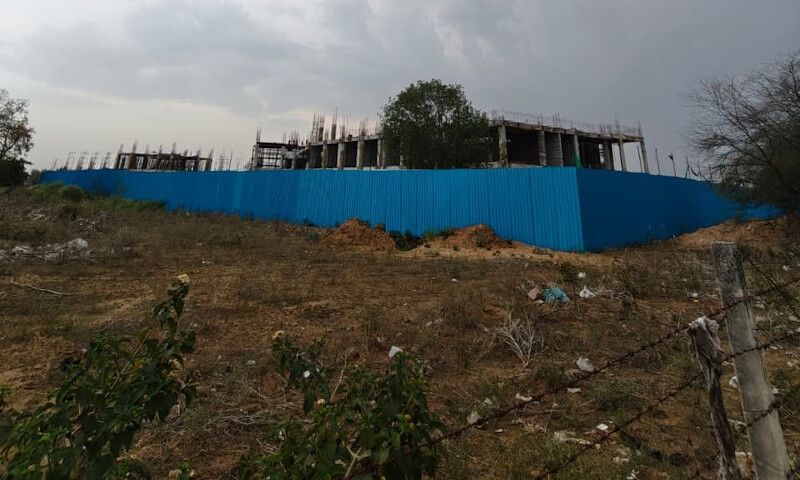
For five years now, untiring activists in Jaipur have been fighting to save Dol ka Badh, the last remaining green lung of the city. Rapid urbanisation has led to a 42 percent decline in the city’s green cover over the past two decades, exacerbating urban heat, air pollution, groundwater depletion, and reducing liveability.[15] The city lost 9.8 acres (equivalent to eight football fields) of tree cover from 2001 to 2025, according to Global Forest Watch.
For a blindingly hot city, which recorded a rise in heat stress days from 20-30 a year during the 1990-2010 period to 40–50 a year recently, this should have been alarming. Jaipur’s mean annual temperatures have risen by 0.53 degrees Celsius per decade— more than double the global average of 0.2 degrees Celsius.[16] This year, Jaipur’s maximum temperature touched 41.8 degrees Celsius on April 23.[17] with extreme heat days starting mid-April.[18]
The Dol ka Badh forest, however, has fallen to a fintech park, PM Unity Mall and other construction projects. The plan was to fell 2,400 to 2,500 mature and native trees in this naturally grown forest as the land marked for industry lay unutilised for over four decades.[19]
The only patch of vegetation one can see in the satellite image is Jhalana Doongri, a forest on the outskirts of the city. “In a semi-arid area like Jaipur, around 600 mature trees have been recently cut at Dol ka Badh to make space for the mall. A total of 1,000 trees have been cut in the past three years,” says Shaurya Goyal, a mechatronics engineer-turned-entrepreneur who has been relentlessly fighting to save the Dol ka Badh.
Goa’s Mollem and the quiet struggle
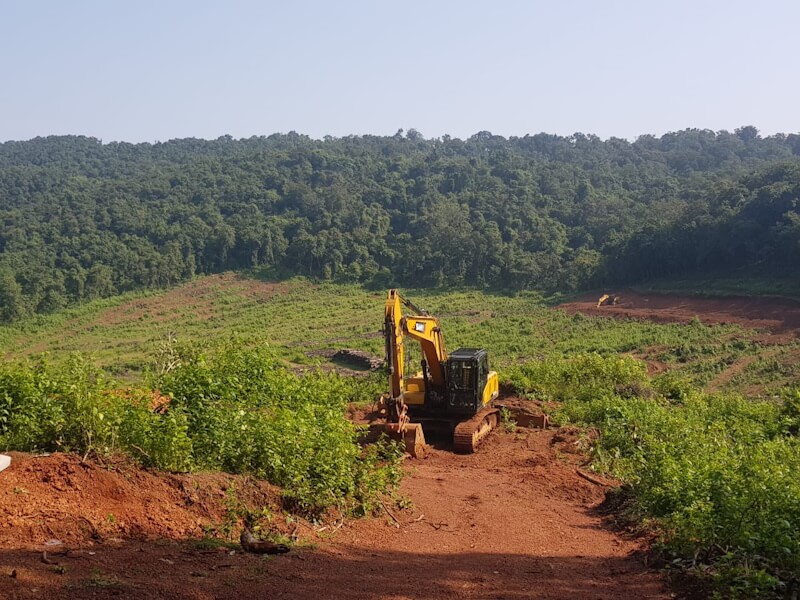
Photo: Amche Mollem Citizen Movement
The languid and lush green Goa may soon be history. A total of 54,176 trees were hacked down in 2021 for the Mopa international airport; three years later, the Goa Tree Authority approved the felling of 4,263 trees for three infrastructure projects; last year, for widening only one road from Mapusa to Parra, 27 heritage trees were felled; and Mollem/Anmod saw the approval to chop down more than 50,000 trees back in 2019.
The state has seen intense protests against tree cutting in nearly every instance. The Amche Mollem, to protect the Bhagwan Mahaveer Sanctuary and Mollem National Park, has stayed the course since 2019, challenging the need to cut down an estimated 50,000 to 59,000 trees. Nearly 12,100 trees were cut for the highway expansion; and the power transmission line (of GTTPL) meant up to 15,772 trees were earmarked for cutting.
In just about a decade, between 2010-11 and 2021-22, the state’s tree cover depleted from 334 square kilometres to 258 square kilometres— a loss of 76 square kilometres.[20] People’s protests have drawn attention to the issue but have not halted any of the projects or caused successive governments to pause and reflect.
“There isn’t a place in Goa that wasn’t greener five years ago – Assagao, Saligao and even Porvorim. It’s quite depressing,” says Jerusha D’Souza, working with Amche Mollem movement and The Goa Foundation. She recalls biking to Dharbandora on the National Highway 748 and cooling in the line of trees. But, around 7,000 trees here are slated to be hacked down for road widening.[21]
The spate of development projects in Goa at the cost of its rich ecology and biodiversity has meant more hot days. “The summer has been unbearable. It becomes easy to ignore when so many people now have ACs but what about the people on the streets? It’s horrible,” says D’Souza. On May 10, the state recorded a maximum temperature of 36 degrees Celsius while the “feels like” temperature shot to 47.3 degree Celsius.[22] April this year recorded Goa’s third-hottest summer night in 50 years at 28.6 degrees Celsius and an unusual streak of three consecutive warm nights. In capital Panjim, the minimum or night temperatures entered the 29 degree Celsius range for the first time in this past decade, about 2.5 degrees above normal; it occurred on May 11 too. Yet, the tree-cutting in thousands continues.[23]
Cover photo: Pune residents protest the proposed cutting of trees at Ganeshkhind Road.
Credit: Damini Mahajan