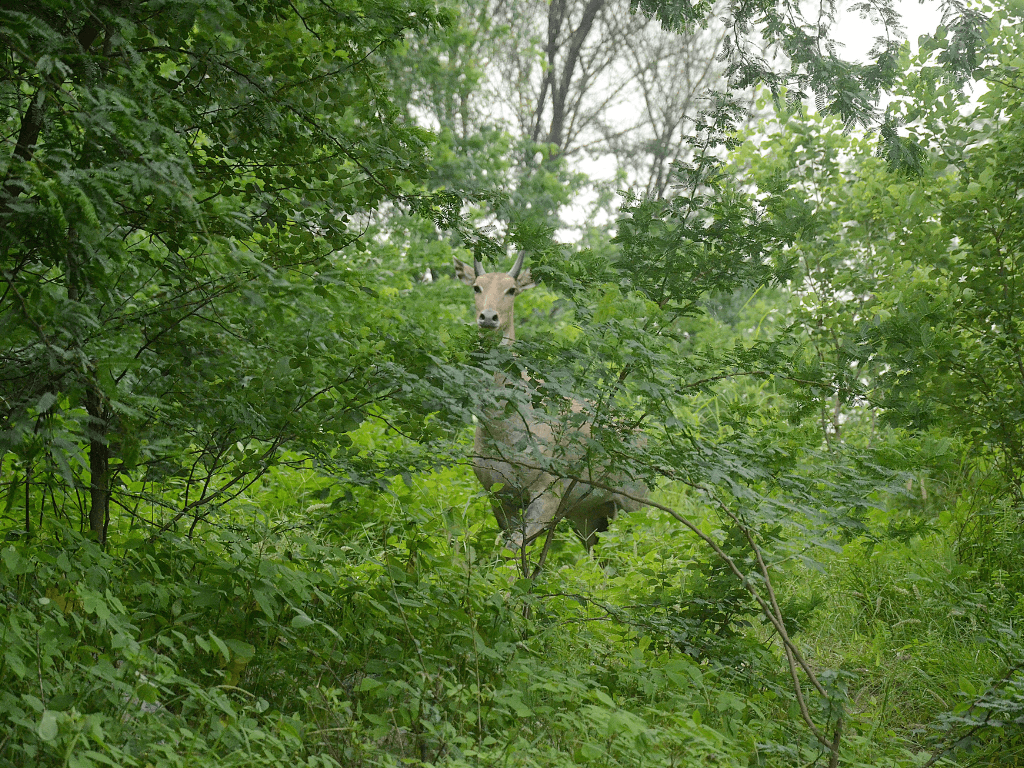

On a hot May morning, in the patch of green that’s the Dwarka forest, in the Southwest of Delhi, it is possible to hear birdsong but its cadence is broken by the noise of construction activity nearby. There are bee-eaters, a rufous treepie, drongos, and purple sunbirds flitting through the trees. Nestled beside the urban village of Shahbad Mohammadpur, which used to be the agricultural landscape, the forest is hemmed in by the airport, the Dwarka expressway, and a metro station.
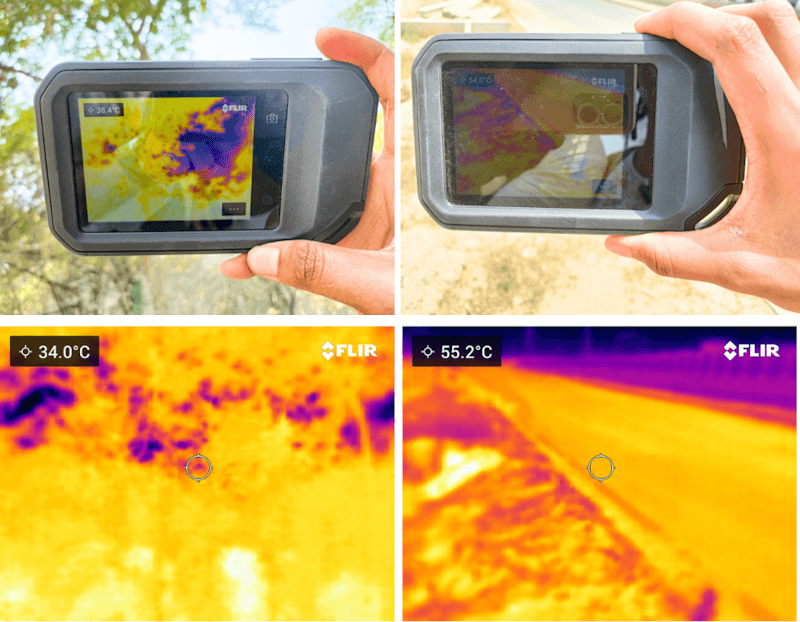
It feels perceptibly cooler here than on the road outside the forest even in the peak of afternoon heat at 1PM. Our thermal camera records 34-38 degrees Celsius within the forest. We step 200 metres outside the forest, on the road. The difference in the land surface temperature is staggering: almost 17 to 21 degrees higher at 55 degrees Celsius.
The verdict is in front of us – the forest goes a long way to keep the surroundings cool even during high heat.
This forest is now under threat. It used to be a barren piece of land with the Delhi Development Authority (DDA) and was later given to the railways. Gradually, nature worked its magic and a forest grew across the 125 acres, a dense forest housing several species. The trees were recently cleared or are buried under concrete for the Rs 800 crore Bijwasan railway redevelopment project[1] which the authorities say is a public purpose project. From the mid-80s till 2022, the Dwarka forest was a thriving ecosystem flora, at least 65 bird species including migratory birds, the Nilgais which are protected under Schedule II of the Wildlife Protection Act, and other wildlife.
But it was not officially recognised as a forest by the authorities. This has now meant an open licence to destroy what grew naturally. On March 20 this year, even as temperatures began to rise in the national capital, the Supreme Court ruled[2] that 30 acres of the densely vegetated Dwarka was technically not a forest; by inference, it meant construction could be carried out here. Upholding an order of the National Green Tribunal, the SC stated that it does not qualify to be a “deemed forest” because it was not classified as such when the Delhi Master Plan came into force.
That the once barren land had organically grown into a forest, exhibiting the characteristics of one, did not matter. Somehow, definitions on paper were more important. That the Delhi Forest Department, in 2025, recorded about 20,000 trees of 33 varieties while independent surveys by Land Conflict Watch counted 25,000 trees did not matter; a cut-off date did.
Speaking to Question of Cities, Dhaman Trivedi, an associate in the office of advocate Ankur Sood, who is representing the petitioners in the Dwarka case, said the judgment sets a troubling precedent for urban forests that emerge organically over time. ”The problem with this precedent is that for many such lands, there may not be sufficient documentary proof showing that trees had been growing before the Master Plan was notified. Authorities simply argue that the vegetation came up after the Plan, therefore it should prevail. Consequently, in the absence of an independent inquiry about the status of trees by the courts, this creates a pathway for the trees and green spaces to be cleared,” Trivedi explained.
The Dwarka forest “existed before the Master Plan 2021 came into force” and the legal team submitted Google Earth images from 2018 showing the forest cover but “the Supreme Court did not pay attention to this,” he rued. The petitioners may challenge the judgment.
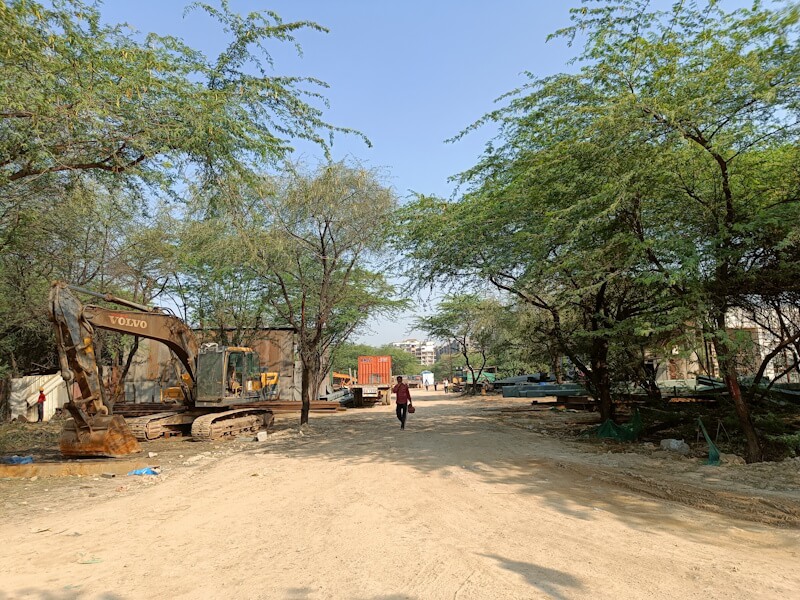
Photo: Ankita Dhar Karmakar
The impact, like heat, radiates
The SC judgment has cleared the way for the felling of more than 1,200 trees[3] in the Dwarka forest. Naveen Solanki, 25, a resident of Shahbad Mohammadpur and an environmental activist fighting for the forest, is livid: “No one seems to care about ecology; there’s this reckless narrative of development. There will be more heatwaves, more climate calamities.” He fears that the remaining 95 acres will see a similar fate too. If that happens, “as many as 25,000 trees[4] will be cut,” he says.
Solanki’s feet are on the ground; he feels the brutal summer heat. Like him, the burden of extreme heat is felt mostly by informal and outdoor workers, and people in informal housing where cooling devices are unaffordable. The natural cooling that trees and forests provide can be a life-saver. A recent study[5] shows that if Delhi were to add eight percent more green cover, it could cool neighbourhoods by at least 1 degree Celsius.
However, Delhi has lost thousands of trees and green patches over the years. The city lost over 77,000[6]trees between 2008 and 2018, Delhi’s Environment Minister Imran Hussain stated in a reply. Since then, another nearly 15,000 have been felled – 2,466 for the Central Vista project, nearly 10,000[7] trees for the Dwarka Expressway, around 1,670[8] trees in the Ridge area for a road, 646[9] trees affected by unauthorised pruning, and concreting around trunks. Besides, about 100[10] trees were allegedly cut illegally in Dwarka in 2025, 28[11] so far this year, and another 100[12] trees illegally cut in the Delhi zoo.
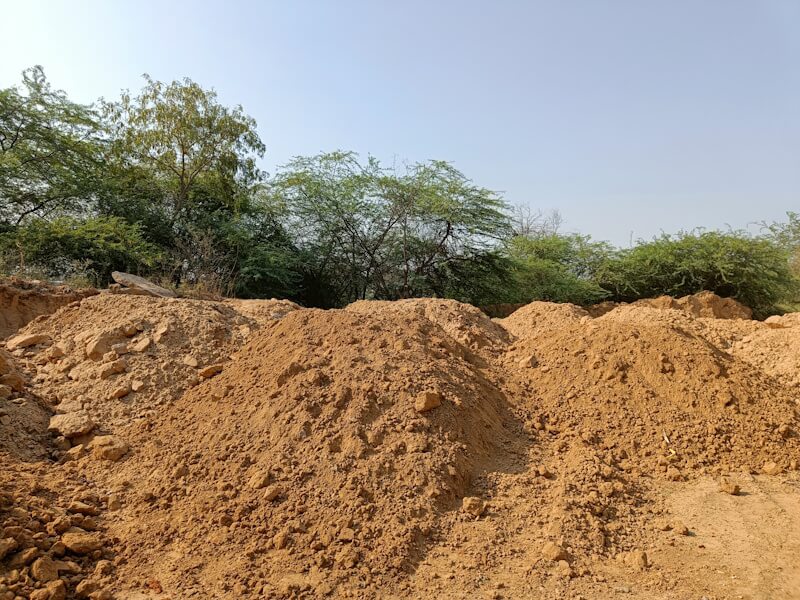
Photo: Ankita Dhar Karmakar
As Delhi experiences extreme heat, it seems a crime to cut down thousands of trees in Dwarka only because it was not legally defined as a forest when, ecologically, it is one. Similarly, across India, the battle to preserve forests is increasingly becoming a battle over definitions – what should be counted as a forest, which trees are ecologically valuable, and which landscapes deserve protection. Mumbai’s Aarey lost over 2,200[13] trees to fit the metro car-shed because it was not legally called a forest. Jaipur’s Dol Ka Badh[14] land allotted for industrial development in the 1980s lay unused and gradually grew into a dense forest, is being stripped down on the same grounds. The SC, in November last year, redefined[15] the Aravallis as not hills; another bench set aside the judgment.
The ecological integrity of a place cannot be at the mercy of legal definitions and Master Plans. In Dwarka, as elsewhere, the lack of a legal tag allows urban expansion to trump ecological integrity.
Delhi’s Ridge too
A similar fate of definitions hangs over the Ridge too. Spread across nearly 7,000 acres, it is Delhi’s critical heat buffer and keeps air cleaner besides being a biodiversity-rich zone and groundwater recharge system.
In a report[16] in Newslaundry, environmentalist Chetan Agarwal argues that the Draft Master Plan 2041 dilutes earlier zoning protections for environmentally sensitive areas, including parts of the Aravallis which comprise the Ridge. The earlier 2021 Plan restricted construction in these areas. “That language is now missing,” Agarwal says.
It’s visible already. In February this year, the SC permitted[17] 200 trees to be felled in a section of the Southern Ridge for road construction. A month later, the Delhi government proposed to convert parts of the Central Ridge into “themed forests”[18] which environmentalists argue is going to kill[19] the forest. These instances reveal a growing tendency to treat forests as administrative categories rather than living ecological systems.
The crux is that, whether legally termed forests or not, Dwarka and the Ridge help keep Delhi cool. And this matters.
Impact on the city’s heat
As our thermal camera showed, there can be a difference of several degrees between a shaded forested urban area and an unshaded denuded one. Delhi already tops the world’s charts for air pollution and is in the list of capitals with extreme heat. The increasing loss of the green matters. The G20 Risk Atlas[20] climate projections warn that under the current high-emissions trajectory, temperatures in India could rise beyond 1.8 degrees Celsius, intensifying risks for cities like Delhi. Data from Global Forest Watch[21] indicates that Delhi lost at least 29.6 acres of tree cover since 2001, intensifying[22] heatwaves in the capital.
Professor C R Babu, architect of Delhi’s biodiversity parks, known as the ‘tree man of Delhi,’ says that the city’s environment is increasingly so fragile that the loss of even a small number of trees can affect heat load and pollution. “Trees, especially those with dense canopies, play an important role in micro-climactic regulation, reduce urban heat island formation, and also influence pollution levels,” says Babu.
For Dwarka, the court said 20 percent of the total built area will remain green and trees will be transplanted; Babu asserts that it has to be in the area itself. “They cut trees in the Great Nicobar and do compensatory planting in Haryana which is nonsense. For Dwarka, transplantation has to be here itself.”
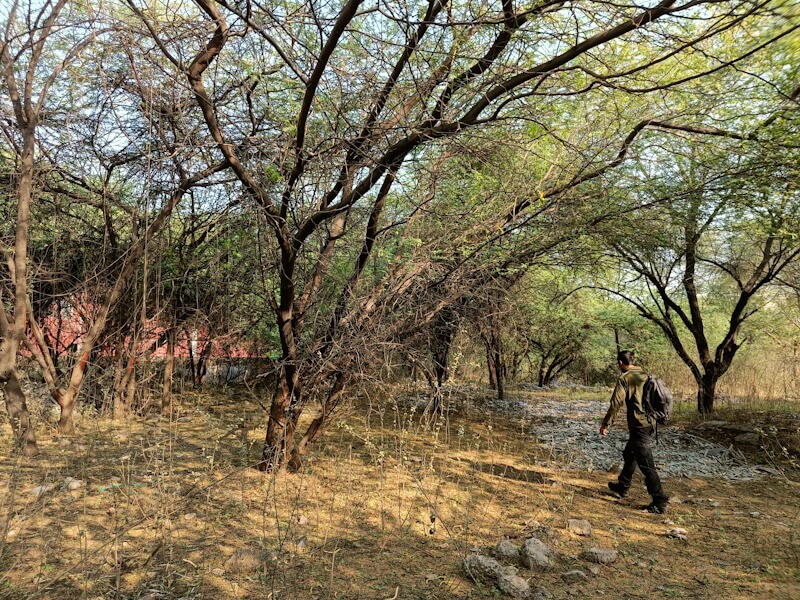
Photo: Ankita Dhar Karmakar
Species, native and invasive
An important aspect which tilted the Dwarka case against it being a forest is the presence of invasive species. The SC noted[23] that “the subject land consists of 70 percent trees of such invasive species which are not beneficial for maintaining ecological balance”. Babu agrees with this reasoning; Vilayati Kikar is not effective for regulating heat or combating pollution, but removing it without adequate replacement of other species is not a solution.
Advocate Trivedi argues that neither the NGT nor the SC ”conclusively addressed the effect of invasive trees in determining a land as forest land”. By this yardstick, the Delhi Ridge[24] which has 90-95 percent of Vilayati Kikar is a non-forest. To understand the nature and impact of invasive species, Question of Cities spoke to independent researcher and writer Nirjesh Gautam, who was associated with the Centre for Urban Ecology and Sustainability at Ambedkar University, Delhi.
Where does the larger argument about invasive species come from?
The Supreme Court’s recent decision sees invasive species negatively. But where is this coming from? There is a judicial authority here that invasive species are bad, so the policy will go in the same direction. This is coming from invasion biology or invasion ecology, which has focused on the negative effects of invasive species. The idea is that local biodiversity is spoiled. But when I work in the field, or observe Delhi, I see a lot of different things. There are invasive species but there is also native biodiversity. There is very good bird diversity in Delhi. And there are some landscapes highly invaded by invasive species. For example, in the Najafgarh lake there are invasive species but 141 migratory bird species go there every year. Environmental management only sees the “invasive” part.
How has the invasive species debate affected the Dwarka forest?
In the Supreme Court, arguments were made about the ecological relationships including the role of Nilgai and biodiversity, but the court was more focused on the invasive species. This framing has larger consequences. Now, there are debates about whether the removal of invasive species requires formal permissions. My concern is that once invasive species are categorised as ecologically undesirable, by default, governments may bypass accountability mechanisms for large-scale tree removal.
This becomes dangerous in a place like Dwarka forest where thousands of trees exist within a politically contested urban landscape. There are already devastating images from the area showing trees buried under construction waste. So, the issue is not only ecological; it’s also about governance and accountability. Once the category of ‘invasive species’ becomes powerful enough to suspend scrutiny, it enables forms of environmental destruction.
What about people living around Dwarka forest if it ceases to be an accessible forest landscape?
The Dwarka forest is not just an ecological space, it is also deeply tied to everyday mobility and survival of nearby communities. People from villages like Shahbad Mohammadpur and Bharthal regularly move through it to reach work, markets and transport points. If the access disappears, many of them would be forced to walk three or four kilometres extra every day.
This sounds minor on paper but, in this landscape, it can have serious consequences. The surrounding area is already dominated by heat-intensive infrastructure: airport, railways, bus terminals, highways and the Dwarka Expressway, all designed around fast-moving vehicles and not pedestrians. Crossing the highway with traffic at over 80 kilometres per hour is dangerous for workers, more so if they carry goods.
The forest also acts as a heat buffer for the urbanised area. Around it, there are stark inequalities in infrastructure and living conditions. Many people in nearby settlements cannot afford air conditioning or other protection from extreme heat. As more concrete infrastructure replaces ecological cover in Dwarka, the burden of heat will fall disproportionately on poorer communities. So, this is not only ecological but also social.
Ecologists and policymakers argue that invasive species should be removed because they threaten native biodiversity. But how do you read this in Delhi, where species like Prosopis juliflora have existed for over a century and are embedded in local ecosystems?
Such decisions are often made without proper ecological assessments. If I were to restore a place like the Dwarka forest, I would first want to understand the ecological relationships that already exist there. For instance, the Nilgai feed on the bark of Prosopis juliflora or Vilayati Kikar, and Nilgai are protected under Schedule II of the Wildlife Protection Act. If you suddenly replace these trees with non-native species, it will take years for the ecosystems to stabilise and the Nilgai may lose an important food source. Birds are also dependent on these trees. Parakeets, for example, eat the seeds of Prosopis juliflora.
This species was introduced in 1877; it has been here for nearly 150 years. Over time, many ecological interactions have formed around it. Even ants play a role. In a city like Delhi, countless seeds of Prosopis juliflora have already been carried underground over generations of ants. So, the issue also has to be viewed practically. Even the forest department has acknowledged this in its publications. In many places, removing invasive species is considered ecologically disruptive and impractical, besides being expensive. You cannot simply remove a species and plant native trees overnight. You have to restore biodiversity, allow ecological processes to recover, and let the landscape regenerate on its own.
What is often missed in these discussions is the different forms of ecological coexistence. In urban ecology, especially in European research, there is increasing discussion about taking a more context-specific approach to invasive species in cities. But environmental management is still heavily shaped by the traditional discourse which recommends their eradication. There is also an ethical dimension to this. Some philosophers and environmental ethicists argue that mass removal of living organisms raises moral questions. Trees are living beings too.
Ankita Dhar Karmakar, Multimedia Journalist and Social Media in-charge in Question of Cities, has reported and written at the intersection of gender, cities, and human rights, among other themes. Her work has been featured in several digital publications, national and international. She is the recipient of the 4th South Asia Laadli Media & Advertising Award For Gender Sensitivity and the 14th Laadli Media & Advertising Award For Gender Sensitivity. She holds a Master’s degree in English Literature from Ambedkar University, New Delhi.
Cover photo: The Dwarka forest just a few years ago. Credits: Nirjesh Gautam