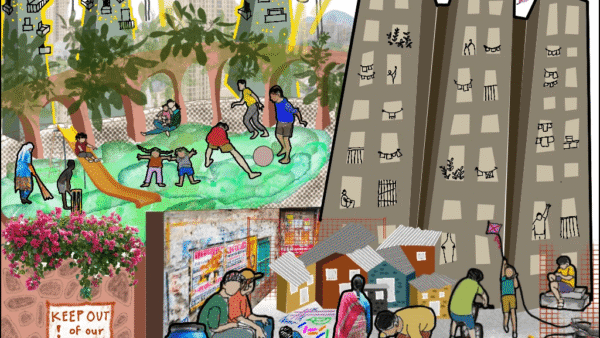

The rapid and somewhat aggressive style and pace of urban expansion in the last few decades sharply brings to mind the disappearance of social spaces, both private and public. These spaces, which many of my generation grew up with, manifested and embodied values, behaviour, practices, and mentalities that constituted the social world of communities.
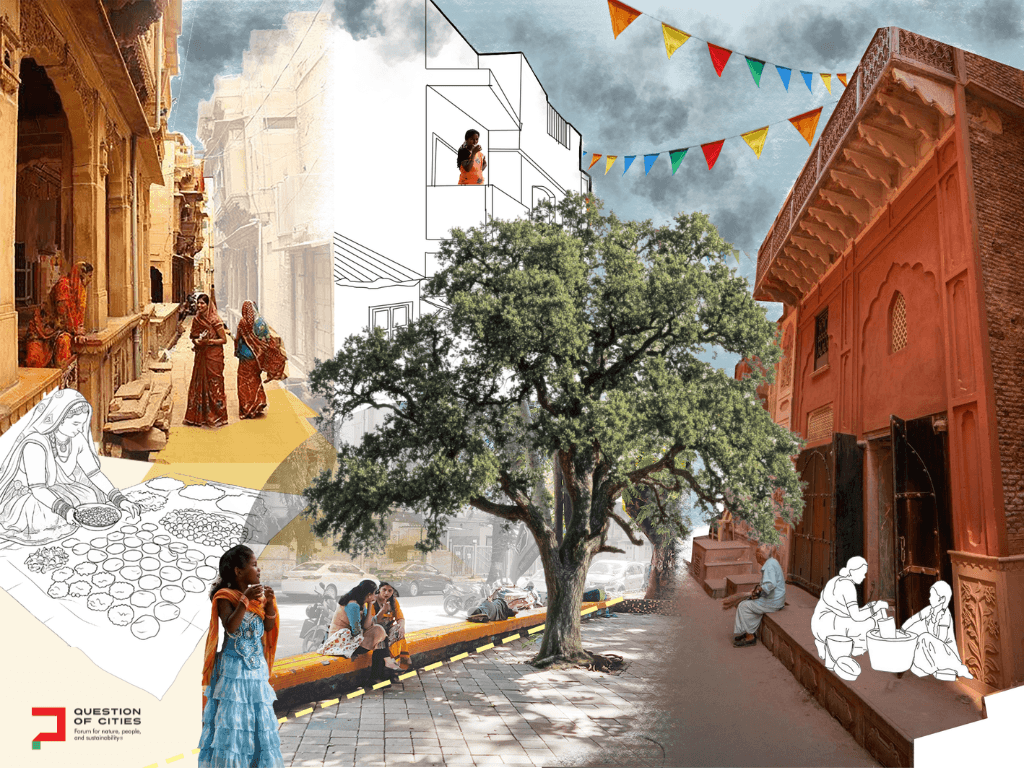
In India, these spaces carry specific names — aangan, chhat, kotha in Punjabi for courtyard, roof, upper-storey room or terrace; kucha, galli, pada in Bengali for narrow street, winding lane, hamlet; nukkad and kona for street corners. They made up the social-cultural-religious milieu of our everyday life. Although largely under assault by the new paradigm of development, they still dot the landscape of towns and cities both big and small as reminders.
Admittedly the stuff of memories and nostalgia, their rapid erasure and deliberate destruction, resulting from the present redesigning of our towns and cities, ought to be a matter of serious reflection and concern. A brief recall of the diverse attributes and experiences of such spaces mentioned above, can be a purposeful as well as delightful exercise. Rewinding to the references to them in literature, film songs, proverbs, popular expressions in everyday exchanges open up the layered, ambiguous, complex, imaginative ways in which groups created, defined, used and experienced these social spaces. They reflected a hierarchy of significance, norms, boundaries, responsibilities, not unchanging but fairly stable, both obligatory and prohibitory.
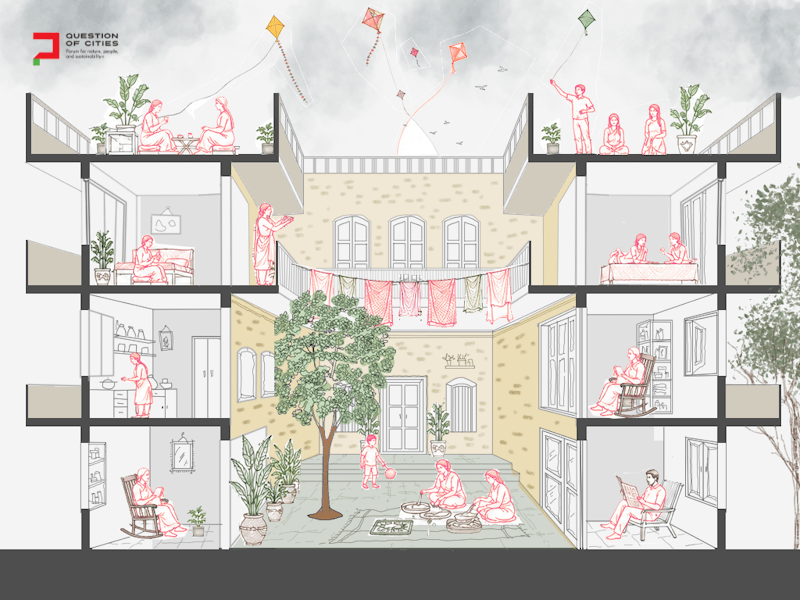
An aangan, for instance, was an open space attached to a house or a central area surrounded by a few houses. It was an intimate open space which the family or a kin group shared themselves, open to the gaze of the elderly. Expressions like having played and grown in the same aangan communicated a degree of intimacy, needing no elaboration. It had other associations and sociological relevance, a girl leaving her aangan at the time of her marriage conveyed a deeply felt separation with her parental home. The sentiment was immortalised by the singer. K.L. Saigal in the lines:
aangan to parbat bhaya, aur dehri bhayi bidesh,
le babul ghar aapno, mai chali piya ke desh
(The courtyard is now a mountain, doorstep a foreign land
Keep my home, dear father, I leave for my beloved’s place)
Spaces for women, for romance
All open private spaces –aangan, chhat, kotha — were the site of social interaction available to women, where they met other women, shared tea, gossiped, exchanged news about the mohalla/galli, made pickles and papad, knitted, sowed, and hung their clothes, spices and vegetables to dry. The family spent their leisure time in the aangan or chhat, both spaces less private than the built space of the house but more private than kucha and galli.
They were the threshold or in-between spaces which, in the modern architecture and design, have been done away with perhaps because they were not ‘productive spaces’. They were, indeed, useful. They offered possibilities of romance, largely forbidden to young men and women who could exchange fleeting glances, even utter a few words and fix the next meeting across kothas. It found frequent mention in Punjabi folk songs like kothe te aa mahiya. Ghulam Ali’s ghazal, Dophar ki dhoop mein, mere bulane ke liye, wo tera kothe pe nange paav aana yaad hai (In the afternoon sun, I remember you coming, barefoot to the rooftop, to call me), touched a millions hearts.
The mohalla was a larger residential unit where an extended kin group sharing a family name, religion or an occupation resided. News of birth, death, marriage, illness, emergency, family quarrel, scandal, matters related to examination, employment, dowry, and most important, ‘inappropriate behaviour’ on part of the young daughter and daughter-in-law travelled fast here. Control of young women by the invisible power of the mohalla, wielded by older men and women, played itself out to the hilt. Young informers were an essential part of the informal espionage. Pakistani TV serials have depicted the mechanism and the effects of this control very sensitively and effectively.
But the mohalla also carried obligations and responsibilities. On all important occasions in one’s life, sought and unsought support, care, help, comfort, advice, were available. Any event in a family was unthinkable without the active participation of mohallawallas. In Kashmir, Hindu families felt obliged to attend the marriage of a girl from the adjoining Muslim mohalla, for ‘she was as good as the daughter of their mohalla’. It was reciprocated. Such was the sentiment the communities shared.
Public but familiar spaces
Galli, kucha, pada variously known in different parts of India were more public with a distinct character, smaller, safer, more familiar than the sadak or the road. The galli and kuchas were narrow, often quite dirty, used by the residents and open to watchful eyes. Visiting a friend or relative in the galli, a familiar space, was considered safe for a young girl; after all, people residing there knew each other. This infused confidence in the residents, even dogs. As the popular expression goes, apni galli me kutta bhi sher hota hai (a dog is a lion in his lane) or galli ka kutta hai katega nahi (he’s a dog from our lane, won’t bite). They were also sites of mild flirtation, exchange of messages with or without potential of fulfilment. As Mirza Ghalib expressed for a jilted lover Bade be-aabru hoke tere kuche se hum nikle (with profound humiliation, I leave the lane in which you live). Or the feisty Bollywood song chori chori meri galli aana hai bura, aake bina bat kiye jana hai bura (It’s bad to come in secrecy to my street, it’s bad that you come and leave without a word).
The pada in Bengal was similar in most respects. As indicated earlier, these spaces were clearly gendered. Young girls or women did not roam around unaccompanied even in the pada. A pada could have a small reading room, a club of sorts, where men met and caught up with all sorts of news, chatted, and even sang Rabindra Sangeet or Shyama Sangeet in the evenings. Every pada had a group of young men, who took upon themselves the responsibilities of organising poojas, cultural events, and helping the pada residents in time of need.
They seemed largely unoccupied, smoking or chatting. Ironically, while they felt obliged to protect the girl of their pada from outsiders, a few of them felt free to tease, comment, or throw lightweight objects like slips of papers or flowers in the direction of the girls, or sing romantic lines from a recent Hindi film in a heavy, hilarious Bengali accent. But overall, the pada did offer security, as I recall, once when non-Bengali sentiment flared up and turned aggressive, my father was reassured by the people of total security.
The turn of the galli, pada, nukkad or kona invariably featured a small shop selling paan, cigarettes, a few necessities. A small tea shop nearby was ubiquitous. No woman visited the tea shop or ever sat with boys for an adda (gathering). An adda was often a free-flowing conversation which could turn into a heated argument over thimble sized water-dripping glasses of tea, and cigarettes taken on credit. Addas in college canteens, coffee houses or one’s own sitting room were for the more serious and intellectually inclined.
Another such space, the rowak, probably a structural remnant of the verandah in the rural Bengal, writer Priyadarshini Chatterjee tells us, “was steadfastly urban, intrinsic to Kolkata’s evolution as a modern city, it was used by all and sundry to rest, even nap, for young romances with uncertain future, and favourite pass time adda”. She points out: “it is a fantastic architectural representation of the city’s communal spirit”, “an amorphous space neither resolutely domestic nor unreservedly public. It is an extension of hospitality that could be revoked or violated by either party at any point”.
As with the other social spaces, with the razing of old houses to make way for modern apartments the rowaks are disappearing and pada addas have become rare.
Beyond nostalgia, the relevance today
The point is not to romanticise or idealise all these social spaces. They were hierarchical, clearly segregated along caste, class, and gender lines although some parts of them were positive and valuable. The intention is merely to circle back to their memory to show that these spaces have been rapidly eroded in the modern understanding of architecture and urban design, without replacing them with similar or better possibilities.
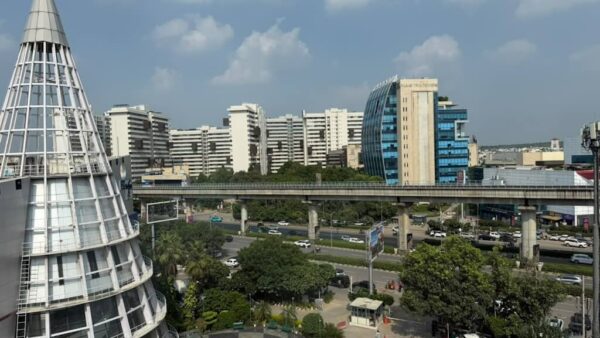
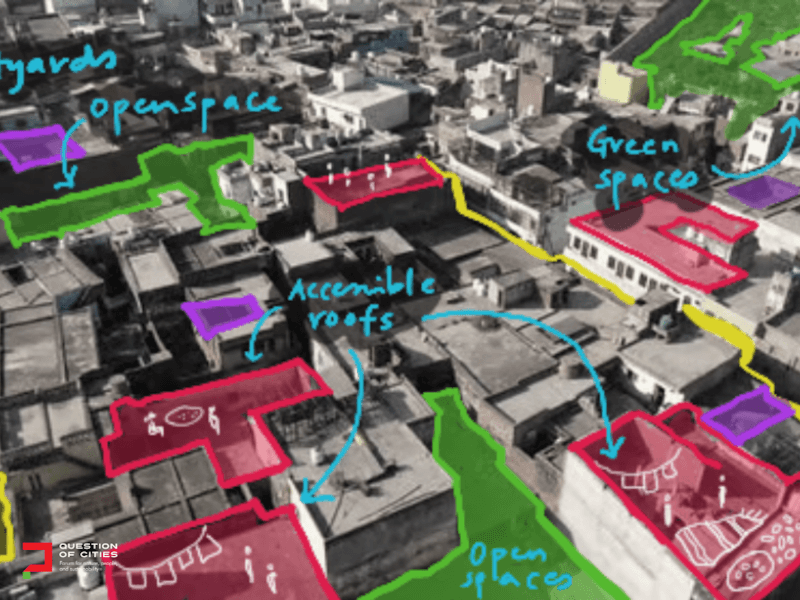
By and large, spaces in our cities now appear homogenous, flattened, devoid of social meaning or significance, and there are hardly any threshold or in-between spaces constructed any more. Taken to an extreme, the contemporary quest for privacy, anonymity, freedom to choose one’s lifestyle, non-interference/imposition (though desirable in themselves) have also resulted in major problems. Our present urban lifestyle linked with spatial organisation, is largely perceived as responsible for an alarming rise in loneliness, alienation, anxiety, and depression by sociologists, psychologists, and medical practitioners. Reduction in human contact, connection, and informal support systems are a huge invisible cost that urban dwellers must pay for the erasure of such spaces.
Surely, more public spaces like small friendly reading rooms, libraries, cultural centres, local museums, open green parks, less intimidating and expensive than the ones that dominate the city scape, can be incorporated into the design of neighbourhoods or localities, including those of the poorest. Even large apartments have very little space for the children and the elderly to play, or just relax and interact with neighbours.
The change per se is not a problem if it improves the quality of life of the largest numbers, but this change in spaces constructed has not yielded fuller lives. Architecture and design are about buildings and efficient use of every inch of space, less about common and in-between spaces. As architect-activist PK Das observes, “design does not imply one building but a larger social space”. Sir Patrick Geddes, an urban sociologist and visionary town planner, recognised long ago that city planning is too serious a business to be entirely left to the urban planner, it must involve the architect, social scientist, artist, geographer, gardener, and, of course, concerned social citizens themselves. It is, indeed, a way forward.
Planning and design must be brought out of hallowed offices to recognise and reflect the way people live, their needs, their inter-personal relations and aspirations for the self. For this, there has to be the realisation and acceptance that spaces need not only be economically productive but carry wide-ranging social significances and possibilities.
The dominant urban paradigm of urban planning and design now in India presents a different picture, although examples are available to us within the country as in many parts of the world, when commercialisation and profit-making are not the only goals of designing social spaces. Even if few and far between, these need to be supported and creatively emulated by governments in power.
Sensitive and sensible planning ought to make available all the benefits and advancement that large-scale industrialisation and urbanisation once intended to bring. Like, technological, commercial, infrastructural, educational, medical, and freedom from traditional constraints and above all improved living conditions. The mere chase for large-scale, fast, smart, fancy, and other trappings of modernity has not quite fulfilled the potential. We are shaped not merely by technology and commerce, but equally or perhaps more so by the spaces we build and inhabit, laugh and weep in, love and spar in. Let’s bring back the threshold, the in-between, social spaces.
Illustrations: Varada Avachat and Nikeita Saraf
Dr Indra Munshi, is retired Professor and Head, Department of Sociology, University of Mumbai, the department set up by Sir Patrick Geddes as the first Professor and Head in 1919. She is also the Executive Editor of the Indian Journal of Secularism (IJS) brought out by the Centre for Study of Society and Secularism (CSSS), Mumbai. Her recent book “Patrick Geddes’ Contribution to Sociology and Urban Planning – Vision of a City” was published by Routledge – Taylor & Francis Group.