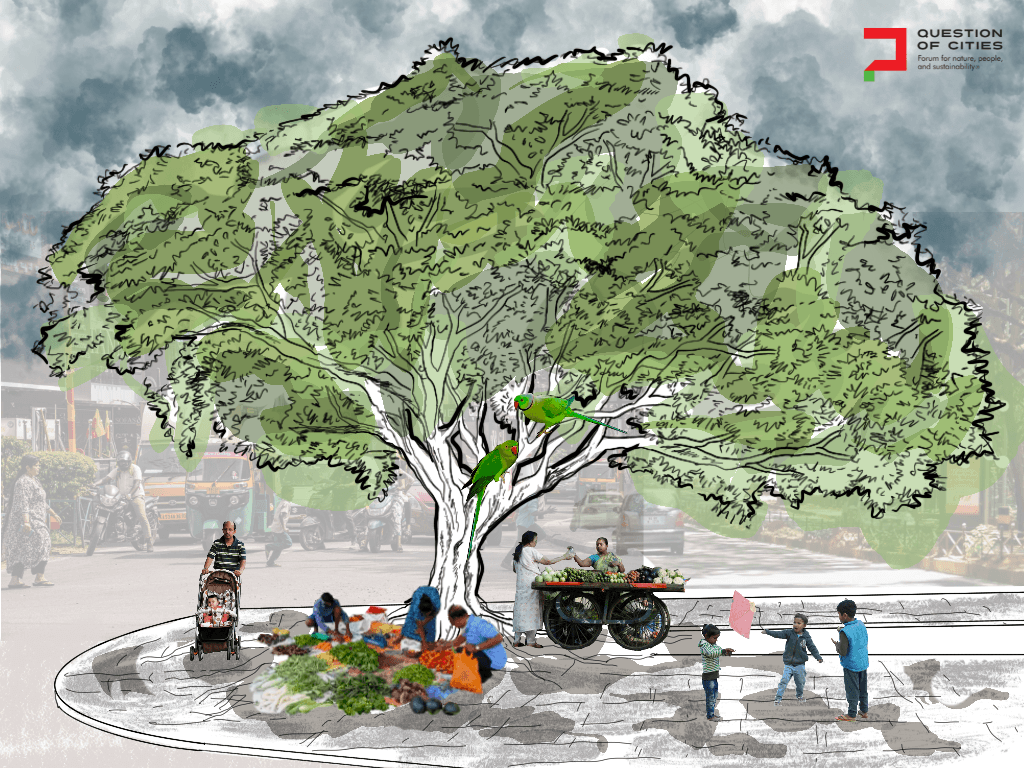

In Jayanagar, Bengaluru, some rain trees are old enough to have shaded multiple generations of the neighbourhood, revealed on leisurely morning walks. The canopy of a rain tree arches over half a street, its roots stretch across the footpath, and under its shade sits a vegetable vendor. Children pass beneath it on the way to school. A pair of rose-ringed parakeets work through the seed pods above.
This tree does not appear in any of the city’s plans. It is not counted as infrastructure. But take it away and something irreplaceable leaves with it — shade, habitat, memory, and the quiet ordering of a street around living things rather than around efficiency. Imagine now the impact of hundreds or thousands of trees being felled in the city, or in any city.
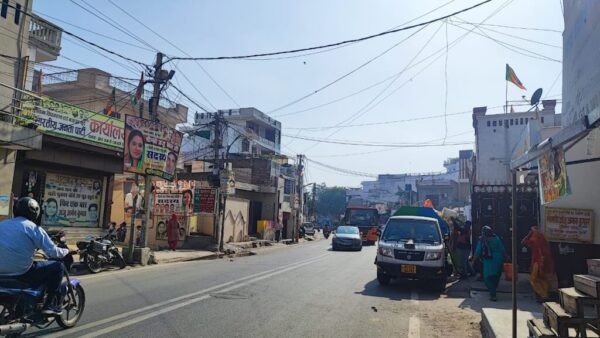
Cities across India are being built or rebuilt at an extra-ordinary speed. Redevelopment of old structures and neighbourhoods, construction of large infrastructure projects,[1] and other construction are re-shaping neighbourhoods from Mumbai to Lucknow, Chennai to Bhopal and beyond. The justification is the same – more housing, improved connectivity, climate-resilient infrastructure. But amid this transformation, a question is being steadily crowded out: what happens to the ecological systems that cities run on when urban land is treated primarily as a surface for construction?
This essay argues that India’s urban redevelopment model has a biodiversity problem — and that it is also, for this reason, a social justice problem. The two are not separate concerns. The communities who depend most directly on urban green spaces — lower-income residents, street vendors, women, the elderly — are also those with the least power to defend them when a road is widened or a wetland is filled.
Building with nature, not against it, is therefore not a luxury position. It is a question about whose city is being built.
The urban ecology we are losing
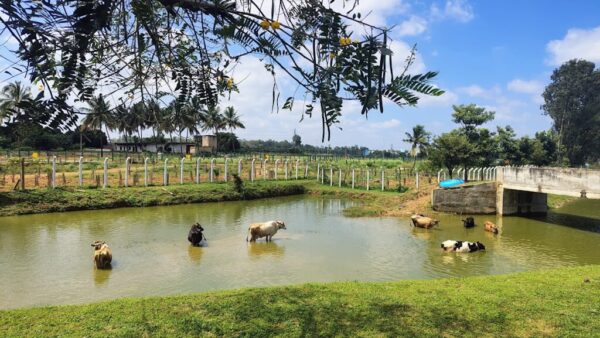
India’s cities were never ecologically empty. Bengaluru was historically a city of lakes — over 260 of them[2] — connected by a gravity-fed system that managed stormwater, recharged groundwater, and supported fisheries. Today, fewer than a hundred remain, many choked with sewage and encircled by concrete. Delhi’s Ridge forests — the last arm of the ancient Aravalli range — continue to shrink[3] under residential and infrastructure pressure. Mumbai’s mangroves, which buffer the coastline against flood and storm, are mapped as “wasteland” in several official records,[4] a classification that makes their clearance procedurally simpler.
What is lost is not merely scenic. Urban tree canopy reduces ambient temperatures by 2–8 degrees Celsius, a figure that becomes life-or-death during the kind of heat events Indian cities now regularly experience. Water bodies and wetlands recharge aquifers that sustain cities, even certain communities. Green spaces or corridors are home to insects, birds, and small mammals that form a part of the quiet food chain in cities. None of these are acknowledged, let alone counted, in project feasibility reports. None of them appear as a line item in a Smart City budget.
The IISc campus in Bengaluru[5] offers a counterpoint worth pausing on. It functions as an urban forest — dense, diverse, and largely undisturbed within the city. Bird surveys conducted here have documented well over 100 species. The campus is not just a green lung; it is a refuge population for species disappearing from the surrounding city. It exists not because of urban planning, but in spite of the pressures around it. It is an accident of institutional land use, not a model being deliberately replicated.
The hidden costs of redevelopment
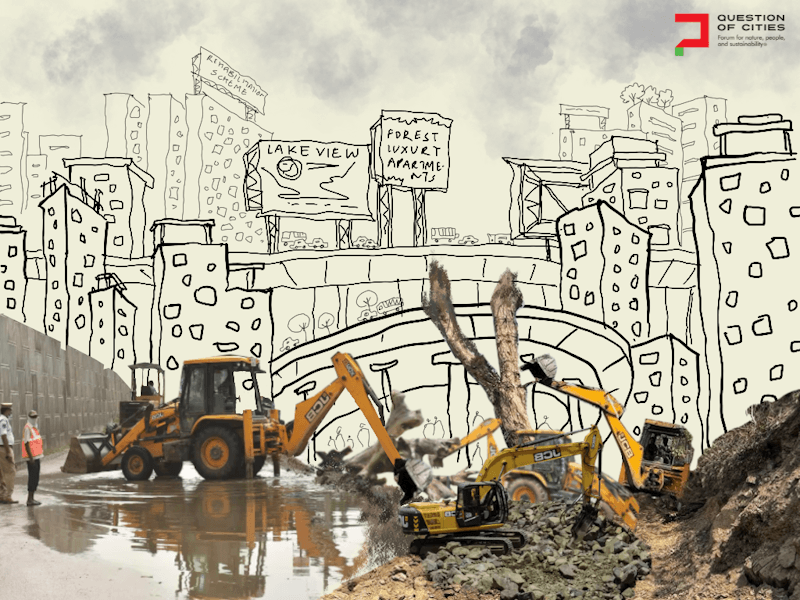
The arguments for urban densification are not wrong. Vertical growth rather than outward growth is preferred for cities; horizontal sprawl uses land meant for agriculture and lengthens commutes. India’s cities are growing both ways – expanding out and upward as the redevelopment juggernaut gathers momentum. In the dominant model, the ecological systems are seen as obstacles to be routed or afterthoughts for token actions.
In this approach to city making, trees are to be felled and replanted a distance away, water bodies can be culverted, soil can be sealed under layers of concrete. The underlying assumption is that nature can be added back later, in the form of parks and planted medians, once the “real” work of construction is done.
This assumption fails on its own terms. The planted saplings, even if they are nurtured, do not replace trees that were 50-100 years old; rivers and water bodies with concretised channels do not replicate the function of floodplains. Ecological systems, it is now well-documented, take decades to develop and, when disrupted, do not simply reset or cannot just be replicated. The costs of this disruption fall unevenly. When Bengaluru floods, it is low-lying informal settlements — often built on dried or encroached lake beds — that first go under.[6] When heat events intensify, it is in the dense, tree-less neighbourhoods with high building coverage that temperatures reach dangerous levels.[7] The residents there are rarely the ones who designed them.
There is also an economic argument being missed but is useful sometimes to leverage. Nature-positive economic or urban models have been studied. The research is clear: ecological assets such as functioning wetlands and urban forests generate measurable economic returns through temperature regulation, flood protection, health outcomes and productivity. Every dollar invested in urban green infrastructure generates between three and seven dollars’ worth benefits over time, found a study.[8]
India’s infrastructure planning frameworks have not yet found a way to count these returns, or calculate the comprehensive accumulated setback due to the planned destruction of these ecological systems. This means they consistently lose the comparison against projects whose costs and benefits are legible in conventional terms.
Nature as infrastructure, not amenity
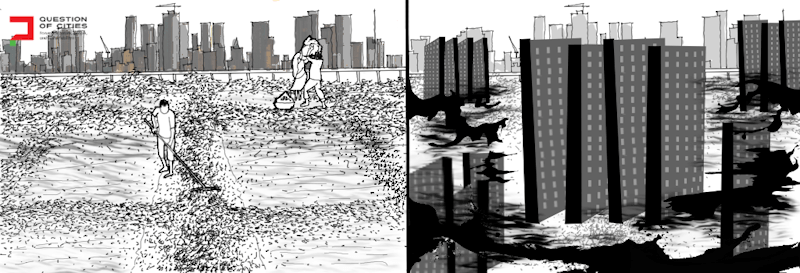
The conceptual shift needed is not technical — it is categorical and a fundamental shift in perception. Across the planning establishment in India, nature in cities is reduced to amenities such as parks, gardens, tree-lined avenues. Amenities can be relocated, deferred or scaled down depending on budgets and political will; infrastructure cannot be.
If urban ecological systems were classified as infrastructure — which functionally they are — they would be subject to different protections, different accounting, and different political weight. A few cities have taken steps in this direction, driven more by a crisis than by deliberate planning. After the 2015 floods, Chennai began to take its network of water bodies seriously;[9] the devastating flood in Surat back in 2006 led to significant investments in drainage and greening. The conservation of green areas and water bodies is now a part of most climate action plans. For political will to drive this, the costs of inaction have to be visible enough during an extreme weather event but the goal should be to do it before the flood arrives or the heat wave strikes.
Nature-positive frameworks, increasingly adopted by global corporations[10] under international disclosure standards, offer a useful vocabulary here. They ask businesses to account for their dependencies and impacts on nature — water, biodiversity, soil, climate — and to demonstrate that their operations leave nature better off than they found it. Urban development, treated as a sector rather than a series of individual projects, creates the same kinds of dependencies and impacts. The nature-positive lens applied to city planning – before construction starts –would ask what ecological systems does this area have, how does the community here depend on them, how can the project account for both.
The communities that cannot wait
The equity dimension of urban ecology is not incidental. It is an outcome of urban planning and the built form. Across cities in India, people’s access to green spaces is deeply unequal. Neighbourhoods with wealthier residents tend to have better tree canopies, more parks, and are closer to water bodies. Poorer wards — often the product of informal settlement processes, built on land that formal development overlooked — have less of the natural ecology. In a cruel twist of irony, the lower-income areas and communities tend to have higher exposure to heat, floods and polluted air – the conditions that green infrastructure would help mitigate.
In this, women are disproportionately affected. Their access to parks, green spaces, and waterfronts is restricted by issues of safety and distance besides the demands of care work. Yet urban trees and green spaces also provide material benefits that do not require leisure — shade while working, cooler temperatures while cooking or commuting, cleaner air in homes. When these are removed in the name of modernisation, it is often women and children who absorb the cost most directly in their daily lives.
The NTFP — non-timber forest product — dimension of urban ecology is also worth naming. In smaller Indian cities and in urban peripheries, communities collect edible plants, medicinal herbs, and fuel from green spaces that formal planning does not recognise as productive. These are invisible livelihoods, erased with the green spaces that support them and never compensated. Urban redevelopment, in this sense, does not just displace communities from land — it removes the ecological substrate that portions of their economy depend on.
What building with nature looks like
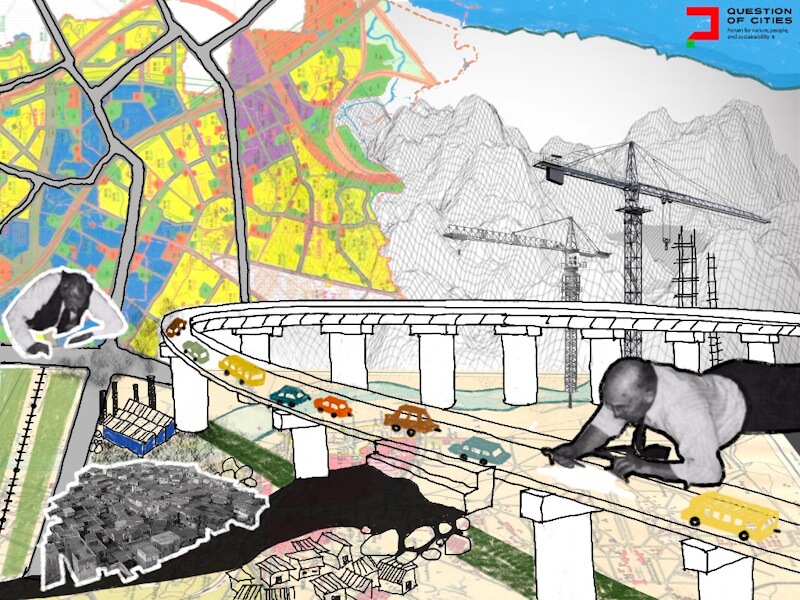
None of this requires that Indian cities stop building but pivot to build differently. The way forward would be to see ecological systems in cities as fixed constraints rather than flexible, which means mandatory ecological baseline assessments before major projects are undertaken, and documenting the biodiversity and hydrological characteristics of a site before they are disrupted. This would also call for biodiversity-sensitive design standards including tree-retention targets, permeable surfaces, and integrating water bodies into project layouts instead of removing them.
Importantly, it could mean the legal re-classification of key urban ecological assets — old-growth trees, functioning wetlands, contiguous green corridors — as protected infrastructure. It would also mean building the institutional capacity to count what urban nature does. Ecosystem services valuation is a mature enough field that Indian cities could begin incorporating it into project appraisal. The methodologies exist. What is missing is the political decision to treat the absence of a monetary value as a gap in accounting rather than proof that the value is not there.
Most importantly, it would mean involving the communities who depend most on urban ecology in decisions about it. The woman vendor under the rain tree in Jayanagar has a stake in that tree that a project engineer, reviewing a road-widening alignment on paper, cannot see. Participatory ecological mapping — asking residents what green spaces they use, depend on, and value — would surface a different picture of urban nature than what official land-use maps reveal.
India’s cities are at a critical point. They are being built and rebuilt right now, and the ecological structures that get erased in this decade will not come back in the next one. The rain tree takes fifty years to become itself. The lake takes longer. The question of what kind of cities India builds is not only a question about housing density and transit corridors — it is a question about whether urban life will remain liveable for the communities that do not have air conditioning and private gardens to buffer them from what is being lost.
Building with nature is not romantic and, least of all, anti-development. It is about recognising the centrality of ecological systems in our cities, understanding that concrete cannot replicate the complex ecology, and that these systems influence the lives and well-being of communities whose voices are rarely heard in the offices where urban plans are made. The shift required is less technical, more political – a decision that a city’s development or redevelopment will count the ecology that exists and account for what it removes.
Dr. Sanchi Singh is an independent researcher working on nature-positive business models, circular economy, and biodiversity. Her doctoral research examined forest governance and ecosystem services in the Western Himalayas.
All illustrations by Nikeita Saraf