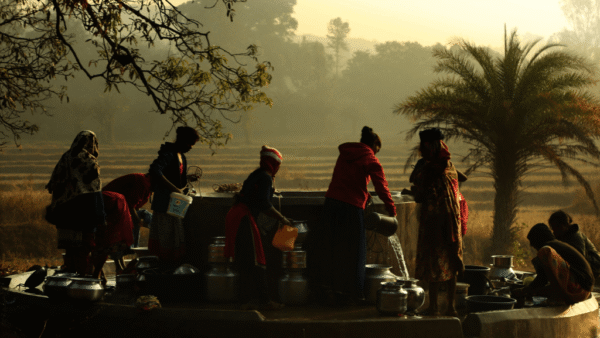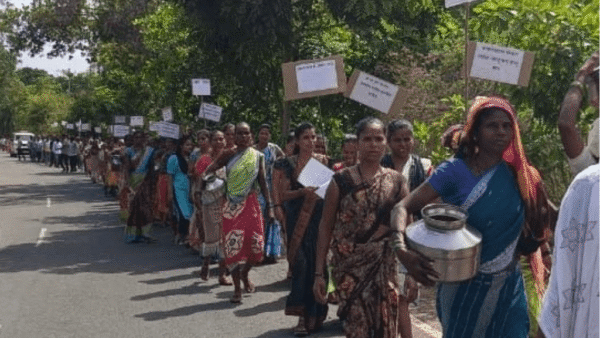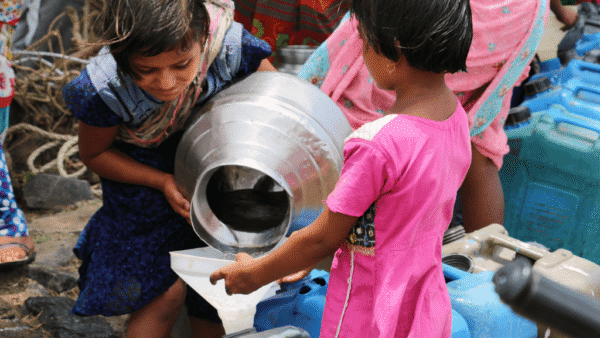
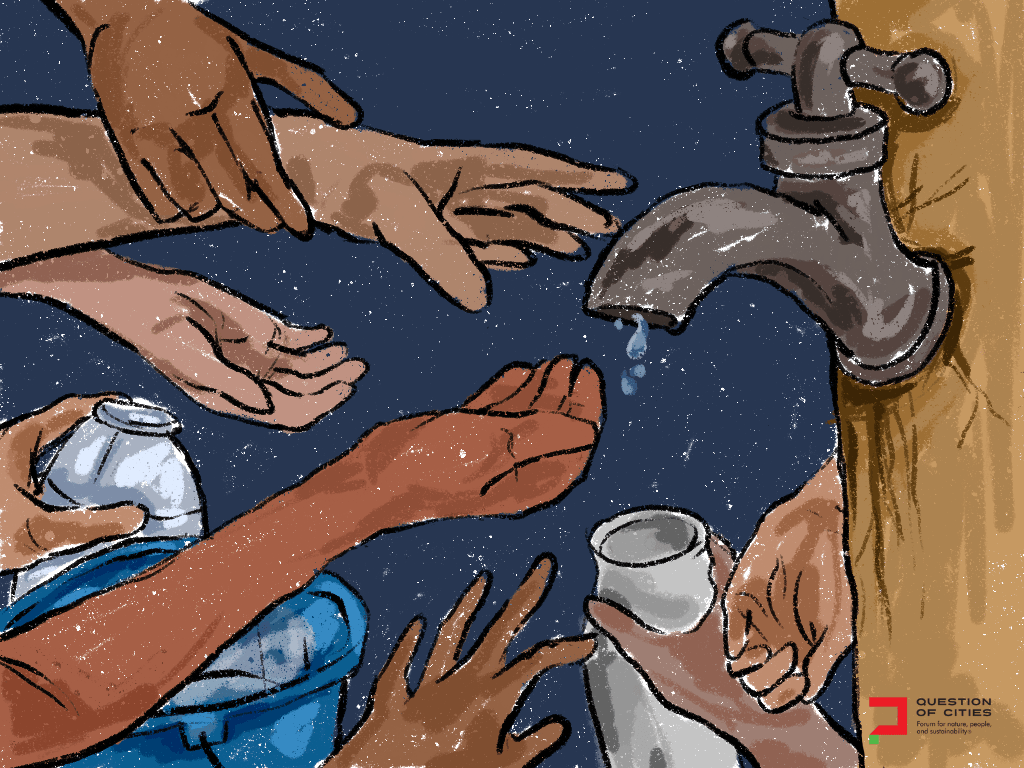

In times of extreme heat, people’s access to reliable and affordable water supply can make the critical difference between comfort and distress, sometimes even life and death. Yet, water as a public good is not always available or accessible to millions in India’s cities where temperatures now routinely rise to beyond 40 degrees Celsius forcing them to struggle to beat the heat.[1] Except the formal housing complexes and workplaces, nearly every location and person suffers from inadequate and unsafe water supply, lack of water connections, dependence on illegal means or water tankers, and exorbitant rates.
How then are people supposed to stay hydrated and offer a glass of water to others, as the Prime Minister advised Indians[2] to do in May? Staying hydrated in the brutal heat is common sense, offering water to others – including birds and stray animals – is ingrained in the Indian psyche; people do not need to be reminded of these. But where is the water, why is it so inaccessible to so many especially in cities where water management was meant to be more modern and equitable than in villages? Water access and equity, critical underpinnings of a dignified life matter throughout the year but the lack of these hurts the most in summer.
At the last count, at least two million people living in Mumbai slums – nearly one-third of the city’s slum population – did not have access[3] to water because they were non-notified slums; in the rest, tap connections existed but water did not flow. In slums, modest housing colonies, small-scale commercial establishments and other places, people were forced to rely on water tankers.
Tanker water, across Mumbai, cost an average 52 times the price of piped water, according to research published in 2019.[4] In slums and all places without metered water connections of the Brihanmumbai Municipal Corporation, people literally paid a ransom for water. Families in slums and chawls shelled out up to Rs 700 for 1,000 litres while the BMC supplied at a mere Rs 5 for 1,000 litres, according to this study. In an inexplicable inverse logic, those who live and work in high-rises spent negligible amounts on water while the vulnerable millions in informal housing and outdoor work were forced to spend exorbitantly for water – a public good.
This is true of other cities too. In Bengaluru, which has seen severe water shortages in recent years as the city expanded outwards without an adequate water supply system to service the new areas, tanker water costs 12 times the price of piped water.[5] In Chennai/Tamil Nadu, residents of low-income households spent up to 15 percent of their income to fulfil their daily water needs, showed a study by IIT-Madras; while houses with piped water supply spend Rs 553 a month, those without shelled out Rs 658.[6]
Water sources and unseen groundwater
For domestic use, India’s cities have relied on a mix of water sources depending on their location, hydrology, climate, ecology, infrastructure and socio-political dynamics. Typically, it has been surface water through rivers (in the far outskirts, dammed and carried to cities), reservoirs, lakes, streams all piped through municipal systems; groundwater drawn through borewells or tube wells to supplement the piped water; and tankers and packaged water which fills in the gaps in the other two.
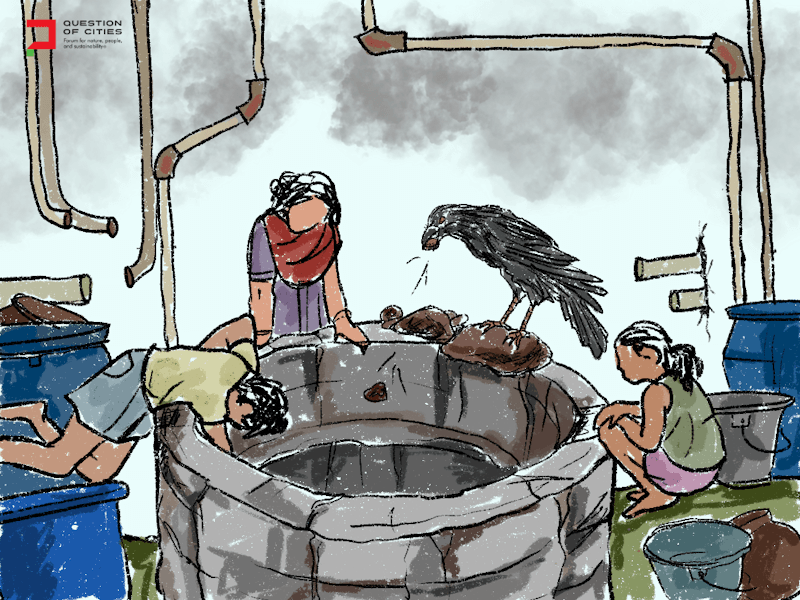
Both surface water and groundwater get recharged during the monsoon. However, every city suffers from a gap – sometimes a severe one – between supply and demand. Bengaluru’s ‘Zero Water Day’ is still fresh in memory but other cities routinely see shortages, which exacerbate in summer. The coastal city of Chennai, where water shortages are legendary, resorts to desalination of seawater to augment its municipal supply, producing 350 million litres per day (MLD) and installing another plant for 400 MLD.[7]
Cities increasingly rely on groundwater extraction as the demand rises and core supply sources become erratic. The 2023 report of the Central Groundwater Board showed that Bengaluru and Chennai were “in over-exploited stage while three others – Delhi, Hyderabad and Kolkata – were in the critical stage,” Pune and Ahmedabad were in “semi-critical state” and did not have information for Mumbai, according to the analysis by Open City.[8] Chennai, Hyderabad and Delhi drew groundwater mainly for domestic use.
Experts have urged the recycling of wastewater to enhance the water supply, as is done in many cities with rapid urbanisation and growing populations, but the reality is far from encouraging. Barely 28 percent of wastewater in urban India is treated and re-used, showed a report of the Centre for Science and Environment in 2024.[9] There are government mandates to treat and re-use at least 20 percent which hardly helps. Overall, the potential goes wasted.
While cities pour crores to develop large-scale water development projects – Mumbai is supposed to get water from Gargai Dam, Pinjal Dam and Damanganga-Pinjal link projects hundreds of kilometres away – public policy experts like Sachin Tiwale, PhD, say that most cities do not have a water shortage problem but a water access problem[10] governments “over-estimate demand to justify dams”.[11]
Inequity begins at the planning stage
Water is a state subject; on the ground, it is more often the Urban Local Body (ULB) that handles water supply and management but under the watchful eye of the state government. Based on the guidelines of the Central Water Commission and the Ministry of Housing and Urban Affairs, the recommended water supply standard in cities is 135 litres per capita per day (LPCD) depending on the city’s size, piped systems and related factors.[12]
This is not uniform. The benchmark for metropolitan cities is higher than for small towns but it includes domestic usage (bathing, cooking, washing), institutional and commercial use in offices and schools or colleges, and home-based industrial or commercial use. None of India’s cities have or receive the amount of water they need; every city except Kolkata has a shortfall (see below).
| City | Water Received | Water Needed |
| Delhi[13] | 3,785 MLD | 4,731 MLD |
| Bengaluru | 1,450 MLD[14] | 2,600 MLD |
| Kolkata | 1654 MLD[15] | 2,180 MLD |
| Mumbai | 3,950 MLD[16] | 4,200 MLD[17] |
| Hyderabad | 550 MLD[18] | 650-670 MLD[19] |
| Indore | 500 MLD[20] | 700 MLD[21] |
This gap between a city’s requirement and availability is worsened by how its ULB or designated agencies such as the Bengaluru Water Supply and Sewerage Board allocate the available water. Unable to bridge the demand-supply gap, it allows water to flow in community taps for only a few hours a day or on alternate days, sometimes in a trickle, and forcing people – mostly women – to queue up for hours for a few pots of water. Parts of Chickpet, Banashankari, Cement Colony in Bengaluru fall in this category.[22] They cannot access the groundwater without facing the full force of the law. However, in the newly-expanded areas like Bellandur and Ulsoor, the high-rise gated complexes have tapped underground aquifers and spend lavishly on tankers. The search for equity here is as hard as the search for water.
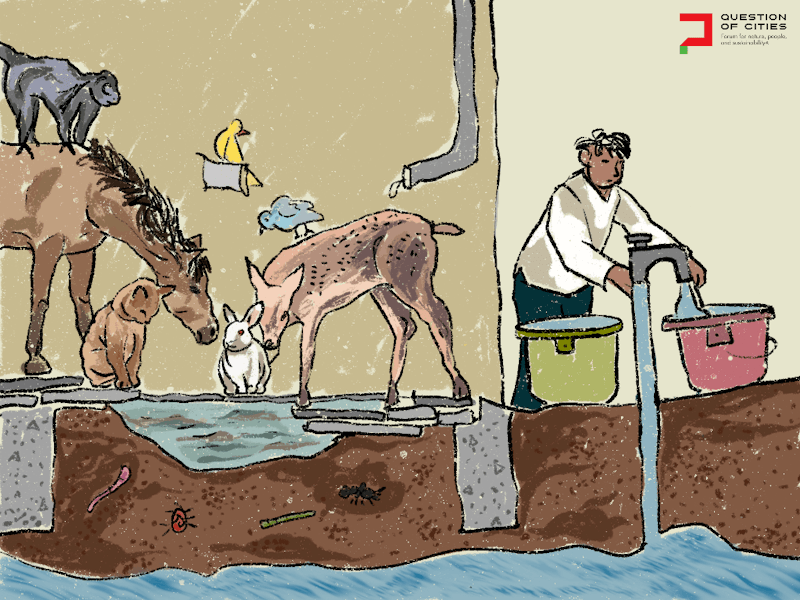
In Mumbai, the inequity is built into the plan itself. Most of the city’s water is transported from the verdant rural or forested areas to its north but its 4,128 MLD is not distributed evenly across the city. In fact, the supply is calculated based on a person’s address – slum dwellers get 45 litres per capita per day, and residential buildings with community toilets such as chawls receive 90 LPCD while residents in buildings such as housing complexes get 135 LPCD.[23] Slum dwellers are supposed to manage with about one-third the water in a day that residents in housing complexes do – a built-in inequity.
Delhi, Chennai, Kolkata show similar trajectories too. Kolkata’s marginalised areas such as Tollygunge and Jadavpur are served by more tankers than other areas.[24] In Delhi, “access to drinking water is deeply inequitable across its approximately 20 million inhabitants. An estimated half the population is not connected to the centralised water network and has to rely on other means such as tankers, private taps, tube wells. Shortages are common; those with water connections get water “only for 2–4 hours a day, whereas some neighbourhoods have 24-hour access,” observed a research paper of the School of Planning and Architecture.[25]
In Mumbai’s slums, many of those surveyed by Pani Haq Samiti, a water rights collective that took the unequal water access to the Bombay High Court[26] – which then resulted in the BMC’s ‘Water for All’ policy in 2022 – believed that they did not have a right to assured water supply or deserve it because they were in some ways ‘illegal’. PHS founder Sitaram Shelar wrote: “When we went around to bastis for our fieldwork, people were saying, ‘Why should we get water? We are illegal.’ They seemed to internalise this gaze of the state.”
Bad situation worsened by data centres
Water as a basic right should not even have to be debated. But state agencies have found various excuses to deny water connections or stagger supply to a trickle such as a slum being not notified, criteria for tap connections not fulfilled, allegations of water theft and so on. There are leakages in the system; what most ULBs call ‘non-revenue water’ is a fair portion of a city’s supply. This is where researchers call for better demand-side management[27] such as providing metered water connections to all, levying a staggered slab-wise rate on usage so that more use attracts higher payment, regulating water tankers which draw groundwater. But the tanker lobby is a formidable one in most cities, serving lakhs but threatening strikes.[28]
All of this is set to worsen as India gets bullish on locating massive data centres in cities or their peripheries. While digital sovereignty demands that data centres are located in India, the inescapable fact remains that they are proven energy and water-guzzlers. Even as India’s total data centre capacity increased from about 375MW in 2020 to around 1.5GW last year,[29] and the furious pace of expansion clearly puts added pressure on local resources – especially water used to cool down the centres – it does not have a distinct policy for water usage by these centres in the local context.
The city of Mumbai alone hosts at least 25 data centres, many of them clustered in the Powai-Chandivali area where slum dwellers in the area are forced to make-do with less than 45 LPCD a day from community taps or depend on tankers and the posh high-rises also occasionally call for tankers. The Mumbai Metropolitan Region has 60 data centres in all – and the numbers are growing.[30]
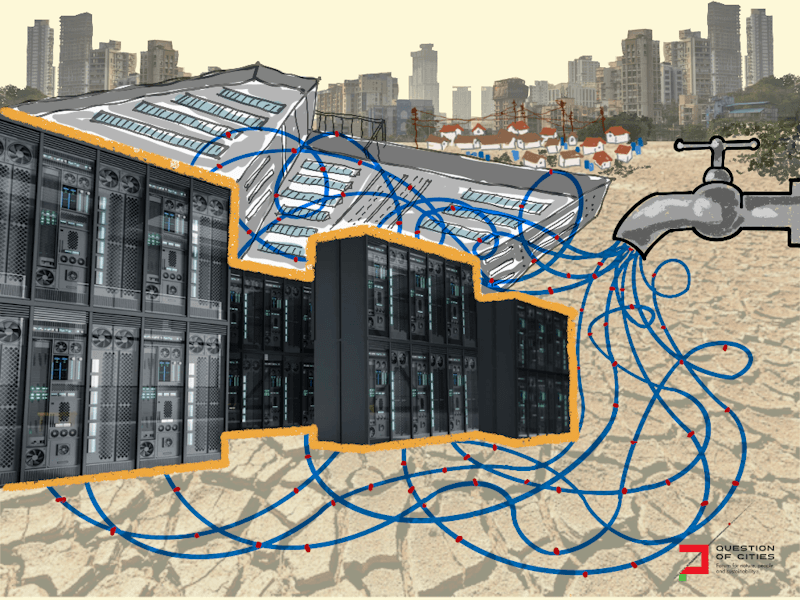
The data centre near Thakurpada slum in Navi Mumbai, where factory workers and daily wage earners live, receives uninterrupted 24×7 water supply while the slum dwellers have been relying on community pipes that bring a trickle every day, and water not fit to drink. If the data centre can get assured water supply now, why have we not got all these years or even now, asked a resident here,[31] The company plans to build six more data centres in this area which, according to its documents, will consume 2,06,000 litres of water every day; eight others are planned, expected to consume 2,23,000 litres of water a day.
Globally, the consumption of massive amounts of water and straining local resources has led to agitations against data centres. The US-based activist Erin Brokovich initiated a tracker[32] which showed that the data centres were coincidentally or otherwise located in water-stressed communities or areas. In Sydney, Australia, if all the 41 proposed data centres are built, they could use an estimated 15-20 percent of the city’s water supply in a decade, warned researchers in The Conversation.[33]
“AI’s water footprint—many millions of litres of freshwater consumed for cooling the servers and for electricity generation—has largely remained under the radar and keeps escalating. If not properly addressed, it can potentially become a major roadblock to sustainability and create social conflicts, as freshwater resources suitable for human use are extremely limited and unevenly distributed…Despite its profound environmental and societal impact, the increasing water footprint of AI has received disproportionately less attention from the AI community as well as the general public,” pointed out a landmark research paper[34] last year in the Association for Computing Machinery (ACM) digital magazine; the ACM is a hub for peer-reviewed journals, conference proceedings and more on all things tech.
India’s case will not be different. Data centre operations can send surface temperatures rising by an average of 2 degrees Celsius and, in extreme cases, it can be as high as 9 degrees Celsius, which is “roughly the difference between a pleasant Delhi winter morning and a scorching May afternoon,” according to this report.[35] The demand for water is bound to rise as surroundings become hotter.
In January 2026, India had about 271 data centres across nearly 23 million square metres of land, and used approximately 150 billion litres of water.[36] Mumbai led the market with 46 of them, Delhi had 38, Bengaluru 31, Hyderabad 28 and Chennai 33 – all water-stressed cities. As they race to host more, the comprehensive water – and environmental – cost remains to be calculated. Else, the existing poor level of water equity in cities is set to worsen.
All illustrations: Nikeita Saraf