
At the far north of Mumbai, in Borivali suburb, lies the informal settlement of Ganpat Patil Nagar. Here since 1998 and housing about 1,400 families, it received piped water only in 2021 when a few eligible ones got taps indoors. This was not the largesse of the Brihanmumbai Municipal Corporation (BMC) but the sheer doggedness of people filing applications from 2018 onwards at the local BMC office and pursuing their cause, after advocacy made them understand that they had the right to water.
Now, about 1,000 families – 70 percent of the informal settlement – have piped municipal water from 9pm to about 11.30pm on most nights. The water pressure fluctuates wildly, especially during summer and monsoon. Even when it is steady, there is never sufficient in the taps forcing people to look for other avenues. “We still have to buy water from outside because the taps don’t meet our demand,” says Sunil Yadav, resident and member of Centre for Promoting Democracy.
The shortfall, which stresses families – especially women – is because the pipeline has not been fully extended to cover the entire settlement and because the area does not receive as much water as the high-rises in the vicinity. Each municipal pipe serves five houses; the water bill of about Rs 1,000 every three months is shared among them, with each family paying about Rs 200. This is a major saving for a family that had to spend between Rs 1,500 and Rs 2,000 a month to source water from tankers or nearby baolis or buy bottled water. When the water is insufficient, “we get some from the baoli, a small well we dug, which we use for cleaning and washing,” explains Poonam Agrahari, 40.
The families that do not yet have connections in their houses also save money but less. They buy water from neighbours with water connections, paying Rs 300-500 a month. The application-to-connection process that should have taken a month has stretched to months, even years for them. “The delay by BMC officials has become normal for us. We do not give them anything under the table. Maybe because of this, officers delay the process even if the file has all the documents,” says Yadav.
In summer months, there is a city-wide reduction in water supply. In Ganpat Patil Nagar too, there is a declared 5-10 percent water cut and the pressure reduces further. Then, women have to find ways to save the water they get and store it in every conceivable corner so that it can last for two days. Men mostly work as daily wage construction labourers or as app-based delivery workers; some of the latter prefer to work at nights when it is less hot.
For those with taps in their houses and for others purchasing water from neighbours, water is insufficient but still a relief. Before the pipelines were laid, many of them cycled all the way to Navagaon, a few kilometres away, mostly late at night, to buy water at Rs 10-20 per gallon. Some went to nearby houses which had private water connections and paid Rs 2 for every ten litres.
The fight for water access
The process to access municipal water should not have to be this long or painstaking. Throughout it, the people of Ganpat Patil Nagar had the support of the Pani Haq Samiti (PHS), a water rights collective and advocacy group. Its Public Interest Litigation (PIL) in the Bombay High Court in 2014 led to the landmark judgment that it was the government’s responsibility to provide water to all, irrespective of the legal status of their homes; this, importantly, overruled the state government notification of 1996 which allowed the BMC to deny water supply to illegal slums or those that did not fall within the cut-off date.
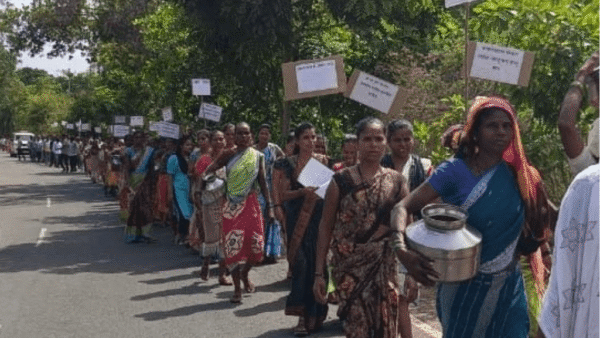
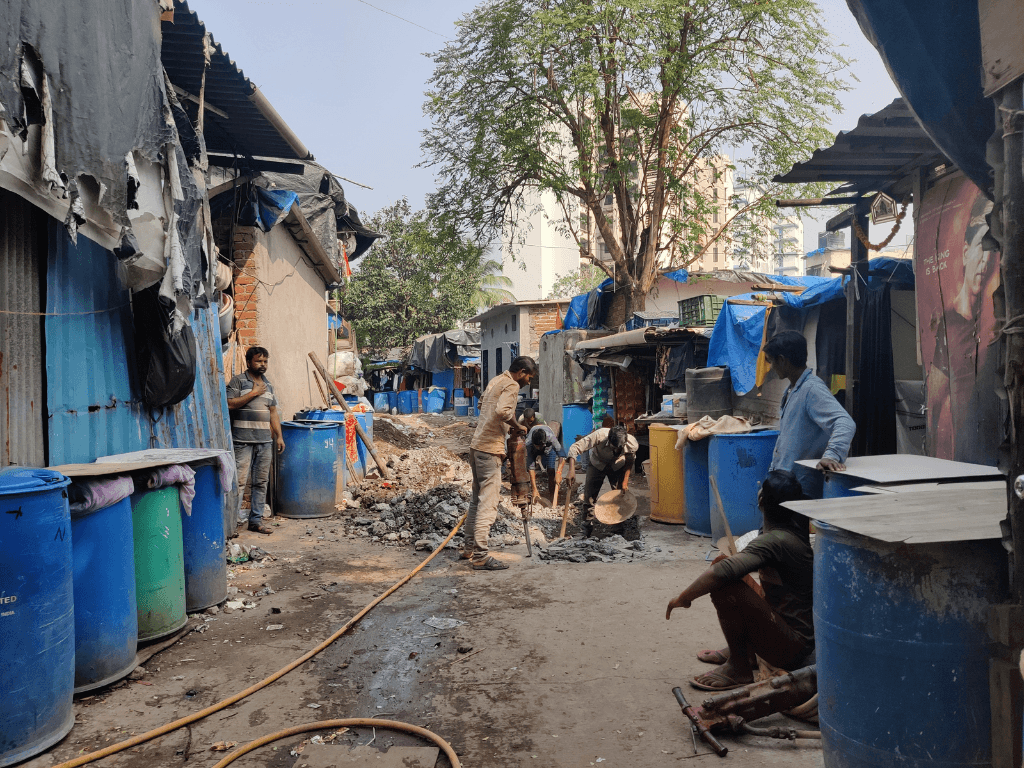
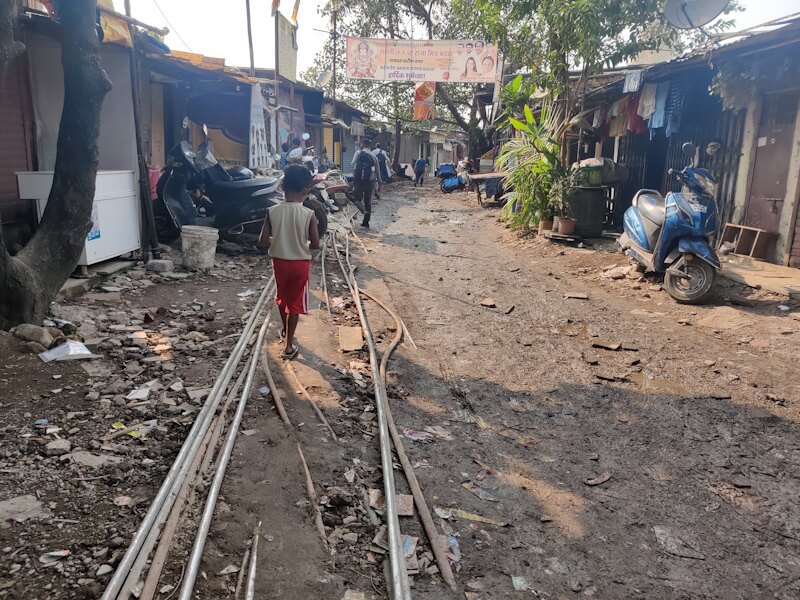
Forced, the civic body rolled out its ‘Water for All’ policy in 2022. It charges differential rates for legal and illegal slums and pavement dwellers – higher than the usual – but provides access to water, at least, on paper. The dirt road in Ganpat Patil Nagar with stretches of narrow pipes on either side, near the swanky IC Colony metro station, is a testament to how people realised their right to reliable and affordable water.
The existing pipeline that brings water here is barely 30 metres long. The proposed 90-metre pipeline, which can ensure adequate water quantity and pressure in all households, has been approved but the BMC has not allocated funds. When residents persist, they are re-directed. “They asked me to contact MHADA and I have also submitted a letter to the local MLA,” says Ishwar Karegol, 34. A resident and volunteer with Pani Haq Samiti, he helped slum dwellers in Ganpat Patil Nagar to file nearly 200 applications for water connections.
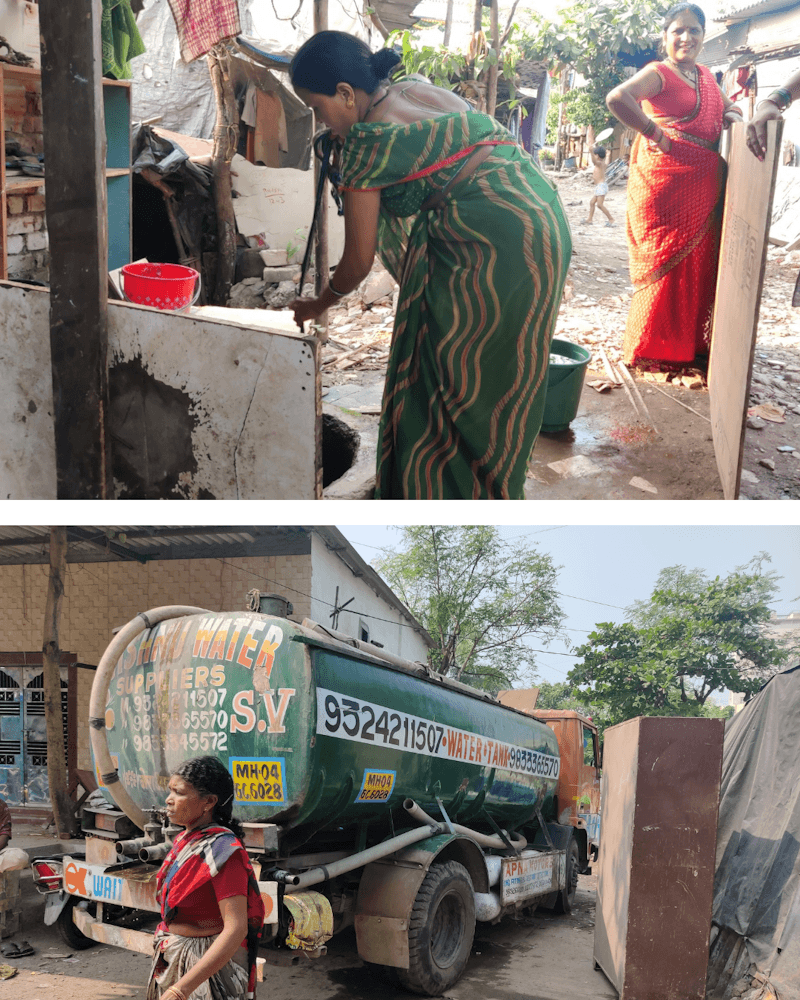
The amount of water that slum dwellers of Ganpatil Patil Nagar receive, in fact their struggle to get tap connections in their houses, reflects the inequity in water access across Mumbai. According to the BMC policy, slums should get 45 litres per capita per day (LPCD) while housing complexes are entitled to 135 LPCD. But the Pani Haq Samiti study of informal settlements in November 2020[1] found that, on average, slum residents received 29 LPCD pre-lockdown which marginally improved to about 34 LPCD during the lockdown after which the average settled at 30.41 LPCD.
Mumbai receives or generates about 4,128 million litres per day of water while its demand is above 5,000 MLD. But as Ganpat Patil Nagar shows, even the available water is not equitably and easily distributed across the city. Sitaram Shelar, co-founder of Pani Haq Samiti remarks, “The marginalised living in informal settlements are often blamed for exploiting the city’s resources but they get less than everyone else. We need a water audit to find out who the actual defaulters are.”
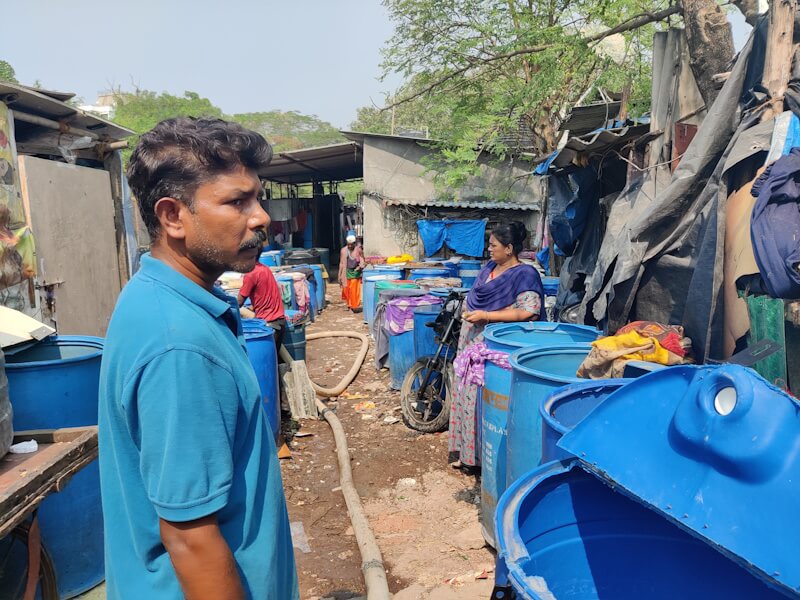
Water distribution has been historically inequitable in Mumbai, explains a study published in Water Alternatives.[2] In 1860, Arthur Crawford, the first municipal commissioner of Bombay, was reportedly against in-house connections to the poor and insisted on providing public connections instead; the under-privileged were also blamed for excessive use and wastages which were caused by poor plumbing and defective pipes imported from England. This allowed only the elite to access the benchmark of 91 LPCD while the poor were left struggling. In 2019, the disparity in water access mirrored the early prejudices. Many slum areas got less than the allocated 45 LPCD but its non-slum areas got 150 LPCD, more than the nationally recommended 135 LPCD, showed a study by the non-profit Praja Foundation.[3]
A key excuse given to deny official water connections to slums was that the cut-off date did not allow legal connections. Mumbai’s slums were regularised retrospectively in phases initially up to January 1, 1995, then the cut-off date was extended to 2000 and later to 2011. Despite the revisions, at least two million people in informal settlements lack access to water in their houses, according to a study by Pani Haq Samiti[4] while nearly 50,000 buildings without an Occupation Certificate lack tap water.
In the informal settlements, water and electricity connections often cost as much as the room itself, anywhere from Rs 40,000 to Rs 2 lakh for connections arranged by middlemen. The ‘Water for All’ policy ensured that the BMC would supply water to all eligible people including in illegal, informal settlements, buildings without occupation certificates (OC) and pavement dwellers. Slum dwellers only had to show proof of identity and residence.[5]
But as Karegol and others of the Pani Haq Samiti stated, the reality on the ground is far from the noble claims in the policy.
The tanker cartel at work
Sidharth Nagar, in Andheri’s Versova, is one of the few slums in the rather posh area that boasts of plush buildings with stars and wealthy business families. The slum received piped water in 2023. For nearly 20 years prior, Zaibunnisa Salim Sheikh, 49, a water broker brought tankers here. She paid Rs 1,200 for one tanker (usually of 10,000 litres) and charged Rs 40 for every 100-litre drum that residents filled.
But this water was not potable. So, when the municipal pipeline was laid in 2022, she accessed drinking water by exchanging it with tanker water. Sheikh seemed confident of continuing her business even after the pipeline was laid, when Question of Cities spoke to her then. But Jai Parmeshwar Mati, 54, community leader for Pani Haq Samiti in the area, says she has since shut shop.
In addition to the BMC supply, Mumbai depends on nearly 2,000 private tankers and 200 licensed tankers every day, operating under the Mumbai Water Tanker Association. The civic body has 33 potable water filling stations for the tankers to fill and supply. It recently introduced an online One-Time Password (OTP) system to deter illegal theft. Why can the BMC itself not supply the water?
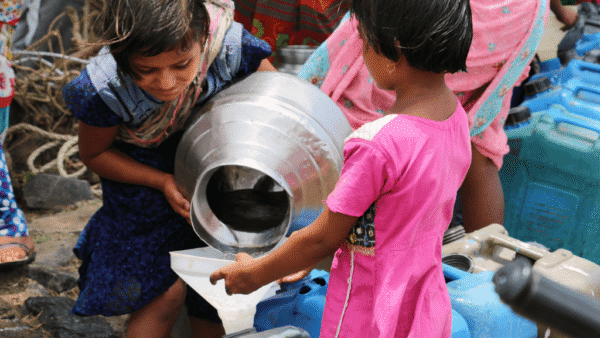
Sidharth Nagar does not even show on Google Maps. Residents work as domestic help, drivers, and cleaners in the surrounding high-rises. Till 2023, women used to wait for tankers to arrive before setting out for work or get water from their employers in the high-rises; packaged drinking water was the last resort if they could afford it. The rest boiled tanker water to make it potable. If the tankers did not come in time, children were forced to collect water, often foregoing school. “Sometimes, children had to do chores in exchange for water, many were ostracised and mocked in school with teachers asking ‘Ghar pe paani nahi aata?’ (Don’t you get water at home?),” says Mati.
In 2026, their dependence on water tankers has all but disappeared, underscoring the importance of piped municipal water to informal settlements.
Here, the process of applying for water connections began in 2017. A local politician helped lay the water pipeline. Water flows in their taps between 8.45pm and 11pm. Mati says the children are back in school and don’t do odd jobs for water now. “People who have spaces have built toilets, some have installed showers too…During summers, there are water cuts but it’s not critical.” The few pending connections are apparently due to bureaucratic delays.
BMC officials, on the condition of anonymity, told Question of Cities that water availability should be equal for everyone irrespective of where they live and Mumbai’s water quality is good for tap water to be used for drinking, but “if people pay for it, they won’t waste it.” The delays in operationalising ‘Water for All’ policy, they insist, is because rules require a host of documents to be approved for every connection: “We are only trying to follow the protocols set by the government.”
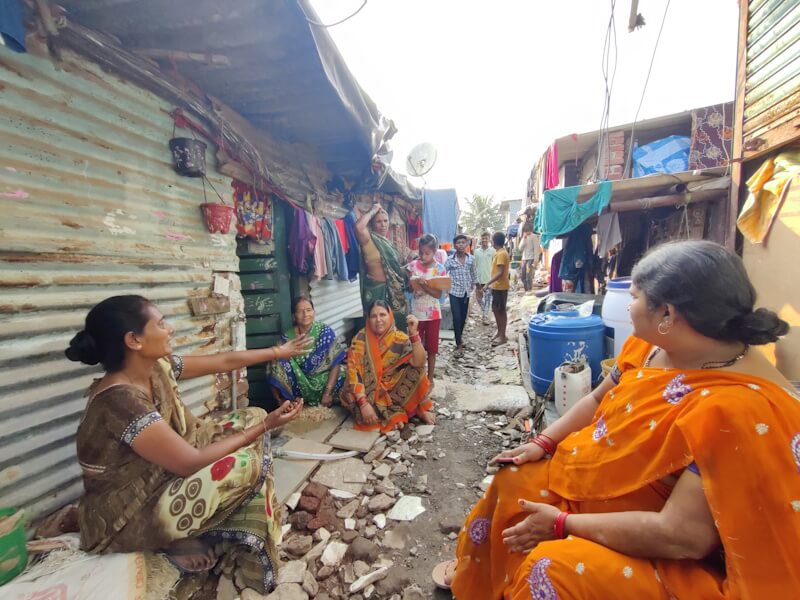
In Bhim Nagar slum in Mankhurd, on the eastern side of Mumbai, BMC’s pipelines brought water in 2021. The slum gets water from 9pm to 12 midnight though the pressure is erratic. Says Jaikish Jaiswal, 23, a volunteer with Pani Haq Samiti, “We have large tanks to store water which keeps our houses clean.” Agrahari in Ganpat Patil Nagar is dreaming of this: “A steady supply means we can do away with the buckets, cans, and containers that take up half the space in our houses.”
Article 21 of the Constitution has been interpreted to include the right to safe water. Access to water and sanitation were recognised as human rights by the United Nations.[6] But people in informal settlements do not always know their rights or cannot claim potable water. The advocacy by Pani Haq Samiti and other organisations have gone a long way to educate them. Says Radhika Yadav, 40, community leader in Ganpat Patil Nagar, “We understood how to get it done legally. Having the taps in our homes is a symbol of victory for us. We learnt how to talk to people outside because of Pani Haq Samiti.” A huge leap in recognising their own rights to something as simple as access to water.
All photos: Jashvitha Dhagey
Jashvitha Dhagey, a multimedia journalist and researcher, is the recipient of the Laadli Media awards for three years in a row – 2023, 2024 and 2025 – for her work in Question of Cities. She holds a post-graduate diploma in Social Communications Media from Sophia Polytechnic and is presently pursuing her Masters in Urban Studies at the Indian Institute for Human Settlements, Bengaluru. She observes and chronicles multiple interactions between people, between people and power, and society and media, and developed a deep interest in the way cities function, watching Mumbai at work.
Nikeita Saraf, a Thane-based architect, illustrator and urban practitioner, is now with Question of Cities. Through her academic years at School of Environment and Architecture, she tried to explore, in various forms, the web of relationships which create space and form the essence of storytelling. Her interests in storytelling and narrative mapping stem from the need to understand people and the methods with which they map the world. Through her everyday practice of illustrating and archiving she intends to explore this further.