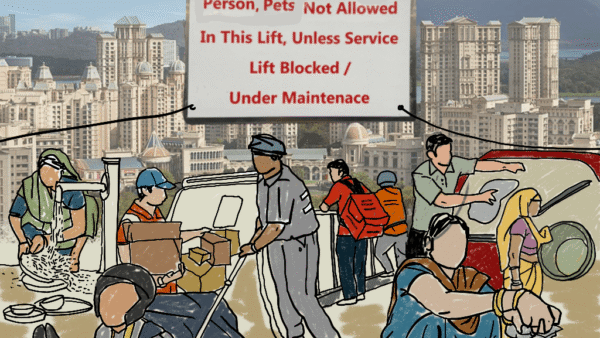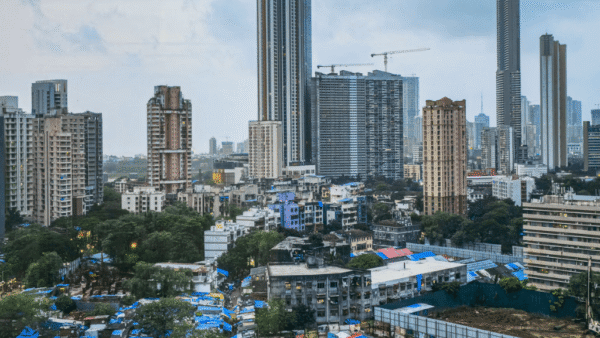

Walk past a construction site in any Indian city after dark, and the lights are often not coming from the building under construction but from the temporary shelters beside it. Men sit outside after work. A woman cooks on a smalprodl stove. Children sleep nearby as trucks, generators, and machinery continue through the evening. This is how most of the people who build India’s cities live. Not in the apartments they construct, nor in the neighbourhoods around them, but in makeshift settlements attached to worksites or on vacant land nearby.
Over time, these arrangements have become so common that they rarely attract attention. Yet, they reveal something important about how Indian cities are planned and built, by whom and for whom. It is assumed, or has been normalised, that construction workers will somehow live in informal and uninhabitable ways on or near the construction site. Why does it have to be so?
India’s construction sector employs over 71 million workers[1], making it the country’s second-largest employer after agriculture. By 2030, that number is projected to cross 100 million. The National Infrastructure Pipeline[2] envisions Rs 111 lakh crore in investment. The Smart Cities Mission covers 100 cities.[3] PMAY has sanctioned over 4 crore housing units.[4] Yet, in all this planning and big spends, one question is rarely discussed: Where will the workers building these cities live?
Construction workers, mostly migrants coming from states such as Jharkhand, Odisha, Andhra Pradesh, Bihar and Rajasthan, live in makeshift shelters built within the project premises by contractors or employers. These arrangements are almost entirely unregulated. There is no standard for floor space, ventilation, water supply, or sanitation. A documentation carried out by SEWA[5] on migrant construction workers shows the pattern: Families living without dependable electricity or access to clean drinking water, children growing up with limited access to schools or anganwadis, and healthcare being generally too far away to reach.
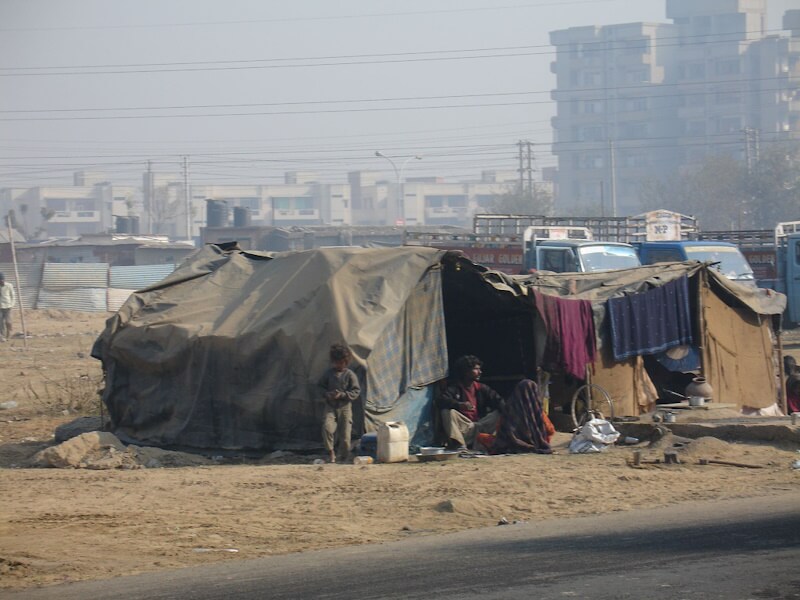
Photo: Wikimedia Commons
Workers, who are hired from the urban labour chowks and the informal job markets in the cities, look for and frequently manage to secure rental housing in the most disadvantaged neighbourhoods. A study carried out in 2024[6] among migrant workers in the outlying areas of Bengaluru found that the closeness to their place of work was the one most important factor while looking for housing.
Workers live close to construction sites not because the conditions are better than elsewhere but travelling long distances every day would take away their time and money, which they can hardly afford to lose. Construction work is rarely permanent. As one project ends, workers move to the next, often to a different part of the city. Years can pass this way, moving from one site to the other with little connection to the places they help build.
What the numbers miss, women on site
Women, who make up a significant share of the workforce, experience these conditions and situations differently. Tasks such as carrying materials, mixing cement, fetching water, and cleaning the worksite are commonly carried out by women workers. Construction sites across the country lack water, adequate toilets, and washing facilities, which are a discouragement for women workers. The facilities they have access to seldom take this into account. Lack of sanitation, privacy, and childcare has an effect on their health, safety, and working conditions.
Women often accompany their husband or father and travel from one project to another with the workers and live at the construction sites. Although they do not work there, their lives are just as affected by the uncertainty of migration, moving from one temporary shelter to another without continuity in their daily lives. For children growing up in these settlements, access to schools, anganwadis, healthcare and basic documentation usually remain restricted, which makes it hard for them to establish the stability and support they require.
A study conducted by Prayas Centre for Labour Research and Action (PCLRA), which works among the unorganised sector, mapped 1,869 families across 30 worker settlements in Surat on the facilities and amenities for workers. Although 50 percent of the families mapped had spent up to five years or more working as migrants in the city, very few were able to afford rented accommodation. Open settlements have housed migrant families for generations, and yet the spaces and communities remain absent from planning policies and documents.[7]
Why the city doesn’t see them
The standard response from municipalities across the country when it comes to worker settlements has more or less been similar, which is to classify them as ‘temporary encroachments’ on land, making them vulnerable to demolitions and displacements.
This is often treated as an administrative oversight. But the problem runs deeper. Most planning frameworks simply do not account for worker housing in any meaningful way. When planning documents make no provision for worker housing, the settlements that emerge or crop up around worksites are often treated as encroachments rather than as a necessary part of the urban economy or structure. This systemic exclusion is precisely what field research also exposes.
Researcher Renu Desai documented the construction workers in Ahmedabad from 2016–2020 and found that migrant workers lived in “semi-pucca rooms, had no toilets, forcing tenants to defecate in a nearby field; no paving or drainage in the lanes, leading to severe waterlogging in monsoon; and shared water taps from which they had to fill and store water twice a day”.[8]
Be it master plans or town planning policies, there has been a consistent erasure or invisibility of housing as a right for migrant workers, and to this effect, there has been no clarity whatsoever as to where the workers should live, whether on the shop floor, in shelters attached to worksites, or in makeshift settlements nearby. This is not limited to one city’s planning documents. It reflects a broader gap in urban planning across India.

Photo: wikiMEDIA commons
This is not limited to one city’s planning documents. It reflects a broader gap in urban planning across India. The people building the city often have the least secure place in it. A few days of heavy rain can flood a settlement or bring down a temporary shelter, leaving families to manage on their own. When a site ends, and they move on, there is no authority tracking where they go next.
The law without teeth
India does have a legal framework for construction worker welfare. The Building and Other Construction Workers (BOCW) Act, 1996,[9] mandates welfare boards in every state, funded by a cess on construction activity. The boards were meant to provide housing support, among other things.
According to a Right To Information (RTI) reply, cess collections now exceed Rs 1.17 lakh crore nationally, of which more than Rs 70,000 crore[10] remains unspent. The CAG audit[11] has flagged this across multiple state boards. In Gujarat, over Rs 4,700 crore[12] was collected but only Rs 808 crore was spent on workers. In Madhya Pradesh, Rs 416 crore was diverted[13] from the BOCW fund to an unrelated state scheme, something the CAG found to be in contempt of Supreme Court orders.
Why does this happen? It is difficult to term this simply as an administrative failure. Welfare boards, after all, have successfully collected cess for decades. Several factors help explain why these funds remain underutilised. Construction workers are often migrants with limited political influence in the states where they work and rarely constitute a significant electoral constituency there. Organising collectively is also difficult.
Workers frequently move between projects and employers, while contractors and builders often discourage union activity. Many migrants continue to rely on social networks organised around village, region, language, or caste identities, making it harder to build a collective identity around shared experiences as workers. As a result, welfare boards face relatively little sustained pressure from the very workers they are meant to serve. At the same time, builders and developers wield significant economic and political influence.
A more recent scheme specifically targeted at this problem, the Affordable Rental Housing Complexes (ARHC) initiative under PMAY-Urban[14], designed to provide rental housing to migrant workers, has produced similar results. As of late 2024, only 7 percent of ARHC units[15] had been allocated to migrant labourers. Despite the policy intent, the implementation has been limited.
But even if both worked perfectly, they would not fix the structural problem. The BOCW Act operates within labour law logic: It can, in principle, provide cash and housing support to individual workers, it cannot mandate that worker accommodation be built into the planning of construction activity itself. The ARHC scheme provides housing through dedicated complexes, but it does not make decent accommodation for workers a basic requirement of construction.
The subcontracting chain and who gets lost in it
Most construction workers in India are not employed by the principal developer. They are employed by subcontractors, who are engaged by contractors, who are hired by developers. Each layer of this chain diffuses responsibility.
When a subcontractor fails to provide adequate shelter, the developer points to the contractor. The contractor points to the subcontractor. The subcontractor has no formal obligation for anything beyond the daily wage. Even where labour laws have provisions on worksite housing, enforcement is weak because the applicable employer is unclear. The makeshift houses built by migrant workers are treated as ‘unrecognised slums’ and they lack basic services as absence of voting rights in the city weakens their attempt to access the slum schemes.[16]
In theory, developers are responsible for the conditions under which workers build their projects. In practice, the responsibility often gets lost in the layers of contractors and subcontractors that dominate the construction industry. When housing or welfare conditions are poor, workers are often left unsure about who should be held accountable.
Mandate worker housing, implement rules
None of these interventions require entirely new frameworks. Most involve enforcing existing responsibilities or incorporating worker housing into planning processes that already exist. One option would be to make provision for worker housing mandatory for projects above a certain scale. Covered and serviced accommodation could be made a non-waivable condition before an occupation certificate is issued. This would make worker housing a planning requirement rather than a matter of employer discretion. This would not be a new idea: several countries require labour camp standards as part of the project approval process.
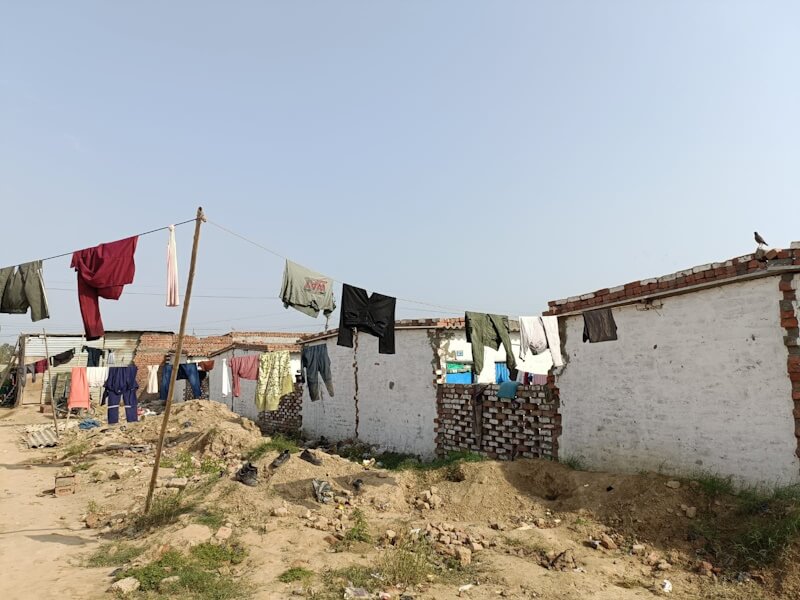
Photo: Ankita Dhar Karmakar
Designated transit housing zones near major construction corridors with guaranteed water, electricity, and sanitation would give workers a shelter with legal status. Municipal land banks near metro and infrastructure projects could be used for this. Regular and mandated inspection of these facilities would need to be built in from the start, not added later.
On-site facilities, including washrooms, changing areas for women, and crèches for children, should be a non-negotiable condition for any project above a certain threshold. The continued absence of such facilities also highlights how little attention workers’ everyday lives receive in planning.
Stricter enforcement of principal employer liability under the BOCW framework would mean that when a subcontractor fails to provide adequate housing, the developer bears the cost — not the worker. This would change the incentive structure immediately: developers would begin requiring contractors to provide worker housing, because the alternative would be their own liability.
By 2036, India is projected to have 600 million urban residents.[17] Every tower, every metro corridor, every smart city infrastructure project in that trajectory requires workers to be present on-site for years at a time. The question of where those workers live is not a welfare question that sits outside urban planning. It is an urban planning question that has been systematically excluded from policy discussions and city planning processes.
Urban housing debates often focus on residents, homeowners, and future growth. Much less attention is paid to the workers who physically build the city. Until their housing needs become an integral part of urban planning, the gap between the city and its builders is likely to remain.
Utkarsh Mishra is a journalist based in Ranchi, writing on labour rights, urban policy, and informal economies. His work has appeared in Feminism in India, The India Forum, Down to Earth, Ideas for India, SPRF, Countercurrents, and Zee News.
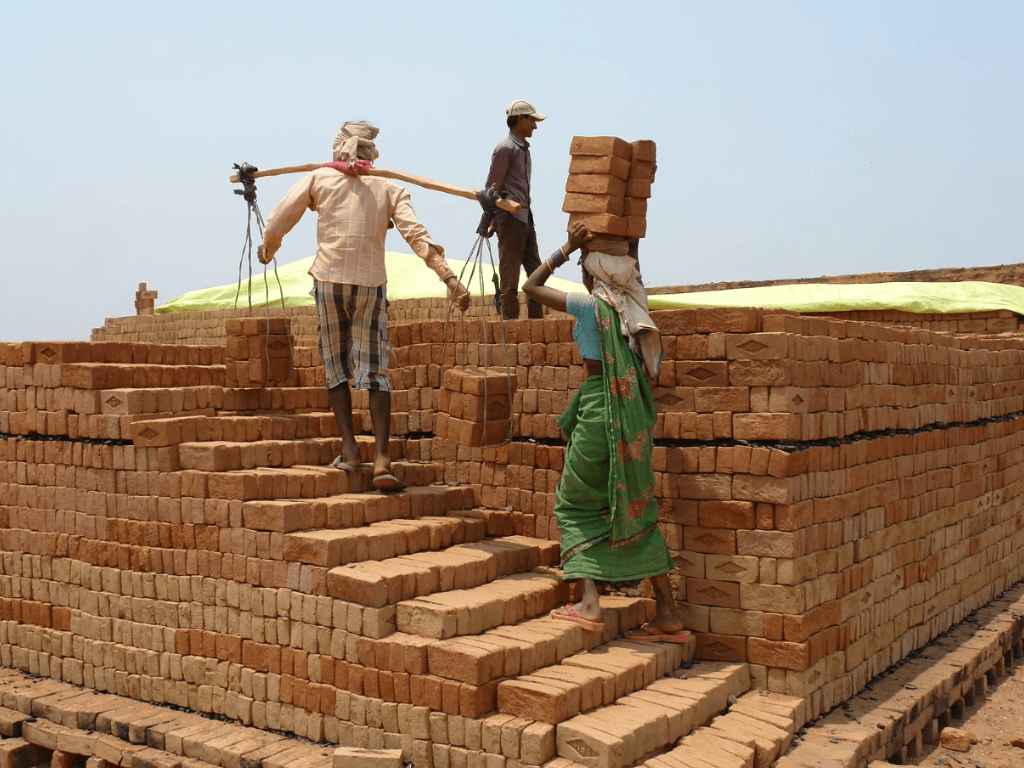
Cover photo: Workers piling bricks at a construction site. Credit: Flickr