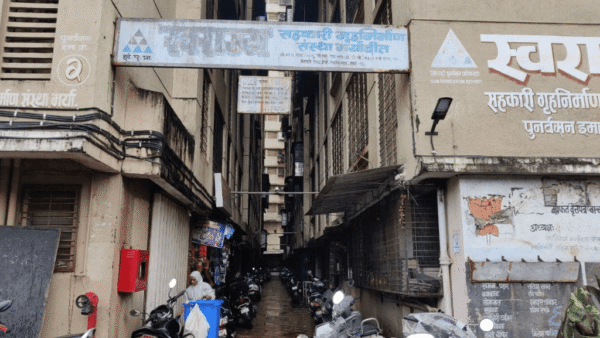

When 35-year-old Mahesh Dasari and his family moved into the new Raja Rajeshwari Peta (RR Peta) in Vijayawada, in 2022, he was very happy. It was a government constructed resettlement colony for the displaced poor. Before moving, his family lived in “huts” around Ryves canal. These houses had neither electricity supply nor water connection; the doors and windows were either damaged or completely removed. “The government left us here in darkness. We were diverting the neighbour’s electricity connection during the day with their permission but we had no light during the night,” says Dasari, who works as a painter.
These houses, constructed under the Jawaharlal Nehru National Urban Renewal Mission (JNNURM) between 2009 and 2014, lay vacant[1] for years. The buildings were neglected, doors and windows were stolen. Dasari and his wife, Madhavi, with their two school-going children survived for a year without electricity till the civic body heeded their petitions for power, doors, and windows.
Most of those who were allotted flats in RR Peta are very poor Dalits or de-notified tribals who lived in vulnerable geographies like riverbanks and sea shores, or are project-affected persons. These pucca houses, built under various slum rehabilitation or resettlement schemes, are often favourably compared to informal settlements or make-shift houses, but this is an incomplete picture. Many of these buildings are poorly designed, built with low-quality materials, and lacking in services such as water supply, sanitation facilities, and electricity. Also, they are located in low-lying flood-prone areas, far from the workplaces of labourers.
Communities living in these colonies, especially in RR Peta, suffer the climate impacts of extreme heat as well as extreme rainfall. The houses do not protect them enough. “For people like me, who did not have a house, simply having this feels enough. It is better than living in a hut but if the government built stronger, well-planned houses it would be even better,” said Dasari. In resettlement, climate impacts are rarely thought of, yet residents in them are confronted with the extreme weather events, affecting their health and livelihood.
Houses do not protect against heat
During the summer months, living in RR Peta is unbearable, residents say. The top floors are virtually unlivable. When 37-year-old Kavitha (name changed) moved here in 2018, she was on the fourth and last floor. “The nights were too hot. Everyone in my house came down to the ground floor and slept on the road; we went back home around 3 am when it got cooler,” she says. A waste picker, she had to rush to work at dawn, barely getting a night’s sleep. Residents splashed water on walls and floors to cool their houses.
During heatwaves, the colony experiences frequent power cuts. Residents speak of how the heat builds in the house “like steam” and how they feel “suffocated.” Vijayawada, situated in NTR district (erstwhile Krishna district) in Andhra Pradesh, was placed at a very high heat risk in the 2025 study[2] by Council on Energy, Environment and Water (CEEW) which mapped night-time heat too. Housing structures should have prevented the heat rather than pull it in, explains Dr Faiz Ahmed Chundeli, an architect and researcher with work focused on climate, building energy efficiency and built-environment, and a teacher at Vijayawada’s School of Planning and Architecture.
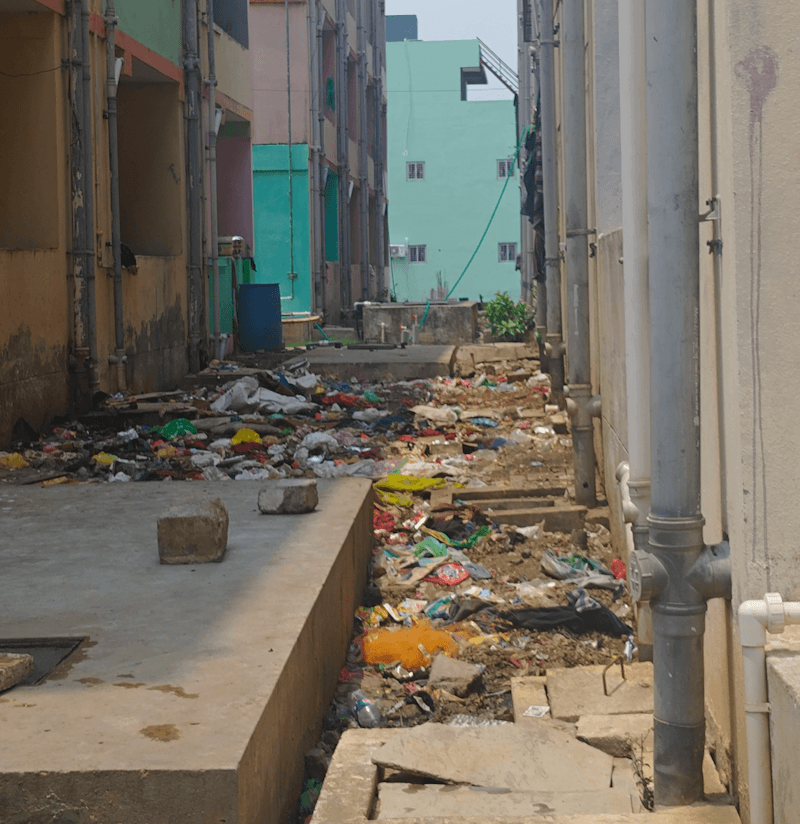
Photo: Pavani Pendyala
During the multi-site study[3] done in Austria and India on low-income housing and heat-coping strategies, when Dr Chundeli’s team studied RR Peta, it found indoor temperatures were always higher than the outdoors. “Normally we expect indoor temperatures to be lower… But our instruments[4] inside the houses, monitored for a week in summer, found that indoor temperatures were always higher than the outdoor all day,” he says, and the stark differences were during the hottest hours with indoor temperatures hitting 50 degrees Celsius. “Being constantly exposed to higher temperatures can create health issues,” he adds.
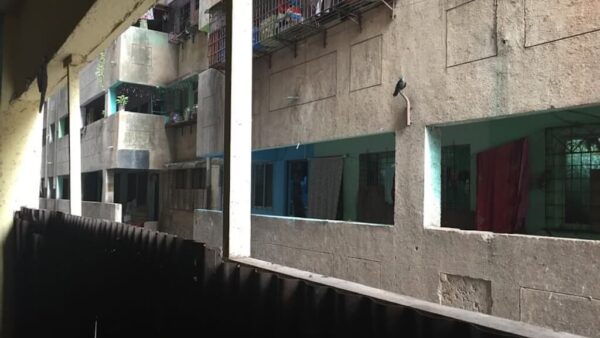
In RR Peta, the heat modulation is not good enough because[5] the roofs are not treated properly with materials that reduce heat, the walls are made of hollow block walls, among other issues. Open and green spaces help alleviate the heat, but are absent or inaccessible in such resettlement colonies.
Health problems
Prolonged exposure to extreme heat can lead to a range of heat-related illnesses – heatstroke, dehydration, and respiratory issues. People with chronic diseases,[6] the elderly, and children are most vulnerable to heat risks.
Sandhya, in her late 30s and a diabetic, lives with her husband and five children in RR Peta. She used to sell breakfast items such as idli and dosa on a cart, but an accident stopped her; now she finds even basic household work difficult. During summer, her legs swell, and she gets headaches and back pain. “This house barely has any ventilation. I sweat continuously while working inside; it’s so frustrating.” Some houses have windows but residents keep them shut. “The houses are too close to each other and some windows cannot be opened. There are drainage and waste management issues; the septic tank does not get cleaned. Open windows bring in mosquitoes,” explains Dr Chundeli.
The government rationale in building such resettlement colonies is to accommodate as many houses as possible in a plot, leading to dense colonies,[7] and smaller houses of barely 300 square feet, with barely any ventilation. The combined impact of this built environment, without open spaces and increased heat indoors, is associated with the spread of tuberculosis[8], among other illnesses.
This is reflected in Mumbai’s Mankhurd slum too. Here, Kanta Nadar lives in a densely-situated resettlement colony situated near the garbage dump, with lower floors getting no light at all. “Below the fifth floor (in seven-floor buildings), we keep the lights on all day. There is no breeze,” said 58-year-old Nadar, who works as Programme Director, Health and Education with Pehel Foundation.[9]
The research[10] led by ‘Doctors for You’ showed that about 10-11 percent of the households here suffered from tuberculosis; those on lower floors, lacking ventilation and daylight, were at higher risk. Importantly, the study[11] showed that this built environment was not “incidental” but stemmed from relaxations in the Slum Rehabilitation Authority’s norms for light and ventilation. This applies also to JNNURM projects and other government affordable housing projects such as RR Peta, where the minimum standards are extremely[12] low.
Lack of basic amenities
Most houses in RR Peta do not have direct water supply. Residents struggle to get water which, they claim, is often not potable. Water-borne diseases follow. In 2025, the diarrhea outbreak[13] here affected at least 263 of them, after residents complained of getting red and smelly water, and alleged[14] that drainage water was getting mixed with it. Civic authorities later admitted that they found[15] E-coli in the local RO plants and identified it as the cause for the diarrhea outbreak.
In Mumbai, Nadar said that when she moved to Natwar Parekh Compound in Mankhurd in 2012, the water had tiny bugs, possibly from gutter water getting mixed with it. “We lived on footpaths, but it is here that our families got typhoid and malaria,” she rues. Relentless petitioning the civic body brought them some relief.
Building maintenance and house maintenance systems, a norm in most middle-class societies, are alien concepts for those resettled from roadside shacks. Garbage collection and maintenance of the built environment are things all resettlement colonies struggle with. Poor waste management and drainage is a problem in such resettlement or rehabilitation colonies[16] across the country including those in Ahmedabad[17], Indore[18], and Coimbatore[19].
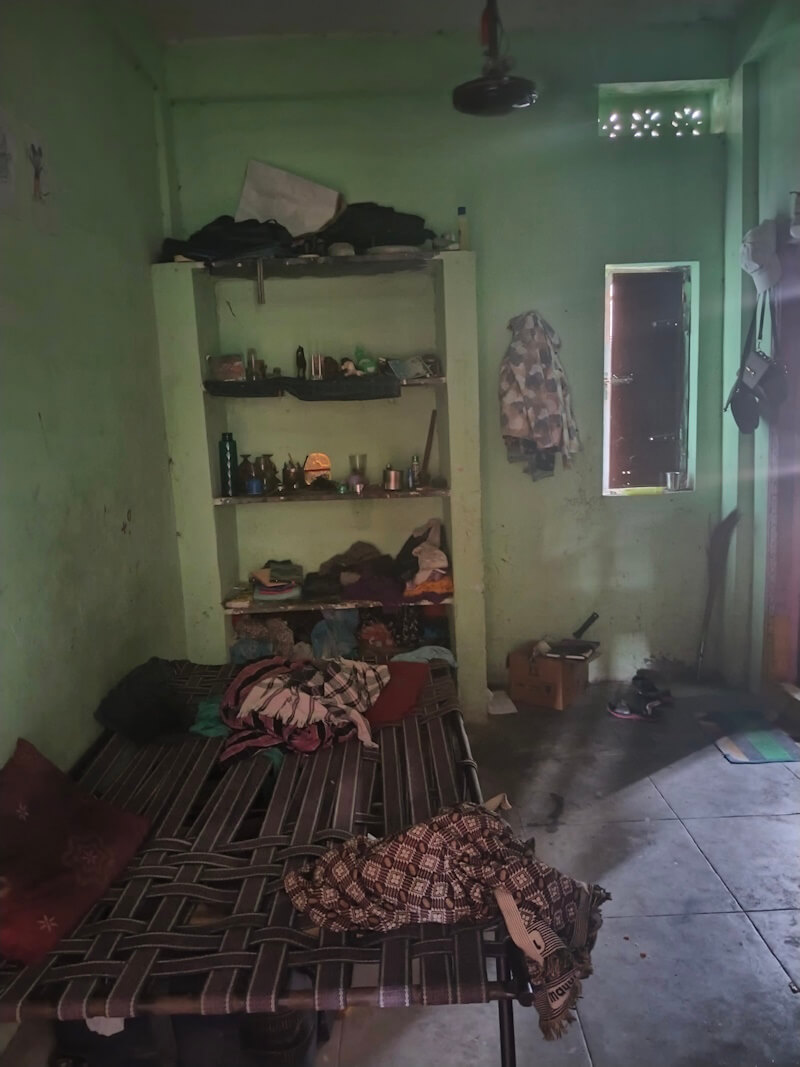
Photo: Pavani Pendyala
Dr Sudha Arlikatti has conducted research[20] on resettlement housing in Nagapattinam, Tamil Nadu, after the tsunami in 2004. “People said earlier they thatched the roofs and repaired them with coconut trees after the rains, but they didn’t know how to buy cement and repair the cracks in these colony houses. They ended up not repairing at all; they did not have money either. The deterioration worsened,” said Dr Arlikatti, Professor and Head, Symbiosis Centre for Urban Studies (SCUS), Pune. Her research paper[21] compared two approaches to re-housing – donor-driven where people were resettled away from the coast like RR Peta, and owner-driven where they were given monetary assistance to retrofit their homes. The study compared and concluded that the owner-driven approach fared better on all parameters.
Dr Vidit Panchal, a public health physician who worked with residents of the Mankhurd resettlement colony during the COVID-19 pandemic, said that patients here became irregular with their check-ups and medicines because they lacked mobility. “Lifts were barely working in buildings, keeping many old people stuck in their houses, which impacted their mental and physical health. Some ill people were brought down only after their death,” said Dr Panchal, now based in Udaipur.
Nadar said Mankhurd’s colony’s residents understood the importance of building maintenance after years; with the help of civil society organisations and constant petitions to the civic body, garbage collection and disposal have been streamlined with each house contributing Rs 500 a month. Their buildings can afford lifts only in the mornings and evenings when people go out to work and study, and return. Dr Arlikatti suggests that education programmes and monitoring should be tied to the resettlement programmes.
Residents of these colonies[22] also face social problems, possibly due to the large number of vacant flats which are sometimes occupied by drug addicts and alcoholics. “We are often unable to even sit outside the apartment and chat with our neighbours in the evenings. We are scared of being targeted. Robberies are frequent too,” says Dasari.
Built on low-value, flood-prone lands
Many resettlement colonies are constructed on low-value lands or margins of cities, far from work hubs which causes many to lose their livelihoods[23] or making it unaffordable to reach workplaces. These are also often flood-prone areas, including[24] RR Peta which was on the floodplains[25] of Badameru rivulet (with infamous moniker[26] ‘Sorrow of Vijayawada”). Chennai’s resettlement colonies for the tsunami-affected 2015 were built on environmentally sensitive marsh areas[27] under central schemes for affordable housing. Dr Chundeli’s studies have shown that most have such low plinth levels that rainfall of two-three hours is sufficient to flood them.
RR Peta residents complain of water stagnation in the monsoon which then leads to mosquitos and related illnesses. “During rains, small puddles with stagnant water are where mosquitoes breed; water often stagnates between buildings too. Snakes also enter homes,” says Dasari. In August 2024, Vijayawada faced the worst floods[28] in two decades. That Sunday morning, in RR Peta, the water rose rapidly when many were in church.
People describe walking in neck-deep water to salvage their belongings, carrying children and pregnant women, and taking shelter in the nearby stadium for a few days. When they returned, snakes were in their houses. Many vacated the settlement altogether. “My daughter was nine months pregnant; she almost died. My other daughter had fits,” recalled a resident woman in group discussions. Many lost their work equipment, vehicles like second-hand bikes used to travel for work, and household equipment was damaged. Many like Sandhya could not afford repairs. Such incidents have long-lasting effects on people’s mental health, besides the physical discomfort.
Lack of agency
Many residents of such resettlement colonies worry about being evicted even from here because, like Dasari and others in RR Peta, they do not have house deeds but only allotment papers which are small slips. “We are scared we will have to vacate in the future; we have no proof this house belongs to us,” he says. Kavitha’s house ownership is more precarious. Having re-modelled a unit “purchased” on the ground floor she is legally in the grey area and could lose it all, but this is all she could afford.
While residents are relatively happy about having pucca houses in resettlement colonies, they are unanimous that their contexts and needs were not kept in mind. They had no say in how their houses were designed. “The best option was to ask us, right?” comments Dasari. Residents believe they should have been included in the decision-making processes related to the re-housing and the process should have been participatory. Nadar puts it bluntly: “For humanity’s sake, the government should have provided houses with clean air, water, and sunlight. There are so many towers around us where every facility is available for residents. We also have a life.”
Menaka Rao works as the Project Communication Officer with the Urban SHADE project with The George Institute of Global Health.
Hemanth Chandu and Pavani Pendyala work as researchers with Urban SHADE at The George Institute for Global Health.
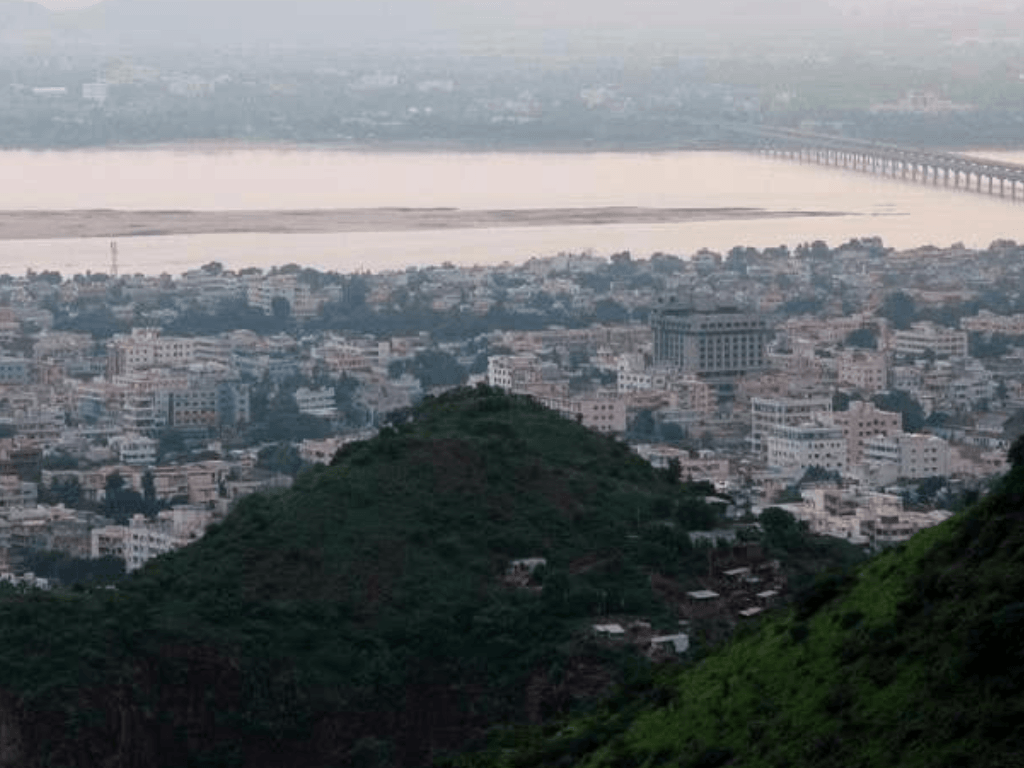
Cover photo: An aerial view of Vijayawada. Credit: Wikimedia Commons