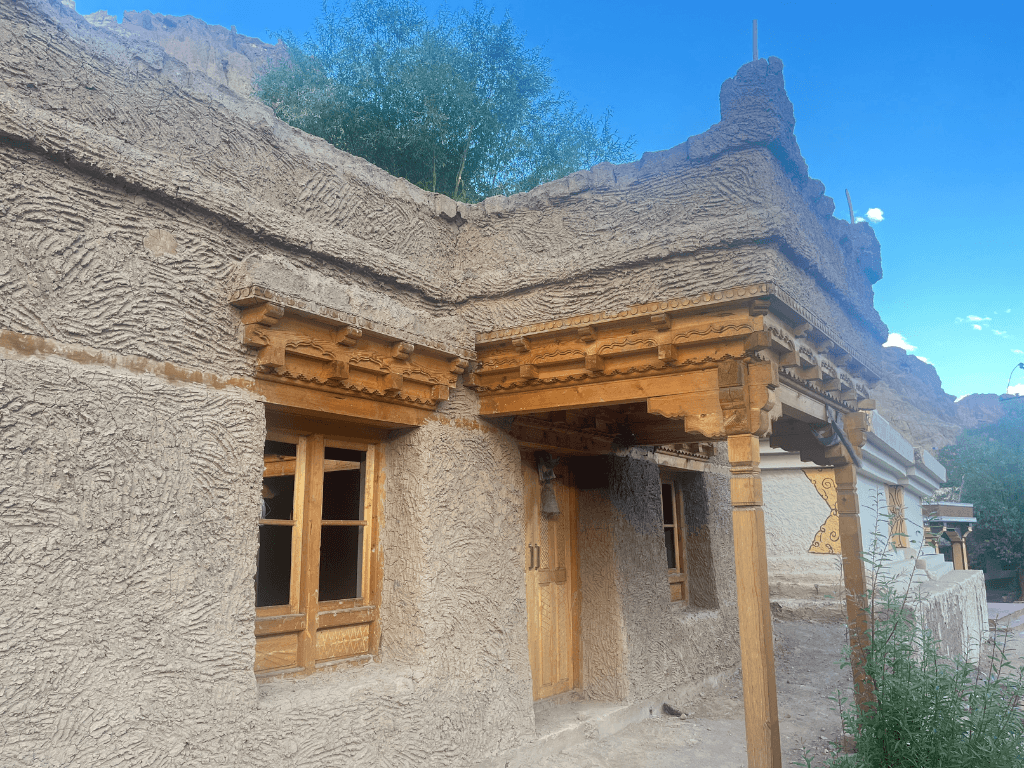

Homes in Ladakh traditionally had thick walls made of mud bricks, flat roofs built with layers of grass (locally known as yakzas), mud spread over wooden beams which came from local trees such as poplar and willow. The flat roofs served a practical purpose beyond shelter. Families used them as outdoor workspaces, drying vegetables and fruits in the sun, and carrying out everyday household chores. All the materials and processes were perfected through generations and responded to the region’s bitter winters and harsh summers.
The one element they did not have to respond to was rain which was scarce, brief, and rather scanty. Ladakh was the typical high-altitude cold desert. Its geography in the rain shadow of the Himalayas meant that the rain clouds were blocked before they burst. Ladakh’s average rainfall for decades was barely 75 to 100 millimetres a year. But that has been changing.
The region recorded the highest rainfall excess in India this monsoon, according to India Meteorological Department data; by July 15, the Union Territory had received 65 percent more rainfall than normal. And this happened for the fifth successive year.[1] “It rains intensely now in Ladakh” was a repeated statement I heard in different parts during a recent visit. August last year saw the highest in over 50 years at 80.2 millimetres.[2]
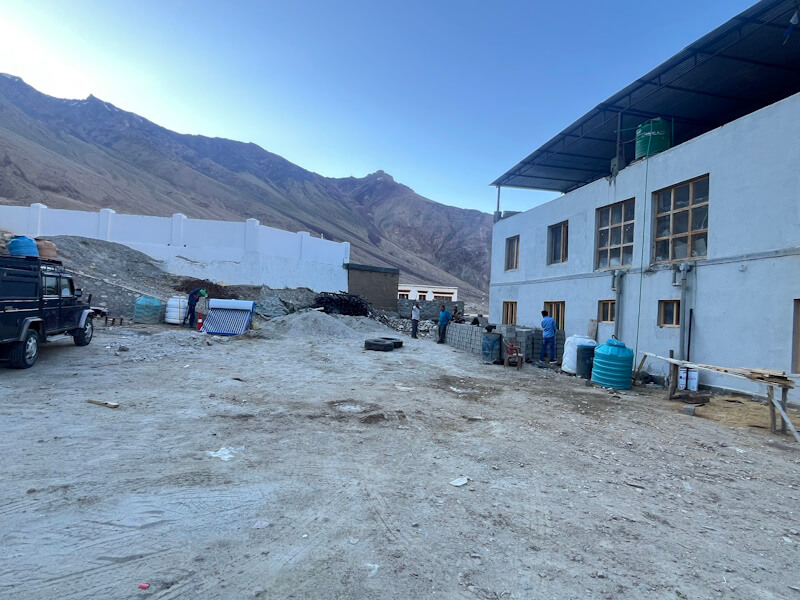
The impact on people begins with the dwelling. The traditional mud roofs were never designed to withstand such high and incessant precipitation. A heavy spell now leaves behind leaks, damaged walls, costly repairs. Families struggle to keep rainwater out and have been making a visible shift to tin sheet roofs and concrete. The change is significant because Ladakh’s traditional architecture was a remarkable response[3] to the local climate but what was once sustainable in one of the world’s harshest environments has proved insufficient in recent years.
‘Necessity, not preference’
Research on Ladakhi vernacular architecture describes the materials used earlier not as primitive substitutes for modern construction but as products of generations of adaptation to extreme climatic conditions before ‘adaptation’ became a buzzword. This field study[4] of Ladakh’s vernacular architecture documents how the locally available materials formed the backbone of traditional construction and how local building knowledge was closely tied to their use.
A study[5] published in the Indian Journal of Hill Farming described locally-made mud bricks as a low-cost, climate-resilient material that provided thermal comfort in Ladakh’s extreme cold. According to this case study[6] on Ladakh’s architecture, the region exhibited a highly evolved traditional understanding of controlling adverse climatic circumstances through vernacular construction, resulting in human survival for centuries. “The native inhabitants have devised a highly efficient and climatically sensitive vernacular architecture thanks to their ancient indigenous understanding of building construction,” the study stated. The vernacular architecture, it added, was a dynamic reflection of how identity and sustainability are naturally linked with environment and culture.
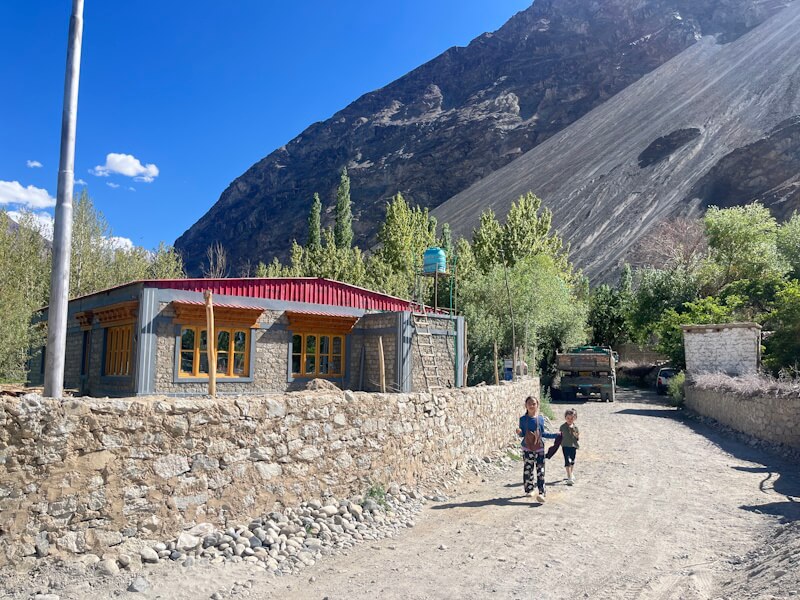
However, when unusually high rainfall proved the centuries of indigenous knowledge, passive designs, and local materials inadequate, people had to break the mould and evolve responses to re-construct their homes. A drive up towards Khardung La pass shows corrugated tin sheets roofs glinting in villages; elsewhere, reinforced concrete slabs have begun replacing the traditional roofs. Not only have tin sheets and concrete edged out local materials and designs but are turning out to be expensive because cement and iron have to be transported to Ladakh from Srinagar, 450 kilometres away.
Residents say that the change is a matter of necessity rather than preference. “The kind of rainfall now is different from what we used to experience 15 years back. Mud roofs leak, forcing repeated repairs, and prompting many families to replace them with corrugated tin sheets or reinforced concrete slabs,” said Lobzang Vishuda, a Leh resident who now has tin-sheet roofs on his home.
Three years ago, when Dechen Angmo’s family built the house in Leh city, the family deliberately chose traditional architecture; the walls were made of sun-dried mud bricks and coated with mud, cement was used only in the bathrooms. But last summer, a week of unusually intense rainfall seeped through the mud roof and walls, damaging both. Left with little choice, corrugated tin sheets replaced the mud roofs.
“The tin roof was out of character with the local architecture and expensive at Rs 2,80,000 but we had no other option,” Angmo said, “The rain has become too frequent and too heavy for traditional mud roofs to withstand.” She still values preserving the mud walls but sacrificing the roof was the only way forward to a changing Himalayan climate. “Mud kept us warm during the freezing winters and cool in summer. The local materials we used traditionally were ideal for this climate. We cannot live comfortably in houses made entirely of cement.”
Standing beneath the tin roof of her home, Angmo, 31, reflected on the dramatic change in the rainfall: “When I was in school, rainfall was rare and lasted only a few minutes. Now it rains for days, with short breaks in between. Earlier we had heavy snowfalls in winter but very little rain in summers. Now, it is the opposite.”
People across Ladakh such as in Basgo, Khardung, Diskit and Hunder recounted similar experiences of the changing climate – less severe winters, hotter summers, and increasingly fierce rainfall where it used to be minimal.
“There is a clear change,” said Sonam Dorje, a resident of Hunder, as he waited with fellow villagers for a local festival to begin, “We now experience much more rainfall and much less snowfall. I would say rainfall has increased by at least 30 percent.” Dorje too replaced his traditional roof with a concrete one.
A costly adaptation
From an economic standpoint,[7] using locally available materials kept both construction and maintenance costs relatively low. The availability of the materials close to the building site meant that transport costs over the region’s difficult mountain roads were reduced. Mud bricks could be made from local alluvial soil; the principal materials of earth, stone and timber were locally sourced too.
The economic advantage of the local low-cost building technology was not limited to construction. Mud walls and roofs could be repaired and re-plastered using local materials rather than relying on industrial products brought from outside which added substantially to building costs. But now, as households are replacing traditional roofs with tin or concrete, that equation is changing and is making climate adaptation an additional financial burden for many families.
“The material for making concrete roofs is expensive in the region and costs almost double the prices elsewhere,” said Sonam Dorje. For example, he said, a bag of cement costs about Rs 800 while 100 kilograms of iron reinforcement bars for a roof slab cost around Rs 7,500. Every bag of cement, iron rod and corrugated roofing sheet must be transported hundreds of kilometres on the snow-bound mountainous highways. The transportation costs inflate the construction expenses for both new constructions and home improvements.
The state could step in to assist with the transition but, as environmentalist and activist Sonam Wangchok told me, the tin-concrete response is happening in haste; there should ideally be a collective response wherein all the stakeholders, including the government, devise a policy on climate-driven changes.
Eroding architectural heritage
While residents are adapting in ways they can, heritage conservationists warn that the hasty measures are gradually eroding Ladakh’s centuries-old architectural heritage. They worry that if heavier rainfall continues to push households towards concrete and metal, entire villages could gradually lose the vernacular character that has defined them for centuries and suggest that vernacular alternatives must be thought through by all stakeholders and relevant experts.
“Most of the changes made by residents and monastery authorities are driven by urgency and convenience. Instead of investing the effort needed to make traditional, locally available materials more resilient to a changing climate, people are opting for quicker fixes,” said Wangchok, founder of the Himalayan Cultural Heritage Foundation (HCHF) in Leh who works on preserving Ladakhi culture and stupa innovation.
“I’m not suggesting that people should leave traditional buildings unchanged and simply endure the damage. My concern is the adaptation. Rather than strengthen traditional construction with locally available materials, many are turning to cement for walls and roofs, and tin sheets for roofing, because it is easier,” he explained. “Any effort to make Ladakh’s buildings more climate-resilient should be guided by conservation architects and other experts. Adaptation needs to be thoughtful and informed, not random.”
Thoughtful adaptation or immediate response?
Residents say Ladakh’s weather has changed so much that traditional architecture increasingly feels like “a mismatch with the new weather realities” characterised by extreme rainfall by the standards of this cold desert. Whether the climate change was sudden leaving the community with no time to evolve or modify with equally sustainable local alternatives, like thatch roofs with deep overhangs to protect mud walls, is inconsequential. The region is now experiencing intense and localised rain, exposing a new vulnerability in structures not built to withstand such precipitation or prolonged moisture, explained Sonam Lotus, Director of India Meteorological Department (IMD) in Leh.
Recent research suggests that precipitation changes in Ladakh are complex. A 2025 study[8] based on nine decades of rainfall data found significant changes in rainfall patterns and an increase in extreme rain events in Ladakh. A separate 2025 study[9] using satellite rainfall observations found a significant increasing trend in one-day rainfall maxima in Ladakh, even though extreme rainfall patterns vary considerably across the wider northwestern Himalaya.
For residents, however, the distinction between annual rainfall totals and damaging individual events are less important. Their homes that evolved for a predominantly dry climate do not need a dramatic increase in annual precipitation to become vulnerable; a few unusually intense downpours are enough to damage an earthen roof. Climate-resilient changes should ideally be guided by conservation architects and other experts, but without a state-led or collective effort, people are falling back on what they can do.
Tsering Samphel, a resident of Khardong, a scenic village on the banks of a tributary of Shayok River, said that people are using tin sheets “because they feel the need of using them.” His theory of the changing rainfall pattern is that the “drastic change” can be attributed to a “lot of tree plantation” in the past 30 years here. “When I was young, I would hardly see any trees around. Now we have a lot of greenery here. This could be a reason for frequent rains,” Samphel, 60, observed.
While climate science can weigh in on this, the cold reality here is that the intense rainfall spells have forced people to adapt quickly, with the means and imagination they have, even if it means moving away from traditional materials and vernacular architecture of this fragile Himalayan landscape.
Athar Parvaiz is an award-winning journalist based in Srinagar, Jammu & Kashmir. He has extensively written on environment and climate change from several regions of the Himalayas since 2010, and his work is published by a number of national and international publications.
Cover photo: Thick mud walls, seen in detail, were the common local architecture in Ladakh
All photos: Athar Parvaiz