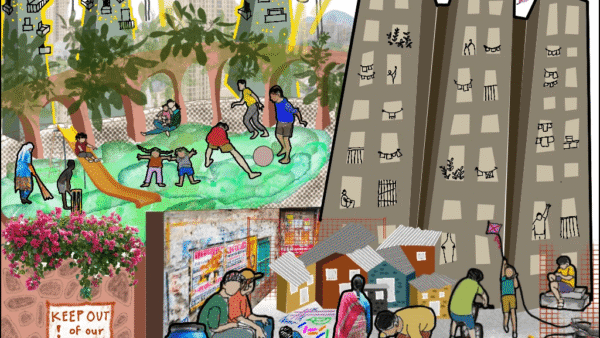

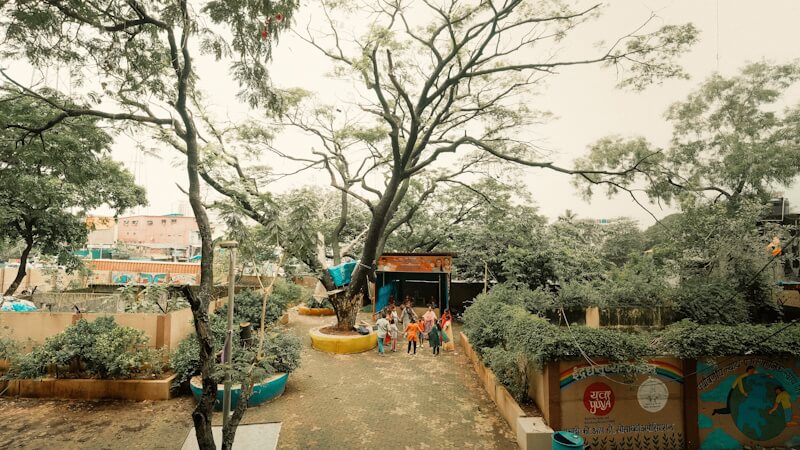
On June 5, 2026, children in Lallubhai Compound, a Resettlement and Rehabilitation (R&R) colony in Mankhurd, Mumbai, celebrated World Environment Day in Indradhanush (Rainbow) Garden[1], a 13,000 square feet greened, open space which they co-designed and are the caretakers and users of since 2023. The cool breeze from the trees, the smiling faces of the children and the women, pointed to the excitement of celebrating the fact that they could nurture a space like this, which, till three years ago, was derelict, strewn with trash, and used sparingly.
The use and creation of this space prompts a question: is it only a matter of developing such spaces, or is there a more foundational issue with how statutory rules and building bye laws such as the Development Control Regulations (DCRs), shape the built environment and, in turn, reshape the experience of childhood? We argue that the built environment of R&R sites does not merely accommodate displaced populations but actively shapes childhoods through the imposition of standardised building practices, underprovisioned social infrastructure, and a lack of institutionalised processes and structures to improve R&R housing.
While DCR 33(10) broadly applies to slum rehabilitation in Mumbai, Clause 3.11 applies specifically to slum rehabilitation buildings built for slum households displaced by vital public projects. In Mumbai, R&R buildings began to be built in the late 1990s; in 2026, most of these buildings are 20 years old or older. They have shaped more than one generation of children and continue to influence the childhood experience of the current and future generations –- their right to education, their right to play, their right to a safe, healthy environment, and their right to protection and participation.
This essay draws on the findings from a 2019 study by Youth for Unity and Voluntary Action YUVA, My Home, My Hopes: Impact of Resettlement and Rehabilitation on Lives of Children in Mumbai[2] (henceforth referred to as the study), to demonstrate how the built environment shapes the lived experiences of children. In doing so, we move beyond the immediate experience of displacement to examine how children’s opportunities for development are reshaped through prolonged residence here. And argue that DCRs are not neutral but produce a form of conditional inclusion, where access to formal housing coexists with the erosion of essential developmental opportunities for children.
When regulation impacts childhoods
The DCRs, as legally stipulated guidelines, are clear about how many units to build, on how much land, and what is permissible to build. However, in doing so, they simultaneously impose constraints on essential requirements for living. The increase in Floor Space Index (FSI) for slum redevelopment is a case in point where amendments to the DCRs from 1991 to 2018 increased the FSI from 2.5 to 3 to 4 to incentivise private participation in rehabilitation projects.
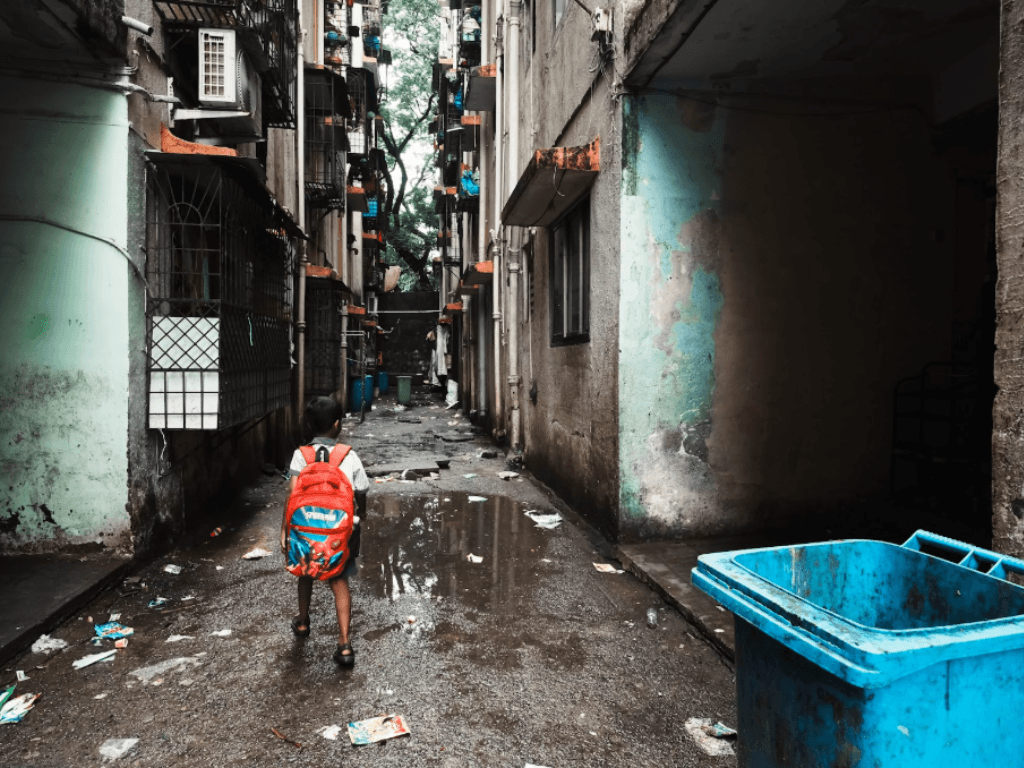
This translated into higher residential densities, permitting approximately 500-650 tenements per hectare. The impact of higher densities, the need for proportional increase in amenities, and the pressure placed on common infrastructure have been strongly argued (Patel, 2013). For children, the study showed higher densities and their consequences on strained/poorly provisioned amenities are particularly significant. Play is integral to the overall growth of children. However, in R&R colonies, the lack of open space, coupled with maintenance challenges (linked to widespread substance abuse, lack of space for parking and garbage disposal), has led to exclusion of children from accessing open spaces for play.
There is a systemic shift towards indoor play and an increase in online gaming and mobile use. The study findings highlight that 31.5 percent of children surveyed did not play; 59.6 percent cited lack of open space in the colony; maximum number of parents stated the children play in the corridor (36.9 percent) and at home (12.5 percent) and the least number of parents reported that their children play in an open space (11.2 percent). The lack of adequate and safe play infrastructure was a concern amongst children and parents and influenced the choice of location for play for children of different age groups.
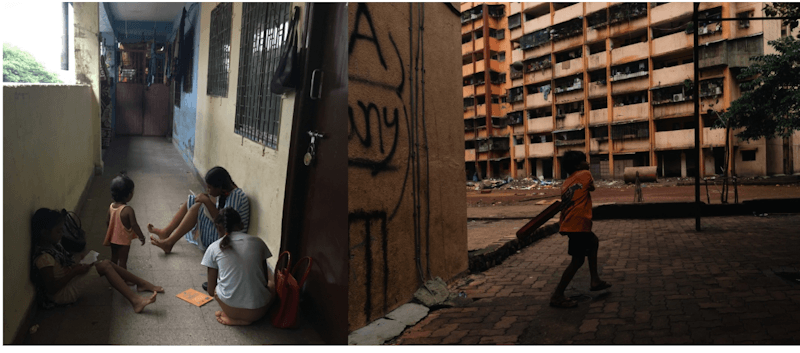
These reflect the spatial consequences of planning frameworks that prioritise maximising residential units within limited land parcels at the cost of forgoing allocations for open spaces. The 2018 DCRs provide special concessions for the construction of R&R buildings, which impact the requirements of basic infrastructure, open spaces, light and ventilation. For example, the regulations mandate that when R&R buildings are located along a nullah (stormwater drain), the marginal open space along the nullah will be 3 metres from the nullah’s edge; the distance between any two buildings 32 metres in height shall not be less than 6×6 metres; and only eight percent of amenity open space needs to be maintained at ground level. The incentivised FSI coupled with these concessions has resulted in poorly serviced, high-density, poorly lit and ventilated living conditions.
The limitations imposed by the built environment also shape access to another critical dimension: education. Education fundamentally shapes a child’s overall development and enables socio-economic mobility. The study found that on average, the majority of residents (60.5 percent) of R&R colonies did not complete high school. Therefore, for children, there are generational educational challenges that they also have to overcome, in addition to the barriers that arise due to relocation and constraints of living in R&R housing. Research on such colonies in Mumbai has consistently highlighted the educational disruptions experienced by children following relocation (TISS, 2009; Sharma, 2010).
The YUVA study found that 70 percent of children experienced interruptions in schooling for up to six months after relocation, while around 10 percent dropped out permanently; one-third of the children surveyed had access to school within two kilometres from their residence, and many reported longer travel times and increased educational expenditure after resettlement. These findings suggest that educational disadvantages in accessing education in R&R colonies is not only a consequence of poverty but equally shaped by planning norms and decisions including the location of the rehabilitated housing, education provided there, and the amenities that the DCRs permit.
These educational challenges are closely linked to the planning framework. Clause 3.11 of DCR 33(10) that facilitates the relocation of project-affected households, makes provisions for residential rehabilitation; however, it does not adequately account for the educational infrastructure required for large resettlement colonies housing thousands of residents. While amenity spaces are mandated under the regulations, the provisions remain limited and are largely conceived as spaces to be accommodated within residential tenements. Thus, schools, anganwadis, health centres, and community facilities are frequently accommodated within spaces originally designed as residential units. The regulations do not differentiate sufficiently between neighbourhood-level (in situ) rehabilitation and large peripheral resettlement colonies, where demand for schools and other social infrastructure is considerably greater.
This regulatory approach becomes visible in most large R & R colonies. A case in point is the one at Vashi Naka, Chembur, which houses more than 6,000 households. Land for a municipal school has been reserved in both the Development Plan 1991 and 2018, but this plot was never developed. As of 2026, there is limited access to proximate government schools and inadequate public transport connectivity. Two private school functions with residential tenements.
In many R&R colonies, private and government schools operating within residential or commercial tenements are a common practice. This leads to cramped classrooms, insufficient ventilation, with no recreational spaces, along with the absence of facilities commonly associated with learning environments that are supportive. While whether children are enrolled or not in school is an issue, so is the lack of quality educational infrastructure available to them.
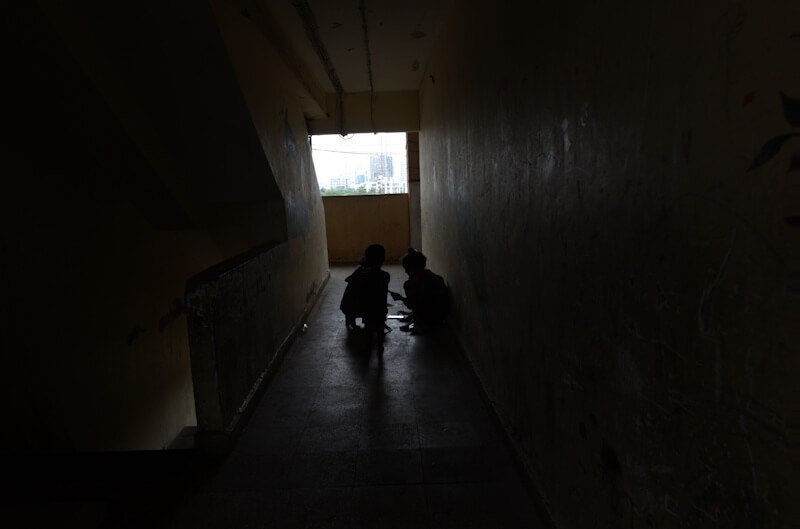
The educational consequences of relocation are not limited to temporary disruptions in schooling or attendance alone. When educational infrastructure is treated as a secondary concern, instead of a central component of rehabilitation planning, this risks reproducing generational educational inequalities. As demonstrated through examples of play and education, the difficulties faced by children in R&R colonies are not accidental, nor are they solely the result of poverty and displacement. Rather, pre-existing generational inequalities are reproduced through planning regulations that determine density, amenities, educational infrastructure, and open space.
The DCR 33(10) 3.11, therefore, does more than regulate buildings in Mumbai; rather, it actively shapes the social and physical environments within which children grow up. The developmental challenges that have been documented in rehabilitation sites are an outcome of planning decisions that prioritise redevelopment volume and housing delivery without ensuring a corresponding investment in social infrastructure. The consequences can be seen in three interconnected domains of children’s lives — access to education, opportunities for play, and their everyday experiences of safety and well-being.
Therefore, children’s developmental needs must become a central consideration in planning and rehabilitation policy rather than an afterthought.
Conclusion
The most demanded infrastructure (53.6 percent) by children in 10 R&R colonies surveyed was open space (playground/ garden). This is telling of a child’s inherent need and desire to be out in the open. Civil society organisations and private agencies have responded to this and made attempts to develop open spaces, recreational spaces and also supplement the educational infrastructure. The greening of community-identified locations is done with the perspective of reclaiming open spaces for children and to counter the heat island effect due to poor design and ventilation, and the concretisation of existing public open spaces (Dulari, 2024; YUVA, n.d).
Indradhnush Garden in Lallubhai Compound and Ek Aasmaan Tale[3] in Natwar Parekh Compound demonstrate how even in extremely challenging circumstances, there are small sustained steps to move a step closer to the dreams and aspirations articulated by the children — to have a garden, playgrounds, libraries, and maybe someday a swimming pool, games room, music and dance classes and much more in their colonies.
The reason that the findings of the 2019 YUVA study continue to be relevant is that infrastructure and governance in R&R housing have not yet changed. While DCRs are foundational to determining the limits of the built environment, institutional processes such as management of infrastructure vis-à-vis the capacities of co-operative housing societies, the roles of the Brihanmumbai Municipal Corporation and Project Implementation Agencies are blurred, and hence even the development and management of infrastructure remain wanting.
References:
- Parmar, D. (2024). Hands Together: Nature-based Placemaking in an Urban Poor Settlement. The Journal of Public Space, 9(2), 185-198. Retrieved from https://www.journalpublicspace.org/index.php/jps/article/view/1792
- Patel, B. S. (2013). Life Between Buildings: The Use and Abuse of FSI. Economic and Political Weekly, 48(6). Retrieved from https://www.epw.in/journal/2013/06/special-articles/life-between-buildings.html
- Sharma, R. N. (2010). Mega Transformation of Mumbai: Deepening Enclave Urbanism. Sociological Bulletin, 59(1), 69–91. DOI: 10.1177/0038022920100104
- Tata Institute of Social Sciences (TISS), (2009). ‘Base Paper’ for Seminar on ‘Exploring affordable housing solutions for Mumbai’, 25 March 2009. Mumbai: Tata Institute of Social Sciences
- Youth for Unity and Voluntary Action (YUVA). (2019). My Home, My Hopes: Impact of Resettlement and Rehabilitation on Lives of Children in Mumbai. Navi Mumbai: Youth For Unity and Voluntary Action (YUVA). Retrieved from https://yuvaindia.org/wp-content/uploads/2023/03/My-Home-My-Hopes.pdf
- Youth for Unity and Voluntary Action (YUVA). Climate Justice, [n.d. online]. Available from: https://yuvaindia.org/climate-justice/
Richa Bhardwaj is Senior Manager- Programmes at Youth for Unity and Voluntary Action (YUVA) where she works at the intersection of grassroots practice, urban research, and inclusive development. Her work focuses on poverty, urban planning, and governance, with particular interest in how policies and planning processes shape the lives and rights of marginalised communities in Indian cities.
Marina Joseph is Associate Director at Youth for Unity & Voluntary Action (YUVA). She works on issues of habitat, informal work, and urban governance.
All Photos: Youth For Unity and Voluntary Action (YUVA)