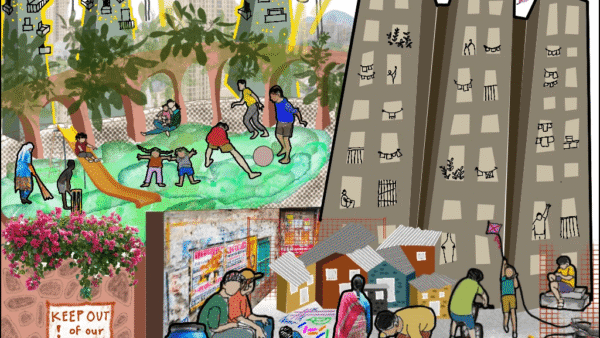

Santosh is a gig worker on his way to deliver an early evening snack order from a restaurant in Bengaluru’s Indiranagar to a business park in Domlur, roughly 2.5 kilometres between them. Traffic is backed up but inching forward, egged on by impatient honks and exasperated sighs of exhaust fumes fill the air. Santosh feels that everyone is desperately trying to run away. He would too, if he could but ‘paapi pet ka sawaal hai’.
It’s a good thing, this traffic, around these gated buildings. If these places were not so difficult to access, these folks would simply walk across and grab a snack, and he would be out of a job. It’s hotter outside these office buildings than on a road with shops and trees. He adjusts his helmet and revs his bike. For a Friday afternoon, the traffic isn’t so bad. He can easily make at least two more runs before dinner orders start coming in. He thanks his Gods for the ever- hungry city people.
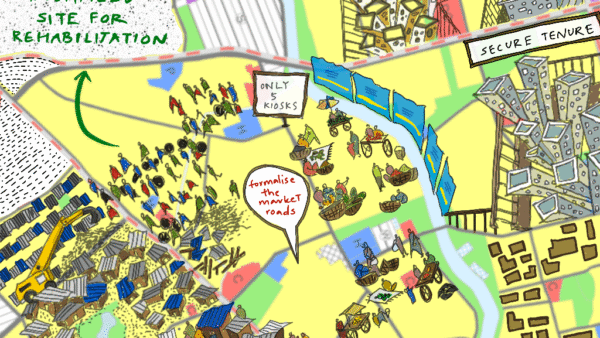
Across the road, Shantamma wipes the sleep out of her eyes, heaves the last of her metal canisters onto her food cart, and peers into the side street. Cab drivers park here to catch a quick evening meal before starting their far-flung drops and night shift pick-ups. This evening, the menu is vegetable pulao, boiled eggs and medu vadas. She scans the traffic for her husband. He had gone back home after dropping her and the food to pick up the ten-rupee packs of buttermilk for her customers.
Shantamma’s regulars have been requesting her to move her cart to the other side of the road. With the new dividers, it is no longer possible to just walk across the road to her cart. The new foot-over bridge is a long walk. A car ride means an extra 20 minutes to take a U-turn and come back. She may lose this spot too. With a new building being developed on the plot behind her, she is sure she will soon be evicted. She pushes her worries to the back of her mind, as her first customer arrives.
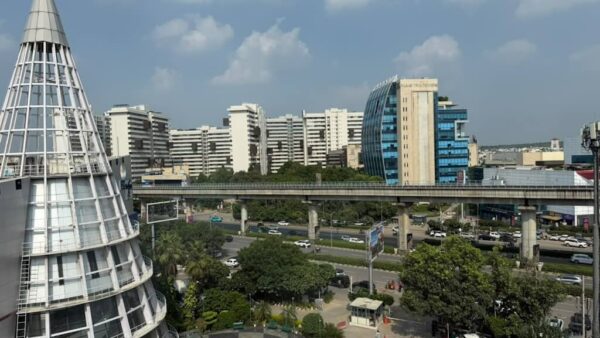
Seated in a cab, Sharanya looks up from her smart phone and stares blankly at the food cart on the footpath. Behind it, there’s a clump of dusty bushes and a steel skeleton of a building. Building technology that makes day lit- barrier free internal spaces possible. It’s a matter of time before another boring façade comes up. She turns her gaze in the other direction. The setting sun is glinting off the grey facades of the business park buildings.
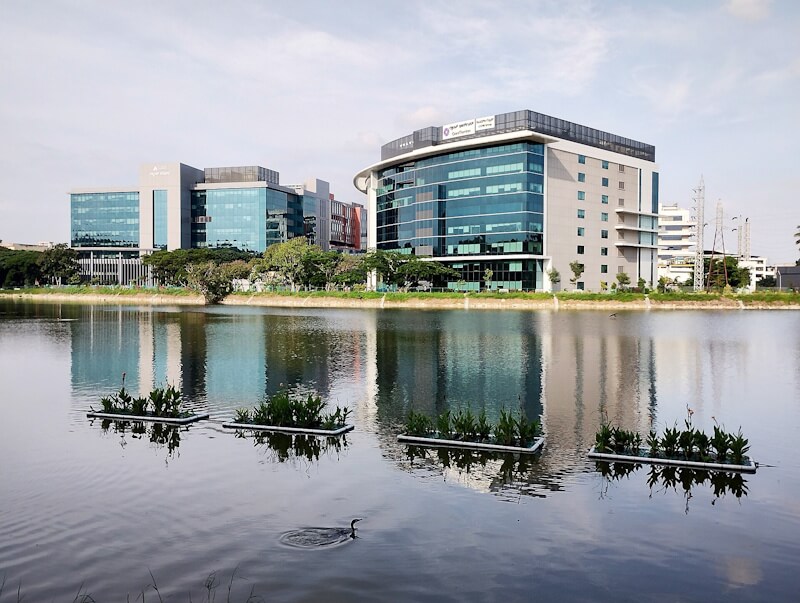
Photo: Wikimedia Commons
Except for the reflection of the evening sky, there’s not much to look at. All business parks look the same. As the traffic lights change and her cab moves ahead, a line of delivery guys zip past her. Further ahead, where there once used to be visual relief in the form of greenery, a new wall has been built cutting the view. With a sigh she turns back to her screen.
In the neoliberal imagination and construction of Bengaluru, the food delivery guy, the street cart food vendor, and the aggregate taxi driver have little to call their own or feel belonged.
Neoliberal remodelling of Bangalore
Since when did the city once known for its gardens start getting so alienating and disquieting that most people are not able to endure it for extended periods of time without wanting to escape? With its PSUs and defence enclaves, Bengaluru was used to walled enclosures and gated colonies much before it became an IT- hub and global city. But back in its Garden City days, the city balanced its gated enclosures with open, tree lined, planned neighbourhoods like JP Nagar and Jayanagar.
Under the Smart City Area Based Development, planned in 2017, some of the high-end neighbourhoods of Bengaluru saw neoliberal anesthetisation but the TenderSURE pilots that prefigured it, there were already guidelines laid out on how to include street trees and organise under street services. Its biggest contribution was making the pedestrian realm a dominant and unmissable part of the visual cityscape, ideas that other cities have picked up. Church Street[1] and Gandhi Bazaar redevelopment[2] are some products of these efforts – contested but adding some vitality and new life to public spaces in the city.
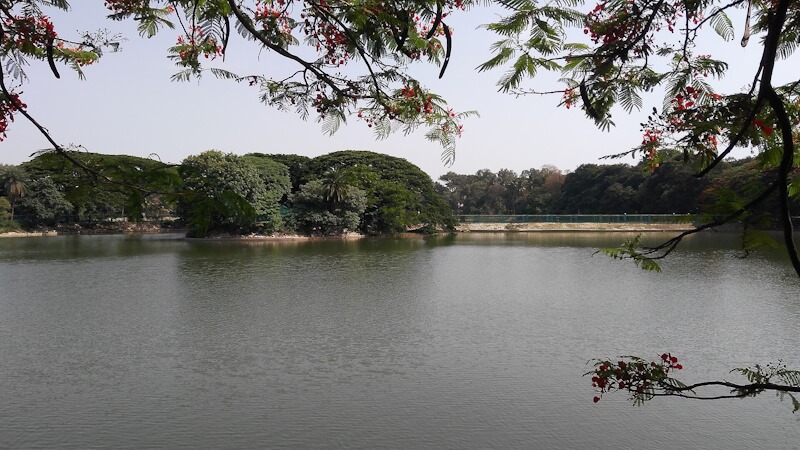
Photo: Wikimedia Commons
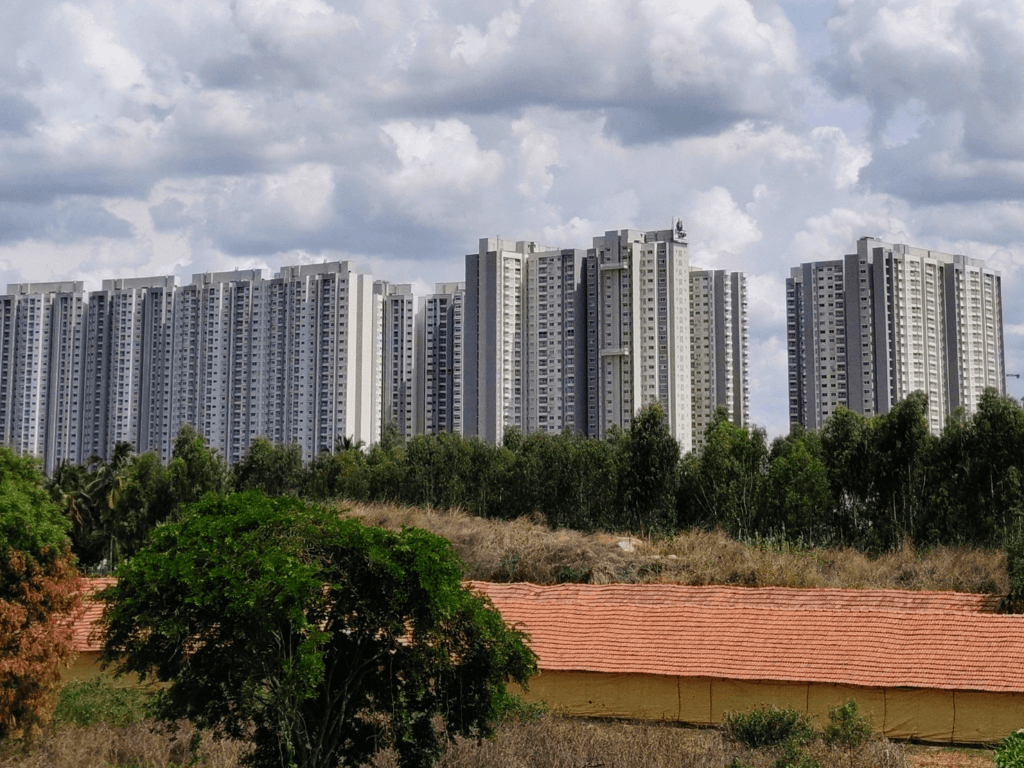
Globalisation saw building typologies like the business park and gated communities take root and grow, mostly on the peripheries of the city. They cropped up on lake beds and created an insatiable demand for housing. The city responded by encroaching on the urban commons including the natural drainage links not only cutting off social and ecological flows – access, storm water, green areas, lakes, and livelihoods – but also dumping waste heat, energy, runoffs and sewage into public spaces. This triggered the need to engineer nature rather than work with it. Incidentally, some of these business parks are platinum rated green buildings, efficient machines and appropriate for their particular setting and function, which is ironic from the point of view of the effect they had on the city systems.
Architecture of walls
Neoliberal capitalism prioritises privatisation and individualism over social welfare. Urban planning takes a back seat and architecture drives the growth of the city but of a particular kind that favours interiority and fragmentation. The urban fabric of the city is increasingly lined with walls, punctured with gates, security check points and cavernous entrances to parking facilities. Accompanied by transportation infrastructure that doesn’t seriously bother itself with urban design and last-mile connectivity, the city feels disjointed and illegible.[3]
Neoliberalism in architecture manifests as market-driven urban development, prioritising privatisation, profitability, and investment over communal needs and public space. Neoliberalism itself favours high income groups and their bids to attract more capital and growth. The obvious built form expression of that intent is the construction of flyovers which tries to shrink travel time for some at the cost of elongating it multiple times over for others.[4]
It creates uncrossable roads — one side of a neighbourhood cut off from the other side opposite and forests of metro pillars and flyover pylons. For the pedestrian, this means longer walks; for two wheelers, longer runs with larger higher speed vehicles, facing dust, heat and emissions. While flyovers are flanked by gigantic billboards, facades of buildings, especially at junctions, are often lit up by neon advertisements, adding to the confusion and sensory overload.
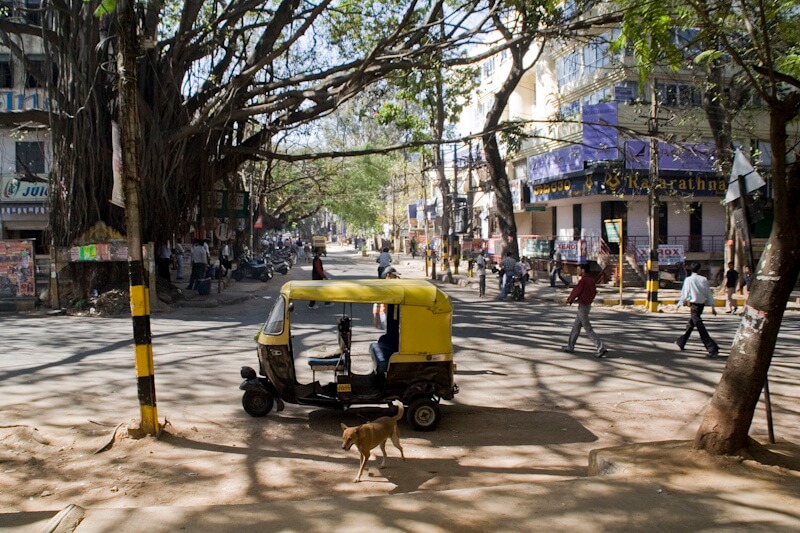
Photo: Eirik Refsdal/Flickr
The design of buildings and the built environment, particularly in high-income residential and aspirational neighbourhoods of Bengaluru seem to say that we want to own a piece of this place and capture its economic value but we will not engage in placemaking efforts needed to sustain it. This holds true for other systems as well – the social, the community, and the ecological. Walkability and cycle-ability are held together by a chain of individual design decisions that property owners take to co-create the public realm.
Its absence renders a footpath and other urban design elements as unsafe and unusable. Internal roads and neighbourhood streets are lined with buildings that in their bid to maximise rentable floor area, end up looking like walls. This is ironic as architecture through the ages has always served to hold street edges and contribute actively to the public realm in the form of colonnaded walkways, shaded arcades, shopfronts, steps, seating and many other affordances.[5]
Not only the business parks and gated communities and their walls, concrete conduits for storm water drainage and highspeed trains are adding more walls where there used to be green verges and softer edges. In the non-places that these are creating, the most dominant and unavoidable built environment element that meets the eye (and the senses) are barriers. This is the view from the road that millions like Santosh, Shantamma and Sharanya have to endure on a daily basis. In ancient cities, the fortress walls were meant to keep the enemy out. In the neoliberal city, the city dweller is made to feel like the enemy and this has deep psycho-social effects.
An alternative measure of a city’s performance
The GDP is one measure of the success of the city but what if one could measure performance in terms of what it makes people do and be[6] and how it makes people feel.[7]
An optimum amount of enclosure makes us feel safe but where the city becomes an endless maze of barriers, it becomes stressful and exhausting. As an urban affordance,[8] it keeps us out of certain spaces and also evokes a sense of insecurity and fear because we do not know what is lurking behind or around these walls.
Hard edges[9] make you feel disconnected and separated while the inability to cross over frustrates and angers us. Billboards for gated, piecemeal utopias add to cognitive tension. Constant struggles with water shortage, urban floods and congestion, is draining and dispiriting.
Many people try to get by holding an indifferent, blasé attitude[10] but the overall effect of living in such an inhospitable city surely compounds over time in ways that have not yet been studied.
How can the neoliberal city be ‘sustainable’?
A sustainable neoliberal city is an oxymoron because neoliberalism is committed to limitless growth where natural systems have finite limits and capacities. Neoliberalism also espouses a free market which means minimal governance or regulatory safeguards. So far, the political economy of urban development has been unconvinced by sustainability arguments unless we collectively find a way to repackage sustainability into a serious value proposition supporting growth. Here are some ideas on what can be done:
- Sarkaar / state – Implement all existing environmental mandates without allowing any workarounds. Sujalam, suphlam, malayaja sheetalam (translates as suffused with water, bountiful with fruits, with a cool breeze blowing but can also mean life affirming and heat proof) and serve as a vision. To this end, stop adhocism in city expansion and conduct state-mandated statutory urban planning.
- Bazaar / market – Make sustainable urban design attractive to capital/ists and eco-social connectivity as lucrative a proposition as vehicular transport related accessibility by making them a part of societal aspirations. Flood-free business parks, institutional campuses or gated communities that boast upstream and downstream ecological connectivity. Link it to the risks posed by the tapering off of the demographic dividend and skilled labour lost to non-communicable diseases and aging. Right now, AI seems to be the answer (Narayan Murthy has been quoted as saying that the era of mass hiring is over) but all the AI the world needs is yet to be built
- Samaaj / society – Scout the interstitial and co-create social and ecological third spaces. In the current form of the neoliberal city, the pleasanter views are coveted but the underlying connections are overlooked for short term economic gains. Third spaces rebuild connections and cohere around shared interests, starting with community music circles, kitchen gardens, microgreen terraces, gathering around natural processes like composting and bio swales, Ashwath kattes[11] and neighbourhood shrines, particularly those that afford interactions with non-human species, are where all the layers of the urban fabric still comes together, however threadbare and bedraggled.
Finally, as an individual, soften your heart to those who cannot afford to move in cars but are forced to make a street-based living and if you own any form of a liminal space or are designing a one, turn it into a mural or a selfie point. Nothing transcends boundaries and counters ‘placelessness’[12] than the shared experience of urban public art.
Anuttama Dasgupta is an urban development consultant and specialises in capacity building and urban design. She is an Associate at Swastik Harish and Associates where she provides consultancy on research, leadership and services for the urban development sector.
Cover photo: A view of the Bengaluru skyline. Ram Kumar/Pexels