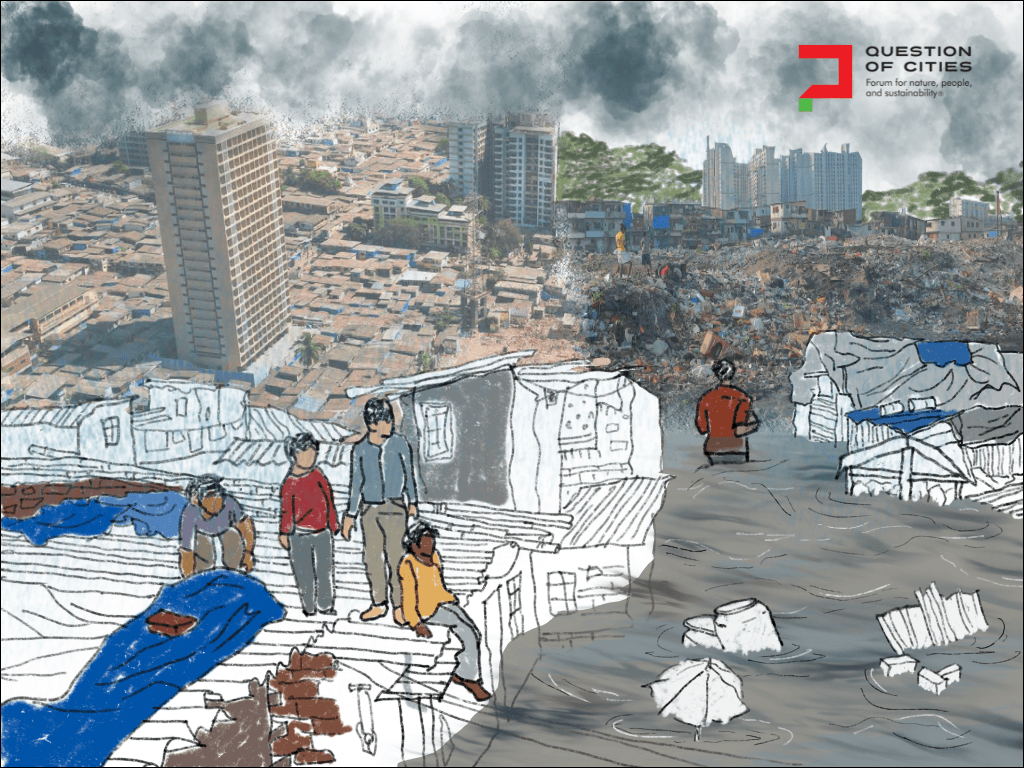

For over 42 long years, Radha and Krishna have been with my family, taking care of our comfort and house, and aging with us. Naturally, they deserve reduced workloads which we took care of to an extent. They deserve better living conditions too, better than the Prem Nagar slum in the neighbourhood of Irla, where they have lived and raised their two daughters. It has been slated for redevelopment. The first proposal was by a developer nearly 15 years ago, under the aegis of Slums Rehabilitation Authority (SRA). Since then, several developers have entered and exited the project even as the living and environmental conditions worsened—floodwater stagnates during the monsoon, sewage flows back into houses, toilets get choked.
Lately, there has been a near-complete breakdown of the basic infrastructure. Residents allege that it is a deliberate ploy by agents of developers to push people to leave so that the vacant and encumbered land is free for a high-cost real estate project with potential for high profit. When torrential rains hit Mumbai recently,[1] Radha and Krishna, like other residents of Prem Nagar, and other slums across the city, were awake all night fearing the worst. The couple’s petitions have been tossed between the SRA and the Brihanmumbai Municipal Corporation (BMC). I led a delegation to the SRA—in vain. If residents in slums are subject to dehumanising conditions, the situation is no better in SRA towers, as has been well documented.[2] The abysmal living conditions, lack of rest and perpetual stress adversely affect people’s productive capacity and social relations.
This is not accidental; this is not even the lack of planning, as many experts justify the on-going development order. This is, in fact, the intended outcome and consequence of the prevailing kind of an exclusive city-making idea that the ruling dispensation is committed to and keenly pursues. The instrument of planning was meant to be a comprehensive and all-encompassing blueprint to direct and regulate land use, built form and density through spatial planning, physical infrastructure and the environment for the growth of the city and ensuring people’s well-being. In the hands of planners—and administrators with political backing now committed to privatisation —land use and spatial planning have been given a go and city making has been reduced to identifying profit-oriented projects and land parcels which are connected by mega-budget roads or freeway projects. Ensuring a dignified quality of life and the environment for millions is not the purpose of planning any more.
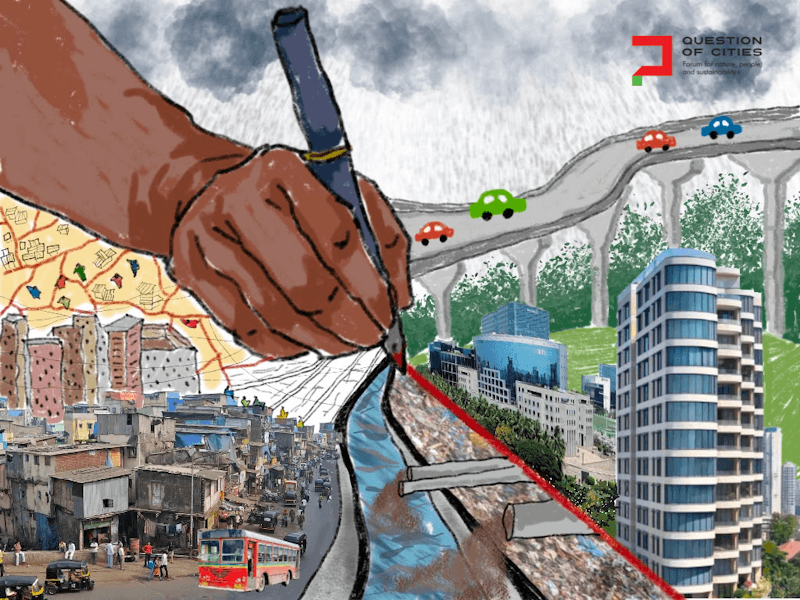
In Mumbai, the deliberate undermining of spatial planning is starkly evident—buildings and construction anarchy without open spaces,[3] humiliating living conditions of more than five million residents of slums,[4] the appalling lack of public or social housing, the emphasis on road projects when the majority commute by public transport, the declining open spaces,[5] the capture of natural areas like the protected Sanjay Gandhi National Park for construction, the abysmal condition of the city’s rivers and water bodies. It is most acute in housing where, for more than five million people, slums are the only available alternative because the development plans seldom enable public or affordable housing, on ownership or rental basis.
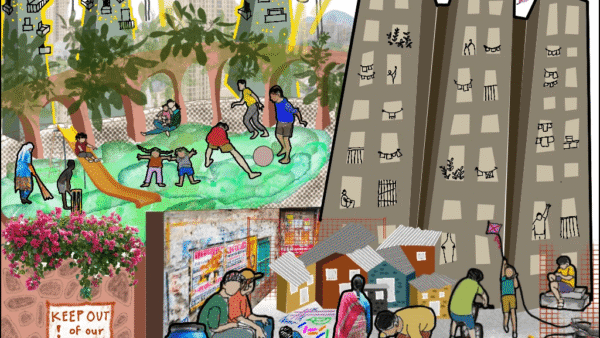
Instead, successive governments, through the city’s Development Plan and SRA, promoted private developers to blatantly take over slum land, push people into untenable high-density ‘vertical slums,’ and profiteer. Politicians who supervise planning often nurse direct or indirect interests in land use and construction. The existing reality is that, in recent years, Mumbai’s housing stock increased but in the high-end segments, land was created or freed but for exclusive projects. But millions—including 25,000 Safai Karamcharis and other workers of the BMC and vast contingents of police force who keep the city functioning, and over 2.5 million in dilapidated buildings—continue to live in deplorable conditions in slums or redeveloped ‘vertical slums.’[6] On the redeveloped plots, slum residents are crowded into one-third of the land while two-thirds is allowed for commercial sale on the pretext of cross-subsidising the substandard SRA towers. This redevelopment policy undermines the utilisation of land-use potential for current and future demands, in affordable housing, amenities and open spaces.
This humiliating and dehumanising life forced upon millions is, simply put, structural abuse by planning, the intended outcome of planning rather than its failure. This is not limited to Mumbai though the city presents the starkest evidence of all. Similar situations prevail in cities across India.
The continuing crisis
The human and environmental crises in our cities today have been caused by planning. The continuing destruction of natural areas, the indiscriminate land-filling, the on-going concretisation of rivers and water courses, the unscientific and indiscriminate felling or trimming of thousands of trees despite the severity of climate crisis have been, or are being, done by planning. What is the significance of a city that fails to take care of its people, places and the environment? What good are its plans?
The Bombay High Court observed recently that the BMC did not value the lives of people.[7] In the name of development, successive governments have systematically broken down the city into disparate and conflicting fragments, severing the relationships between people, fragmenting the relationships between people and natural areas. These processes, the intensifying individualisation, is furthered by the absence of comprehensive all-inclusive spatial planning. The city’s plan is reduced to making land available for exclusive high-cost construction and isolated projects. This approach to planning has manufactured social and ecological crises—and continues them.
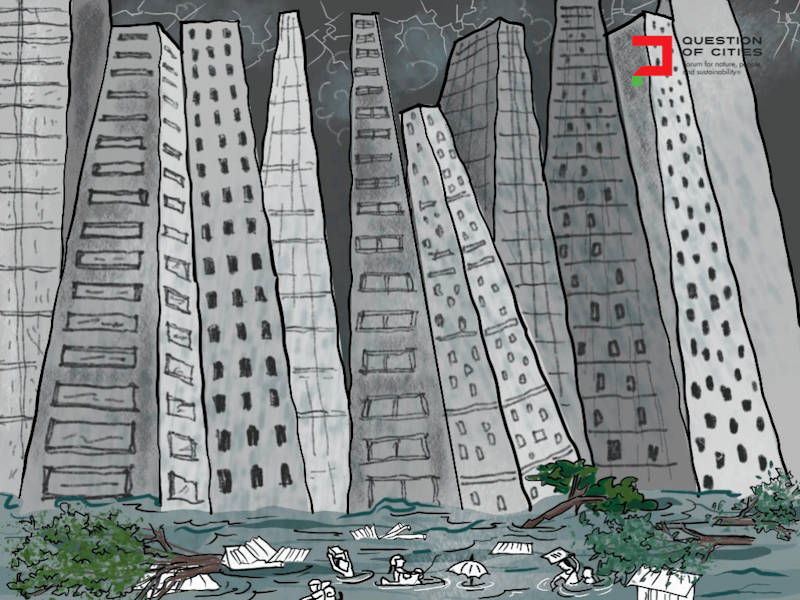
Whether plans for greenfield cities like Mumbai 3.0[8] or redeveloping slums and slums clusters like Dharavi, there is increased privatisation of land and services, but these plans are hardly ever in the public domain, leading to public discussions. Rather, it is abundantly clear that the state government is fulfilling an agenda which includes:
- Enabling privatisation and take-over of public lands by private entities to promote private profit rather than fulfil critical public needs of social housing, accessible amenities and public transport.
- Deliberate and planned push of millions into worsening quality of life, health and well-being, and social and environmental connections thus perpetuating humiliation and indignity.
- Creating and encouraging untenable density of the built environment, especially in rehabilitation buildings—that dominate the city landscape, which are without amenities and open spaces, conveying that these residents are an impediment to the city that the government wants to make.
- Ensuring that people have no say in matters relating to their housing and neighbourhoods. For example, the Maharashtra government’s recent declaration that people’s consent is not required for redeveloping their settlements.
- Establishing a network of structures between the government and private capital, between the government and privately-controlled think tanks, between the government and selected NGOs for the city’s governance.
In all of this, city planning in its larger perspective and purpose is given a go; even the plans that exist are skirted around in the pursuit of profit maximisation for a few individuals or corporates. The progress and development of a city is judged by the number of projects, irrespective of their relevance to the majority or impact on nature and the climate change extreme events.
The way forward: Three imperatives
When it is clear that the prevailing planning exercise and the resulting plans have yielded cities for an exclusive few and deepened neo-liberalisation while condemning millions to structural abuse, the alternative must start from the realisation of its flaws. Three fundamental shifts must be made.
Existing reality-based planning
Planning can no longer be contained in exclusive rooms and be a top-down exercise with little relation to the ground realities. To remedy this, the recognition and integration of all the existing realities—people, places, geography of the land, natural areas—is essential. This calls for inclusion of not just the poor but substantial sections of the middle class, the minority communities, women, construction workers, young people, migrant workers, and historically discriminated communities who together constitute about 75 percent of the city’s population into the planning exercise, through their groups and movements.
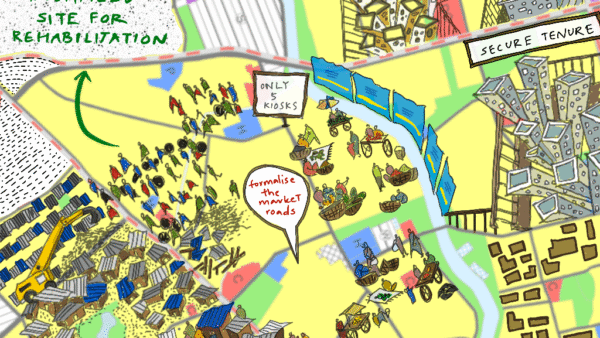
Planning must begin with collective mapping of the existing land occupation patterns, which includes slum and pavement dwellers, and the vast array of informal economic activity like hawking. When existing realities form the basis of land use and spatial planning, and the exercise is pursued in an open democratic manner, planning becomes an effective tool of intervention for equitable, just and environmentally sustainable cities. Planning based on existing realities is the antithesis of the current approach which is oriented towards free-market and profit-driven land-use, which tragically excludes vast numbers of people and continues the abuse of nature.
Such an approach, on the one hand, will enable the re-invigoration of the internal efficiency of people and places and, on the other hand, consider the geography of land and conserve its geomorphology and natural areas. These will yield a sustainable place-based structure of the built form—buildings and open spaces, thereby breaking the enforced uniformity —that are otherwise imposed by a centralised power structure. Environmentally too, the existing reality-based participatory planning approach has the potential to create walkable, healthier, climate-responsive, people-sensitive neighbourhoods. Importantly, this approach can realise the true potential of area or place-based participatory planning.
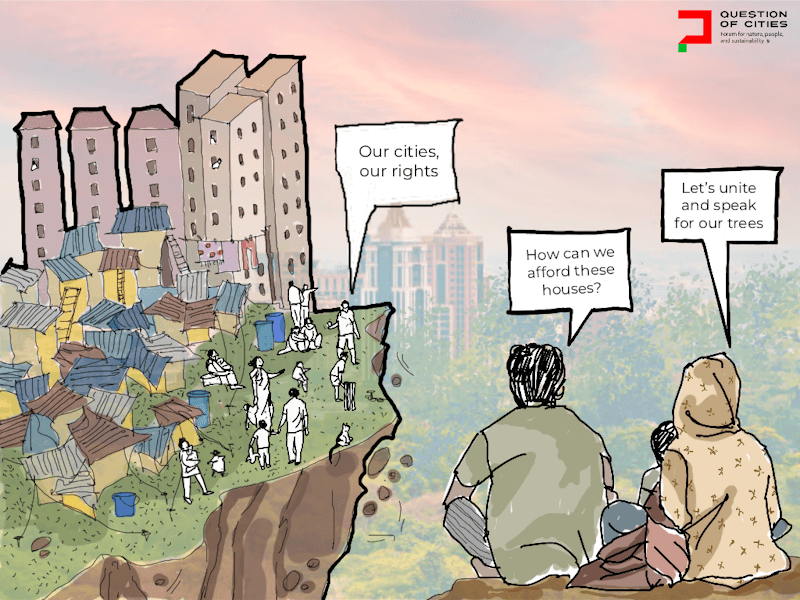
Land use equity
The key objective of spatial planning must be land use equity. For this, land must be considered a common property resource and not privatised under any pretext—not even under the guise of the much-celebrated PPP mode of development under which public interest projects are colonised by private agencies. To start with, the prevailing land occupation patterns must be collectively mapped, not with the objective of displacing people but to recognise the existing potential, and enhance it through inclusion, restoration, retrofitting and rebuilding as may be necessary.
Land use equity must be at the heart of land use planning. It calls for fair and inclusive distribution or allocation of land so that benefits are not concentrated in a few hands while the majority is left to deal with fallouts. Land use equity would also demand that cities are planned and built with nature—as opposed to hard engineering and containment—which demands that all natural areas and sensitive ecological conditions are recognised, conserved, protected and re-invigorated through nature-based means and integrated with the built-up areas. Planning with this approach gives cities a chance to deal with the consequences of the climate crisis and repair people’s relationship with nature.
An honest assessment in Mumbai, popularly called a land-starved city, shows that there is abundant land, and internal reinvigoration potential, to take care of current demand and shortfalls in housing and amenities if land use is just and judicious, and based on equity principle rather than geared towards speculative investments and business turnover. This can make better cities for all.
Reclaiming rights
Spatial planning, based on existing realities and done in an open democratic way, would support and facilitate the achievement of multiple rights for all—land use, civic services, amenities, infrastructure, open spaces, healthy environment, the Right to the City,[9] and above all, human rights. This way, a rights-based city planning would get established and open up the possibility for policies and laws based on people-place-nature.
While no one in power openly counters the rights-based approach to city making, the prevailing planning paradigm and its implementation surreptitiously undermine even the existing rights of people in cities. In the absence of a rights-based discourse, planning and city making turn people into ‘beneficiaries’ at the mercy of the government or the municipal corporation or private agents. Equally, the deliberate denial of basic rights promotes social tension, thus undermining the very idea of democracy, and vitiating social and political environments.
The rights-based approach to planning and development must be reclaimed by people’s movements and campaigns. Its erosion which markedly began with the liberalisation-privatisation in 1991[10] has metamorphosed into a sweeping privatisation of public land, public amenities, and increasing private enclaves such as gated complexes or townships. These undermine the very definition and purpose of cities where people were meant to realise equality, liberty and freedom.
In conclusion, the paradigm shift in planning calls for a paradigm shift in the ideology of neo-liberalism and privatisation. Adequate land and resources, and development potential are available to urbanise for the general good and sustainable environment, but this will come to pass only if planning is inclusive of the existing reality; considers land and resources as common property; keeps equity-based land use, rights, and well-being of the majority, and nature, at the centre of the exercise. This calls for a new planning order.
PK Das is an urban planner, architect and activist with more than four decades of experience. He has been working to establish a close relationship between his discipline, urban ecology and people through a participatory planning process. He has received numerous awards including international ones for his work in revitalising open spaces in Mumbai, rehabilitating slums and initiating participatory planning. He is also a trustee in the Participatory Urban Design and Development Initiative (PUDDI), and a founder of Question of Cities.
All illustrations: Nikeita Saraf