
Mumbai’s Slum Rehabilitation Authority (SRA) scheme, established in 1995, operates on the principle of giving real estate developers the right to develop and sell market-price housing on a portion of a slum site in exchange for providing rehabilitation or resettlement housing nearly free for the displaced residents of that slum. The policy put no cost on the government beyond regulation.
However, barely 13 percent of the sanctioned projects had been completed till 2013; the Maharashtra Economic Survey 2025–26 showed a total of 2,545 projects completed with about 2.75 lakh units in three decades,[1] but even in these, the houses are under-sized, improperly ventilated, and unsustainable to live in. Based on the experience from an internship with a SRA developer as well as current literature policies, this essay analyses the failure of the SRA framework.
The assertion is that the failure of SRA is not an accident but the deliberate result of the structure of the scheme. The three primary actors – the state government, the real estate developer, and the resident – have diverging objectives that the policy does not bring into alignment. The analysis identifies three points of tension – between policy design and implementation, between developers’ profits and residents’ well-being, and disparities between building completion and post-occupancy issues – and proposes five reforms to fix some of the issues without increasing government expenditure.
Framing the issue
Housing is a fundamental human right, not dependent on income level. In Mumbai, one of the world’s largest and wealthiest urban economies, an estimated 5.5 million – 42 percent of the city’s population – lived in slums, according to the 2011 Census[2] – a decrease from 2001 Census which showed 6.5 million slum residents[3] but certain poorer areas like M-East civic ward saw a huge rise in slums from 30 percent to nearly 80 percent.[4]
The Slum Rehabilitation Authority (SRA) scheme was Mumbai’s housing policy response to the informal settlements. Established in 1995, the SRA was based on the concept of developers building and selling houses at market prices on a portion of the slum site while building almost-free rehabilitation units for slum residents, with the consent of at least 70 percent residents. On paper, the scheme seemed sensible; the reality has hardly lived up to the promise.
In the first eight years till 2013, only 197 – or 13 percent – of the 1,524 sanctioned proposals were implemented.[5] Maharashtra’s Economic Survey 2025–26 showed a total of 2,545 SRA projects completed since 1995 with 2,74,076 units against the original aim of five lakh; this meant barely 9,000 homes every year. In December 2020, it admitted that 533 of the 2,131 projects had failed to take off.[6]
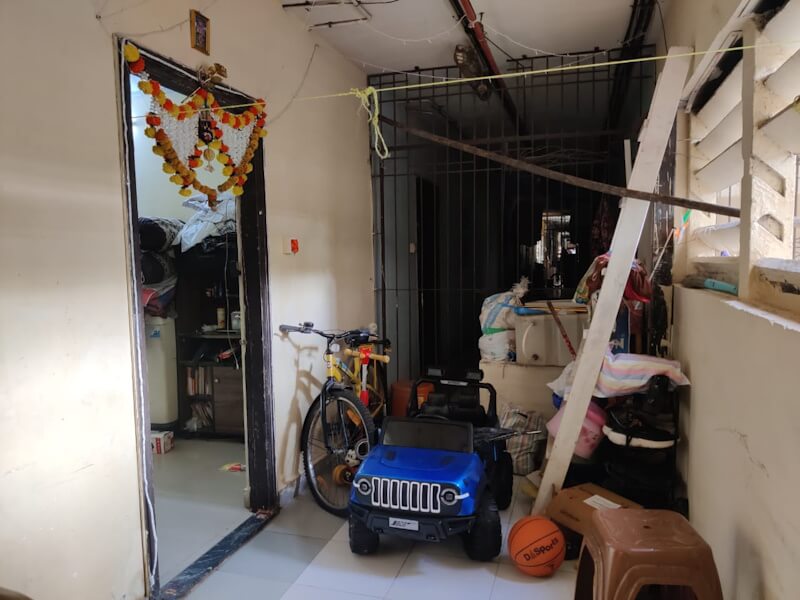
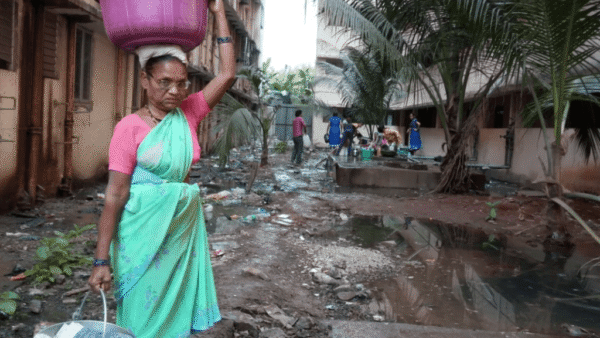
Photo: Nikeita Saraf
Importantly, on-ground research of 254 projects between 2007 and 2022, presented as a paper in Cambridge, Massachusetts, by PhD researcher Alishuba Philip this year, showed that only one-third had been completed and 29 percent did not start after approvals.[7] The findings point to a persistent problem: approvals do not mean construction and construction does not ensure rehabilitation or resettlement. The paper puts it poignantly: “eviction is immediate while the asset arrives only if and when construction is completed.”
The core argument, therefore, is not that SRA is a bad idea; it is that SRA has been subverted through the incentive structure for profit maximisation purposes, leaving its central purpose – rehabilitation of slum residents – abandoned. This essay challenges an assumption that is rarely questioned – that rehabilitation and housing construction are the same.
The nature of the problem: Actors, incentives, and mechanisms
To understand the reasons for this, one needs to identify the main players and their incentives. The state government wants to report completed projects in the annual report, and nothing else. The developer’s incentive is to minimise the cost of building rehabilitation units while maximising the usable commercial floor space – and pull in massive profits. The residents’ stake is limited to 70 percent of them signing consent and accepting the offered resettlement unit – or living in slums. Vidhi Centre for Legal Policy termed the consent process “often coercive” with “limited transparency or any genuine community engagement.”[8]
Moreover, the process of implementation itself lacks transparency. The Development Control and Promotion Regulations (DCPR) are designed to make the SRA tendering process open and competitive, but, in reality, politically-connected realty companies win contracts over and over again, regardless of the quality of design and/or previous performance (Columbia University Infrastructure Politics Project, 2017)[9]. Plans are not released in advance. Information on the status of a project is available only upon request; this takes 30 days and contradicts the very nature of the process.
Over 1,000 SRA projects were pending for 15 years, till 2019, reports stated.[10] Industry professionals, on conditions of anonymity, admitted that the SRA scheme provides access to valuable land in Mumbai and the almost-free rehabilitation slum residents is merely a small price to pay. With this approach, residents are forced into poorly designed, uninhabitable buildings which the Bombay High Court termed “vertical slums”[11] . and those deemed ‘ineligible’ are relocated 20-40 kilometres away. The slum site, however, is open for construction and profiteering.
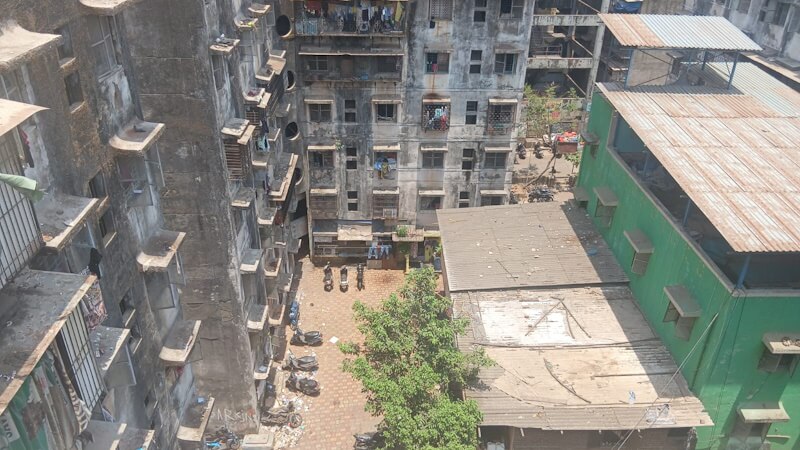
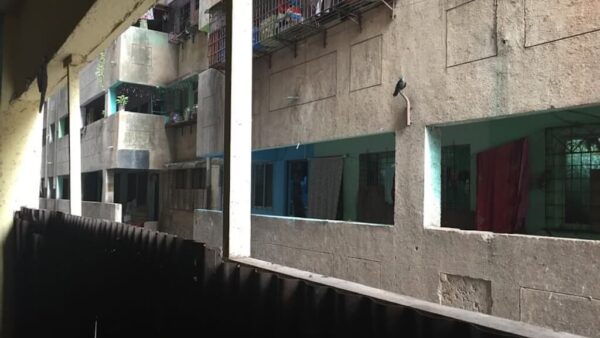
Photo: Nikeita Saraf
The money makes things worse. The state spends nothing; the developer pays upfront for the rehabilitation building and the residents’ transit rent, then earns it back by selling free-sale flats and development rights. If a developer runs out of money, the rehabilitation building is the first one to be halted. By 2022, 230 SRA projects had stalled over finances, and in 59 of them builders had stopped paying residents their rent.[12]
Points of tension analysis
Tension 1: Policy design versus implementation
The discrepancy between the SRA scheme and implementation is one of its primary contradictions. Reportage over time has shown that the main causes of delays were financial mismanagement, land acquisition conflicts, and lack of enforcement. Not only was the number of rehabilitation units constructed very few, the sanctioned projects were hardly more encouraging; by 2002, only 26,000 of 75,000 applications were sanctioned.[13] Many of the unfinished projects remained in that state over 15 years while the for-profit construction on the same site was completed in 2-3 years. At least 100 contractors reportedly discontinued rehabilitation work on their sites as of early 2017 once commercial buildings were completed.[14] Developers justify the delays but the fact is that the authority does little to regulate this.
Tension 2: Commercial motivation versus residents’ benefits
For the displaced and relocated people in India’s cities, there is little data on post-resettlement issues. But Mumbai’s SRA housing studies have shown evidence of flawed architectural design and lack of amenities leading to health problems such as high incidence of tuberculosis, breathing and respiratory issues, menstrual issues, and mental health setbacks.
The standard SRA layout are densely-situated towers, barely 3-4 metres apart, each of them featuring a corridor-block arrangement that residents compare to a train car with ‘houses’ on both sides of the unlit hallway, leading to a constant lack of sunlight and ventilation especially on the lower floors.[15] This architectural layout and design – deliberately adopted to minimise the land used for rehabilitation housing and maximise for-profit construction – has been associated with high TB rates, including drug-resistant tuberculosis, in three documented SRA resettlement colonies.[16] The health impacts do not stop there. Mental health worsens too; 60 percent of SRA residents reported loneliness compared to 16.7 percent in slums and chawls in a 2022 study.[17]
Tension 3: Physical housing versus post-occupancy services
The third tension gets the least attention in the SRA analysis, probably because it deals with the lack of amenities as opposed to malfunctioning of services provided. Most developer-led SRA units feature poor insulation, small windows, over-crowding, and lack of green space, all of which contribute to making them unliveable and, consequently, the poor health of residents.[18],[19]
These may not be strictly SRA’s responsibility given that there are nearly 10 institutional actors – developer, architects, chief engineers, the Brihanmumbai Municipal Corporation, transit camp administration, legal bodies and so on – but once the buildings are handed over, all of them step back. The developer is liable for defects for 3 years. The residents’ society gets a one-time deposit of Rs 40,000 per flat, after which the building is theirs to manage.[20] No actor is required to provide healthcare, basic services, or mental health support, and the SRA has no grievance system that actually responds.
Potential policy changes
There appear to be five distinct areas where policy alteration or changes could remedy the existing SRA developer-incentive structure without imposing an additional financial burden on the authority. To begin with, the SRA must review and reset the land apportionment of the slum site so that the rehabilitation housing is not squeezed into about 25-30 percent of the land; more land for slum residents would lead to better and liveable design of the built environment, buildings farther apart and more open green spaces. In a PIL, the Bombay High Court, which it took up in 2024 after the Supreme Court asked it to, said of the SRA buildings: “No light, no space, no sunlight and no ventilation.”[21] In May 2026, it ordered an expert audit of the Act.[22]
Then, the concept of “completion” should be reconsidered. For decades, the ‘handing over’ signifies the completion of the SRA project. In reality, however, it must mark the beginning of the post-occupancy stage of rehabilitation, if slum residents have to be properly resettled. Compulsory contribution of the developer to a fund meant for residents to receive healthcare, employment opportunities, and social services can go a long way to improve the lived reality in these buildings, regardless of the more fundamental change in land apportionment.
Third, the design and construction pipeline must be diversified. The current failure of the SRA model is not despite or due to the lack of high-quality architects and designers; instead, the existing procurement system tends to favour politically- connected or politically-invested developers and architects who may or may not be skilled in this type of housing. A recommendation I make is to let schools of architecture, non-profit design studios, and mission-driven organisations bid for SRA project designs.
Fourth, the procurement process must be made more transparent. Clearly stated and independently verified criteria of evaluation including design quality, community impact, and post-occupancy accountability could hinder the inefficient but politically-connected firms from repeatedly bidding.
Finally, the consent process should be substantial rather than be a token element. Currently, the residents’ influence on the SRA process ends with the 70 percent consent vote but there are ways to make the process more participatory and inclusive. Odisha’s JAGA Mission[23] is an example of how residents’ participation during the design and construction process can lead to positive results and fewer disputes upon moving in.
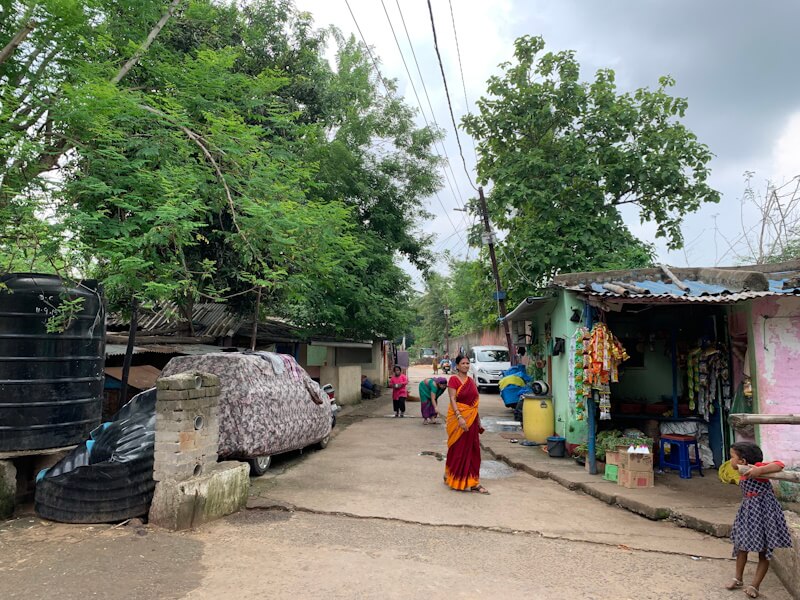
Photo: QoC File
In 2026, the eligibility criteria for rehabilitation and resettlement largely relies on cut-off dates based on Census 2011, leading to disputes. Eligibility is its own source of disputes. Only families whose homes were built before January 1, 2000 get a free flat; slum residents settled between 2000 and 2011 have to pay Rs 2.5 lakh for the rehabilitation flat.[24] To conclude, the SRA’s greatest problems lie inside the system and the framework, not outside of it. There is nothing within the SRA or outside its remit that cannot be fixed. However, the disconnect between the purpose of its basic model and implementation remains; the latter must be corrected, at the very least. The disconnect will persist till the SRA recognises slum rehabilitation and resettlement as more than simply handing out keys to poorly-designed and ill-serviced matchbox flats.
Ananya Milind Naik, an architectural designer, is in the process of becoming a licensed architect at Stevens + Associates Architects, San Francisco. She assists in projects involving international master planning, transit, airport, and landscape through research, concept design, and documentation. She graduated from the University of San Francisco with a Bachelor of Arts in Architecture and a Minor in Entrepreneurship and Innovation. She completed her internship with SRA developers in Mumbai. While at university, she co-founded S.T.A.R.T or Strategic Tactics and Resources for Thinkers, to provide economic and entrepreneurship opportunities to students to implement their ideas.
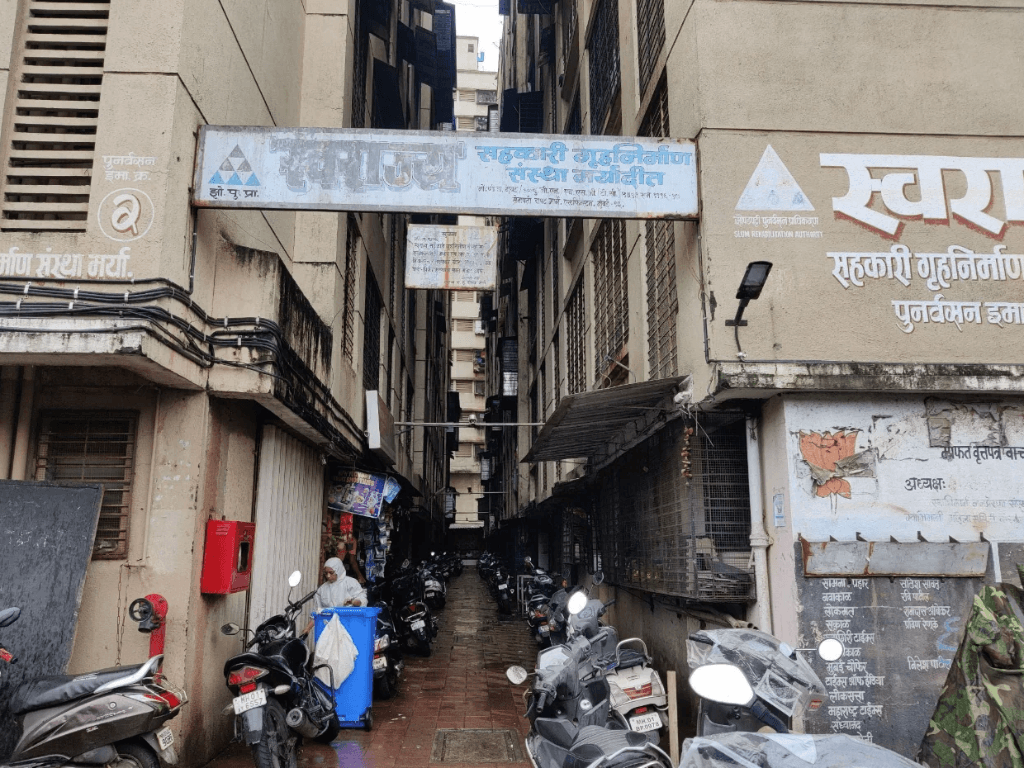
Cover Photo: Swarajya CHS, in Dadar West, Mumbai. Credit: QoC File