
Mumbai’s slum rehabilitation scheme (SRS) is nothing but the commodification of slum land through Transferable Development Rights[1] Since the mid-1990s, with the Slum Rehabilitation Authority, slum demolition and resettlement have happened[2] on a larger scale. However, only eligible families (based on cut-off dates) received houses in resettlement colonies. For most, resettlement has meant displacement and gentrification. In fact, sociologist Liza Weinstein argues that Mumbai’s resettlement is “planned displacement” in which governing agencies, real estate developers, and political authorities[3] are collectively involved.
A range of infrastructure projects have been rolled out for Mumbai’s development and thousands displaced by them – mostly the marginalised – have been resettled 30–40 kilometres from their original homes, affecting their livelihoods and health. Its impact through the lens of gender and caste remains under-researched (Ayyar, 2013[4]; Doshi 2013[5]; Bhatkal, 2021[6]. This essay specifically focuses on the impact, through the lens of gender, caste and religion, on Muslim communities and Dalit (lower caste/Scheduled Caste) women.
Mumbai’s M-East civic ward, known as the city’s margins with garbage dumps, landfills, and industries, has more than 13 resettlement colonies across Mankhurd, Chembur-Trombay, Govandi, Mahul, and Vashinaka (Burte et al., 2016)[7]. Some, like Lallubhai Compound have 72 buildings[8]; Mahul Gaon too has 72; Vashi Naka 90 (Jha, 2023)[9]; Natwar Parekh 61[10]; and the PMGP resettlement colony 16 buildings.[11] Drawing on secondary literature and the author’s ethnographic fieldwork – comprising semi-structured interviews and participant observation from January to June 2025 – this essay shows the struggles and challenges of marginalised women after resettlement.
Socio-cultural difference and dominance
That Dalit women faced caste-based discrimination and exploitation in Mumbai’s resettlement housing was argued in studies by Ayyar (2013)[12] and Ayyar and Khandare (2007)[13]. The former contended that upper-caste women dominated lower-caste women in self-help groups, cultural and religious festivals, and cooperative housing societies in resettlement colonies. In Mumbai’s Lallubhai resettlement colony, Ayyar (2013)[14] argues that caste, religion, and gender are three dynamics found at the highest level of discrimination and social exclusion.
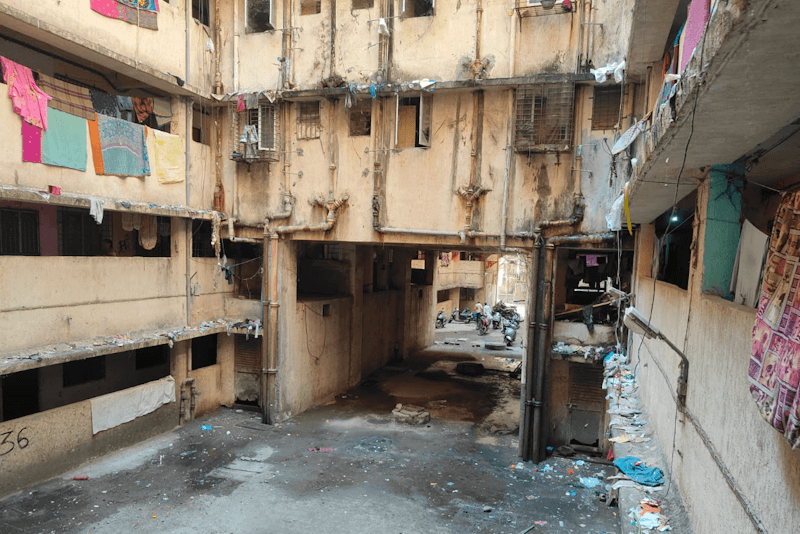
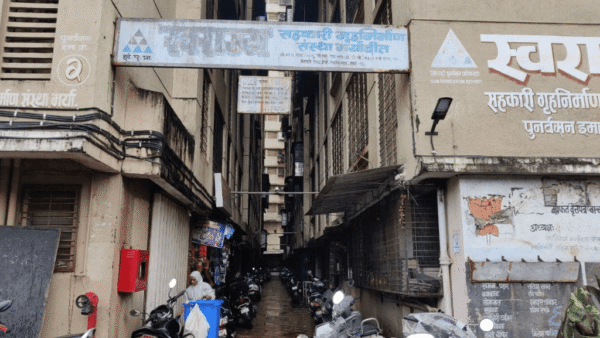
Photo: Priyanka Mokale
Women in Mumbai’s resettlement colonies, according to Jha et al. (2025)[15], Chaskin et al. (2024)[16], and Sarkar and Bardhan (2020)[17], face social isolation and socio-cultural issues, though the scholars offer little on caste and religion. The fieldwork confirmed the former. A 55-year-old Mahar (Dalit) community woman in Mahul Gaon said: “In our chawl in Vidyavihar, we used to celebrate Ambedkar Jayanti with other neighbourhoods. But here, we cannot, because people are from different states, castes, and religions. No one mingles much with each other. I feel very isolated here.” Another woman, 35, in Natwar Parekh Compound said: “When we lived in Sewri, we celebrated Eid together and prepared food for an iftar party. Here, people do not want to speak with us, so celebrating Eid, serving food, is not possible. They might even refuse it.”
A 38-year-old woman from the PMGP Colony in Mankhurd said, “In our building, women from North India, South India, Maratha and Dalit-Buddhist communities have different groups of SHGs and for socio-cultural activities. “Maratha women call us ‘Jai Bhim wale’ as we follow Dr BR Ambedkar’s philosophy. They do not involve us in any social or cultural programme of the building. Also, we are excluded from the cooperative housing society’s meetings and decision-making.” A 40-year-old woman in Mahul Gaon said: “We do not hate our neighbours, but since they do not speak Marathi, it is difficult to communicate. I really miss my days in the chawl, where everyone was from our community, lived like family, and celebrated every festival together.”
Though Mumbai’s native language is Marathi, the city attracts migrant workers from various states like Uttar Pradesh, Bihar, and Tamil Nadu – living mostly in slums – who do not speak it. In resettlement colonies that are Marathi-dominated, their voices are often suppressed; and they are excluded from the building’s cultural and social activities. Besides caste and religion, language-based discrimination and exclusion meant women facing multiple levels of discrimination and social isolation.
Lack of security, mobility and livelihood issues
Rising costs, job losses, and long distances to their earlier schools and workplaces mean women from these colonies face greater economic hardship after resettlement (Vyas, 2012[18]; Ramanth, 2016[19]). Studies showed that Dalits and Muslim women are more vulnerable, after the resettlement, while accessing water and during mobility. Bhide (2015)[20] and Burte et al. (2016)[21] argue that ghettoisation, crime, vulnerability, and women’s safety issues feature in Mumbai’s resettlement colonies. The study by Indorewala and Wagh (2017)[22] and a report by Ghar Bachao Ghar Banao Andolan (2018)[23] argued that the lack of access to schools in Mahul Gaon affected children’s education.
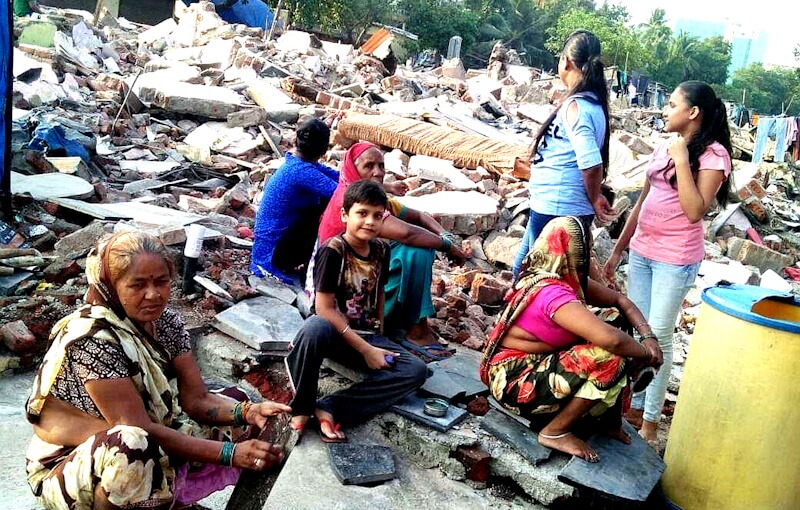
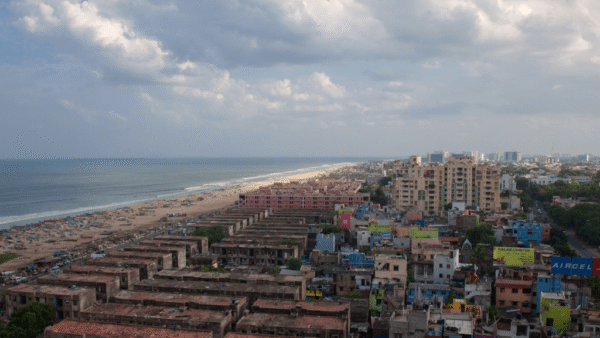
Photo: Jeevan Bachao Andolan
The ethnographic fieldwork validated these points about educational crises, livelihood loss, and lack of security. Many women said they were targeted at workplaces due to caste and religious identities; after the resettlement, they were unable to reach their workplaces on time, which led to many getting fired. Some then engaged in papad-making, running small shops and beauty parlours, arts-and-crafts, and other small income-generating activities. However, their economic hardship worsened because resettlement colonies are located on the city’s outskirts. Low bus frequency, poor transportation facilities, and high auto-rickshaw fares meant that many women and college-going girls stopped going to work or pursuing their studies. Besides this, young boys and alcoholic men loitered at every corner, making them insecure and fearful, especially at night.
A 20-year-old girl from Mahul Gaon, who had just completed her 10th class, said that “due to poor finances, privacy issues, lack of night-time security, and poor bus frequency, my mother decided not to send me for higher studies. So, I do household chores and help her to make papads. I really wanted to study but due to these problems, I cannot. Now my parents want me to marry for which I am not at all ready.” A 27-year-old woman from Natwar Parekh Compound said “Because our address is Natwar Parekh, Govandi, we get job rejections. Govandi has a reputation for high crime and no one wants to hire from this area.”
A 45-year-old Dalit woman waste picker from here faces hostility from neighbours because she uses building corridors to sort garbage; the civic body has not provided them space for this.. Similarly, a physically challenged 50-year old woman in Mahul Gaon requested an accessible space for her grocery business, but the authorities allotted her a flat on the 6th floor. “My brother takes me down in the morning and my son helps me back in the evening; I use the ground-floor neighbours’ washroom,” she says.
Such issues have pushed the marginalised women into a vicious cycle of isolation, and lack of opportunities and empowerment.
Congested built environment and health crises
Women in the resettlement colonies face health crises due to congested housing, poor built environment, and lack of civic amenities (Sarkar & Bardhan, 2020[24]; Pardeshi et al., 2020[25]; Jha, 2023[26]). They were found to be victims of various diseases like asthma and TB due to the lack of ventilation and green spaces. The constant garbage smell from the Deonar dumping ground also reduced their appetite.
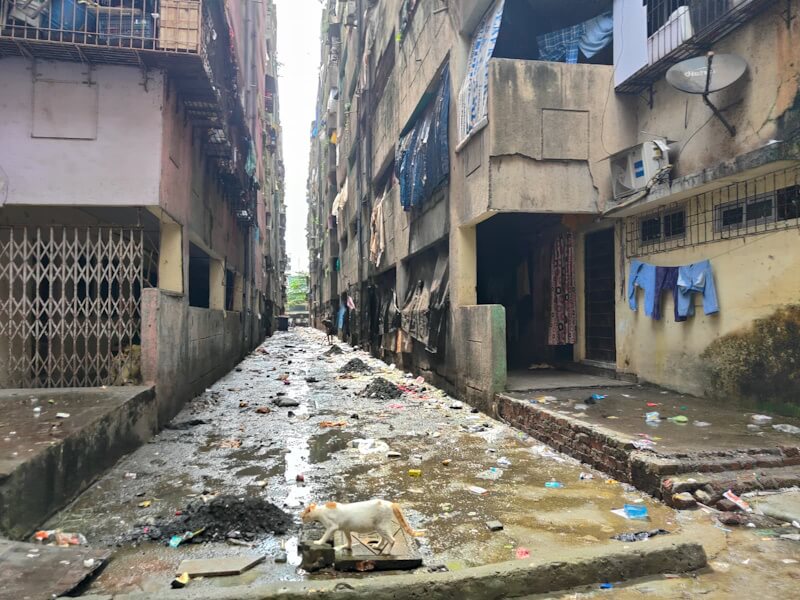
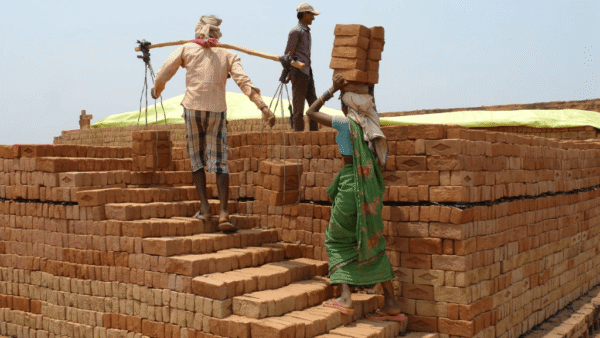
Photo: Priyanka Mokale
Similarly, in Mahul Gaon, women were constantly tired and had headaches, possibly due to the continuous smoke and pollution from surrounding chemical factories. Many women and young girls here showed malignant tumours, and issues like sudden stoppage of the menstrual cycle, miscarriage, premature babies, skin diseases, and dizziness. Low water supply and contaminated water forced many to buy mineral water to drink, adding to their household expenses. Those who cannot afford it have become victims of cholera and frequent stomach aches.
Additionally, chemical factories, the Deonar dumping ground, garbage-burning fumes, and air pollution have created a toxic built environment for them. This, in academic understanding, is environmental injustice in addition to the socio-spatial segregation that Dalits and Muslim communities have been pushed into. The vicious cycle of unwelcome geography and a poor built environment keeps them impoverished. This is akin to the environmental injustice faced by Black communities in the US Sharma[27] (2022).
A 45-year-old woman from Mahul Gaon, who is part of the Ghar Bacho Ghar Banao Andolan, rued: “The government sent us here, to a human dumping ground and gas chamber, to die. This is Mumbai’s toxic hell-hole. We are powerless and marginalised. I never imagined I would have to live in such an environment. Even after taking part in the Andolan, I have not received housing elsewhere.” When the abysmal living conditions were brought to the notice of the Bombay High Court[28] in 2019, it asked the state government and Brihanmumbai Municipal Corporation to relocate them. Only 288 families[29] were allotted houses at a different location.
The poorly-designed built environment of resettlement colonies is made worse by the lack of green spaces and trees, and over-concretisation, which leads to higher heat levels. Women, while cooking and staying indoors, face the heat crisis the most; Mumbai’s humidity makes it worse for them. These marginalised women must be seen as victims of climate vulnerability.
Self-redeveloped community-led housing
The fieldwork showed that women were dissatisfied with the resettlement, and felt like it was ‘forced displacement’ and ‘eviction’ due to the city’s infrastructural development. They did not feel ‘settled’.
Mumbai’s current model of slum rehabilitation and resettlement is developer-centric and dominated by real estate interests[30] (Doshi, 2013[31]; Bhide, 2023[32]). However, there are other models to follow. The need is to focus on self-redevelopment and a community-centric housing model. There are case studies that emphasise this Nair and Lahoti (2019)[33] rather than the builder-led resettlement, which the Bombay High Court termed “vertical slums.” Communities taking ownership of building their houses and colonies would be the best.
The Chandivali Sangharsh Nagar[34] project, for the 18,000 families resettled after eviction from the Sanjay Gandhi National Park, the architecture firm of PK Das & Associates developed a neighbourhood where clusters of buildings with Ground+7 storeys were intertwined with social infrastructure such as schools, hospitals, playgrounds, and other facilities. Another model, funded by the World Bank, is in Charkop, Gorai, Malvani, Kandivali, Mulund, and Mandale. Owens et al. (2018)[35] and Testi (2023)[36] showed that the authorities allocated land to low-income slum families, and people built houses according to their needs. Larger plot sizes, the sites-and-services approach, and mixed-use neighbourhoods made these livable; over time, their locations became strategic and improved access to job markets. These delivered a more livable urban fabric than the standard resettlement colonies.
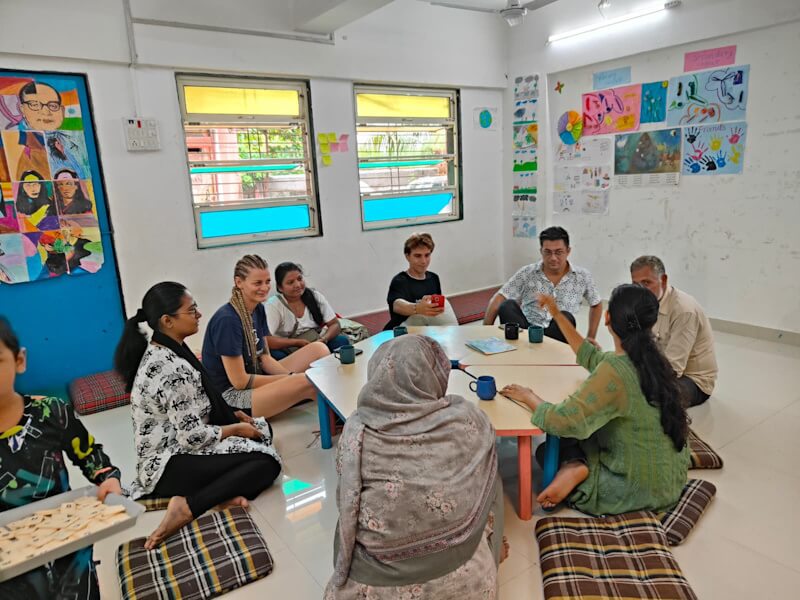
Photo: Priyanka Mokale
At the fundamental level, the government must prioritise and facilitate a community-oriented, economically-and-socially sustainable approach to resettlement; community-designed and owned would be the best. Then, the process must also be meaningfully participatory and NGOs in the area can facilitate the community to participate and design better. NGOs like Community Design Agency and YUVA are active in placemaking and community development work in Natwar Parekh and Lallubhai Compound, but after the resettlement was designed and built, to only improve it.
Also, the government has to be consciously non-discriminatory about environmental regulation and zoning while relocating the slum dwellers; the current housing design[37] violates environmental regulations, urban planning norms, and construction rules set out in the National Building Code of India. Even when all this is done, there has to be mindfulness and an effort to prioritise all the vulnerable groups like women and the marginalised communities.
When studies show that Dalit and Muslim women in resettlement colonies are the hardest hit, government policies must respond. Ideally, women-centric housing models should prevail but at least the participatory process must include women’s representation, especially from marginalised communities. In-situ housing, or within a 1-2 kilometre radius of their original site makes resettlement easier,so their livelihood, education and socio-cultural bonds are not disrupted. Mumbai’s resettlement can be better for Dalit and Muslim women but do the authorities see this?
Priyanka Mokale is pursuing her PhD in the Department of Geography, Earth, and Environmental Sciences at the University of Birmingham. Her research focuses on sustainable housing challenges and the impact of Mumbai’s slum rehabilitation on the marginalised communities. Her interests include urban informality, gentrification and displacement, urban citizenship crises, housing, education challenges in the marginalised communities, solid waste management, urban health and sanitation, urban policy and governance, and climate change and sustainability.
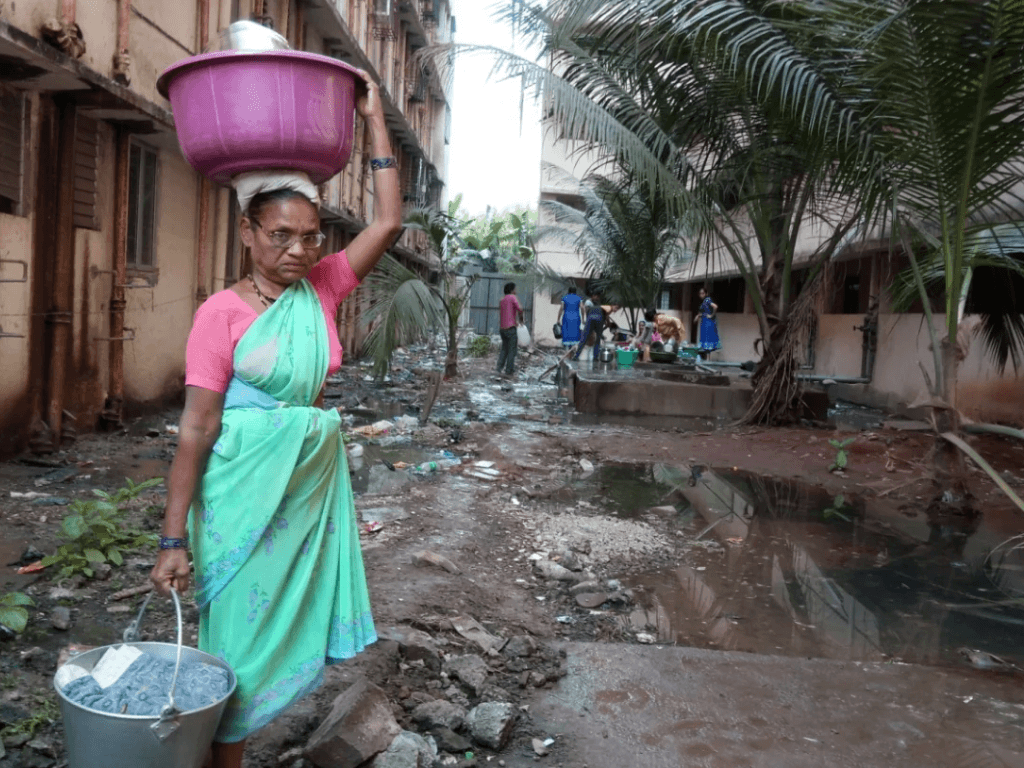
Cover photo: Women report social isolation, loneliness, and adverse impact on health as part of their life in resettlement colonies in Mumbai’s M-East ward, this one in Mahul Gaon.
Credit: Jeevan Bachao Andolan.