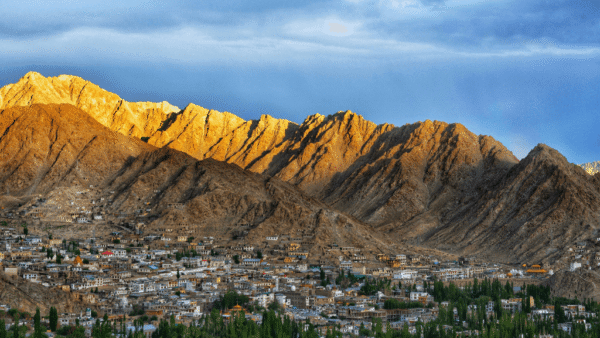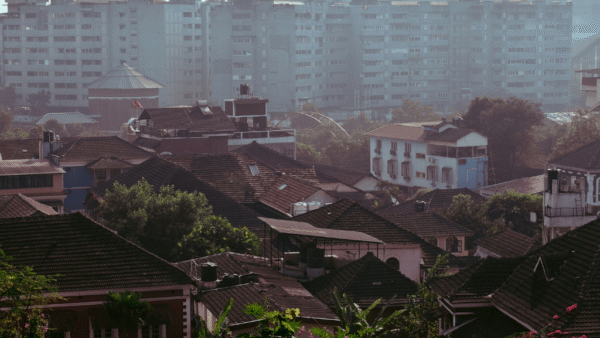

For the past couple of years, Jameela Akhtar, 34 and mother of two little children living in Srinagar’s Bemina area, has complained about increased heat in summer. Last year, the family tried using thermocol sheets on their tin roof but it did not help. Her husband, Mehran Ahmad, 38, was willing to spend Rs 15,000 to have the roof insulated because “it became very difficult and unbearable to sleep in these rooms during summer”.
Ahmad’s is among the thousands of families across Srinagar grappling with high heat – a phenomenon they are not used to and their living environments are simply not equipped for. This year, temperatures breached the normal in late April itself. Daytime temperatures in Srinagar were consistently in the high 20s and low 30s, significantly higher than normal.
The past few years have consistently recorded an increase in average temperatures across Kashmir. Last summer was the hottest in 70 years in Srinagar; July 5 recorded the hottest[1] day temperature. In the summer of 2022,[2] day temperatures rose above 35 degrees Celsius. Since 1891, when the local weather observatory was established, Srinagar experienced its second-highest maximum temperature[3] in September 2023[4] In 2020, the city’s mercury hit high on several days and touched 37.7 degrees Celsius on August 13 – the hottest in 39 years for that month.
The trajectory is clear – Srinagar and parts of Kashmir have been more hot in the past few years than ever before, leaving behind the average April-September temperature in Kashmir Valley[5] of 19.1 degrees[6] Celsius to 27.6 degrees Celsius. Winters have been warmer too with temperatures rising 6 to 8 degrees above average. The region has seen unusually snowless and dry winters in recent years, including during the Chillai Kalan period – December 21 to January 31 – when it is traditionally bitterly cold and snowing. In the winter of 2024, the snow-clad mountains of Gulmarg were brown and barren.
Now, discussions are about declaring heat waves in a region that was anything but hot. For hilly regions, a heatwave is declared[7] when the maximum temperature reaches 30 degrees Celsius.
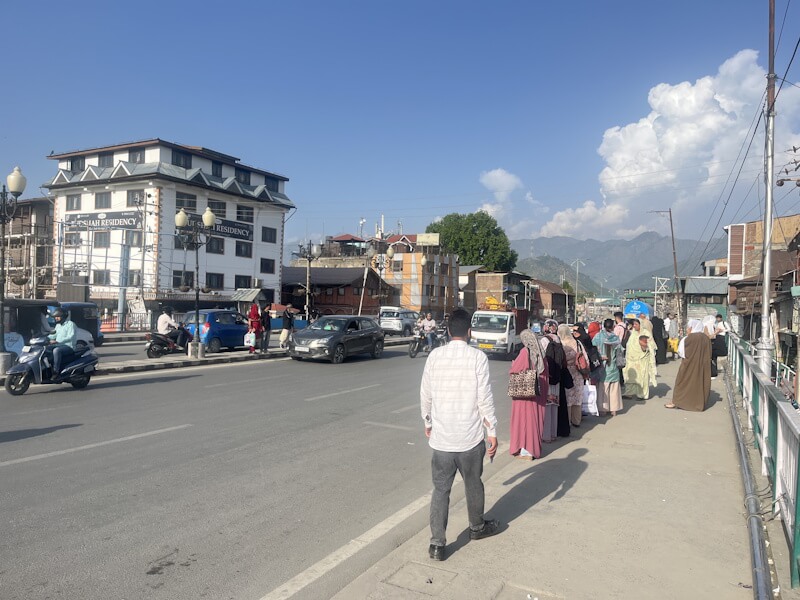
Photo: Athar Parvaiz
Heat impact where “cooling concept” did not exist
Consequently, the demand for roof insulation has increased by over 150 percent in the past couple of years, said Obaidullah Wani, a businessman dealing with this. He started the business in Srinagar seven years ago when “there was no cooling concept in Kashmir”. Residents in Srinagar say the unusually hot summers have forced them to consider installing roof insulation or air conditioners in their homes.
The demand for air conditioners has surged. “We used to sell 20 ACs on an average around five-six summers ago but, over the last two-three years, we have sold an average of 220 ACs a year,” said a sales executive in Srinagar. “The demand has increased massively. This may have to do with increasing affordability, but families install a unit only if they feel the need,” said Javid Ahmad, who sells electric appliances.
Studies show the temperature increase[8] in the region with some areas reporting an increase of nearly 5 degrees Celsius in recent years. For a region long defined by its cold, which brought tourists, heat is no longer an aberration but becoming the norm. The rising temperatures and lack of snowfall in winters prompted Jammu and Kashmir Chief Minister, also the Tourism Minister, Omar Abdullah to urge climate adaptation measures such as artificial snow-making.
In Gulmarg, globally known for snow sports, the rising temperatures threaten footfalls. Gulmarg, which attracted an impressive 1.1 million tourists last year while Pahalgam was a close second,[9] registered a spike of nearly 10 degrees Celsius in normal winter temperature even as the lack of snow left its ski slopes bare in two consecutive winters. The state tourism department invited tenders for artificial snow-making this month.
Residents say Srinagar’s unusually high spring and early summer temperatures are “unheard of”. Faizan Arif, an independent weather analyst, analysed that the past seven winters, from 2019 to 2026, recorded below-normal precipitation. Summers now mean droughts. This February witnessed a deficit of 89 percent – only 14.2 millimetres precipitation against a normal of 130.4 millimetres.
Melting glaciers, shrinking tree cover, drying water bodies
The combination of global warming and local stressors which include shrinking and degraded forests, disappearing water bodies, and unregulated urban growth have led Kashmir to get scorched.
The global warming effect on glaciers in the Himalayan region plays a role in warming the region. The Intergovernmental Panel on Climate Change (IPCC) documented declines in snow cover and glacier mass in high mountain areas, including the Himalayas, which are linked directly to rising temperatures. The assessment is that even if global warming is limited to 1.5°C above pre-industrial levels, which was breached, a large fraction of Himalayan glacier ice could be lost by the end of the century. Under higher warming scenarios, the losses could be more.[10]
The compliance report by the Chief Secretary acknowledged that 82,327 trees were cut across nearly 150 projects in forest areas.[11] In all, nearly six lakh trees were axed across Kashmir between 2020 and 2025 while removing encroachments from the Jhelum river system, official data revealed.[12]
The 2026 report of the Comptroller and Auditor General (CAG) of India pointed to a steep and long-term decline in Kashmir’s water bodies too,[13] with significant implications for local climate resilience. Tracing changes against a 1967 baseline of 697 lakes, the report revealed that 315 lakes once spread across 3,798 acres in Jammu and Kashmir, have disappeared entirely and 203 surviving lakes have contracted sharply. This has eroded the ecological functions of lakes such as temperature regulation and water storage.
The loss of landscapes is not limited to trees and water bodies. Official statistics[14] peg Kashmir’s cultivable farmland loss at nearly 84,016 acres between 1996 and 2023. The primary causes are unplanned urbanisation, residential sprawl, and large infrastructure projects. All of this has contributed to the rising heat, especially in cities and towns that saw large-scale construction in the past few years.
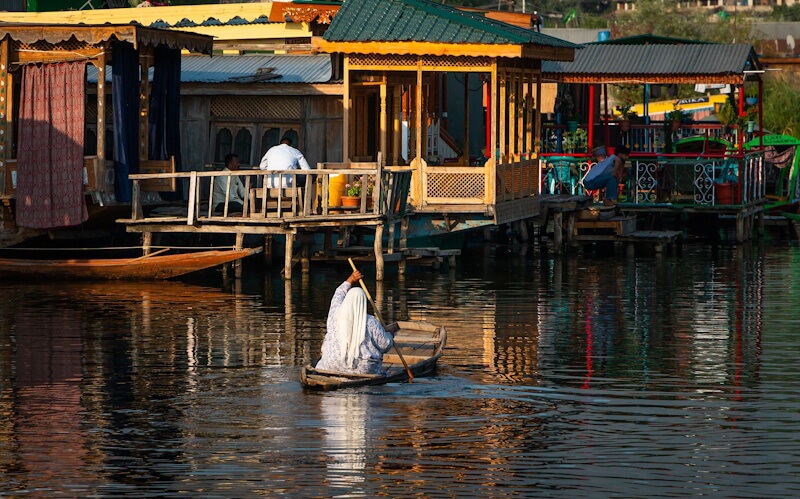
Photo: Abid Sidiq Ahanger/ Wikimedia Commons
Srinagar unprepared for heat
Unlike cities in India’s plains, Srinagar was not built for heat. Its architecture, infrastructure, and lifestyle evolved around cold winters to cool summers. This is now a liability. Home insulation against heat and air conditioners were unheard of; public spaces too were not equipped for harsh heat. The newly-created infrastructure lacks enough shelters to protect people as summers turn hot.
Without designated cooling centres and water access, the rising temperatures have turned discomfort into a health risk. Doctors say cases of dehydration, fatigue, and heat stress have become more frequent in the summer months; the elderly, children, and those with pre-existing conditions are particularly vulnerable. Outdoor workers such as street vendors, construction labourers, traffic police and others face prolonged heat exposure. “There is no system for rest breaks or shaded work zones…people manage somehow,” says shopkeeper Mohammad Aslam in Srinagar’s Batamaloo.
The Srinagar Heat Wave Action Plan 2024-25[15] states that rapid urbanisation and changing land use coupled with the congested residential and commercial areas make Srinagar a classic case of Urban Heat Island. It recommends inter-departmental interventions aimed at heat-reduction such as development of green spaces, induction of electric buses, preventing illegal conversion of Abi and Nambal lands, and averting encroachment on water bodies and urban forests.
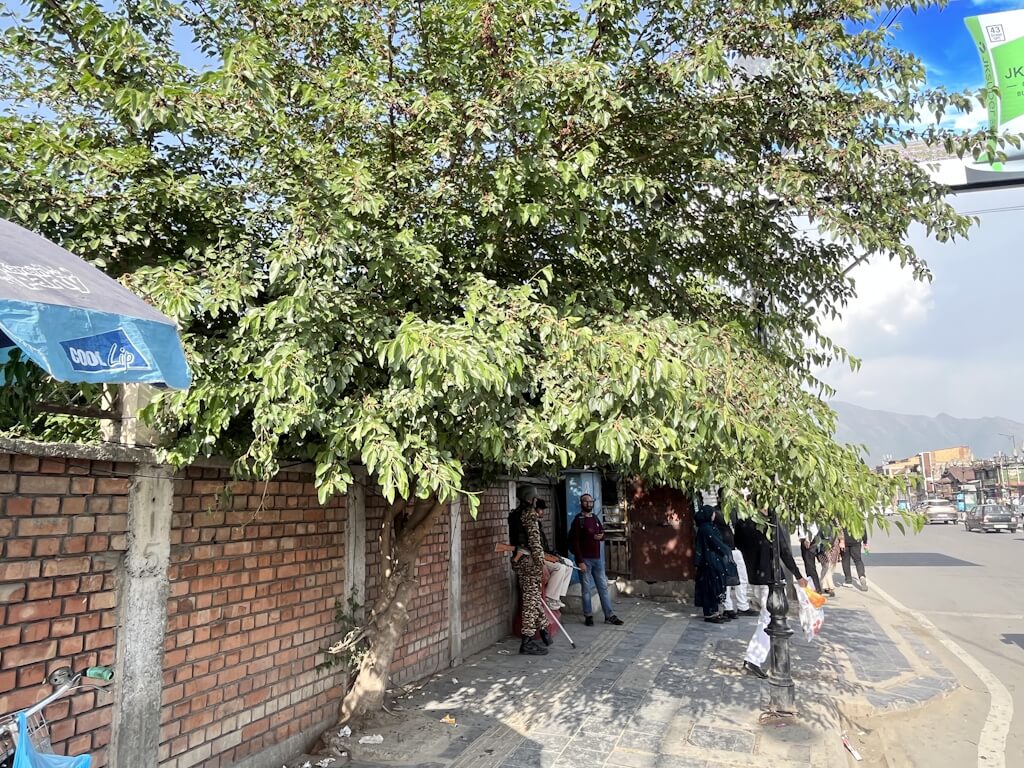
However, the implementation on the ground does not reflect the intentions. Two young women standing beside a parked vehicle of the Central Reserve Police Forces (CRPF) in Srinagar’s Jahangir Chowk in the blistering heat on May 10, said it was “the only shade they could find”. Importantly, people remain unaware of heat stress and risks; many are unfamiliar with the symptoms of heat-related illness and preventive measures because such risks were historically negligible.
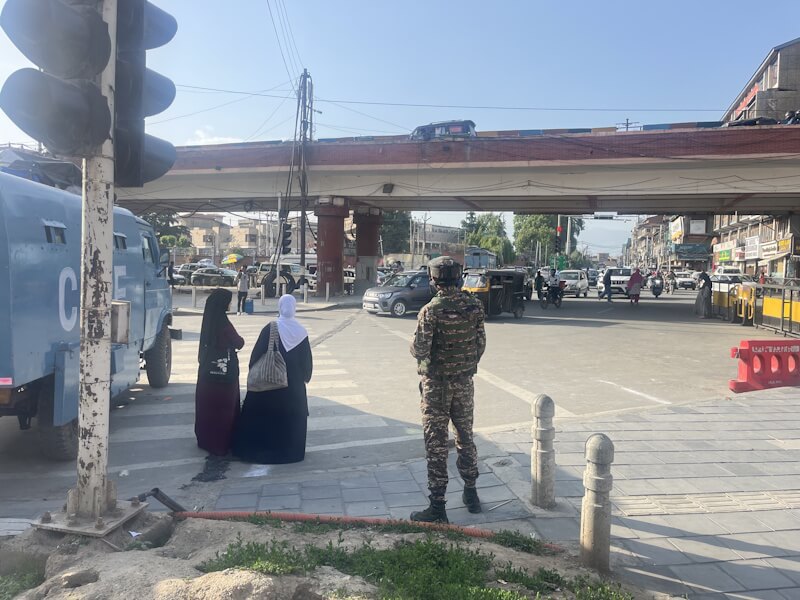
Photo: Athar Parvaiz
Urban planning has yet to fully integrate climate resilience. Many parts of Srinagar city were renovated in the past three years as part of the Srinagar Smart City project – without leaving any green spaces in areas such as Lal Chowk, Karan Nagar, Amira Kadal, Batamaloo. The city has been overly concretised without a thought to climate adaptation. So, on the one hand, heat is becoming a structural challenge while, on the other, the institutional responses are falling short.
Even as climate change is bringing in changes in temperature and precipitation, “we have worsened the situation by ruining our land, water and other natural resources,” said Mutaharra Abida Deva, environmentalist who has extensively written about the ecological degradation in Kashmir, “If we had left these resources undisturbed or had properly managed them, we would be better placed to deal with climate challenges such as heat waves or frequent floods.”
Livelihoods singed
The heat-related concerns are not only confined to people’s health but reshape livelihoods. Agriculture and tourism, mainstays of Kashmir’s economy, have been hit. Heat-sensitive crops such as maize, saffron, and apples are already under strain. As rivers and streams run low in summers – and now during spring – the authorities have asked farmers to ration irrigation. Kashmir’s agrarian economy is finely tuned to seasonal cycles. Snowfall plays a crucial role in maintaining soil moisture and groundwater levels; its decline is disruptive.
According to Irfan Rashid, an assistant professor at the Earth Sciences Department, University of Kashmir, who studied glaciers in the region, the glaciers have witnessed a reduction of 25-30 percent in the past 60 years. After analysing the recession patterns of nine glaciers in the Kashmir Himalayan region between 1992 and 2020, Rashid and his co-researchers wrote in their 2022 study[16] that these are melting at an accelerated pace compared to other regions across the Himalayan arc. Farmers report reduced water availability during the growing season; some have shifted away from water-intensive paddy cultivation.
Farhat Shaheen, an agricultural economist at Sher-e-Kashmir University of Agricultural Sciences and Technology, has extensively researched the impact of climate change on agriculture and the shift by farmers in water-stressed villages to climate-resilient or less water-requiring crops such as maize or beans, or have adopted horticulture. Apple cultivation offers environmental and economic advantages over paddy farming, he says because “the water footprint of apple is very low compared to paddy” and apple trees sequester carbon while paddy fields emit methane, although paddy has to do with food security. Horticulture also has a significantly smaller carbon footprint.
Tourism, a pillar of the local economy, is also feeling the strain. Winter tourism has taken a hit from erratic snowfall with skiing seasons in Gulmarg becoming shorter and less predictable, although exact official data is hard to come by. Summer tourism, once driven by Kashmir’s reputation as a cool escape, risks losing its climatic advantage over the plains.
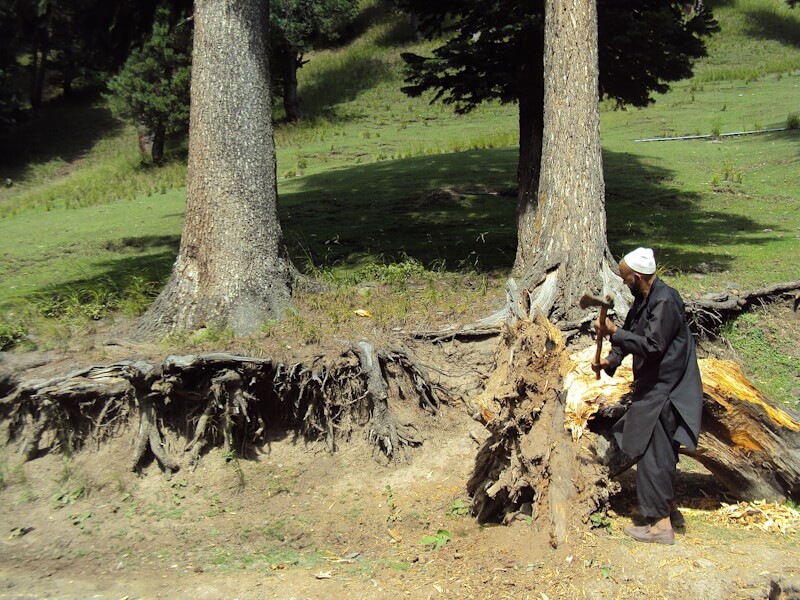
Photo: Vinayaraj/ Wikimedia Commons
The way forward
The intensifying heat and other climate-driven extreme weather events are a governance challenge. The state and Srinagar authorities must now adopt a region-specific and city-specific heat action framework which, typically, includes early warning systems, public advisories, and inter-agency coordination.
Equally important is that Kashmir – and Srinagar – revisit its urbanisation path and seriously weigh the risks of heavy concretisation against diminishing natural areas. Also, the damaged wetlands, lakes, and forests must be restored – not as cosmetic or ‘smart’ projects but as climate infrastructure.
Public awareness will play a crucial role in managing heat-related illnesses. For people unused to such heat, they need to be repeatedly alerted to it and inspired to make simple behavioural changes such as avoiding the outdoors in peak heat and having community-managed water points.
Adopting or reviving cooling architecture and making this the policy for the built environment would prove important in the years ahead as the temperatures continue to rise. Without embedding heat responsiveness and resilience into policy, planning, and everyday practice, Kashmir risks drifting into a pattern where each summer is treated as an anomaly rather than the new baseline.
Athar Parvaiz is an award-winning journalist based in Srinagar, Jammu & Kashmir. He has extensively written on environment and climate change from several Himalayan regions since 2010 and his work is published by a number of national and international publications.
Cover photo: Athar Parvaiz