
‘Noida just stopped pretending, the cracks were always there,’ read a placard during the workers’ protests there. Workers were agitating against the 12-hour workday for a meagre Rs 10,000-12,000 a month. This is starvation-level wage when the monthly room rent alone is Rs 6,000. When the West Asia war deepened such daily stresses, protests broke out. “If our employers earn Rs 3-4 lakh a month, it means the companies are doing well. Why are we paid so little,” they demanded to know. The Noida workers are not the only ones. Over the past few months, a wave of workers’ protests across North India posed this question[1] to employers and the state. Besides the grossly inadequate and unequal salaries, their larger point is about work and life in urban India.
It is a perpetual cycle of poverty and precarity. Low salaries compound inadequate housing, deprivation of basic amenities, and ultimately spatial and social marginalisation in cities. For migrant workers – nearly one in every four rural Indian in 2020-21, according to the Economic Survey[2] – who comprise large sections of the urban workforce, this means a push back to their points of origin. Work, work conditions, and the quality of life for workers in cities determine their very citizenship and how, if at all, they can claim their Right to the City.
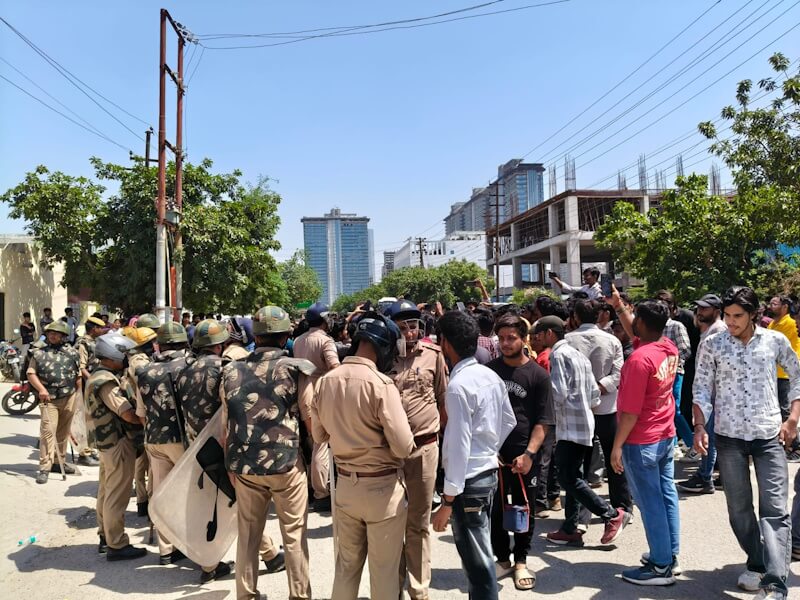
Photo: By special arrangement
Who works and who belongs
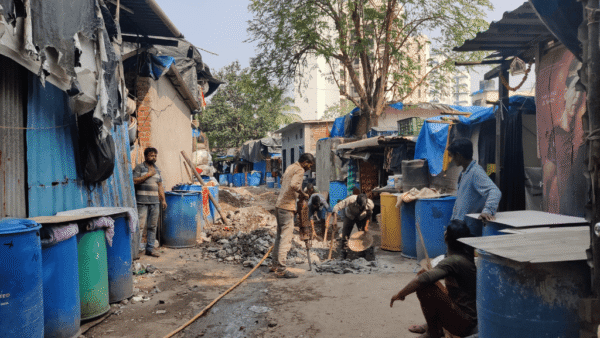
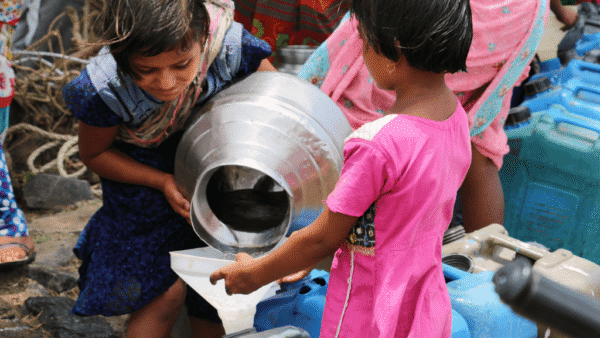
Far away from Noida, near the affluent Vasant Vihar of Delhi, lies Kusumpur, an obscure settlement, home to nearly 10,000 people. Thousands more live in the nearby Coolie Camp, Nepali Camp and Bhanwar Singh Camp. Almost all are informal workers who provide services to south and southwest Delhi: Construction, sanitation, housekeeping, and security. Ironically, their colonies lack basic dignified housing and civic amenities. They live in these informal settlements in perpetual fear of demolition and eviction.
From the roofs of the slums in Kusumpur’s D Block, the DLF and Ambience malls of Vasant Kunj are a pretty picture of ‘development’. In between the two, lies a vast swamp. It is both their toilet and thoroughfare; many pick their way through this cesspool to reach workplaces and homes in Vasant Kunj. When the Delhi Development Authority attempted to erect a wall between the slums and the swamp some years ago, protests broke out. The unionist who led it and lives in the D-Block slums, joked that the slum’s name is ‘The Mall View Slum’.
The Noida protests, the mall view from Kusumpur, the police brutality on protesting workers all pose burning questions such as how do workers, whose labour builds and sustains urban India, claim the Right to the City; why are they treated as ‘encroachers’ in spaces claimed by the propertied classes like the state, industrialists, private landowners, and middle-class professionals? The ongoing exploitation, growing stratification, and the burgeoning inequality[3] underscore a harsh truth: those who work in our cities struggling to belong in them. Trade unions and social movements have consistently suggested that the crisis of belonging, or citizenship, is the outcome of choices made by those in power, the outcome of policies and governance.
The lives of workers, their hopes and aspirations, have been systematically rendered ‘informal’ to deny them substantive rights. The ‘informal’ simply never makes it to the city’s formal plans and layouts, formal workplaces and sectors, formal jobs and aspirational spaces. The India Employment Report[4] (2024) confirmed what is anecdotally known. A staggering 90 percent of India’s workforce is informally employed. The available data shows 119 million informal workers in cities in 2017-18; an estimated five million are in Delhi alone, according to a WIEGO report.[5]
Informal lives, unequal cities
Informal employment is of two kinds: work in the informal sector and informal jobs in the formal sector. The India Employment Report suggests that most of India’s workers are in the informal sector. Agriculture and allied activities have the largest numbers, followed by small-scale or unregistered manufacturing units, trade and services (hospitality, transport, retail, street vending), construction work, domestic work, gig work, artisanal and home-based work. Except agriculture, all other work is in urban or peri-urban spaces.
The formal sector in cities and towns also has myriad types of informal work, showed a report[6] of the Communist Party of India (Marxist)’s Study Group. This has created new informal categories, in the place of permanent jobs, such as on-the-job trainees, long-term trainee employees, and non-permanent workers. It points to the last Census in 2011 which showed that 77.5 percent of workers in the formal sector had no written contracts; among women, this was 91 percent.
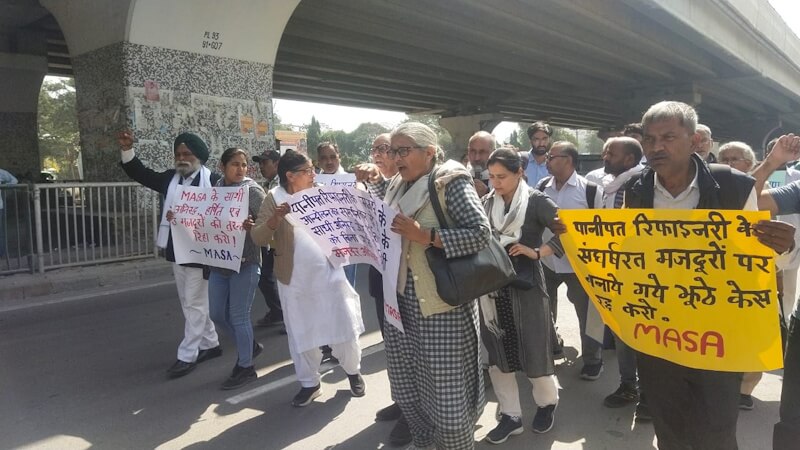
Photo: Mazdoor Adhikar Sangharsh Abhiyan
The informalisation over the past two decades has meant an overwhelming majority of workers have been thrown out of the ambit of legally-enforceable workplace rights such as minimum wages, timely payment, specified working hours, job security, social security benefits, and the right to engage in collective bargaining by forming trade unions. It also increased their vulnerability to heatwaves, urban floods, air pollution and other climate-related disasters.[7] The contract labour system,[8] the basis of informal hiring, has been detrimental to workers and their families. Back in 1990, in the Sankar Mukherjee v. Union of India case, the Supreme Court described the contract system as “an improved version of bonded labour”.
Tikender Panwar, urban policy expert and former Deputy Mayor of Shimla, suggests that the exclusions and denials have not only created a large class of informal citizens in urban India, but also augmented the inequality gap. Three areas widened the inequity in cities, he argues. Firstly, the reduced capacity of workers to bargain and reclaim their right in the city; secondly, the privatisation of utilities and services such as health and education that puts them at a disadvantage; and thirdly, housing turning into a distant dream. (Panwar, 2025) Informal workers pay a greater percentage of their income than others to access privatised – and relatively more expensive – utilities and services.
Over time, the inequality gap in urban India has increased. The Oxfam[9] report of 2017 showed that the gap between the top 10 percent and bottom 10 percent asset holders in rural India was 500 times but a staggering 50,000 times in urban India. The report of the Institute for Competitiveness 2025 underscored the economic disparities within cities: “the urban bottom 50 percent grew at a CAGR of nearly 7 percent between 2017–18 and 2023–24 against five percent for rural areas, (but) within cities, the gains were uneven: the ratio of top 1 percent earnings to the median rose from 5.89 to 6.25 times.”[10]
Exploitation legalised
Greater legal protection, economic upliftment, social and political empowerment were the need of the hour. Instead, the new Labour Codes – the Code on Wages, 2019; the Occupational Safety, Health and Working Conditions Code (OSH Code) 2020; the Social Security Code, 2020; and the Industrial Relations (IR) Code, 2020 – have done the opposite (Bhattacharya, 2026; Centre for Workers’ Management, 2025).
The Labour Codes institutionalised the informality by creating new categories, giving fewer rights, and pushing millions of informal workers out of the ambit of labour laws by raising the compliance thresholds. The Codes created new categories such as ‘fixed-term employees’ and ‘unorganised workers’, and a system of differential rights for different categories. Far from guaranteeing a minimum wage, they laid the ground for a possible decline in wages which could widen the gap between real wages and cost of living, pushing workers into a debt trap. The Noida protests show the gap; most workers are paid Rs 10,000-12,000 when monthly living costs are around Rs 20,000.
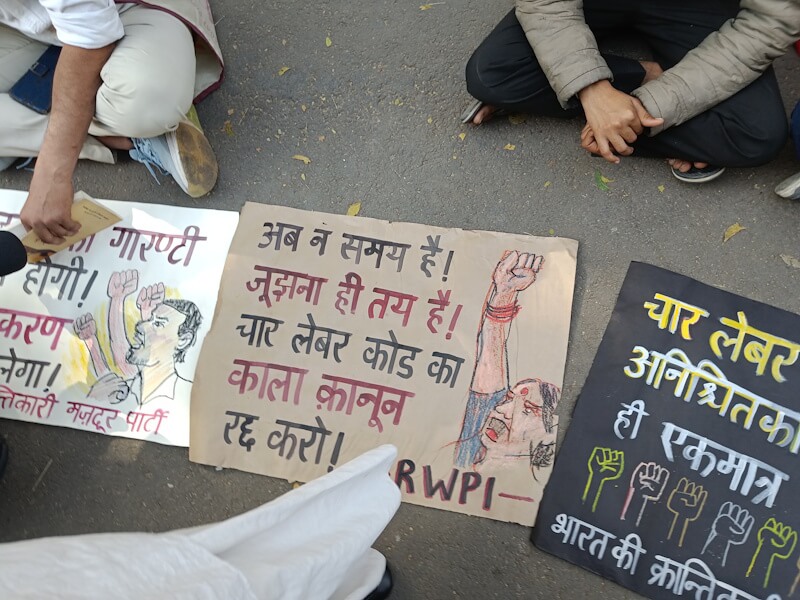
Photo: QoC File
The Codes also worsened formal exclusion by raising the thresholds of applicability. The following table details the difference:
| Old laws | Applicability Threshold | New Labour Codes | Applicability Threshold | Purpose |
| Factories Act, 1948 | 10 or more workers with power, 20 or more without power | OSH Code | 20 or more workers with power, 40 or more workers without power | To ensure basic health, safety, welfare facilities, decent working hours, and leave for workers. |
| Industrial Employment (Standing Orders) Act, 1946 | 100 or more workers | IR Code | 300 or more workers | For framing standing orders governing service conditions. |
| Contract Labour (Regulation and Abolition) Act, 1970 | 20 or more workers | OSH Code | 50 or more workers | For the abolition of contract labour under conditions, mandating basic safeguards such as timely wage payment, provision of basic amenities, liability of the principal employer. |
| Inter-State Migrant Workmen Act, 1979 | 5 or more workers | OSH Code | 10 or more workers | For the provision of facilities and welfare amenities to migrant workers. |
Gig and platform workers form a major component of the urban workforce. As per the NITI Ayog[11], they will number 2.35 crore by 2029-30. The government has projected their inclusion in the Code on Social Security as a step forward but it replaces statutory rights-based social security with scheme-based social security for ‘unorganised workers.’ This places gig and platform workers outside the traditional employer-employee relationship and deprives them of the right to collective bargaining without which they struggle to collectivise. In fact, the Codes curtail all rights to collective bargaining as lawyer and trade unionist Maitreyi Krishnan explained here.[12]
The housing question
The urban precarity of informal workers is worsened by the insecurity of housing. Sharp conflicts over land have emerged in towns, cities, and peri-urban areas. The past few years have seen major demolition and eviction drives in Delhi[13], Mumbai[14], Ahmedabad[15], Prayagraj[16], Lucknow[17], Khargone[18], Bareilly[19], Surat[20] and other places (Bhattacharya 2025). The Bharatiya Janata Party (BJP) had made ‘urban upliftment’ one of its poll planks in 2014 but its schemes have stuttered[21] over the years.
In its flagship Pradhan Mantri Awas Yojana–Urban (PMAY-U), the Parliamentary Standing Committee Report[22] of 2023 revealed major gaps in housing demand assessment, the lack of basic amenities in 5.6 lakh houses, and the high cost burden on beneficiaries; it was particularly critical of the poor record of houses given to slum dwellers; only 99,000 houses were delivered against a demand of 14.35 lakh houses. The housing shortfall has been compounded by widespread demolitions – or ‘Bulldozer Raj’ as housing rights activists term it (Pati, 2025). Delhi has been the worst hit; informal settlements were sweepingly demolished in 2023 to prepare the city for the G20 Summit and have continued. The Housing and Land Rights’ Network (HLRN) reported[23], in 2023 alone, five lakh forced evictions across India of which Delhi accounted for 2.8 lakhs.
An estimated 5.7 million people of Delhi, a third of the city’s population, belonging primarily to Muslim[24], Dalit and backward caste groups[25], and nomadic communities[26] live in slums or unauthorised colonies. They face eviction and displacement. In Mumbai, millions in Dharavi and other informal settlements face relocation and sub-standard housing, as seen in the Slum Rehabilitation Authority[27] buildings. The Public Private Partnership model in SRA – the Dharavi Redevelopment project involving Adani Realty – has been criticised[28] for opening doors to massive speculation and profits for developers while the poor are relocated disrupting their livelihoods and breaking their social networks.
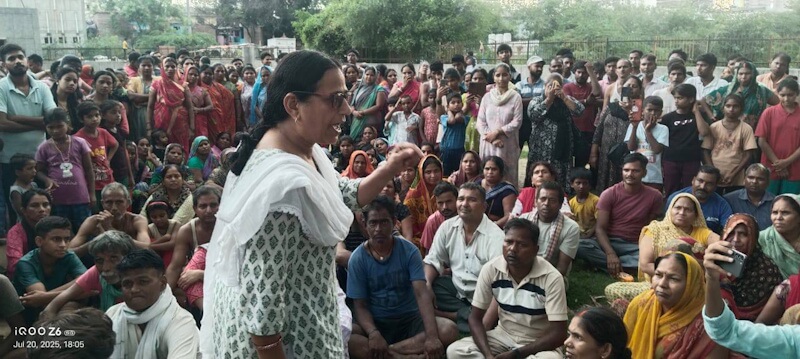
Photo: AICCTU
The state has also used demolitions as a political weapon[29] to target the working classes and minorities, calling them ‘encroachers.’ The ‘encroacher’ discourse denies the real land-housing crisis and spatial inequalities. Urban policy expert Gautam Bhan showed that urban informalities are the products of official planning, not a subversion of plans, and termed them ‘planned illegalities’ (Bhan, 2013). The All-India Lawyers’ Association for Justice[30] showed that the ‘encroacher’ discourse increasingly intersects with the anti-immigrant discourse against India’s Muslims and Bengali-speaking migrant workers.
The city, the right
Cities in India are undeniably premised on exclusion, denial and discrimination of millions. Majoritarian politics has added new layers of discrimination. While political parties, including the opposition, have so far floundered[31] on the urban question, cities have witnessed a slow rise of a people-led Right to the City movement, evident in mobilisations for wages, workplace rights, and clean environment.
In terms of their location, modus operandi, and vocabulary, these mobilisations echo wider sentiments for equality, justice and dignified life for all; they also carry the possibility of mobilisation along backward linkages as the 2025 Delhi Assembly elections gave a glimpse of. While the Aam Aadmi Party, the Congress, and the BJP competed with each other to promise a range of subsidies and financial benefits to the poor and lower-middle classes, several citizen-led alternative manifestos[32] struck a different note.
Emerging from grassroot organisations, and authored by many – activists, practitioners, lawyers, community organisers, trade unionists and others – these manifestos identified the systemic urban crisis and called for structural reforms. For example, the Peoples’ Manifesto[33], drafted by the coalition ‘Dilli Ki Awaaz,’ listed three major crises in environment, livelihoods, and housing. Its introduction shows its ideological anchor: “This vision reflects the aspirations of Delhi’s residents, especially those often left out of the policy-making processes – working class communities, informal workers, youth, women, children, LGBTQIA++ individuals, and climate activists.”
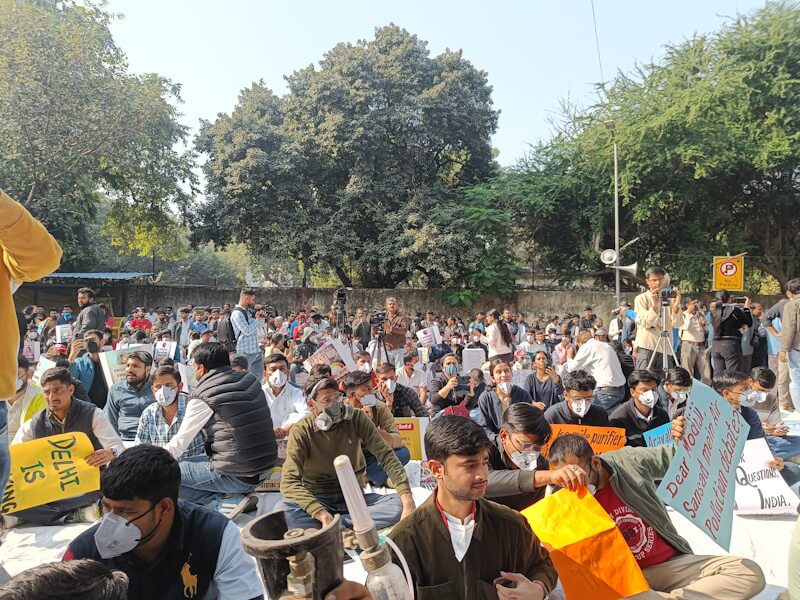
Photo: QoC File
Similar attempts are underway in Jaipur[34], Kolkata[35], and Bengaluru[36]. Left-wing organisations and forums such as the All-India Central Council of Trade Unions[37], the Awas Adhikar Jan Andolan[38] in Delhi; nation-wide movements such as the National Alliance of Peoples’ Movements[39]; and localised community efforts such as Jai Bhim Nagar Bachao Andolan[40] in Mumbai have been at the forefront.
These efforts are rooted in the belief that progressive ideas from urban social coalitions, combined with effective mass mobilisations, hold the power to force the necessary political action against inequalities, exclusion, and denial of rights to workers in urban India. However, at the moment, these efforts exist at the margins of mainstream electoral politics; they are yet to intersect. The Right to the City is yet to become a key electoral agenda. Informal workers across India’s cities continue to work, agitate to belong, and claim the city through practices of their everyday lives.
References:
- Bhan, Gautam (2013). ‘Planned Illegalities: Housing and the ‘Failure’ of Planning in Delhi (1947-2010).’https://www.epw.in/index.php/journal/2013/24/special-articles/planned-illegalities.html Economic and Political Weekly 48 (24):58-70 (15 June).
- Centre for Workers’ Management (2025). Decoding the Labour Codes: A Handbook for Workers, Delhi.
- Panwar, Tikender (2025). City Limits: The Crisis of Urbanization, Vintage: Gurugram.
- Pati, Sushmita (2025). ‘Bulldozers in the City: Economies of Excess and Repair.’ https://doi.org/10.1215/08992363-11767244 Public Culture (2025) 37 (2 (106)): 217–242 (May).
- Bhattacharya, Akash (2025).
- ‘India’s Bulldozer Problem’, https://www.theindiaforum.in/politics/indias-bulldozer-problem The India Forum (10 October 2025).
- ‘The New Labour Codes: A Disaster Disguised as Reform?’, Guest Lecture https://www.youtube.com/watch?v=JFYbRPMEOek at the All-India Professionals Congress Think Lab, 4 December 2025.
Dr. Akash Bhattacharya is a historian, lawyer and trade unionist based in Delhi. He is associated with the All-India Central Council of Trade Unions (AICCTU).
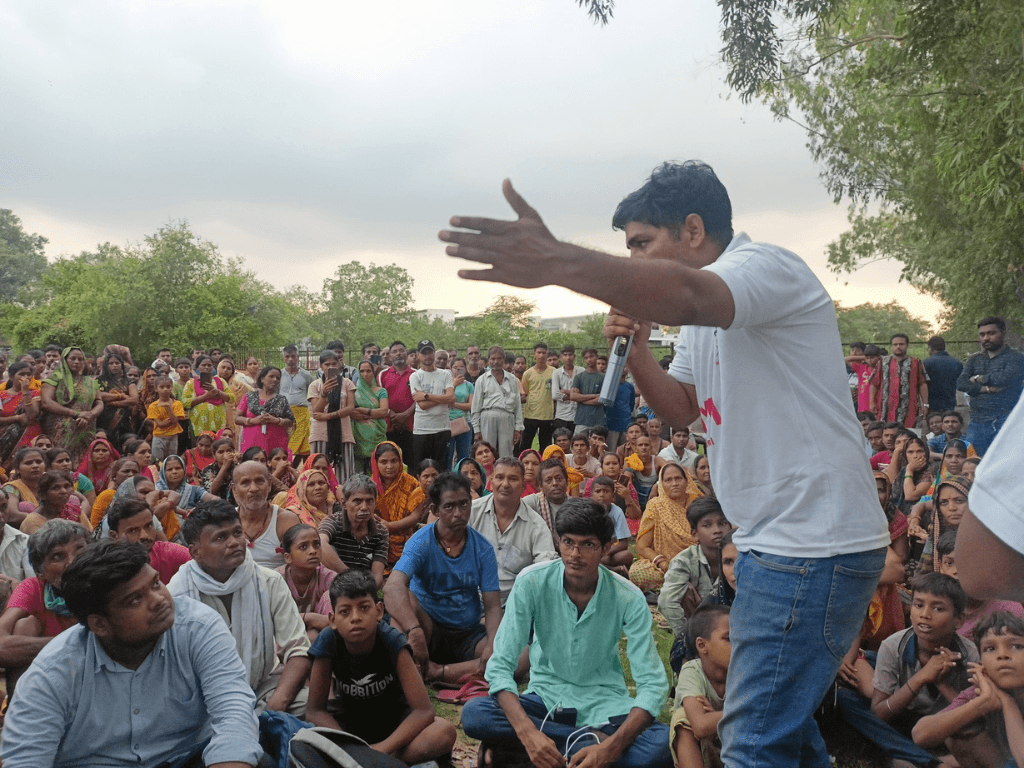
Cover Photo: Residents of Punjabi Bagh in Delhi attend a meeting on slum demolition
Credit: AICCTU