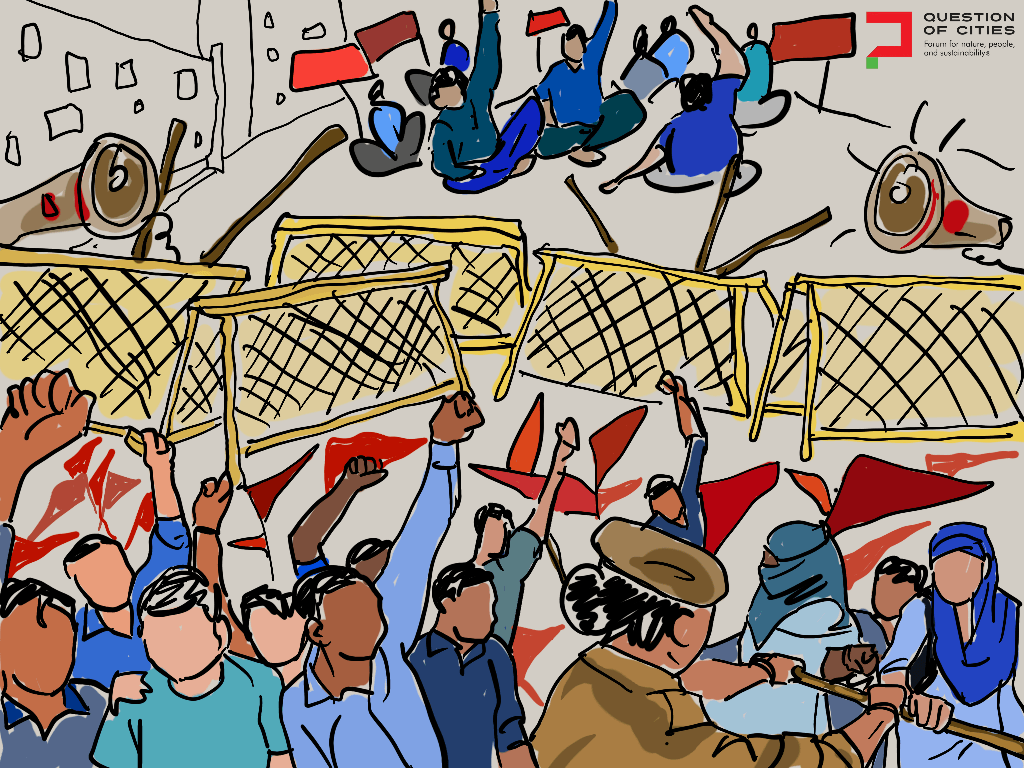

On April 9, around 7,000 contractual workers from several companies in IMT Manesar, Haryana, went on a strike, demanding increased wages, which had been stagnant for years, and improved working conditions. A day later, the Haryana government ordered a 35 percent hike[1] in minimum wages with effect from April 1, raising the salaries of unskilled workers from Rs 11,378 to Rs 15,646. But this was not without a crackdown on the workers — at least 55 workers were arrested[2], 20 of them women, over the violence that ensued during the demonstrations in Manesar, that too under grievous charges such as attempt to murder.
When this news reached Noida’s industrial area, 66 kilometres away, it inspired similar labour rights’ protests by contractual workers in the auto-industry, over their working conditions, especially in light of the LPG crisis. One worker speaking to the Print[3] says, “A small LPG cylinder has increased by Rs 350 to Rs 400 now. What should I send home?…I am saving nothing. I am living hand to mouth.”
On April 22, a sessions court in Gurgaon rejected the bail applications filed by some of the arrested workers. According to union leaders, at least 11 workers remain in custody. Outside the court, family members waited, visibly exhausted. They said they lacked the resources to pursue prolonged legal battles, but had little choice. For days, they have been running from one office to another, trying to secure bail for what they describe as their relatives’ right to demand fair wages and working conditions.
In the case of Noida, over 300 workers have been arrested[4], similar to Manesar, under grievous charges. However, activists put this number close to a thousand. Families of workers arrested for the Manesar and Noida protests are hassled, running from pillar to post to secure their release.
In Manesar, two first information reports (FIRs) were registered; workers named in one of them have secured bail. Four workers were charged with attempt to murder under Section 109(1), along with other provisions including Sections 115(2), 121(1), 132, 190, 191(2), 221, 223(a), 324(4), 324(5) and 61(2) of the Bharatiya Nyaya Sanhita (BNS), as well as Section 3 of the Prevention of Damage to Public Property (PDPP) Act, relating to rioting, obstruction and damage to property. They are yet to get bail.
In Noida, eight FIRs were filed against workers under Sections 191(2), 191(3), 190, 109, 115(2), 351(2), 352 and 324(5) of the BNS, along with Section 7 of the Criminal Law Amendment Act, 1932.
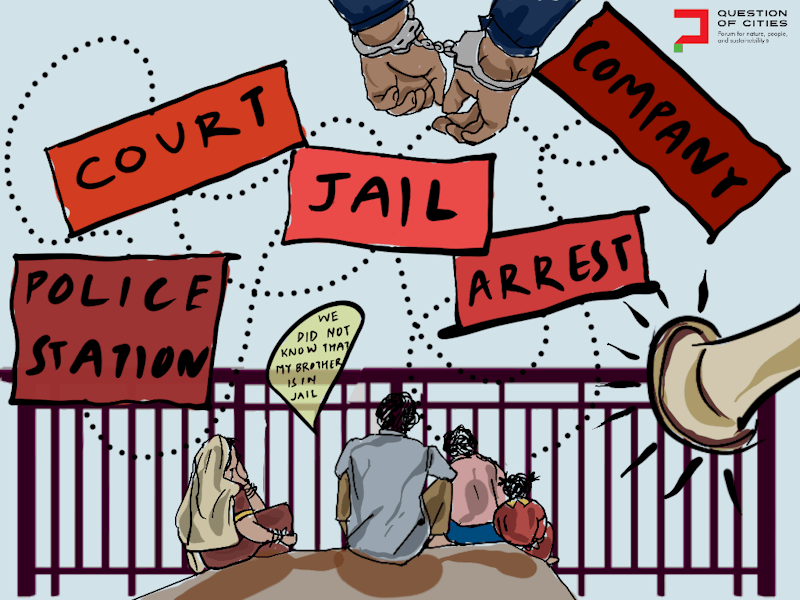
‘They have been trapped for no reason’
Sarvesh Kumar, brother-in-law of Abhishek Kumar
“We are from Uttar Pradesh. My brother-in-law is a young man of 23 years but working for around two-and-a-half years in Richa Global, Manesar. He earns around Rs 12,000-13,000 a month. He was supposed to get married on April 20 but he was arrested. We had to stop the wedding. He was picked up by three men from his rented flat on April 9 at 11 pm. When I went to the police station, they did not give me any information but hurled abuses and intimidated me, and said they would send me to jail. The next day, I went to the police station again. This time, there were many other relatives present, and they told us I would have to go to the court. I went to district court on April 10, but he was sent to jail.”
“They have been trapped for no reason. All are worried at home. The government is making this out to be a conspiracy. When I called the company and asked the manager or supervisor, they told me that Abhishek is innocent. He pays Rs 4,000 a month as rent. With the rise in gas prices, will a worker not demand higher wages? Abhishek told me there are at least four people locked up whose relatives do not even know they are in custody. Their families haven’t been informed.”
“I too have been working in a Manesar company since 2024. I work as an operator and am involved in making steering parts. My salary is now Rs 18,500. Our company is better than the rest as it takes care of workers if they are injured.”
‘My brother hasn’t even got his first salary’
Shyam Sundar Patel, 35, Noida, Uttar Pradesh
“My brother, who works in Rapido, has nothing to do with the protest but was picked up by the police. My 22-year-old nephew had joined the Motherson company 15 days before the protest. He had come to support the peaceful protest by other workers but he was also arrested. He hasn’t even got his first salary of Rs 11,000 a month. The police put pressure on the company and arrested everyone.”
“We have come here to Noida to earn, we live in a rented room. Our entire family is in Sheohar district in Bihar and depends on us financially. We hardly earn enough to survive. A lot of people are facing the same situation. The police randomly picked up workers and arrested them, some from a park, some from a market, may be to show numbers to the administration. People are still being picked up and random cases slapped on them. Who listens to the poor? None of them got bail on April 28; now, the next hearing is on May 5.”
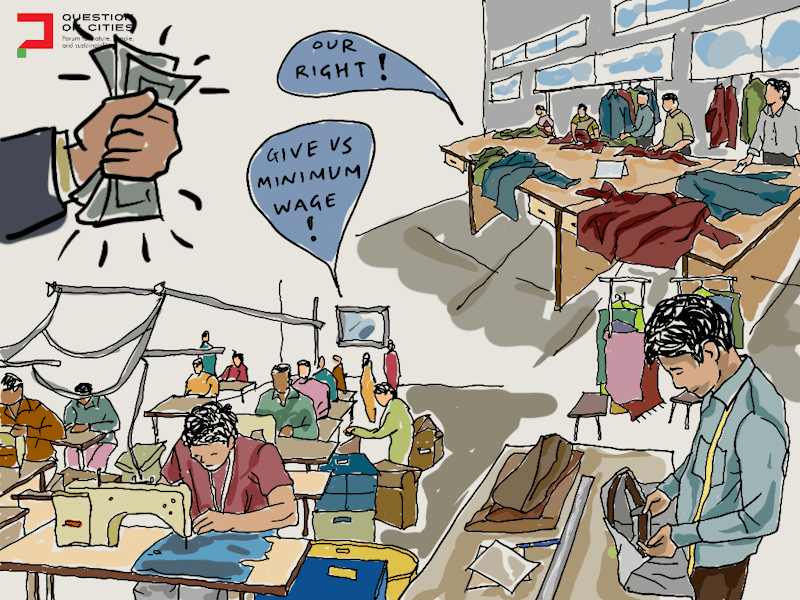
‘Industrial dispute has effectively been treated as a criminal matter’
Rakhi Sahgal, labour researcher and activist, Noida
(Sahgal was present when the police picked up the workers in Noida and has been helping them get bail)
“There was a lot of confusion initially. We didn’t have access to FIRs or even know the FIR numbers. Information was coming mainly through workers and their families who were meeting them in jail. Things were unclear between April 12 to 19. Under Section 151 of the Bharatiya Nyaya Suraksha Sanhita, people in preventive detention should be released within 24 hours, but many were held for five-seven days. My estimate is that around 1,100 people were picked up. There is no official data from the UP Police or the government. By April 19, around 1,000 had been released. However, arrests are still continuing. Workers say that they are being called back to companies and then arrested at the gate. Because of this, many have stopped going to work.”
“The arrests were procedurally flawed. Families were not informed at the time of arrest or were present during remand. In many cases, there was no clarity on whether detainees had legal representation, which is a constitutional right. When family members went to police stations to ask about the arrested, they were threatened and chased, even beaten. There was also confusion about whether people were in jail at all. The only way to check was to get a parcha to go inside instead of the police checking their computerised records. Family members were breaking down – there was simply no information about their relatives.”
“We still don’t have a complete list of those arrested — it remains a jigsaw puzzle that we are trying to piece together by going through remand registers, court records and some limited cooperation from one police station. But, overall there is no transparency. There are also reports that minors were detained, but the police are denying it. An industrial dispute has effectively been treated as a criminal matter. Peaceful protests are being handled as criminal activity.”
‘If he was involved in a riot, why would he roam around unafraid?’
Harivansh, Brother of arrested worker, Manesar, Haryana
“My younger brother, 40, has been working as a garment checker at Richa Global for the past four years. He used to get Rs 12,400 a month and his salary used to increase by a meagre Rs 10-20 a year. He liked having a stable job, so didn’t switch companies. As I was to travel to my village, Ajamgarh, on April 10 for a wedding, I was shopping with my children and him. While we were shopping, a man approached us and started asking us questions about where we work. He then called three-four people and took my brother to a black car, probably slapped him, and took him away.”
“When we asked where they were taking him, they said they were taking him to the company and would release him after interrogations. But they took him to the police station. The police switched off his mobile phone. We didn’t know that my brother was involved in a riot. If he would have been involved, why would he roam around without being afraid? The next day, a police officer called us. The cops had gone to the village and met his wife.”
“The financial situation was so bad that everyone, including my brother, was on strike. The more we worked, the more money we could earn so that our family’s expenses could be covered. This was his main interest. There were no cases against him. It’s difficult to survive these months due to the rising LPG prices and room rent, which is Rs 3,000-Rs 4,000 per month. My brother used to send money home. I work in the village and came here to get my brother out of jail. My brother is innocent but the most disturbing thing is that he has been put behind bars. He has two teen daughters and a 10-year-old son, all in school. How do we pay their fees?”
“When I met him in jail, I assured him that I will get him released. There are many others like him in jail.”
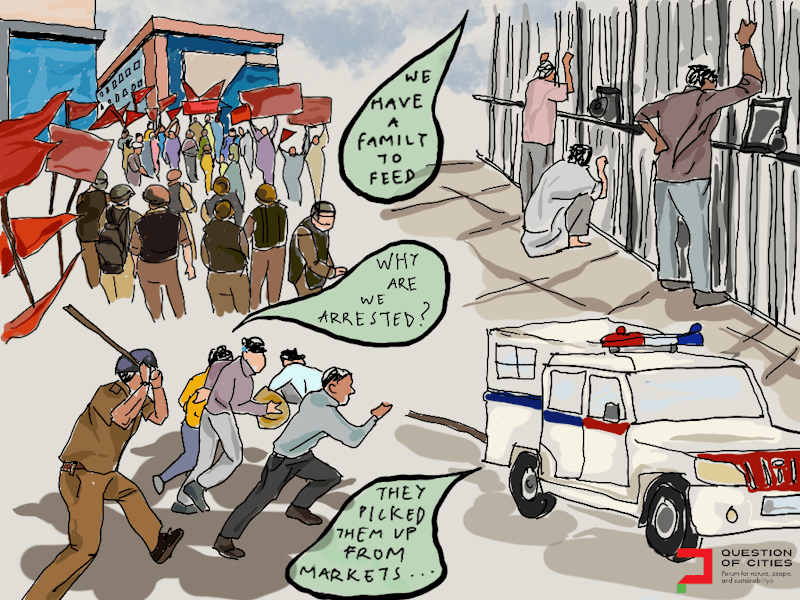
‘For two days, I was clueless about his arrest’
Praveen Kumar Chandravanshi, brother of Aravind Kumar, Manesar, Haryana
“My 24-year-old brother was working as a sewing operator at Richa Global for three months. He earns Rs 12,700 a month. Before that, he used to work in Chennai but I called him here. I work in Machino Plastics as a senior engineer. We live together in a rented room that costs around Rs 6,000 a month. For two days, I was clueless about his arrest. The workers told me that the police arrested him but I had not got any call from the police. I first went to the police station on April 10 but I returned without any information about his arrest and without meeting him. After asking around for two days, I came to know of his arrest. Some people reportedly came in civil dress and picked him up, beat him, and whisked him away in a car.”
“In the jail, he shares the cell with a murderer, apparently older inmates snatch food from him, make him do their laundry, and clean the room. He has been doing sewing work for 10-12 years, and has worked in Ludhiana, Delhi, Chennai. All that he and other workers of the company did was demand more salary. My brother had an 8-hour shift but had to work for 12 hours. They have arrested 11 people in all for that. My company does not have such problems. It employs skilled people; I get a salary of Rs 50,000 per month.”
“He came here three months back and liked it here. He used to get paid more in Chennai but it was too far. Our hometown is Sitamarhi in Bihar. I haven’t informed anyone at home because they will be worried. I’m getting married on May 8 but I have to keep doing rounds of the court and jail for my brother.”
Illustrations: Nikeita Saraf