
The plight of Rajasthan’s parched Alwar district in the 1980s prompted Dr Rajendra Singh, then an Ayurveda practitioner, to revive the waterbodies in the villages. The rejuvenation of tens of water harvesting structures made once-dead rivers perennial and improved life for villagers. Tarun Bharat Singh, the nonprofit he launched, then took this approach to thousands of villages, bringing more than 20 rivers back to life.
Dr Singh’s extensive environmental and water conservation work has won him many awards, including the Ramon Magsaysay Award in 2001 and the prestigious Stockholm Water Prize in 2015. “Rajendra Singh’s life work has been in building social capacity to solve local water problems through participatory action, empowerment of women, linking indigenous know-how with modern scientific and technical approaches and upending traditional patterns of development, resource use, and social norms,” read the citation of the Stockholm Water Prize.
Often called the ‘Waterman of India’, he spoke at length to Question of Cities about his journey and his concerns including India’s current obsession with riverfront development.
How did you come to be called the ‘Waterman of India’?
It’s an old story. In Gopalpur village, Rajasthan, an old farmer named Mangu kaka and a woman called Nathi Balai came for treatment. They could not see properly. After they recovered, Mangu Kaka said to me, “dawai aur padhai chhod do, paani ka kaam karo (leave medicines and education, do water work)”. He gave me a “PhD” in water in two days. After that, I stopped practicing Ayurveda, left my government job, and started working with water. This was in the 80s. We took up the first river, the Aravari.
In the 90s, the Aravari started flowing. The media came to see how a river that was dry for decades had been revived. A journalist who came from Bombay was Darryl D’Monte. I don’t remember which newspaper he wrote in but it was a detailed story. The stories in The Times of India or The Hindu had headlines calling me ‘Waterman of India’ which stuck. India Today called me ‘Miracle Man,’ villagers call me Paaniwala Baba, some say Jodhawala Baba. Whoever likes a name uses it; I call myself Rajendra Singh (laughs).
How long was the Aravari and what magic made the dry river flow again?
This river is 602 square kilometres, flows for about 46 kilometres, and has 72 villages on both sides. It’s not a very big river but not small either. It was possibly the first time in the history of India that a dry river became perennial. It’s magic, a story of continuous love with nature, a story of love for water. Water made us crazy, we made people crazy, and they worked with madness. The river began to flow, became perennial. The Aravari taught me to flow like water. But when there’s water, there are looters beginning with the government; the fisheries department gave out three contracts as soon as there was water.
His story of ‘falling in love with water’
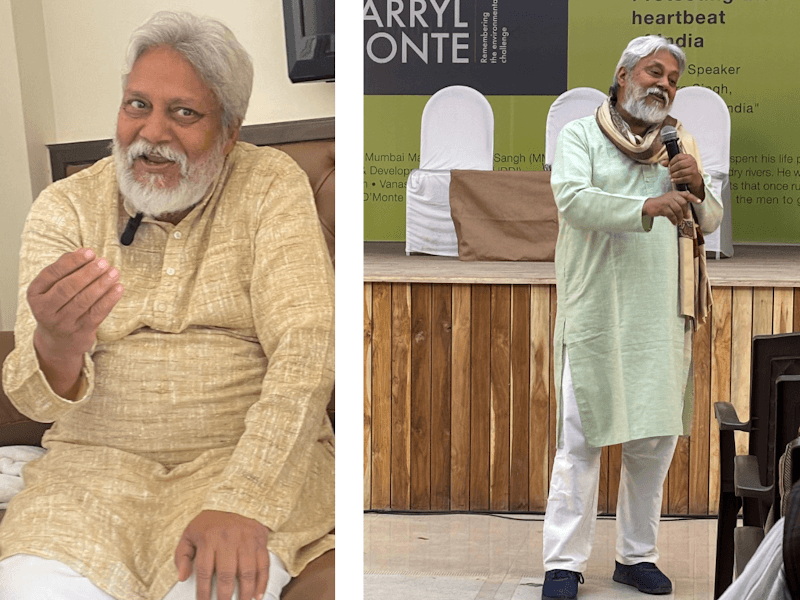
Photo: QoC File.
Tell us how the river was flowing again.
It’s scientific, old knowledge. We made ponds at places, and built small dams where there are confined vertical fractures on the ground. When it rained, the water went below the ground through those fractures. The sun could not ‘steal’ the water; if it was on ground, it would have evaporated. This water was deposited in the real ‘Reserve Bank’ below the earth. You think the Reserve Bank of India is in Mumbai but the real one is below the ground; it holds water, the water brought by the clouds from Mumbai and the Arabian Sea.
Most of it is spent before the clouds reach Rajasthan but some remains. Getting water from them is done by the Aravalli hill range, the only mountain range in India from the North to the West. That’s why it’s called Ada Parvat, which obstructs. Another name is Araval Parvat. It has many names locally. When the clouds came against it, they collided; that gave us a little water. We had to gather it and guide it to Mother Earth, always the merciful one. When she was full, the excess water poured out of her and became the Aravari River.
This is science with sense. The villagers sing about it.
The clouds come with the water.
It rains on the earth.
When it rains, it runs on the earth.
Teach it to walk.
Then teach it to walk.
When it starts walking, look at the open stomach and sit in it.
Then it will not catch the eye of the sun.
Take out that water and run your life.
This is also community science. This awakened me. The knowledge of Ayurveda combined with the knowledge of the water and the community. It connected the scientific and the spiritual; it made me a water lover. A connection exists between mountains and rivers; they cannot be separated. Indian people have had this knowledge although documentation may not be there. They live with this knowledge; it manifests in their behaviour and culture. It’s practical, but also cultural and spiritual. We have forgotten it all in the last 200 years since Lord Macaulay emphasised education over knowledge. Knowledge is the basis of our culture; education is limited, makes us egoistic, we lose emotional intelligence. What Mangu Kaka and Nathi Balai taught me about water was the feeling and knowledge. So, the work never felt a burden or that we are doing for others.
Science with sense and community
The government thinks the Aravallis range is a hurdle and wants to cut it.
See, the Aravallis is a hurdle for the clouds, and should be, but not for us. After the Supreme Court judgment of November 2025,[1] the people of the Aravallis taught the highest court of India that when it decides for some people’s greed without respecting the Constitution, then the democracy of India will rise. The people forced the court to stay the judgment which was clearly for greed and by pressure. I know both.
Please tell us.
We have known for a long time that the Aravallis have rare materials and minerals. Right now, only one industrialist in India is allegedly very influential everywhere, from the Prime Minister to the courts. But the judgment was not only against the Aravallis; it was not in the light of the Constitution. When that happened, people stood up. That’s what you saw in the Aravalli agitation in November-December. Our Constitution is comprehensive—Article 21 protects life; Article 48A is for the conservation of rivers, lakes, mountains; Article 51A and G list the moral duties of people. It gives protection and equal care of both human rights and ecology. The Constitution was largely followed before 2014. Then, institutions become ineffective. People have to rise and remind the institutions of constitutional truths.
A month later, the SC stayed its decision.
The people’s movement which started in the Aravallis spread to the rest of the country and could have gone out of hand. By holding the judgment in abeyance,[2] the SC and the government took some air out of the movement. However, I want to tell both that the people of the Aravallis, like Maharana Pratap, ate grass as food but fought for independence; they won’t allow an anti-Constitutional judgment to prevail. Now, this debate is no longer in the court alone. The people are debating it; they can cross the line any time.
The Aravalli is among the oldest cultural and natural systems in the world. If we cut it for mining, it cannot be re-made and the climate of north India will be badly affected. The clouds from the Bay of Bengal and the Arabian Sea collide with the Aravallis and are discharged in Rajasthan, which has a shortage of water. The integration of the Aravalli with our ecosystem is very deep; the government and judiciary should together save it.
The Aravalli mountain ranges
Riverfront development is happening all across India. The Sabarmati riverfront development has become the model, replicated everywhere from the Gomti in Lucknow to the Mula-Mutha in Pune. How do you see this?
I will start with the Sabarmati project, right opposite the Gandhi Ashram. I was against it. The river was made into a drain by constructing walls, land was taken away from people, and lots of money was made. If there was to be a model, it should have been to make the Sabarmati a pure, eternal river. The riverfront development was nothing but turning the river into a canal.[3] This model is being replicated in other cities. There is only one planner-designer-engineer who knows rivers and plans their development. He is from Gujarat. His name is Patel.
When I was working in the Mula-Mutha, he came one day to talk to us there. We told him: ‘You could do it in Gujarat because Gujarat’s mathematics is money. Maharashtra’s mathematics is not money. People here understand the culture of the river. There was no one to speak against you in Gujarat but people will stand up against you in Pune…Right now, the government is yours, so you can do all this’. Despite the fierce opposition, the government has gone ahead with the Mula-Mutha project.[4]
In the whole country now, in the name of beautification and riverfront development, the work of money is going on. Now, the name has been changed to ‘river rejuvenation’ (laughs), the thief always knows the right words. But the people of this country know. This riverfront development is nothing but the murder of rivers, it’s turning rivers into drains. People have protested, gone to courts, but projects are implemented. As long as the ‘Patel government’ is in power, no one can stop it but it will not always be there. Forgive me for saying it this way but what’s being done to rivers now is a sin. In the country where rivers become drains, corruption pollutes culture. And where drains are made to flow like rivers, culture starts flowing. But we have some seed of hope. Some people take time to rise.
The Sabarmati riverfront development model
You place faith in people’s power but not in the courts. Why so?
Look, the court is not working like the court; I see it working for the government. There was a time when the court meant justice to people; not so anymore. I am not accusing everyone, I have a lot of respect for the honourable judge. Despite that, I say that we are in a situation where the court is not giving us justice. The court today has no time to listen to petitioners because it is drowning in pendency. When every violation must first happen before the Constitution can be invoked, the docket can only grow heavier and the people’s voice fainter.
So, what can we do? We have to stand tall like the Aravallis, like the people of the Aravallis. See what happened in Vadodara. When people came together and fought back, they were able to stop the riverfront development work on the Vishwamitri.[5] When the movement includes all sections of society and they stand up for truth, it is Satyagraha.
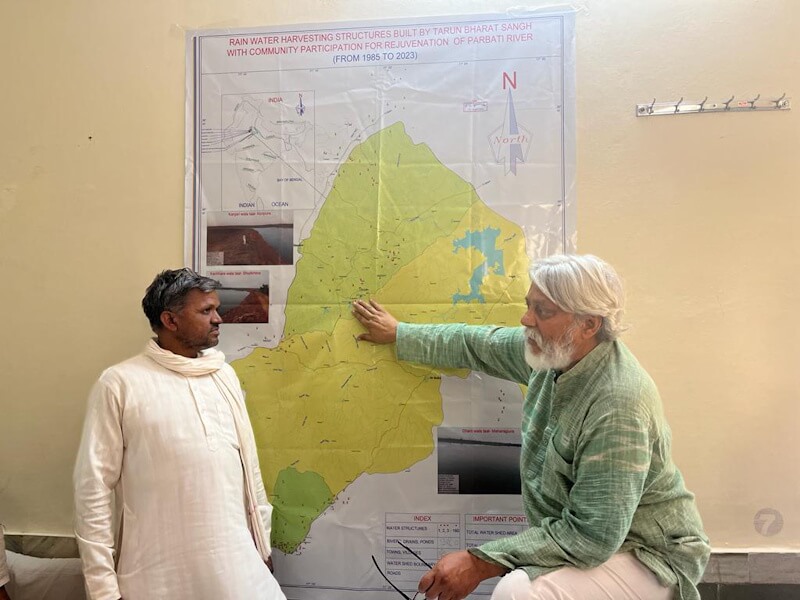
Photo: Tarun Bharat Sangh
How did the people of the Aravallis come together? Where did their power come from?
There is a difference between the movement in Vadodara and in the Aravallis. People stood up on a large scale in the Aravallis. To understand this, we have to go back. In 1988, in Palpur village, Jhansi Meena said to me: “Rajendra, you can do as much work on water as you want, but who will get water in my well?” This was because of the mining. “Stop this mining,” she said, “But they are evil people. If you work against mining, don’t think about life.” She assured me that if I started, people would join. Similar things happened in Tilwari, Chotelal, Meenawal villages. People joined. In 1991-92, hundreds of mines in Sariska were closed.[6] These were all legal mines with the forest department’s permission on forest land.
We didn’t sit at home. Including Alwar and Gurgaon, mines in six districts were shut down. We fought with the same strategy for the Aravallis. After the order on our petition on May 7, 1992, when mines did not shut down, about 500-600 people marched to Raisina Hill in Delhi in October 1993. Raisina Hill, where the Rashtrapati Bhavan and Sansad Bhavan stand, is a part of the Aravallis. The then Lok Sabha Speaker, Shivraj Patil, messaged that he would come to Gurgaon to meet us.[7] Now if you protest, you will be in jail or not allowed to enter Delhi. So, we had everyone’s numbers from 25-30 years ago. When the SC gave its judgment last November, that diary was taken out. So, you saw hundreds of people standing up in no time. This agitation happened because of the groundwork of many years.
This is fascinating because, in Mumbai, the campaigns to save the mangroves or forests have not seen people join in large numbers.
See, there is a difference in the culture, religion, and livelihoods of people in different places. Everyone stands up for ecology in the Aravallis but, in some places, we cannot expect that. It’s a process-–always, there’s education, then creation, then work, and finally Satyagraha. The Aravallis agitation has passed through all four stages. This was a positive agitation-–for the Aravallis-–not a reactionary negative one.
Media and the Aravalli movement
There are stories about dacoits turning farmers in the ‘badlands’ of Chambal. How did this happen?
Rajasthan’s Chambal region, Karauli, and Dholpur districts were nurseries for dacoits from all over. We did not directly start working with the dacoits. I was not such an influential man as Vinoba Bhave or Jayprakash Narayan. I did not focus on the surrender of guns but began working with the wives of the dacoits. They were very poor, helpless, ill. We made their land suitable for agriculture. Then, I worked with them on the rivers. In Chambal, we revived 12 rivers including Sherni, Bamaya, Maheshwara, Parvati. When the rivers went dry, the civilization went dead, it was in the gun. When water flowed, civilization and culture too flowed. The men came around, gave in to their wives’ demands to drop the gun, and surrendered. The flowing rivers turned rebels and dacoits into farmers.
Here and in other areas, how did you draw out the women?
Look, women are more serious and sensible than men. When they got money from farming, they began asking their dacoit husbands why the men had brought them there if they wanted to be in the jungle with guns. And assured them that those who got them water would handle the police cases too. When they spoke to their men, they had food, grains, drinking water and a life. They got respect. That strengthened them, helped make their husbands sensible. The women of India are more sensible than the men.
The ancient people of India considered neer (water), naari (women), and nadi (river) as Narayan (Divine). They used to say, water means life and rivers give birth to all cultures. I worked with that. Now, water is a business and women are not respected.
My thinking was that, from childhood to old age, women do the work of water. When there was division of work, women smartly took this up. It’s a different thing that when there was no water in the villages, they faced a lot of difficulties. Women nourish; so does water. The relationship is very deep. With this understanding, I believed that those who work with water must also work closely with women. We persuaded women to come out of homes and engage in this work.
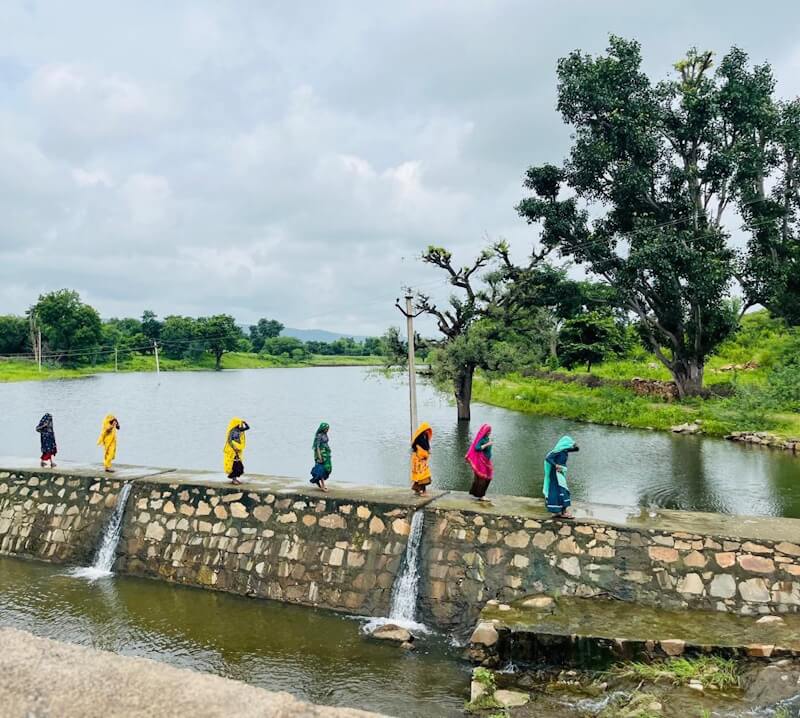
Photo: Tarun Bharat Sangh
Why did the women of Alwar and Chambal listen to you?
I will tell you why. I used to go and sit with them. Those were their bad days; no one listened to their woes. The first woman I trusted was Gopalpura’s Nathi who then explained to others that I would get them water. We did the work, not words but work with hands for 10-12-16 hours a day. They saw it and began to trust. Slowly, women became a part of the work. When you work together, you trust each other. Secondly, I stood by them in their pain and suffering. And thirdly, I didn’t leave the villages for five years. They saw me day and night, how I lived, what I did, ate and drank. That helped. Now I travel a lot-–Mumbai, London, Chicago-–but back then I didn’t leave the villages. People have faith in what they see. It’s not just reviving a river, this work revived people’s lives, bringing people back to life. So, the entry point is love, then action and realisation, then internalisation, then vishwas or trust, then comes shraddha. I am now in the state of shraddha.
How many dacoits surrendered?
I know that 6,332 dacoits abandoned their guns to work in farms and with water.[8]
But we have never seen your photo with any.
Did we do this for a photo? (laughs) We did not work for celebration; we did this for prosperity. We don’t need photos to show, not at all.
The undocumented traditional knowledge
Your work also spanned bigger horizons about policies on mountains and rivers. You did both together, the work on the ground and thinking about policies.
We are working on a mountain policy which India does not have. When you work on land, you quickly realise how it is influenced by policy. Then, one gets into it. In 1996, I made the draft of the Groundwater Control Act to stop the discharge of groundwater. Then, Maharashtra made its groundwater control law under which it manages watershed development, groundwater recharge.
And now you are working on the mountains?
Now, the policy of the mountains. There is no law that exists. We have prepared a draft. And we made this from the Aravallis. Whatever I did or do, it was not because someone told me to but from the realisation that comes from work, from the movement. After 50 years of work, I believe that India must have a law of the mountains.
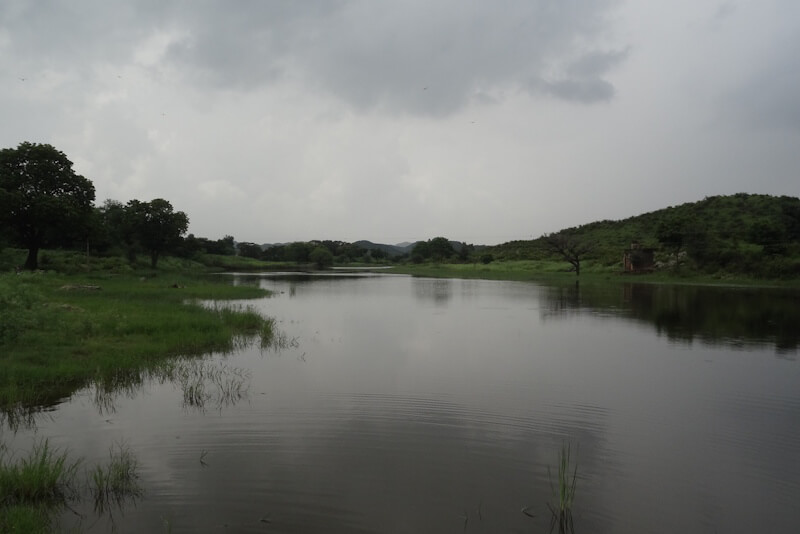
Photo: Wikimedia Commons
How many rivers and villages has your work touched?
In the early days, when we talked about rivers, it was written as five rivers, sometimes as 12. But the number of rivers we brought back to life is 23. And about 17,000 or 18,000 villages in Rajasthan, also in Maharashtra, Madhya Pradesh, Uttar Pradesh, and Karnataka.
Did each state call for something different?
From site selection to execution, community mobilisation to contribution, everything was different. There cannot be a common model; only a common vision of community-driven, decentralised water management. Only this is sustainable; this is my vision. The actual work cannot be replicated. The nature of water, the culture of water, are different. In India, the combination of nature and culture helps create our landscape. And the design of our work in that landscape has been the relationship of humans and nature. When we work this way, there’s no displacement. Development that’s free from displacement, distraction and disaster is called Sanatan Vikas or, in English, sustainable development. Sanatan is not a Hindu word.
‘सदैव नित्य नूतन निर्माण चरैवेति चरैवेति आदि अनंत ।’
Means तुम चलते रहो, तुम चलते रहो, ना तुमारा आदि है, ना तुमारा अंत है
(You must keep going, there is neither a beginning nor an end)
This is Sanatan.
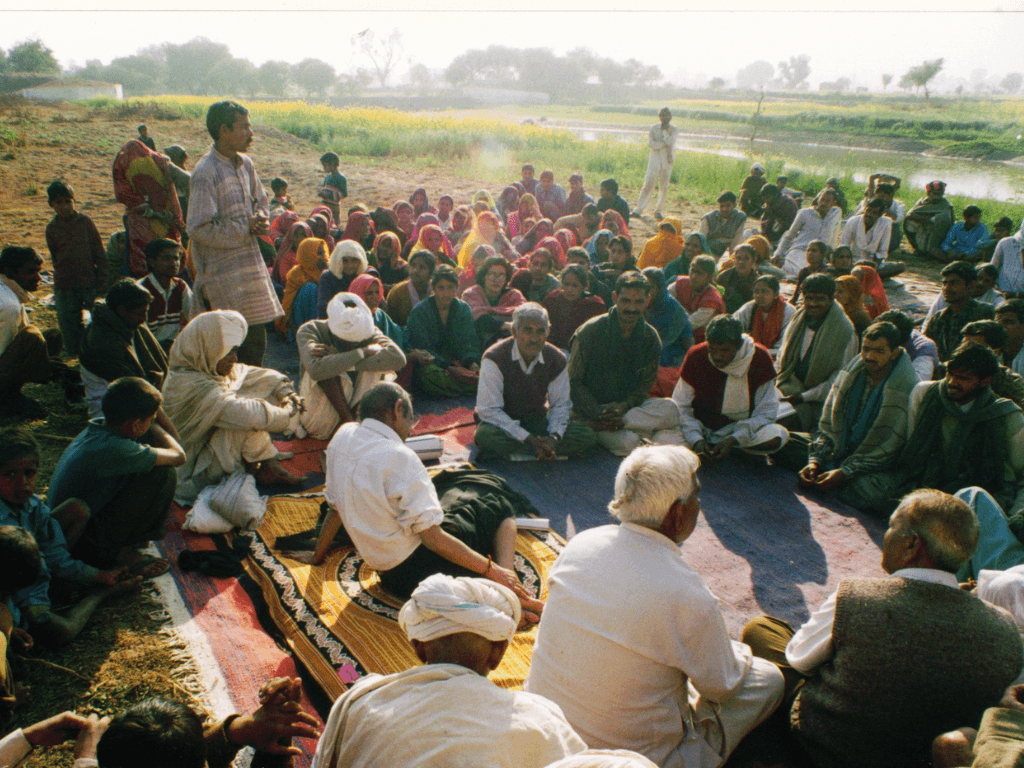
Cover Photo: Villagers at the Arvari sansad organised in Hamirpur, Rajasthan.
Photo: Tarun Bharat Sangh