
The Ramkund in Nashik is legendary, drawing people from far and wide. It is a sacred pool within the Godavari River, about 35 kilometres from the river’s origin at Trimbakeshwar. Located in Panchvati area, in the heart of the old Nashik city, the legend goes that Ramkund was where drops of nectar fell during the Samudra Manthan or the mythical churning of the ocean.
My ancestral home of over 150 years is in the Ramkund area and I continue to live here. The house remains cool inside even during peak summer and has a living spring: Uma Tirtha. It is a small kund fed by natural springs inside the house with cool and crystal- clear water. During the 1972 drought in Nashik, we gave water of this kund to people and to temples like the Kapaleshwar Mahadev temple for abhishek rituals. The Uma Tirth made me realise that natural springs replenish other kunds in the area too.
However, barely 200 meters downstream from Ramkund, the 17 historic kunds and the channelised Godavari River often run dry which shows up the water management.
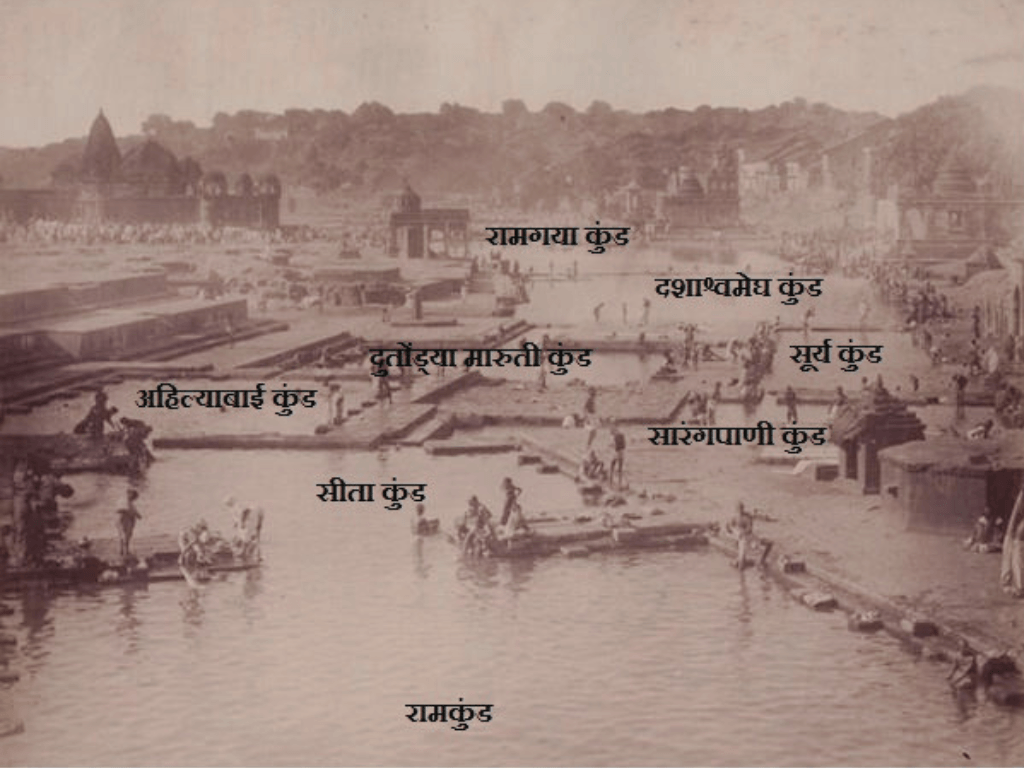
Geographically, all these 17 kunds located in Panchavati were built in the 17th or early 18th century under the guidance of Gopikabai Peshwa, Maharani Ahilyabai Holkar and Peshwa Balaji Bajirao. There is no kund in the upper stream beyond the Holkar bridge or downstream towards Tapovan, which is why this is considered the holy stretch for religious bathing or dips during the Kumbh.
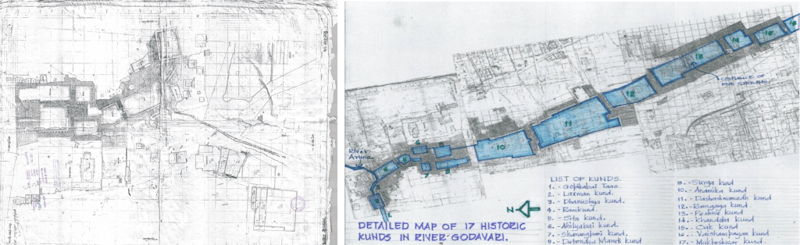
Photo: Devang Jani
According to the contours of this region, the Ramkund area is the lowest point in the river’s stretch, thus supporting aquatic life before concretisation in 2002. The Department of Land Records (DLR) and city survey office map of 1917 as well as the Bombay Presidency Nashik Gazetteer of 1883 has photos, maps and information on the presence of the 17 kunds. Some descriptions in the Gazetteer are as follows:
‘Across the river, in the hollow of the first bend, lies Ram Kund or Ram’s Pool, the holiest spot in Nasik, surrounded by handsome shrines, temples and rest-houses, and with the white dome of Kapaleshvar’s temple rising behind it. ’
‘At the foot of the steps leading to the shrine is a small village consisting of three or four Gauli huts, two drum-houses or nagar khanas and three rest-houses for the use of pilgrims. The place is well supplied with water from springs built with masonry sides and with steps leading to the water, and called Kalikund (26 X 24 cubits)…”[1] [2]
The kunds listed in the Bombay Presidency Nashik Gazette 1883 and other sources include the following: Gopikabaincha taas (1761-1772); Ramkund (1696) reconstructed by Chitrarao Khatav; Lakshmankund (1758); Dhanushya kund; Indra kund; Sita kund Ahilyabai kund (1766 to 1795); Sarangapani kund (1779); Dutondya Maruti kund; Paach Deool kund (1758); Anamika kund (now de-concretised); Dashashwamedh kund (1768, now de-concretised); Ramgaya kund (1763 to 1780, now de-concretised); Peshwe kund (1720 to 1740, now de-concretised); Khandoba kund (now de-concretised); Oak kund (1794); Vaishampaya kund (1870); and Mukteshwar kund (1788).
Channelising the river into a tank
Upstream of Ramkund, there was a well so deep and wide that it was called the Saat paras khol Vihir (well of seven wells). I was told that the contractor needed more than 500 truckloads of debris to fill it up. The Gandhi talao, a part of the riverbed which was reclaimed in the 1.5 kilometers Ramkund stretch, needed over 22 days to be concretised. That is how long it takes to kill a river stretch. I saw it all from my balcony in 2002. In the 1991 Kumbh Mela preparations, the Aruna River was buried, filled with concrete, shortly afterwards turned into a pipeline and, in 2014, a road was built over it. The Indra kund, fed by the Aruna, still fills up with water.
The concretisation of the Godavari was done similar to constructing a slab in a building by casting one on the river bed using steel reinforcements. This obviously blocks the natural springs and the river runs dry. Godavari was a self-sustaining, though rain-fed, river but was made dependent on water from the Gangapur dam due to the concretisation. Before the concretisation, there were natural springs, rivulets and tributaries which were sources of water even during the summer. These kept not only the river but also the kunds healthy and replenished.
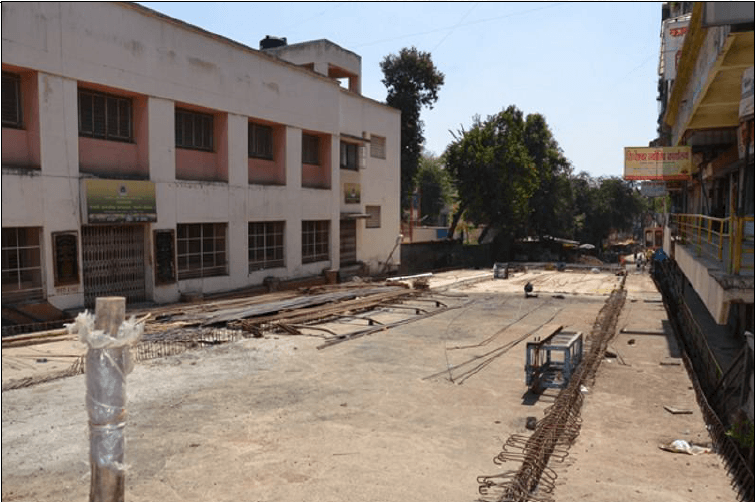
Photo: Devang Jani
The Bombay High Court judgment, on my petition, was in our favour. Since then, in the last 12-13 years, we have been consistently fighting to de-concretise all the kunds. On my PIL 82/2015, the Chief Justice of the Bombay HC directed me, on January 17, 2017, to submit a representation regarding this to the Nashik Municipal Corporation (NMC). After I received their reply in April that year, the task of removing the concrete from the ancient kunds was entrusted to the Nashik Municipal Smart City Development Corporation Ltd (NMSCDCL), who prepared the Detailed Project Report and completed the necessary legal formalities and paperwork.
At this time, we have been successful in giving new life to five of the 17 kunds. A staggering 3.5 lakh kilos or 165 dumpers of cement concrete was removed from these five kunds by June 8, 2020. The floodline was reduced by 3.5 to 3.75 metres after this de-concretisation. Earlier, even with a little rainfall, residents along these stretches of the Godavari had heavy flooding; it has since stopped. The de-concretisation allowed the water in the kunds to breathe and also also provided a supportive ecosystem for the disappeared aquatic life to return. The springs now feed these kunds; the water is usually used for washing and bathing.
The truth is that this is the job of the sadhus and Akhada Parishad members to talk about the concretisation and fight for their river. They are not doing it, so we have to. It is sad to see they do not muster up the courage to speak up and hold the authorities responsible.
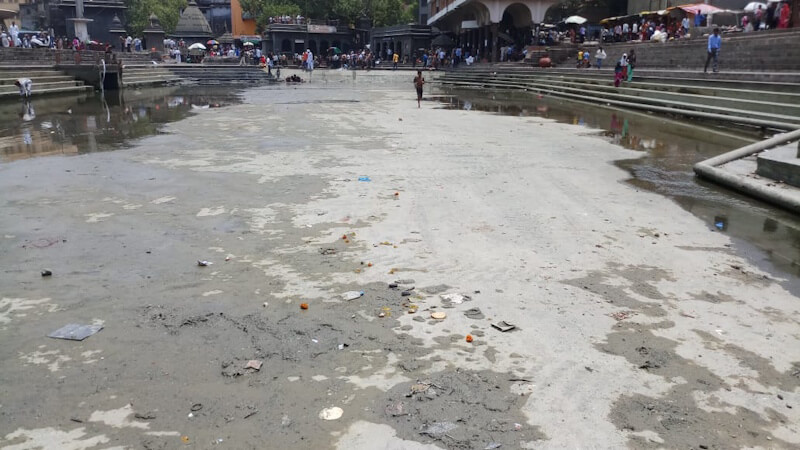
Photo: Devang Jani
Natural springs, groundwater and the way forward
The work and court judgment is not just about removing the concrete but also about preserving culture, water systems, ecology and traditions. The Groundwater Survey and Development Agency (GSDA) and the Survey of India had done a study to understand the effects of river bed concretisation on water seepage. At the identified spot near Ahilyabai Holkar kund, they found 1.5 inches of water at a depth of 80 feet. After monitoring the water output from the spot over 24 hours non-stop, it found that 44 litres of water was being let out in a minute. This means that the sources of water — natural springs and streams – are still present in some form in the Godavari river bed despite the concretisation.
The Smart City workers dig deeper to 120-140 feet for construction works proposed in the mission. They found an output and overflow from that depth into the river, even during the dry summer months. Under the Smart City Mission, there was a lot of work on underwater sewer lines and they came across many similar output points, streams and natural springs. Restoring the river is dependent on allowing the natural springs to flow. Currently, we are in talks with Nashik Municipal Commissioner Manisha Khatri for the de-concretisation of Ramkund and the remaining 10 ancient kunds.
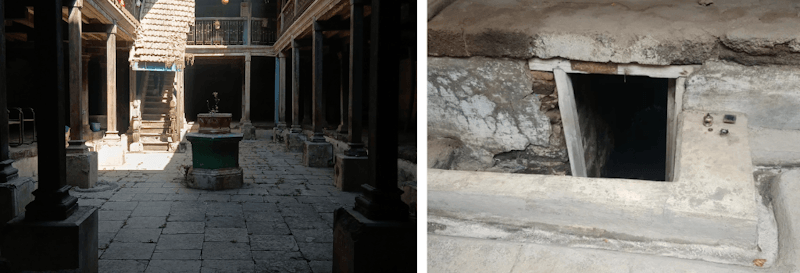
Photo: Nikeita Saraf (left), Parineeta Dandekar, SANDRP (right)
Since my family has been living here for 150-years, we have great attachment and love for the river. I was very young when the concretisation was done and did not understand it fully. But when the river got polluted due to choking, I began to do research. As the water of the river became stagnant and dam-dependent, and the natural springs got concretised, the river started getting polluted. Before the concretisation, you will not find a single news report in any publication about the Godavari being polluted even when sewage was being let out into it. The river was able to digest all of it because it had flowing water. Recently, after almost a decade, the Ramkund and Sitakund were completely dry for two-three days, after they were deliberately drained for construction work.[3]
Maharani Ahilyabai Holkar took 29 years to build the Ahilya kund with an uninterrupted flow of the Godavari. These days, engineers, architects and contractors want to finish the construction in six months. They don’t know any remedy or method other than concrete and cement for construction work. They get a lot of money from the state and the Centre for these projects; the Simhastha Kumbh Mela has a funding of Rs 35,000 crore[4] and Rs 111 crore Ram Kal Path project.[5] Most of the time, these projects are rushed and there is no monitoring or scrutiny of how they are executed.
It is important to understand the geographical conditions of a river and diagnose the faultlines correctly. Ground water is not simply water that we get from underground. There are different ways in which it reaches us. In the case of Godavari, the rocky terrain has a lot of fractures, through which water seeps after it reaches a certain level and fills up the kunds or river beds. For the Kumbh Mela, the state and central governments have approved Rs 44 crore[6] for the Godavari. This should be first used towards rejuvenation of the natural springs and improving the river’s health; beautification can be taken up later, if at all.
Devang Jani, a Commerce graduate, is the president of registered NGO Godapremi Seva Samiti. He has been working towards the de-concretisation of kunds in the Godavari river basin including filing a Public Interest Litigation (PIL) in the Bombay High Court. The judgment led to five of the 17 kunds revived under the “Goda Project” of the Nashik Smart City initiative. The struggle continues to free the remaining. For his extensive work, he has been awarded the Jaldoot Award, the Panidar Manus Award and the Better India Award.
Cover photo: The original ancient kunds of Panchvati. Credit: Devang Jani