
In 2025, the Brahmaputra Riverfront Development (BRD)[1] emerged as one of the primary sites of my inquiry as I began my doctoral fieldwork in Guwahati. My research was on the infrastructural politics of the city. In June that year, during my first visit to the site, construction was already underway along the river bank, concrete structures were being shaped, and metal barricading lined the water’s edge. The project’s ambition was on a large signboard: “Development of Brahmaputra Riverfront from New DC Bungalow to Kacharighat”.
Past the barricades, the outlines of the new vision were gradually taking shape. What struck me was not the vision reflecting in the construction but the nature of the transformation itself. This riverfront project was seeking to change the relationship between the river and the city through a carefully curated landscape of promenades, viewing decks, recreational spaces, and lighting. It was pitched as a flagship urban beautification project to rejuvenate a 1.2-kilometre stretch between the New DC Bungalow and Kacharighat into a commercially developed space to attract tourists and put Guwahati firmly on the tourist map.[2]
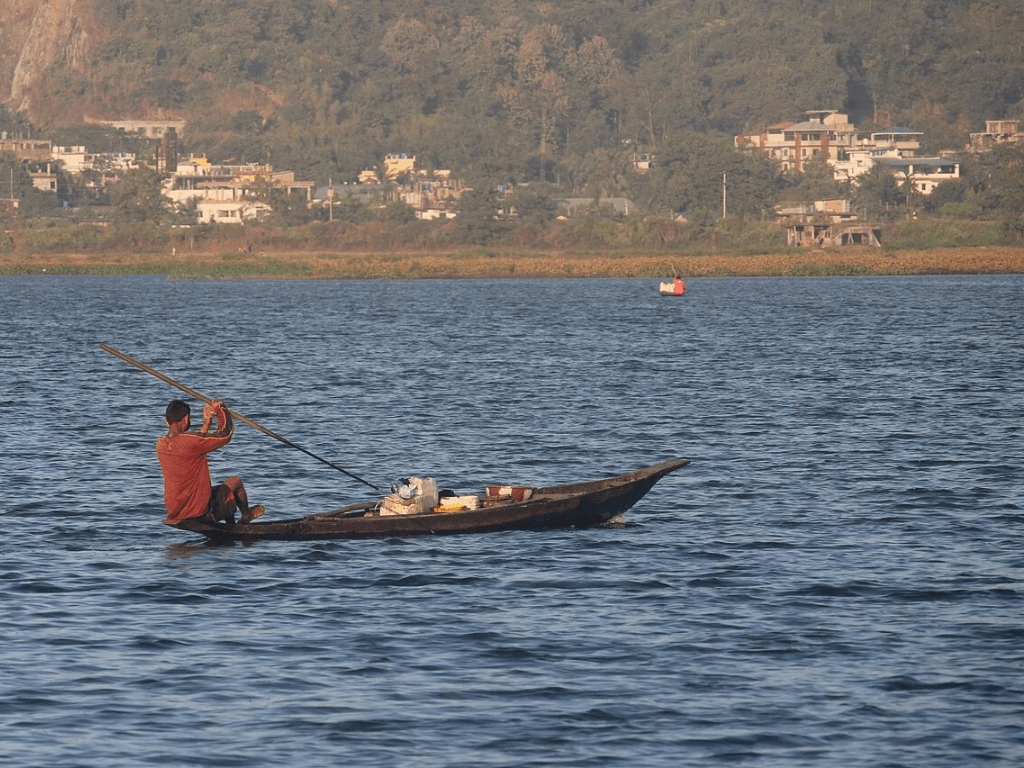
The transformation changed the place itself. For ages, this urban stretch of the Brahmaputra was a relatively open and loosely regulated public open space. The river bank drew hundreds of people every day to sit or walk along its stretch, watch the river, and feel its quiet rhythms. Sundays invariably saw the weekly vegetable market and the fish market effortlessly situate themselves on its banks for customers, many of them regulars. This 1.2-kilometre stretch of the Brahmaputra was a part of people’s lives in a seamless and organic way, integrated into their lives and activities.
In December, when I returned to the site, it had already become a beautified space, inaugurated with fanfare, replete with landscaped gardens, walkways, decorative lighting, and a monumental entrance gate. If the imagination and scale of the project was questionable, the speed of execution was striking. The inauguration had been turned into an event–-high-profile political participation, slick images of the new constructions, significant media coverage, and well-positioned social media feeds.
The project came up repeatedly in Guwahati’s conversations–drawing particular attention to the scale, the speed, and timed to the April 2026 state election.[3] Each conversation returned me to the question that had gnawed at me throughout the fieldwork: Why had this project become so important and what was its visibility doing?
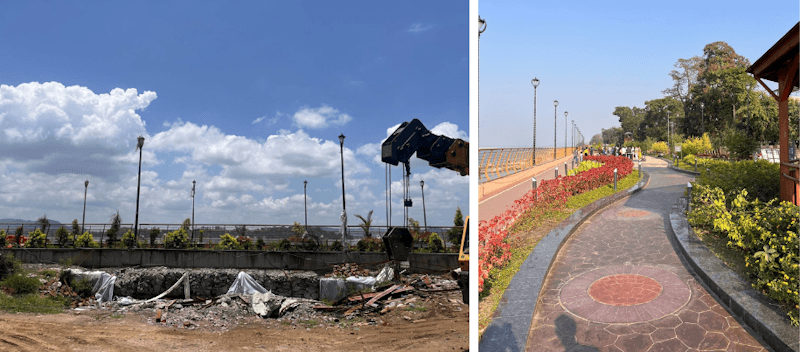
Photo: Purba Barua
“Guwahati is the only city without a riverfront”
During my fieldwork, a senior government official from Guwahati made a remark that caught my attention. “Guwahati is the only city without a riverfront,” she said. Although a matter-of-fact statement, it seemed to carry weight. On the one hand, it was symbolic of the larger picture about the city’s place in contemporary India but, on the other, implicit in it was Guwahati’s comparison with other cities that had transformed their riverfronts into iconic public places, notably Ahmedabad’s Sabarmati Riverfront.
The absence of a beautified riverfront in Guwahati, it was increasingly clear, was not seen simply as a missing piece of the built infrastructure but perceived as evidence that Guwahati has somehow fallen behind in the urban infrastructure parameters of the moment. The rapid inauguration of the BRD in November 2025 must be understood in this context.
Its opening coincided with a politically charged moment in Assam, in the run-up to the last electoral cycle. It was widely publicised, attracted significant media attention and political visibility. For the ruling government of the Bharatiya Janata Party (BJP), which increasingly relied on the language of infrastructure delivery and development to demonstrate governance and consolidate political legitimacy, the riverfront offered a powerful visual symbol and tangible evidence of development —something that could be visited, displayed, photographed, circulated, and celebrated.
But its significance extends beyond electoral politics. It is embedded within a long history of how development has been seen and understood across northeast India. For decades, the region had occupied an ambivalent position within the Indian imagination—simultaneously strategic and peripheral, important yet portrayed as underdeveloped and disconnected from the national mainstream. The economic liberalisation of the 1990s and the introduction of the Look East Policy, (later rearticulated as the Act East Policy),[4] reoriented attention to the region.
In this, development emerged as the dominant framework through which the region had begun to be seen and imagined. Guwahati, the largest city in the region, was increasingly re-positioned as a gateway to South and Southeast Asia, a logistical hub, and a key node connecting India to neighbouring countries. This momentum continued well into the 2000s with the introduction of many national schemes and programmes that aimed at infrastructure development of the city such as the Jawaharlal Nehru Urban Renewal Mission, and later the AMRUT and Smart Cities Mission, to name a few.
With the BJP coming to power in Assam in 2016, the language of development became even more prominent in the political imagination. Urban transformation, infrastructure, and connectivity were projected as evidence that the state was progressing. The BRD was conceptualised in this moment. It came to embody a particular vision of the future of Guwahati—modern, competitive, and globally connected city that was being built. Seen through this lens, the riverfront development project is not merely the re-interpretation of development but a material expression of the city to be seen, to catch up with other capital cities, and thereby to stake a claim for a place in India’s forefront cities.
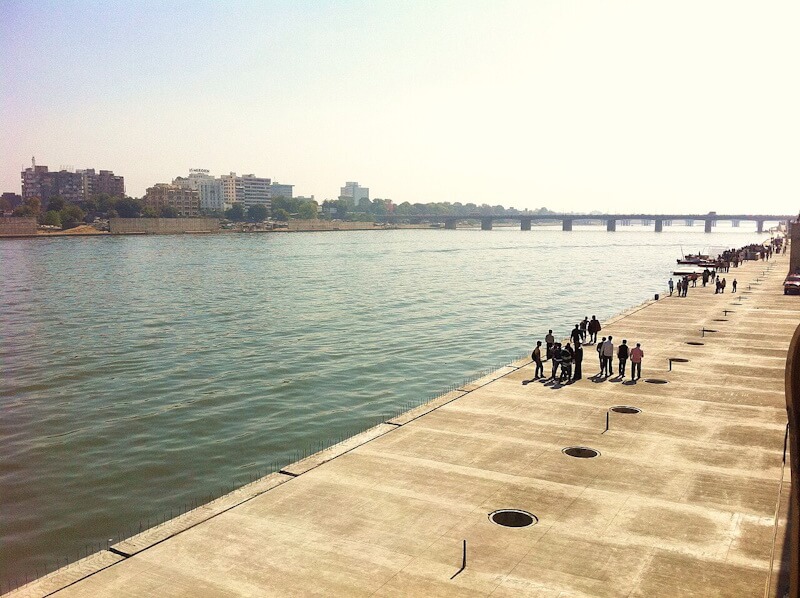
Photo: Wikimedia Commons
Spectacle and the politics of visibility
How, indeed, does a project get prioritised or selected to represent all of this? In cities of the Global South, governments are almost always grappling with the finite resources and multiple competing needs, and must make choices. These, as evidence shows, are rarely determined by the needs of the people alone. Cities that seek to urbanise fast or re-position themselves in the national or international imagination tend to prioritise certain agendas such as attracting investment, signaling modernity, and displaying visible expressions of this in development projects.
This translates into plazas, flyovers, skyscrapers and, increasingly in India, a certain template of riverfront development and beautification. Such projects tend to be routinely chosen over less visible, demonstrable, and basic infrastructure work such as upgrading drainage systems, sustainable waste management, ensuring water supply and so on. These are necessary to improve the quality of life for all people and fulfil the basic standards of urban governance, but they carry no symbolic or spectacular value. Projects like riverfront development, of the kind done now across India’s cities, embody a symbolic value that goes well beyond their function-–if they serve a function–-and they can be made to mean something in the urban discourse. They demonstrate that the city is not only changing from its old landscape but is moving forward, modernising.
This deliberate visibility, I argue, is itself a part of the function of such projects. Geographer Jasnea Sarma[5] offers the analytical lens here. In her work on cross-border infrastructure in the northeast, she introduces the concept of ‘spectacle’ to show how powerful states depend upon grand infrastructure projects to make remote regions or borderlands legible or visible through the built form. Projects like the BRD represent, at once, the ambition and the presence of the state. The spectacle, the visibility, are embedded in these.
While her context was the borderlands, it articulates the development in cities too and offers a cogent explanation of why governments would pursue a project like the BRD with the speed that the Assam government did. The BRD was built to be seen and shown; its ecological impact on the river and the river bank were secondary, and its use incidental. The gleaming and modern riverfront being seen along a key stretch in Guwahati was more important than it being used.
The concept of spectacle, when built into city-making, help us understand a particular narrative about the city itself, its aspirations, who it must impress, if these were decided with the involvement or participation of people who have lived there for decades and, in the case of BRD, have integrated the river and its banks into their life rhythms. From the lens of building a spectacle, the built environment is not merely about planning and building infrastructure for people, but about the production of visibility.
Importantly, in this process, what is rendered invisible and who is excluded—by design or otherwise—are questions that rarely make it to the narrative of development or the media cheerleading or social media feeds that go viral. In the BRD, were the modest vegetable and fish sellers consulted or asked if this project would improve their lives and small businesses, or, on the contrary, adversely affect them? Did the people of Guwahati who used to stroll and sit along the older river bank desire or demand this beautified waterfront? The many exclusions—of imagination, of voices, of priorities—are hardly discussed.
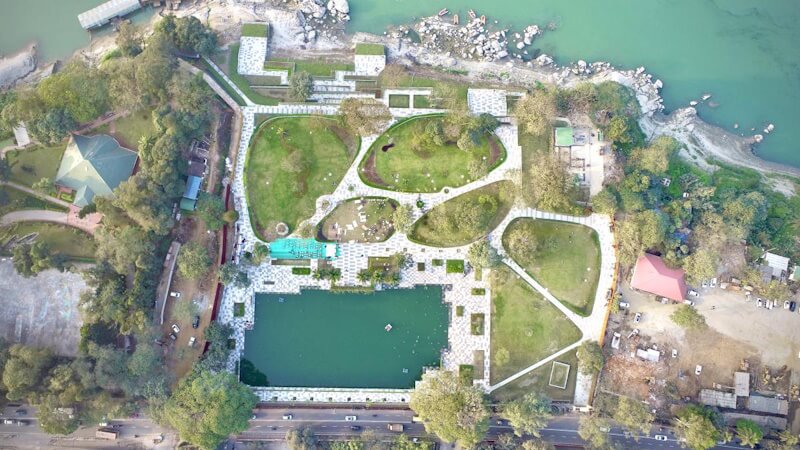
Photo: Guwahati Development Department
Whose riverfront?
In the context of Assam and the rest of the northeast, which carry the weight of certain impressions and perceptions of under-development in the national conversations, development projects like the BRD carry immense political weight too. The BJP government has been deliberately responding to this in planning and delivering projects that are markedly different and more spectacular than that of its predecessors. Roads, bridges, riverfronts are elements in the story it has been re-writing about Guwahati.
But questions linger: Whose riverfront is it, really? Who can access it comfortably? What does the introduction of entry fee after the elections reveal about who it is intended for? Who gets to use it through the days and nights? And importantly, whose relationship with the Brahmaputra does it acknowledge and secure, and who is left out of this spectacle?
These and similar questions have found little space in the conversations about the BRD which have mostly focused on the celebratory or the transformation-modernisation aspect. Who was included and who got left out—inadvertently or deliberately—of this transformation, and the participatory process or the lack of it by which it was carried out have received negligible attention or none at all.
The area around the river front, the 1.2 kilometres of it and more, has changed visibly since the BRD project. The stretch of the street which faces the embankment has become busier; cafes and restaurants have sprung up there, in a sense, creating their own ecosystem. Yet, who does it serve? The BRD has attempted to retain some of the features of the waterfront-–the temple that was there for ages, the ghats that people used for ceremonies, and the fish market that has been there for generations.
While the older systems, people and life around the water have not been totally erased, this beautified and modernised place is not their familiar space either. The point is not merely if the existing users remain and were accommodated, but how their relationship with the river changed through the process of the construction and what it has been since the project was inaugurated.
Equally, ecological questions remain. As almost all the present-day riverfront development projects have shown, this one too involved a significant intervention in the natural flow and expanse of the river, and the water-land relationship was engineered to suit the objectives of spectacle and visibility rather than let the river flow along its natural contours. The Brahmaputra is certainly not a docile river. What the concretisation of its banks in Guwahati will mean for the river’s ecology and how this will impact the city in the years to come are questions that linger.[6]
The overarching question, however, is about the kind of urban development and future that the government imagines for Guwahati. The direction of this development, which predicates constructed and modernised spaces as symbols of progress even on a riverfront, needed a wider debate than we saw. Every project—roads, bridges, parks, riverfronts—is not merely giving the city new and visible markers of development, but also determining the city’s future. As development becomes the most powerful political language and narrative in Assam, the nature of this development needs a deeper examination and attention.
The Brahmaputra Riverfront Development, then, is not merely a riverfront project that changed the river-city relationship but one that has implications for urban development in Guwahati and the rest of the region.
Purba Barua is a PhD scholar at BITS Pilani (Hyderabad) where her research explores the governance, institutional processes, and decision-making shaping urban infrastructural development in Guwahati. Her interest is rooted not only from having grown up in the city but also from a deep curiosity about the everyday changes there, including about the Brahmaputra which has a constant presence in how she experiences and understands the city. Alongside the urban, she is interested in gender and public policy, which she explores through her research and writing.
Cover photo: Wikimedia Commons