
Can nature, in a city like Delhi, be considered as the commons? The koel, singing on the tree outside my neighbour’s house, doesn’t her songs make both our families happy, without either of us owning her? The shade from the amaltas and saptaparni trees that line the pavements of the grand houses in Sarvodaya Enclave, doesn’t it shelter the guards and construction workers alike as they eat their lunch under it on a hot summer afternoon?
What about the seeds of these trees, or the pods of desi babul that fall in my neighbourhood park? Traditionally cooked across villages in northern India as a seasonal sabzi, are these seeds owned by the Delhi Development Authority (DDA)? Can they be collected by the migrant gardeners tending to the park? Could I gather some to cook with? What would happen if many among the visiting joggers knew the recipes and started taking them, depleting the fruit faster, affecting their sustained well-being?
While trying to understand how the natural resources and biodiversity in Delhi look through the lens of the commons, I am beginning to ask if urban planning and design itself can aid natural systems – interconnected and self-sustaining – to flourish, and help us move towards a ‘commoning’ society, in which ‘commoning’ is a social practice beyond nature conservation and expansion, a dynamic social contract.
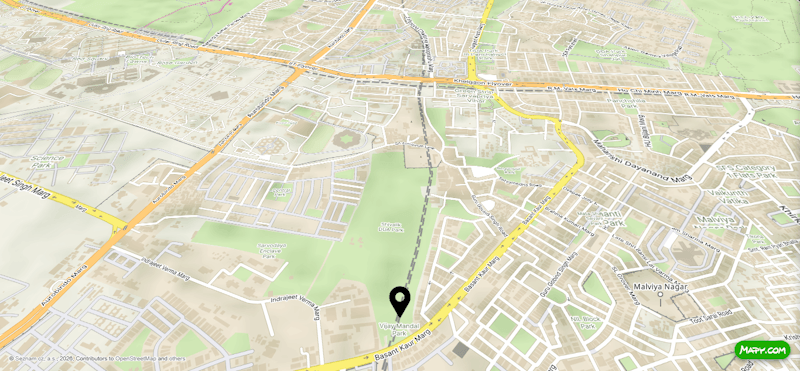
Source: Mapy
Commons in cities
Commons are shared natural and cultural resources collectively managed by and for all stakeholders in a user group. Managed through shared norms, they are organised around the principles of local autonomy, mutual responsibility and collective benefit (SEAS/University of Michigan, n.d.).[1] In rural landscapes, it is easy to identify the commons – peduk or charagarh (pasturelands), forests, rivers, ponds – as they are embedded in the lives, livelihoods, and cultures of communities.
In cities, however, natural commons are not singularly identifiable resource systems. People meet their needs of food, water, air mainly through resources that are often out-of-sight until they run scarce – increasingly polluted air, rapidly depleting ground – and on commons-based ecosystem services located elsewhere like climate regulation in Delhi provided by Aravalli and Himalayan ranges. The access to natural commons-based services also show socio-economic disparities; fresh air or winter sunlight are difficult to access in cramped housing.
Nature in Delhi is a patched network of biodiverse microcosms that survive and thrive in and beyond various types of enclosures, under varying jurisdictions, across spaces. It is neither cleanly non-excludable nor non-rival – two characteristics that define a common pool resource (Ostrom, 1990).[2] On a scale, the ‘commons-ness’ is often derived from physical boundaries and property rights used to govern it through norms defined by institutions such as the DDA, Horticulture Department, New Delhi Municipal Council (NDMC) and others.
So, to look at urban nature as a common resource, one would have to locate them in their socio-institutional context, which can change spatially and temporally (Ostrom, 1990).[3] These rules and norms shape how accessible nature is for people of different socio-economic backgrounds, what species become part of the landscaped areas, how nature is cared for, what knowledge is used for it, and whose knowledge is seen as stewardship.
In fact, ecology and urban design constantly frame and reframe people’s relationships with natural biodiversity within governance frameworks shaped by socio-economic priorities. Designing cities for shared ecological health would thus mean integrating living networks of urban nature, such as urban forests, wetlands, and even parks, into the organising framework of city-making, including concerns of who gets access to nature, who designs that access, and who labours for it.
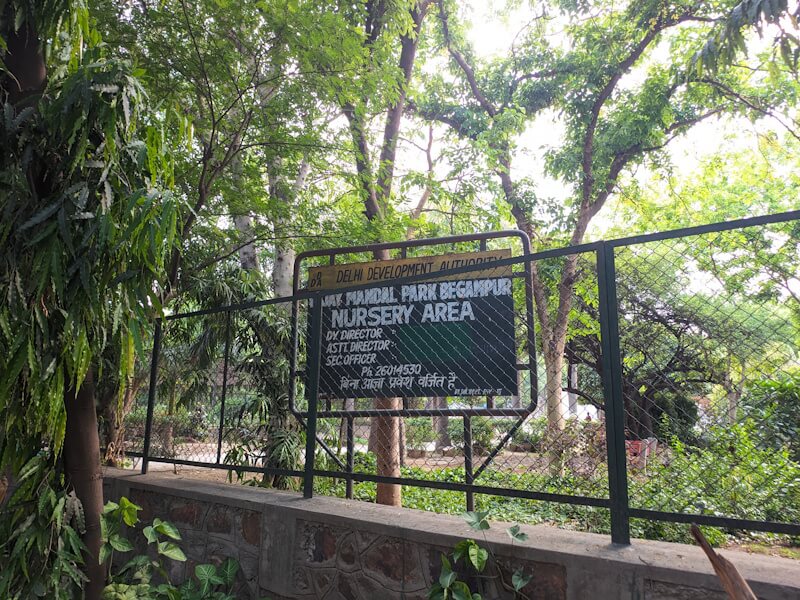
Case study: Vijay Mandal Park
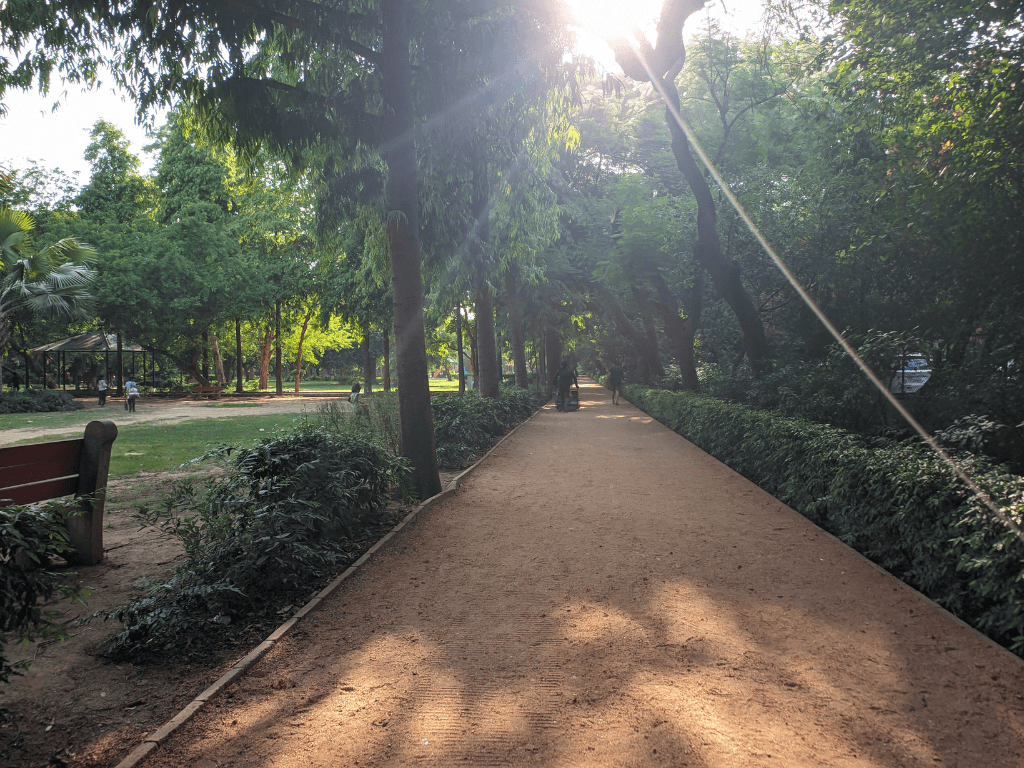
Vijay Mandal Park, a 46-acre park with Sarvodaya Enclave and Begumpur village at one end, and Malviya Nagar market at the other, is maintained by the DDA.[4] With the Begumpur Masjid, listed as a Monument of National Importance[5], abutting one of its sides, the park hosts several open gyms, a running track, a children’s play area, a high flag, multiple bench clusters, and toilet facilities.
I run and bird-watch in this park often, and see it both as its neighbour and a researcher. The park is open and accessible to a range of users — dog owners and dog walkers, fitness enthusiasts, domestic workers resting and crossing through, lovers, families, bird-watchers – from nearby residential and market areas. It becomes a multifunctional public space — a sports ground, a theatre practice area, a tik-tok studio, a picnic spot, a wildlife spot, and one of services to stray.
The park’s landscaping, beyond pleasing the eye, supports local biodiversity. Largely, the species planted across the park – karanj, jamun, arjun, peepal — provide extensive canopy to birds from koels to collared doves, grey hornbills to rufous treepies. Flowering hibiscus, jatropha, gulmohar, and champa line the walkways along with decorative royal palms, providing nectar to bees and butterflies. The wilder corners, usually unmanicured, are brilliant for sun birds and bulbuls. This ecology is not self-sustaining; it was designed, and it is produced and maintained daily by workers who live on its edge.
At a corner, a plant nursery grows saplings to be used in the park and for sale in the Chirag Dilli nursery. It is also a quasi-office where workers gather at the beginning and end of their 9-to-5 shifts. Currently, they are a group of 12-15 families hailing from Tikamgarh and Jhansi. The men generally do the harsher physical work of watering the grounds, lopping branches, mowing grass, and aerating the soil while women sweep the area, collecting garbage to dispose of at the Begumpur waste site.
The group works under the primary ‘jamadaar’ who reports to the contractor/Munshi, who visits daily and keeps a record of the work, and are paid Rs 400-500 a day. Most of the workers have extended families back home tending to agricultural lands; many travel back to their villages during the harvest seasons. They value the horticulture and landscaping skills learnt on-the-job in Delhi, the care work that earns them their livelihood in starkly different ways than the farm.
I caught up with the women heading home, tired from work, at the concrete thada in front of their houses — ranging from makeshift to semi-permanent structures — about the resources they use from the park. The dried, lopped branches help meet their cooking needs. They are deeply familiar with trees like amaltas, safed chhaal, desi babul but don’t have much use for them. Ones like jamun, moringa, neem, gurhal provide leaves, bark, and pods for brushing the teeth and occasional medicinal usage. In Delhi, they aspire to get what they cannot back home, like getting tap water nearby for domestic use, accessing toilets, open gyms and the play area for their kids. It is, however, stratified – usable only when the visiting crowd is thin.
But the workers are not the only ones drawing the park’s resources. Visitors take flowers for worship, seeds for keepsake, dry fallen leaves and even soil to add to garden manure. While I was photographing a pile of firewood next to a shut house, one of the women asked if I was going to complain about it. She recalled one of the walkers complaining earlier about their chulha emitting smoke, making them shell out a princely sum of Rs 300 per kilo for filling up gas cylinders.
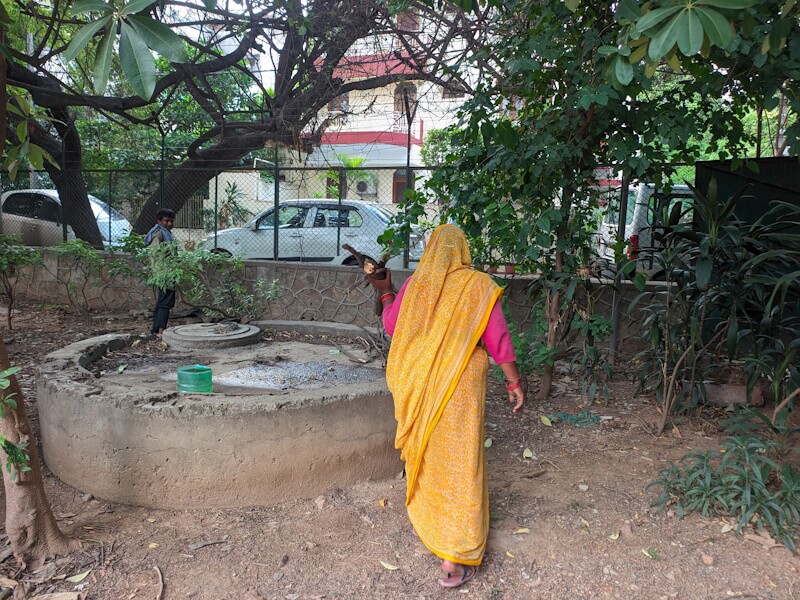
Whose space?
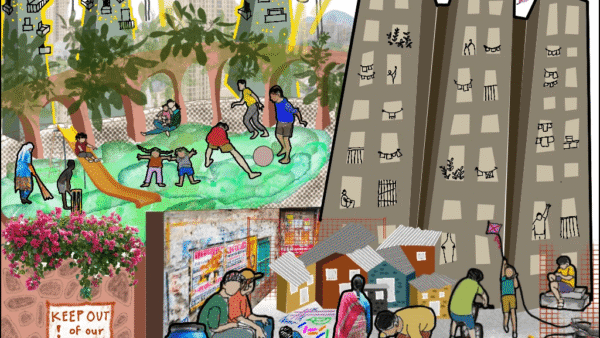
The park, a third and open space for walkers, is home for the workers. The first is by institutional design; the second by necessity – informal, unacknowledged at the literal margins. In summers, the shade offers respite; in winters, the ample sunlight is welcome.But this is not really the commons as the user group does not have the agency to decide the norms and regulations around their access. They have access now but can be taken away anytime. Their visibility here is a precarious balance they must maintain. Before the evening sets in, their children occupy the play area while the women sit and chat nearby. The park also becomes a space of ‘commoning’ – pooling their labour, stepping in for duty if someone has to head back home for a few days. But for this nature to be really the commons, they – and other user groups around the park – would have to have a say in some of its planning.
The group is heterogenous. Nandini, among the seniors in the group, unhesitatingly named lemon, tamarind, moringa growing in the nursery that she sparingly uses. As Bina Agarwal’s work on gender and the commons shows, embodied ecological knowledge is disproportionately held by women, practised everyday but seldom formally recognised (Agarwal, 2010).[6] Rural women cultivate fields, gather timber, food and fodder from the commons, and manage their households. In this urban park, their dehadi (daily wage) work might be lighter than that of men, but the domestic chores remain their burden.
The other stakeholders of the park — the Sarvodaya Enclave RWA, the Sunday clubs, the occasional visitors — are connected closely too; they feed the birds and dogs here, but their relationship with this park is of leisure and civic duty rather than its maintenance and governance. Their needs revolve around safety, convenience, and aesthetics, but have shaped the direction of the ‘greening’ here over time. During the last decade, the park has transformed from an enclosed wilderness – nature’s design, as it were – to a human-designed and landscaped space with only a few corners retaining the natural vegetation (So Delhi, 2020).[7] Whether it’s an improvement is a matter of perspective. A male worker, here since 10-12 years, reflected: “Pehle jangal tha ye saara, oonchi-oonchi ghaas thi har jagah. Iss side se udhar dekho toh kuchh dikhai nahi deta tha. Darr lagta tha. Ab theek ho gaya hai. (Earlier this was a forest, tall grass everywhere. You couldn’t see anything across, standing on this side. It was frightening. Now, it’s become okay.)”
The commons and ‘commoning’
The park allows instances of ‘commoning’ to evolve among certain groups. The ecosystem services it provides – the soil, the birdsong, the aquifer recharge — benefit a range of users. The factors that enable them, however, remain fragmented. The care labour is done by migrant workers; they follow the planning of the horticultural department while their indigenous knowledge of tending to plants is barely recognised as such.
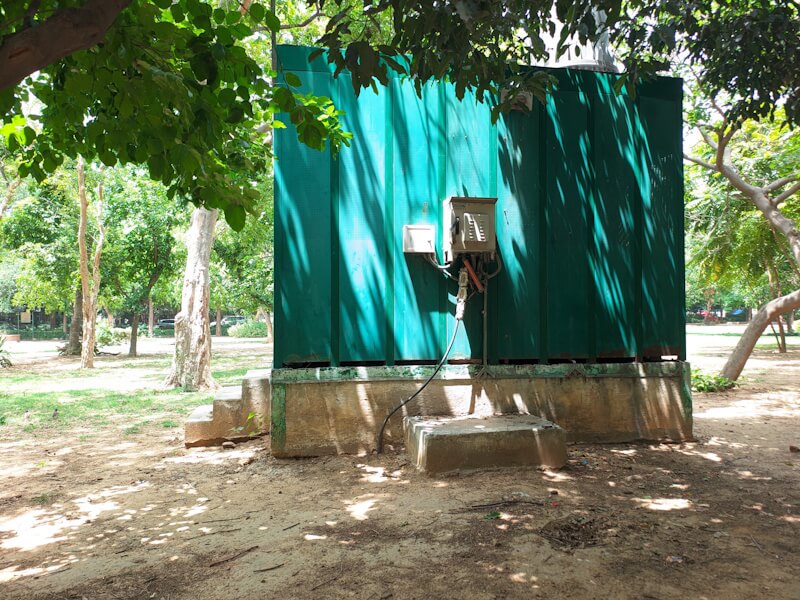
As the unseen care-takers and users of this park, the workers’ ecological knowledge and ‘commoning’ practices get subsumed under the city’s administrative priorities and working arrangements. By design, they have no institutional seat anywhere in the park’s governance while the smallest of complaints can upend their lives and livelihoods. The ‘commoning’ takes place despite the institutional norms. A radical perspective is in Berlin, Germany. Prinzessinnengarten (Princess Garden), a community garden, evolved as a pilot from a vacant lot into a recognised socio-ecological commons (Clausen and Shaw, 2009; Colding and Barthel, 2013).[8] The people who put in the work did so voluntarily along with hired help, holding collective choice and user rights over the produce, able to modify rules, resist privatisation, and have their labour formally recognised.
Certainly, India’s cities differ from those like Berlin – the caste and class inequalities, population density, and resource scarcity are critical realities here that need urgent attention. But another urgent reality is the worsening climate impact on vulnerable populations. And a good city centers the most vulnerable in its design (Gehl, 2010).[9] The lens of the commons can be useful to ask what kind of city should be built, whose perspectives are built into its design, and for whom. The answers make visible whose labour helps produce urban nature, whose knowledge sustains it, and whose access to it is contingent on being in the background (Rao, 2020).[10] Imagining Indian cities designed for nature to thrive even in underprivileged neighbourhoods where caring for it is collectively incentivised, might look like a utopian ask, but it is really a question of whose resilience we are planning for when we plan for climate impact.
The fact remains that Vijay Mandal Park is located in an upscale, metropolitan residential area of the national capital – the presence of nature carefully designed – and I remain a visitor-researcher, speaking to gardeners and their children on a Sunday afternoon.
Reference:
Nishtha Relan is a communications and advocacy professional based in New Delhi, with experience across governance of the commons, forest rights, and climate resilience in India. She writes on urban ecology and the politics of shared spaces, and is trying to grow and diversify her balcony garden.
All photos: Nishtha Relan
The photographs attached have been selected to keep the identities of the workers of Vijay Mandal Park anonymous to avoid fallout or questions on the publication of this essay.