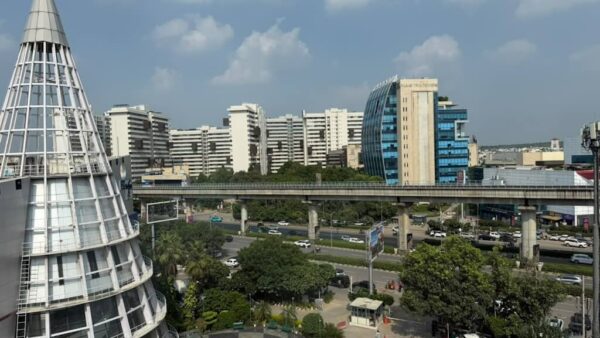

Etawah, a historic city in the southwestern part of Uttar Pradesh, sits near the confluence of Yamuna and Chambal rivers. A semi-arid and ravine-carved expanse prone to extreme weather events, it has more than 1.5 million people living. Like most Tier-II and Tier-III cities across India, Etawah has been witnessing rising concretisation, urban heat island effect, and dropping water tables.
In the midst of this bleakness, the 123-acre green urban forest, the only one in Etawah, stands out as an oasis of a rapidly-urbanising city. Established in 2022-23 under the Nagar Van Yojana, a national urban forestry scheme, Etawah Nagar Van has transformed has infused green in the concrete jungle and become a carbon sink. The degraded and abandoned public land now has a variety of forest trees and chirping of birds.
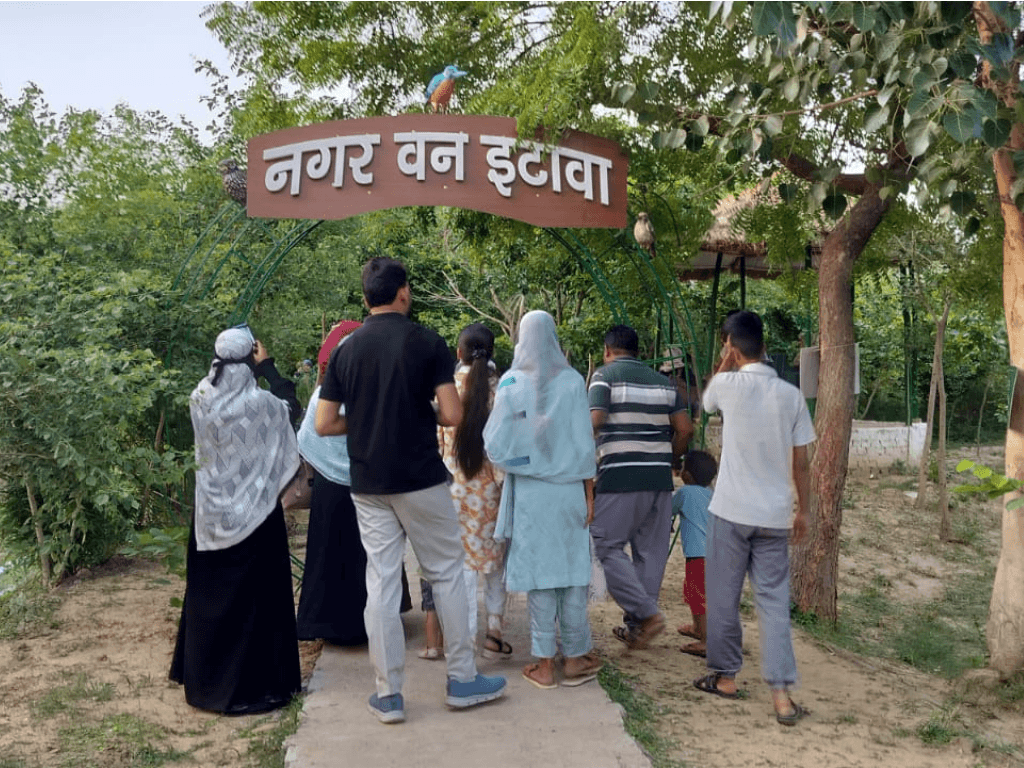
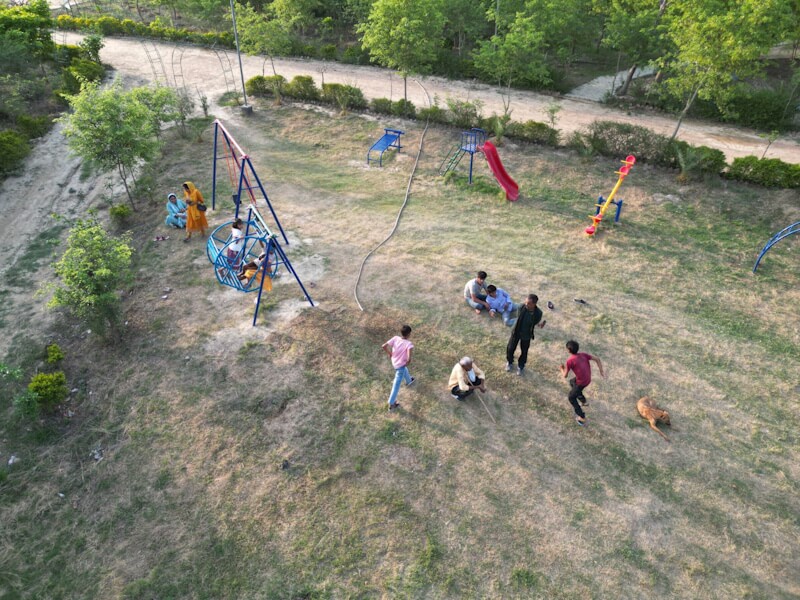
Mornings see 100-150 visitors and leisurely evenings bring around 300 regular ones (June 2026 survey data) while weekends register a footfall of 500-600. The play equipment such as swings and slides draw children; older people do light exercises amid the greenery. This urban forest, in books, is a project but in the daily lives of hundreds here, it is a public space they can claim as their own.
During my visit for the Nagar Van survey, I came across Sunil, an elderly resident of Etawah. Last year, a serious illness had left him bedridden for nearly three months. When the Nagar Van opened with its five–kilometre walking path, shaded rest spots and huts, he took his first steps here in January 2026. He found the forest a place to heal and recover. “The air feels different and cleaner here,” he said. Now, he is a part of a group of older visitors who draw on the clean fresh air for yoga, meditation, and jogging. A visitor survey of the elderly showed the Nagar Van had become more than a park; it is now their health infrastructure.
During the Participatory Rural Appraisal (PRA)–transect walk in June, we had checklists to find out whether the Nagar Van followed guidelines; it had been equipped with all the infrastructure. The state forest department plans to build an artificial pond for boat rides which will help beautify the space while naturally cooling the surroundings. An eco-friendly canteen built using locally sourced and sustainable materials completes it’s carbon-negative mandate.
The transition to the green space
Urban forests and parks are not a luxury in cities but essential public infrastructure; they are about people’s well-being. It has been established now that societies which neglect them “pay a price in poorer health, weaker communities, and less resilient cities”.[1]
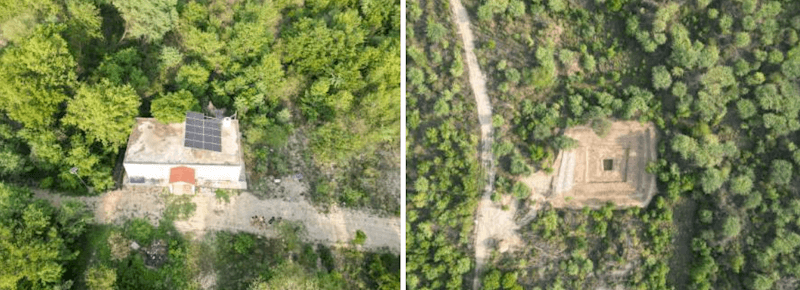
What separates this Nagar Van from a standard park is its commitment to operate without adding atmospheric carbon. The Etawah Forest Department focused on not only making the space green but also carbon-negative. This assessment, based on PRA-transect walk and site monitoring in June, evaluated renewable power sources, canopy, fencing, water-storage structure and groundwater-recharge infrastructure systems. The space has been cut from the coal-heavy power grid and uses a decentralised solar micro-grid.
Etawah is one of the 30 Nagar Vans and Nagar Vatikas in Uttar Pradesh to have completely transitioned to solar power. The model used is expandable as the decentralised solar micro-grid is like a plug-and-play system that smaller cities without conventional electrification can use. The focus on the survival rate of native species can also reduce long-term maintenance costs, creating a financially replicable model for other cities. The maintenance system includes a mandate for joint forest management committee and local participation, especially from women and nearby village heads, as this can provide a scalable template for shifting park maintenance from a purely departmental burden to a sustainable, community-owned asset.
Design with a purpose
Using the government specifications, the sustainable design of the urban forest covers lighting, water use, and groundwater recharge.
Lighting: Solar lights along the paths have illuminated it sufficiently to make it safe for women and children, and dispel the fear of snakes and insects. A four-person maintenance team, on day and night shifts, ensures safety.
Water: The drinking water for visitors relies on solar pumps, even during the brutal summers when temperatures hover over 45 degrees Celsius for weeks, saving the costs of diesel or grid electricity.
Groundwater recharge: Two harvesting ponds, each with a three-layer structure of different permeability, helps to slow the runoff, filter sediments, and accelerate groundwater recharge. This is significant as Etawah’s groundwater table has declined considerably in the last decade.
The Nagar Van Yojana of the Union Ministry of Environment, Forest and Climate Change, administered through the National Compensatory Afforestation Fund Management and Planning Authority (CAMPA) – (disclosure: the writer is a National Fellow at CAMPA) – urban forest funding works out to Rs 4 lakh per hectare (around 2.4 acres). The Etawah department used the Rs 2 crore as foundational money along the ministry guidelines, covering expenditure on purchase of planting items, maintaining 2,20,000 trees (count verified in March 2026), establishing solar lights, fencing, cooling systems, two solar pumps, water harvesting system, public toilets, and rooms for guards and maintainers.
The team chose native forest species like neem, peepal, and banyan over exotic and decorative ones. That turned out to be a wise choice; over 90 percent of trees survived, eschewing the need for frequent spends on plantations and high maintenance costs. The funding also helped keep the access free although people we surveyed said they would happily pay Rs 10 for entry. The paved walking paths, two solar water coolers, toilets, and parking space make it worthwhile for them. The paid-entry model could cover the maintenance costs but it carries the risk of excluding poorer residents who need such health infrastructure the most. There are ideas for a differing fee model for different visitors but it goes without saying that the free-access urban forest has no substitute.
Community participation
In its creation, the Nagar Van drew on the involvement and support of people nearby. Forest officials approached village heads (gram pradhans) of nearby villages, Luhanna and Dhobanpura, that are home to around 4,000 people. Labourers were roped in from the villages during the early phase to prepare the field, lay the soil base, and clear the invasive Prosopis juliflora.
The Nagar Van’s community use includes a rotating birding group of 20-25 people walking around it every month to photograph birds for the forest department. The department has also set up a Joint Forest Management Committee with representatives from the local communities and the mandatory participation of women. The structure has created local responsibilities reflecting community involvement rather than departmental control alone.
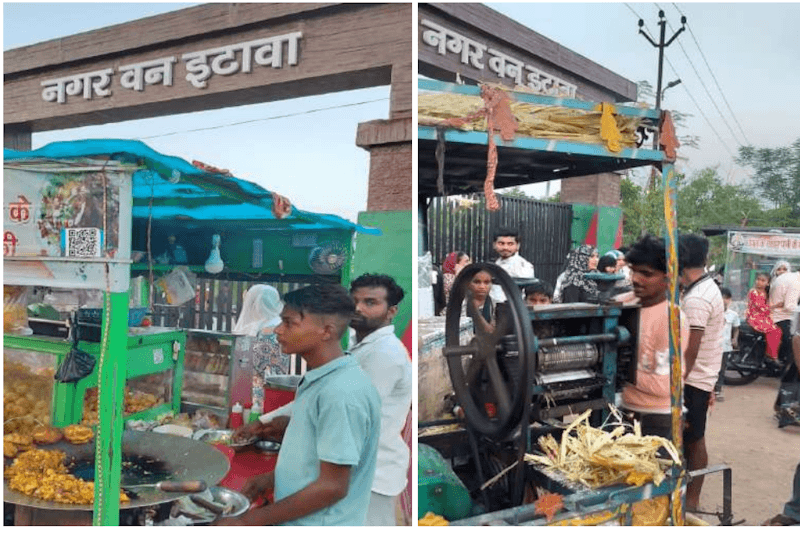
Outside its gates too, a community economy has formed. Every evening, a handful of vendors line up near the parking zones. Sugarcane juice, fried snacks, meals all as small businesses by local vendors who move from the Chowk in the daytime to park gate in the evenings. Plans are to set up a permanent eco-friendly canteen inside the forest too and offer livelihood opportunities for locals.
Urban forests as urban infrastructure
The Nagar Van Yojana, launched by the Union government in 2020, was to develop urban forests in Tier-2 and Tier-3 cities across India, using compensatory afforestation funds. Six years on, Uttar Pradesh has 30 sites in various stages of development, including Nagar Van (more than 123 acres) and Nagar Vatika (more than 24 acres). Nationally, the programme has 652 Nagar Vans and Nagar Vatikas. The 30 sites in Uttar Pradesh span close to 2,347 acres, covering major districts like Agra, Jhansi, Amroha, and Gorakhpur. The state’s sanctioned funding for these stands at around Rs 37.35 crore.
According to architect and urban planner Bhavesh Wadhwani, Nagar Vans, apart from improving urban climate, have the potential to be treated as the much- needed “third spaces” in cities. “In that sense, they should not be imagined as contained enclaves but as an important urban infrastructure integrated into the wider pedestrian network,” suggests Wadhwani, currently working as a Research Fellow at the National Institute of Urban Affairs. He points to the essential last-mile links such as footpaths and shaded walkways for easy access to such public spaces.
These spaces should be designed as inclusive public spaces considering the diversity of users and their needs throughout the day — morning users would have different movement patterns while weekends might need bigger spaces for groups and gatherings. Whether the programme will address the greening of rapidly-concretising cities is another matter. Recent research[2] that audited eight tree-planting programs and policies in India, which included CAMPA, found that only one of those eight programmes, namely Sub-mission for Agroforestry significantly increased tree cover; only time will tell how much greening the urban forests will make any sprawl.
The Etawah model as a blueprint
Etawah’s Nagar Van design could be a model for small as well as large cities in that it shows a way to skirt around high-expenditure creation and maintenance of urban forests and public green spaces, reduce the demand on the conventional grid power, and conserve the high-extracted groundwater. This different and more ecologically-sustainable approach which also included community involvement can be a template to follow.
For an abandoned plot to be turned into an urban forest with all of the above demanded commitment and engagement from the District Forest Officer and Regional Forest Officer. The institutional role to guide site-level decision making, adhere to native-species restoration and plantation, direct municipal collaboration on maintenance and facility management, form the Joint Forest Management Committee, and ensure formal community representation requires official commitment.
The local involvement means the money generated stays in the communities here. Most significantly, it is not an urban forest designed somewhere else and installed here. From the ideas to the execution, it evolved and took shape here. Etawah’s urban forest materialised because every aspect worked out synchronously; no one pulled in different directions.
Arkraj Biswas is a National Fellow at National CAMPA, working as a Research Associate under the GRAAM Embark India Fellowship 2025–26, and conducting independent research on the Nagar Van Yojana across Uttar Pradesh, Madhya Pradesh and Rajasthan. This assessment of Nagar Vans is part of a nine-month mixed-method evaluation approved by the Ministry of Environment, Forest and Climate Change.
All photos by the writer.