
As plans are afoot to make Nashik ready for the grand Kumbh Mela, the ancient city has been undergoing changes and upgradation to accommodate crores of devotees. In May, Maharashtra Chief Minister Devendra Fadnavis launched projects worth Rs 25,055 crore for the Kumbh Mela while declaring that Nashik will become a growth engine of development in the coming years.[1]
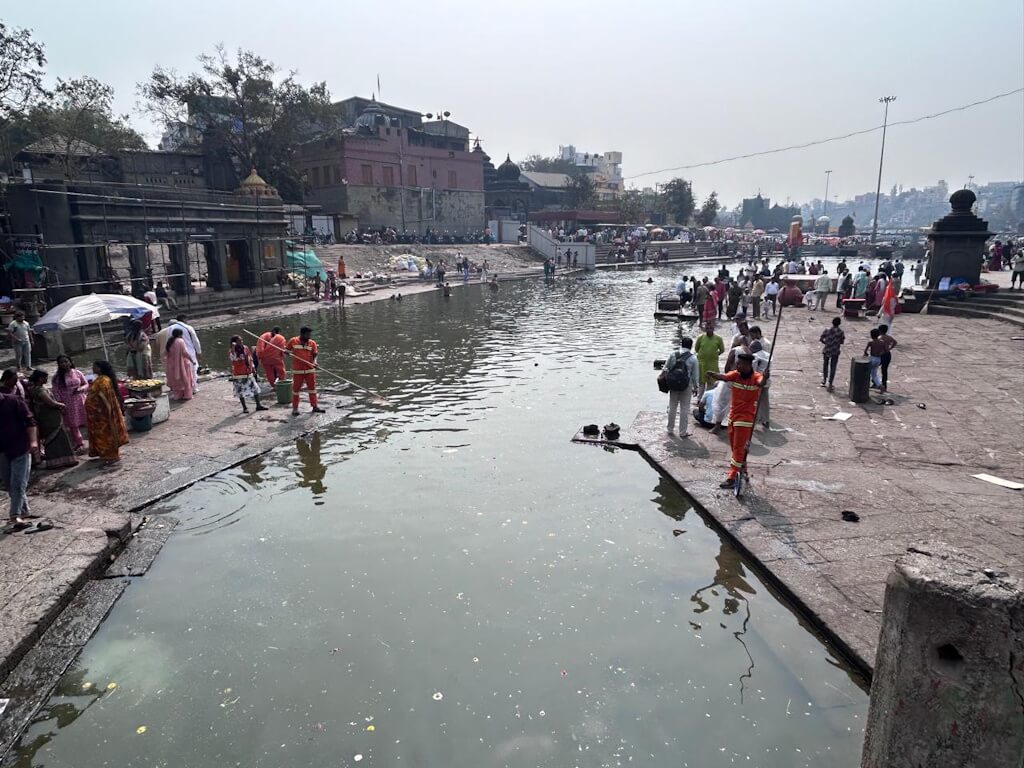
The Godavari is at the heart of the Kumbh Mela with its holy bathing spots and legendary tanks like the Ramkund. A total of Rs 44 crore has been sanctioned to repair the ghats along the Godavari.[2] But the Godavari river struggles to find its way in the maze of constructions and encroachments that have marked Nashik’s development in recent years, pollution levels are high, and garbage chokes its flow. The neglect cannot be papered over with beautification projects for the Kumbh Mela. Concerned citizens have taken the initiative to restore the river and are dismayed at the transactional relationship of the river-city over the years. Question of Cities speaks to two of them.
‘Our target is to make Godavari flow naturally’
Rajesh Pandit, president of Namami Goda Foundation, NGO founded in 2017 to focus on grassroots awareness, waste management, biodiversity protection, and reconnecting people with nature.
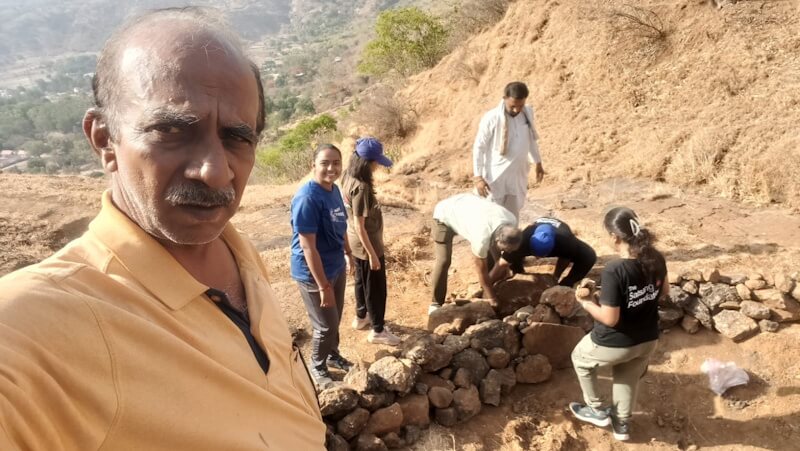
When did you start the work? How has your understanding of the river evolved over the years?
We were initially working to save trees when the Bombay-Agra highway was being constructed and lakhs of trees were being cut. We realised then that the Godavari was full of water hyacinth and the city’s sewage was flowing there. Three buffaloes got entangled in the water hyacinth and died. Their carcases were removed using cranes. The incident impacted me and I started studying the Godavari river.
By 2011-12, a group of us were agitating to save the Godavari. We wrote letters to the heads of all the parties including the UPA chairperson Sonia Gandhi and Sharad Pawar who were in power. We met the decision-makers. We filed a case under Indian Penal Code IPC Section 431 (mischief with a river) in 2012. But nothing happened. Then, we formed a small organisation, Godavari Ghatari Karan Virodi Manch, and it grew. When the ‘Waterman’ Dr Rajendra Singh came to Nashik, I met him and he advised me to approach the High Court. After that, the real journey started.
In December 2012, we showed the photos of the Godavari to the Chief Justice of the Bombay HC and he asked if it was a river; the conditions were so bad. Justice Abhay Oka, who was then heading the bench and later retired from the Supreme Court, took it seriously. We got landmark judgments. The case went on till 2018. Even now, the Godavari rejuvenation issue is monitored by the HC.
What relationship do people in Nashik have with the Godavari besides, of course, the significant Ramkund area? How has it changed?
The HC, in its judgment, made an important observation – on the one hand, the state has failed to protect the river but, on the other, citizens have failed in performing their fundamental duties. When I say state, it’s all the government machinery including the municipal corporation, pollution control board, collector. And citizens means the entire society.
The National Environmental Engineering Research Institute (NEERI), appointed by the HC, gave roughly 85 recommendations to the state. Extensive awareness campaigns were launched; schools, colleges, NGOs, corporates all together. Then, the realisation set in. The Kumbh of 2004 was declared as a green event, Harit Kumbh. In 2011-12, nearly 99 percent of the Ganpati idols used to be immersed in the river. Today, I can say that 99 percent of people do not immerse idols in the Godavari. So, the connection has happened. The bureaucracy and politicians do what the society wants. If the society wants our Godavari, our nature protected, they will take appropriate decisions. So, the people-river connection or re-connecting with Mother Nature, is the most important part of our work. It’s our slogan.
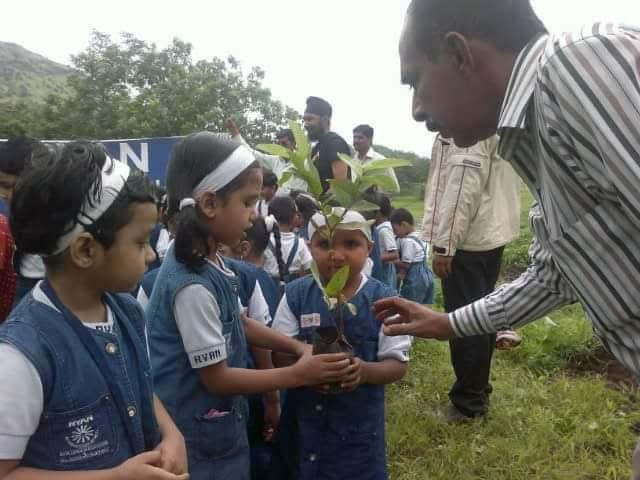
Photo: Rajesh Pandit
What campaigns has the Namami Goda Foundation organised, how do you sustain the work?
The Kumbh is used to send a global message but, essentially, we focus on three verticals. One is plastic dumping; the largest encroachment on the planet is plastic. We are teaching, educating and inculcating a sense of responsibility in the next generation about water, rivers and oceans. We started the ‘Sagar Mitra’ (ocean’s friend) campaign in 200 schools. Children separate dry plastic in their homes and bring it to school once a month where we collect and send it for reprocessing, recycling. Every child feels proud that he or she is trying to save the planet, trying to save Godavari.
The second vertical is groundwater. Our target is to make Godavari flow naturally and ecologically. Almost all the rivers in all the Sahyadri ranges have become dependent on dams. When the dam water is released, the river flows. The groundwater exploitation has become very heavy. We are focusing on preserving water through ‘My Water Bank’ — the water that falls on my roof will go to my ‘bank’ be it a bore well or well. The third is a Kumbh tree. Nearly 25 lakh people in about 5-6 lakh houses in Nashik are hosts during the Kumbh Mela. Every house contributes by growing a tree in their house. This is the real Harit Kumbh. It’s a slow process but people are re-connecting with the Godavari.
So, there is a shift in the younger generation.
We are targeting school students of Class 5, 6 and 7 because our study shows that they are in the listening mode. We are also working with college students. We want them to make their hobby their passion. So, if somebody plays the guitar, he should come to the Godavari and play it. Those who draw or sing, we ask them to do this along the Godavari so that they connect with the river.
Pollution is a major problem in urban rivers. In the Godavari, what are the primary causes for this?
Across India, there are three major issues of a river including the Godavari. When I say Godavari, I mean its catchment — from where the Godavari originates in Brahmagiri up to a Ramsar site called Nandur Madhmeshwar where the Godavari leaves Nashik. The major tributary, Nandini or Nasardi is the major polluter of the Godavari. A lot of work has been done on it. On June 5 this year alone, around 15,000 people joined the clean-up drive. Pollution can roughly be categorised into three — untreated sewage, industrial pollution, and solid waste. The 300-kilometre stretch from Nashik to Paithan has some of the highest levels of organic pollution – critically high[3] Biological Oxygen Demand (BOD) levels of 6–36 mg/L far exceeding the 3 mg/L limit for drinking water and harming aquatic life.
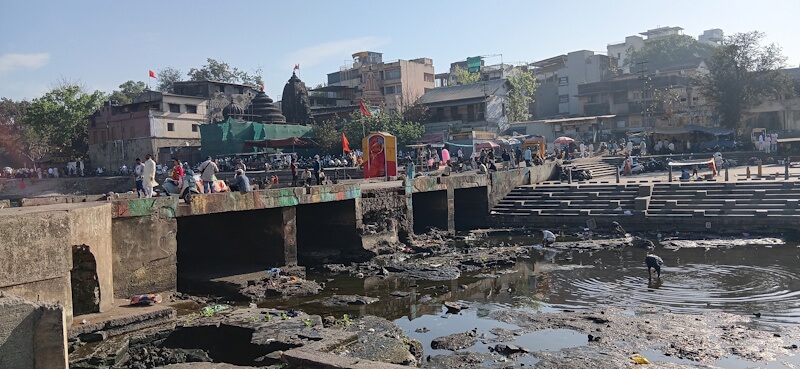
Photo: Nikeita Saraf
How is the ghats construction for the Kumbh and riverfront development affecting the river?
The consultants and the irrigation department handle the ghats. But we have a blanket objection to any kind of construction in the river bed and that the river should not be channelised. I have objected to river channelisation and construction works in the river bed on the grounds that the HC-appointed committee has strictly prohibited these. The ghats are in a zigzag way, on this side and on that bank. If you channelise the river, you are inviting disaster. To manage the Kumbh crowds, the authorities are making the ghats but if the river is channelised for this, it will spell trouble because the pressure of the water flow increases at one place.
Our group is against the riverfront development. Where is the river? There is no river. This is not a riverfront but land development. The second most polluted river in India is Sabarmati, which is used as a model for riverfront development. We oppose that. We are saying that because of the Godavari, there is Kumbh in Nashik. Build the roads and bridges, but save the river. Culturally and also economically, Nashik’s identity is tied to the Kumbh and this to the river.
How do you think Nashik should balance growth and sustainability, given that hundreds of trees have been chopped down for the Kumbh Mela?
The rampant cutting of trees, mining, and all these things are not happening only in Nashik, but everywhere. Trees are cut to widen roads or other projects. But, we have to think of alternatives. The road alignments can be changed, one-way can be made, projects can be done without sacrificing so many trees. In Tapovan, we proposed a meditation centre like Shanti Vanam of Hyderabad and insisted that the authorities talk to spiritual leaders but they are talking to builders and developers. About the Godavari too, we say that they are getting money because of the river, the identity of Nashik is because of the Godavari. Like Delhi is because of Yamuna, Yamuna is not because of Delhi.
Is there a master plan for the Godavari rejuvenation?
Yes but the consultants run the development. Contractors and consultants define development. But our plan for the Godavari, like all rivers, is to respect its blue flood line as a prohibited zone. It should be left intact. In the rest, development can be done only by zoning to make green corridors, restore river banks and floodplains, with maybe pathways for people to walk by the river. We gave solutions like these to the authorities but different departments handle different aspects of the river; there are challenges or conflicts of interest. In our civilization and culture, rivers are to be respected. Whether because of culture or religion or need, if we can return to that and respect nature, respect rivers and their ecology, it would go a long way.
‘Water is viewed as a commodity rather than a sacred resource’
Dhanashree Nigudkar, architect and archaeologist, who studied indigenous knowledge systems related to urban native landscapes and their economic expressions.
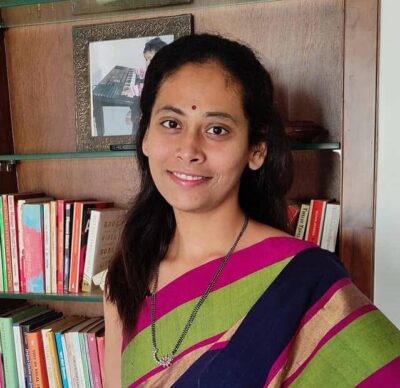
How has the relationship of the Godavari and the city changed over the years?
Originally, Nashik was an agglomeration of not more than a 100 hutments, eventually through overlapping urbanisations at various times in history (from Rashtrakuta, Yadava, Mughal, Maratha, and finally the British), the city saw multiple growth spurts. The present day Nashik is an extended version of the footprints of the past. Yet, its soul remains the same and is spun around the Godavari as a pivotal force.
Earlier, there was a sacrality involved but water has increasingly come to be viewed as a commodity rather than a sacred resource. This has led to collective decline in concern for the well-being of sweet water holding or mostly rivers; Nashik is no exception. Many of Nashik’s old residents are relocating. The old core along the river has been reduced to a densely-packed area with the usual urban problems of lack of infrastructure and accommodation.
The growth in Nashik’s industrial areas is attracting people from various regions, mainly in the MIDC zones, resulting in a significant migration from northern Maharashtra and Vidarbha, and states like Gujarat, Bihar, and parts of southern India. However, these new residents often do not share the same cultural or emotional connection with the Godavari. Their life here is largely disconnected from the river-based traditions. Their daily routines revolve around work, and their leisure time is often spent in modern urban spaces such as malls, the newly developed wine culture. The Godavari begets large flocks of spiritual crowd and has been reduced to a magnet for spiritual tourism.
Life and culture in Nashik revolved around the Godavari. How has it changed?
Historically, the Godavari was the focal point of the city’s social and cultural life. Markets (bazaar, peth), festivals, and various community activities were organised along its banks and its seasonal cycles shaped local traditions. During the summer months, from April to June, when the water level receded, the exposed riverbed was a venue for bazaars and public events; in the monsoon, the Godavari expanded and claimed her territory. The natives were well accustomed to this dynamism and incorporated it into their daily lives and cultural practices.
Over time, however, the city’s relationship with the Godavari changed significantly. Urban lifestyles and changing cultural priorities reduced people’s direct engagement with the river; water became a utilitarian resource rather than a living cultural entity. The construction of numerous ghats and embankments has led to the river becoming more concretised and physically modified. Today, the city has 12 (5,665 metres long) functioning ghats and is on the verge of accommodating six new ghats, measuring around 3,451 metres.
Despite the problems, the Godavari remains an important setting for cultural celebrations. Festivals such as Rang Utsav and Dhol Utsav continue to be organised on its banks; the Rahaad (a festival of colours celebrated on Rangapanchami on the fifth day after Holi) and Vir Nachavne, a poignant 300-year-old ritual celebrated typically by ancestral families in which a young man dressed as a deity leads a 18-hour procession from Budhwar Peth towards Ramkund, are celebrated here. Then, the Hari-Hara Bhet, a union of and a chance for the Vaishnava and the Shaiva sects to forget their feuds and unite, and the Rath Yatra is celebrated on Ram Navami every year. This is just the start — Goda at Nashik celebrates every occasion.
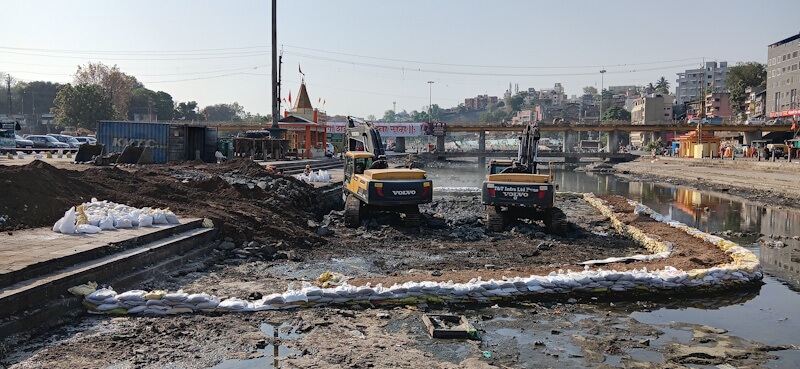
Photo: Nikeita Saraf
How is the city preparing for Kumbh Mela?
Before blindly criticising the preparations and the hindrances caused by the never-ending work that we Nashikites encounter, we must understand that Kumbh is an opportunity for the city to grow technologically and infrastructurally. Unlike earlier, the work has not been entirely indiscriminate; in areas such as Panchvati, the previously concretised sections of the riverbed have been removed. However, new ghats are being constructed to accommodate the expected crowds of pilgrims, the riverbanks are being widened and expanded. Around six new ghats, a ring road of 65.66 kilometres, five major bridges and parking lots are being built.
Of course, this raises environmental concerns; the construction of ghats is often at the expense of existing trees and riparian vegetation along the river. But planners are under pressure to ensure that sufficient space is available for the millions of visitors expected. The scale of infrastructure required in Nashik differs significantly from that of Prayagraj; unlike there, Nashik is constrained by a comparatively smaller river and the limited geographical setting of basalt and rock terrain on both banks. The infrastructure being developed may remain underutilised until the next Kumbh Mela 12 years later. As someone working in this sector, I feel that if the planning and fund release had started early, we would have been in a better place.
How would you describe the Godavari then and now? And what can be done to improve it?
Godavari has not functioned as a truly free-flowing river for a long time. Ever since the Gangapur dam was envisioned during the colonial period, the river’s flow was regulated almost from its source which resulted in channelising her. The upper course is highly controlled but exhibits a wider and more natural flow from Kopargaon onwards where the river channel has greater spatial freedom. Multiple weirs and hydraulic structures further regulate the river, so the water flow is diverted and controlled.
The river is also geographically confined by the basaltic formations of the Western Ghats, limiting its ability to shift course or spread beyond its channel. This has allowed both its banks to evolve, unlike a few other Indian cities, but because of that she remains heavily managed and constrained. During the monsoon, when water levels rise dramatically, the Godavari temporarily escapes human control to swell and occupy its natural floodplain, regaining the characteristics of a free-flowing river.
Rather than attempting to drastically change the physical and tangible properties of the city’s riparian belts, more initiative-based work must be undertaken to view rivers as an integral part of our society, not solely as a source of water. We must aim at changing the notions and re-shaping the thought processes of the coming generations. It can be undertaken by initiating various movements affiliated with schools –- such as cleanliness drives around rivers, changing their perspective towards Indic religions and their philosophies, performing and actively participating in documenting or engaging in various street festivals.
Cover photo: The Godavari being cleaned. Credit: Dhanashree Nigudkar