
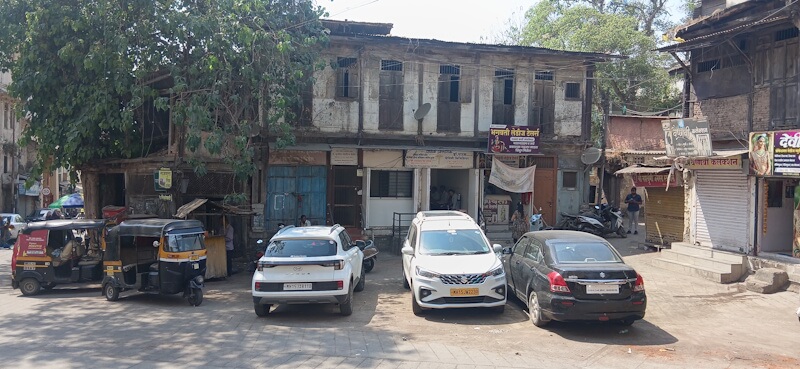
Panchvati, in ecology, is a sacred grove of five ficuses namely Bael, Amla, Ashoka, Banyan, and Peepal. In mythology, it was where the exiled trio of Lord Rama, Sita and Lakshman spent a few of their 14-year long exile and is marked by the Sita Gufa (cave). In the rapidly-urbanising Nashik city, Panchvati holds all this but is a bustling neighbourhood on the northern banks of Godavari River with narrow lanes, small shop fronts, and old-style homes with tiny wooden windows.
One of the narrow lanes leads to the fabled Ramkund – the sacred tank where the Lord Rama is believed to have bathed, where ashes of the dead are immersed, where the Goda Ghat arati is held every evening, and where the upcoming Simhastha Kumbh Mela’s focal point – main bathing spot – will be. Ramkund, in fact all of Panchvati, is the throbbing heart of old Nashik, a world apart from the modern industrialised city that forms a part of the Mumbai-Pune-Nashik economic belt of Maharashtra.
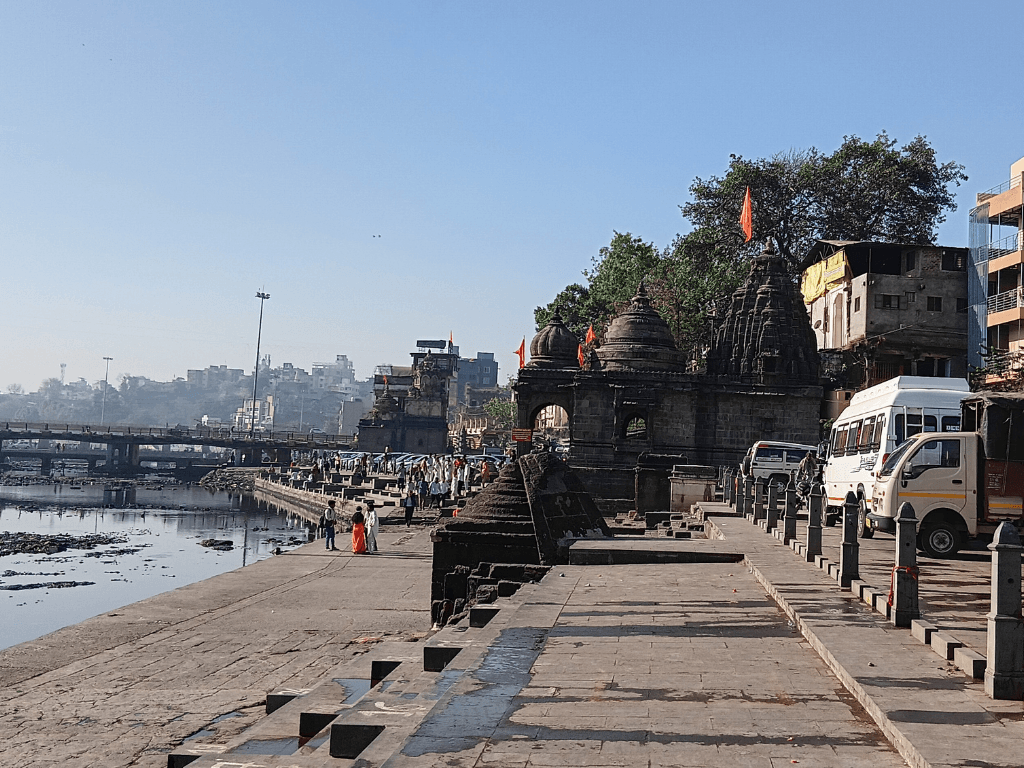
In Panchvati, including the ancient stone steps descending to the Ramkund, the relationship of the Godavari with the city is at its strongest and oldest. It looks and feels quaint, in a tranquil way, as old buildings come alive slowly early in the morning – people going about their business, vendors occupying the ghats with wares, temple doors opening for devotees, bells reverberating, and tea stalls creating steam shapes in the air. On this walk along the Godavari with historian and heritage writer Ramesh Padwal, and architect and urban designer Ulka Pawar,[1] one March morning, the ancient-religious and new-economic versions of Nashik mingle.
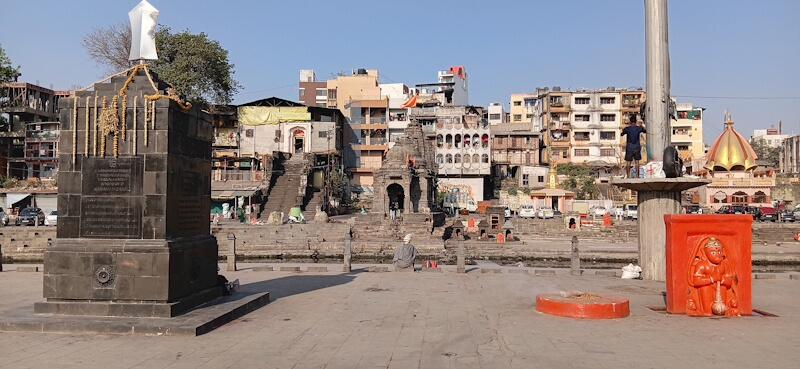
At Ramkund, our walk begins with a strange confluence of mythology, chemistry and modern construction. The present-day Ramkund – the Lakshmankund is nearby – dated in documents to 1696 but surely the chapter of Ramayan unfolded centuries earlier. It is also called the Triveni Sangam, the confluence of three rivers namely the Aruna, the Varuna, and the Godavari. The ritual of asthi visarjan (immersion of ashes after cremation) here draws thousands of faithful every day from near and afar, driven by the infused divinity of the story that Rama immersed his father’s ashes here.
Padwal explains that a “chemical reaction” at the Triveni Sangam, triggered by the rock bed with specific minerals, probably dissolves the bones/ashes completely, which strengthens the belief that the last of the rituals of the dead should be done here for salvation. The Godavari flows here but where are Aruna and Varuna? Now called gupt nadya (hidden rivers), they did not simply disappear one day. They were channelised for human use, turned into sewers, and then finished off by pouring concrete and building roads. The Godavari still flows – it is possible to see it meandering along the riverbanks of old Nashik – but it is hardly a healthy and vigorous river.
We stand on the banks near Lakshmankund and take in the famous 21-feet Dutondya Maruti (two-faced Hanuman) which goes beyond the sacred to the functional as a flood marker. When the skies open up and water level rises, it touches the idol’s feet slowly inching up to its knees which indicates normal rainfall in Nashik. When the water reaches the idol’s waist, alarm bells go off; when flood level is at its neck and above, it is a disaster. During the 2016 floods, the Dutondya Maruti was completely submerged. Even in the age of stream gauges or flood gauges, the idol still serves its purpose.
The contemporary additions
In the Ramkund area, which hosts 17 kunds (reservoirs or bathing tanks) in all, are the (Mahatma) Gandhi talao and the Gandhi jyot (torch) welcoming visitors to the ghat; some of his ashes were immersed here. A few recent structures are being demolished for being inside the river’s ‘blue flood line’ or where floods can occur once in 25 years, in preparation of the upcoming Simhastha Kumbh Mela. Before the government intervened and private companies concretised the riverbank in the name of riverfront development, philanthropy was at work here. That, and a rarely-acknowledged syncretism. Besides the obvious Hindu references, old Nashik shows influences of Buddhism, Jainism, and traces of Sikh reverence too. The Ram ghat is home to the samadhi of Maharani Jind Kaur, the youngest wife of Maharaja Ranjit Singh and the last queen of the Sikh empire.
“Whoever stepped into Nashik contributed to the city,” explains Padwal. We are looking at Gopikabai Peshwe’s samadhi, behind the Gandhi mashal. She built several temples, ghats, and an administrative centre for the Maratha empire. She also built or restored many of the 17 kunds here along with Ahilyabai Holkar and Peshwa Balaji Bajirao in the 17th to early 18th centuries. Holkar, the feisty queen, was the force behind the Ahilyaram temple, opposite the Ram kund, and the Ahilya Vyayam Shala. Legend has it that she often visited the temple. Many stone ghats along the Godavari, stone bridges and structural improvements at the Kushavarta kund are projects she presided over. Besides a number of temples – this is important – Holkar built accompanying dharamshalas or rest houses for pilgrims, funded the construction of public wells for all, and supported the locals in multiple ways.
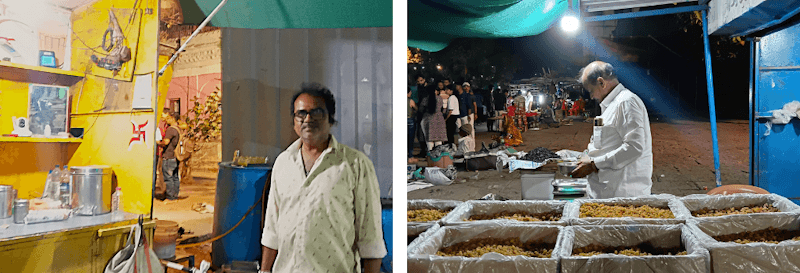
From a contemporary perspective too, life here has revolved around the Godavari and its flows. We meet Suresh Wagh, 52, a fourth-generation resident whose family has owned a modest tea stall since 1974. He says, (translated from Marathi) “The riverbanks were big with stone construction everywhere. As children, we used to cup our hands and drink water directly from the Godavari. People used to fill pots from Lakshman kund. There was ‘living water’ in the kunds here which became polluted after the 2003 Kumbh Mela.”
His friend, Ranjit Parde, in his 60s and fifth-generation resident to live by the Godavari, is worried about the forthcoming Kumbh. A retired municipal corporation employee who assists his son in a spices shop, Parde fears that the authorities will force them to move on the pretext of beautifying for the Kumbh. Says he, (translated from Marathi) “When the kunds were ‘alive’ (clean), the water was good.”
Stone, concrete, and the river
The old stone ghats stand distinct from the concrete ghat. This reveals what has been done to the Godavari riverbank. The concrete we stood upon was 10 feet above the river bed; that much concrete has been poured to channelise the rain-fed river which used to get water, even during summers, from a natural network of small tributaries, rivulets and springs. Concrete closed them off.
“Constructing ghats and concretisation are two different things,” explains Pawar, “For every Kumbh, the authorities construct new ghats which have nothing to do with the alignment of the river or the location of the Ram kund. ” The new under-construction ghats, she points out, are far away from the key locations of the Kumbh and the concrete steps are going to further harden the river’s riparian edges, causing them harm.
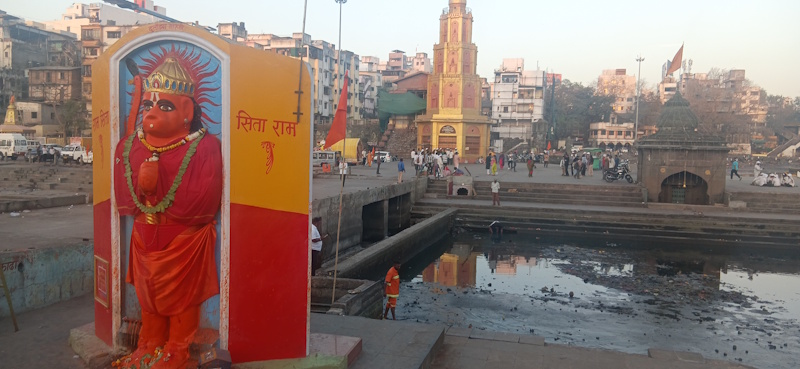
Not only the riverbanks but even the riverbed has layers of concrete poured over it, adversely impacting marine life and groundwater recharge. “The river itself is not dirty; the garbage collects because of the concrete. This should anger people who say the Godavari is their soul,” remarks Padwal, as we go across the Ramsetu to reach near the Naroshankar temple. There is a new breed of visitors here – not devotees but couples with pre – or post-wedding photo-shoot plans who desire the Godavari merely as the backdrop for Instagram-worthy pictures. The stagnant river, the concretisation, and the fragmentation of the river ecology hardly bother them. Local citizens’ groups clean up but Padwal says it’s not their job. “They must instead hold the government accountable…You would never litter in malls. This river is the source of life itself.”
From the Ramsetu, we spot a tekdi or hillock about 30 meters away called Maatichi gadi (mud mound). In 2016, the Archaeological Survey of India’s Aurangabad circle confirmed it as one of 285 mountain sites with National Heritage Monument status. The local lore is that the tekdi was ‘built’ years ago by the river itself as it left silt and mud where it bent. The gadi is at a higher level than the current river bed; the river probably flowed at that height then. An excavation in 1950-51 here found the remains of a settlement dated thousands of years ago – perhaps the first settlers of Nashik. The place and the Godavari have come a long way since but are decidedly less ecologically robust.
Planning failures
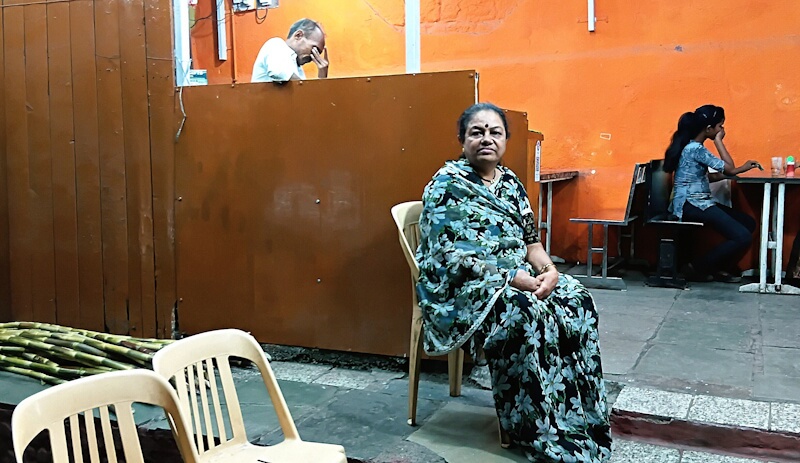
In Ramkund, the buildings stand at varying heights with plinth levels changed to combat flooding as the Godavari flood levels kept rising due to the concretisation and illegal construction. Or as the locals say “nadichi hakkachi jaaga” (land rightfully of the river) was taken. We meet Nanda, 55, who runs a sugarcane juice shop behind the Tarakeshwar Mahadev mandir from the last 42 years with her husband. She says, (translated from Marathi) “There’s no river left now. Before the concretisation, water used to lap at the doorstep of our shop; there used to be a sluice-like way for water where the Goddess revealed herself, said old-timers. All that’s gone. Now, many shops are being broken.”
As we walk upstream, towards the century-old Ganga Tea House overlooking the undulating ghats, the sun turns harsher. There is no water in the river here; dam water is released for people to take a dip, turning one of India’s mightiest and sacred rivers into a dam-fed one. The vendor stalls are shuttered; the weekly market with fruits, vegetables, flowers, spices, and medicinal herbs opens every Wednesday. The three-floor market building nearby, constructed a few years ago, lies empty and dilapidated, a physical reminder of how planners failed to understand that vendors had to be at the ghats or riverbanks where people came to visit temples or stroll along the river. Why would anyone walk up two-three floors to shop?
At this point, the screeching noise of drilling and construction becomes unbearable as the authorities break and reconstruct ghats for the Kumbh Mela. It is expected to draw an unprecedented 10-12 crore pilgrims. The last edition in 2015 saw 2.5 crore people.[2] The Nashik Municipal Corporation contracted Phase 1 of the Kumbh Mela construction and illumination, as also sections of the riverfront development, largely to the Gujarat-based HCP Design.[3] “Hardly any local architects or planners are involved. In the earlier interventions, the river was never stopped, it flowed over the ghats and percolated too. Now, huge retaining walls are being built to obstruct the flow which will definitely cause destruction. The real estate projects across the city on the river’s edge seem to not respect the red and blue floodlines,” rues Pawar.
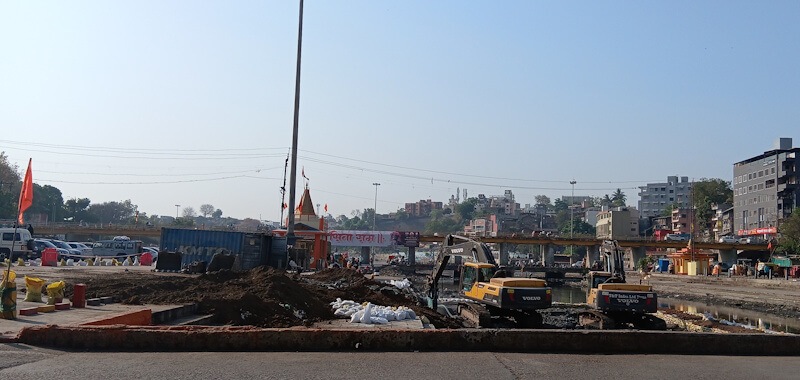
In 2017, the then municipal commissioner Tukaram Mundhe took the ecologically-sound decision to de-concretise from Gandhi talao to Holkar Bridge, under the Smart City project. It turned out to be an expensive and lengthy process, causing harm to the river ecology. Padwal regrets that “the authorities now think only of ‘beautification’ as the solution…They want to show off the bride, so put make-up on.” The concretisation work appears to be haphazardly undertaken without robust plans or a long-term vision that places the Godavari at the centre of such efforts.
The state government allocated a staggering Rs 25,050 crore for the Kumbh.[4] “All funds need not be spent at once. Transport, buses, walking paths, parking, footpaths all these issues also need attention if such a large crowd is expected. The city needs a long-term master plan which guides incremental development as well as future Kumbh Melas, not the other way round. Infrastructure needs to be designed keeping in mind the facilities for devotees but also the conservation of river’s ecology,” says Pawar, who has worked closely with state bodies.
Without the river, the city will cease to exist
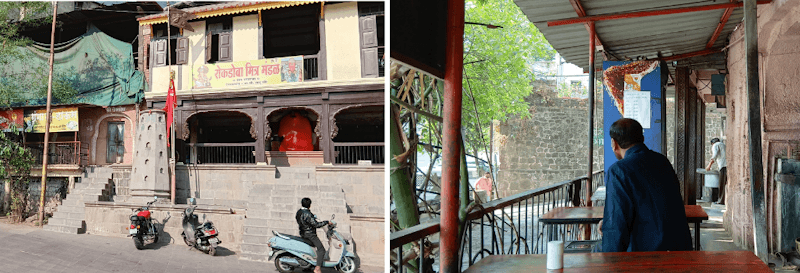
On our way to the Ganga Tea House, on the first floor of an ancient stone-and-wood building is the Rokdoba Talim Sangh, an akhada or traditional gym that encapsulates the wrestling culture of Nashik-Trimbakeshwar, with their idol Hanuman enshrined in a small temple at the entrance. At the tea place, seated on narrow metal benches and overlooking the Godavari, we wait to have what most people order here: Misal-pao with the thin tarri or gravy, papad and tea. This order used to cost a mere 12 paise a century ago here, recount Pawar and Padwal who have come here since their college days. It’s a local favourite and it is delicious.
The complete walk along the Godavari would show 20-30 villages on both its banks but the water is polluted, some villages displaced for the dam but not fully resettled, and tourism with its economic demands threatening the local way of life. Having walked some of the length, from the perch here, it is clear that the Godavari continues to influence – even determine – life in Panchvati and the rest of Nashik. If not restored to health, Pawar reckons it could someday inundate the city itself. “The Mithi river did fight back, right? It entered Mumbai,” she says.
Nikeita Saraf, a Thane-based architect, illustrator and urban practitioner, is now with Question of Cities. Through her academic years at School of Environment and Architecture, she tried to explore, in various forms, the web of relationships which create space and form the essence of storytelling. Her interests in storytelling and narrative mapping stem from the need to understand people and the methods with which they map the world. Through her everyday practice of illustrating and archiving she intends to explore this further.
All photos: Nikeita Saraf