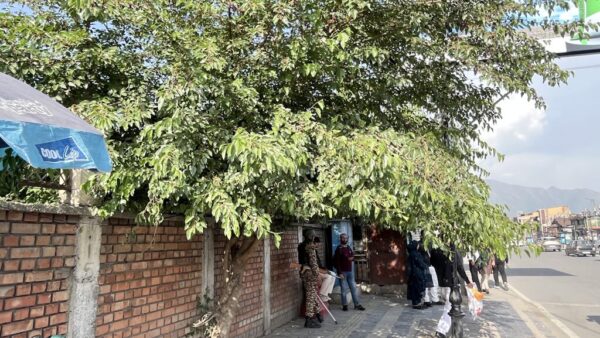

On June 10, women of Sopore town in Jammu and Kashmir marched to the Jal Shakti department, demanding adequate drinking water. They travelled long distances simply to access water for daily needs. After their repeated pleas went unheard, alleging that nothing had been done to address the problem, the women blocked roads.[1]
Residents of Chanot in Hisar district, Haryana, have been protesting for more than 26 days, over the long delay in the Rs 68-crore Bhakra canal water project and the government’s failure to provide them water. ‘No water, no vote’ was the slogan against the legislator who had failed to deliver.[2]
In May, the ‘matka-phod’ protest by the Aam Aadmi Party outside the Delhi Jal Board alleged failure of the ruling party to address the water woes. Delhi is facing a shortfall of around 90-100 million gallons per day (MGD), said the water department officials. This has reduced supply by nearly 10 percent across several zones.[3] For many, this has become a common story during summer.
Protests like these took place in cities as well as in towns and remote villages in many parts of India – from Jaipur and Indore to Delhi and Palghar – as the harsh summer saw rising temperatures and depleting water levels, leading to acute water shortage. That almost none of these protests-for-water became headlines in the country’s media is another story. The severe water shortages in cities and towns were worsened by the inequality aspect too; areas inhabited by the middle-class and the marginalised faced the worst water cuts and more severe scarcity. Some cities protested, others quietly bore the burden.
According to official reports, India has around 18 percent of the world’s population, but just 4 percent of the world’s freshwater resources.[4] But this is not equally distributed. The inequity in water access and use exacerbates during summers, year after year. And people are left with no option but to protest for the simplest of human needs – water.
Devprayag
‘The Ganga originates from Devprayag but we do not have water’
After months of struggle to get water and fed up with the inaction by authorities, residents of villages in Devprayag, Uttarakhand, took out a torch rally on May 26. The visuals circulated on social media showed angry residents marching on the streets, demanding clean drinking water – a plea that has been ignored for months. The ‘Har Ghar Jal’ promise by the Bharatiya Janata Party (BJP) remains a promise.
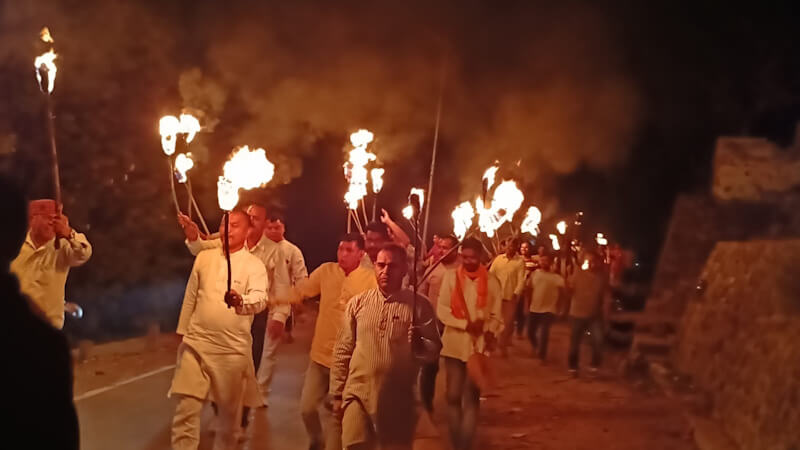
Photo: Hinsariyakhal Patti Yuva Sangh
The months-long shortage reached a point when residents of many villages in Devprayag could no longer bear the heat and the burden to arrange water. Uttarakhand’s rising temperature has increased the demand for water. The state has been seeing a rise in temperatures with Haridwar, Kashipur, Roorkee, Bajpur and Rudrapur recording above 40 degrees Celsius.
When the videos went viral of people carrying mashaals (torches), protesting against the government and the water department over severe water shortage, it showed their desperation and anger. Naresh Umriyal, 30, a social worker in the torch protest, speaks.
“The water problem has been going on for at least a year and a half. We used to get water in our taps once every 3-4 days or even a week. But for the last six to seven months, there was no water at all. We had approached the local authorities many times but nothing happened – only got assurances. The Ganga starts from Devprayag but we do not have water. I am from Umri village in Devprayag block, Uttarakhand. Around 5,000 people live in the village. Other villages such as Hinsariyakhal, Talakot, Pothi, Pujitha, Lawli, Barsoli, Jawar, Lakshmoli are facing the same problem.
“Around 250 residents joined the torch rally. After the protest that went viral, we got some relief – we started getting water once in three days but only 30 minutes. We have to fill containers to use the water for three days. We are facing a lot of problems during summer – apart from household needs, we have to look after the animals. Those who have vehicles travel for three to four kilometres to buy water. Some get water on horses and donkeys. Families in a village collect money and buy water — around 2,000 litres of water cost Rs 1,000.
“After the ‘Har Ghar Nal Se Jal’ under Jal Jeevan Mission was implemented, the old water pipes were removed. Although the scheme has been implemented and new pipes laid, there is no water in taps. The old plan, which is around 80 years old, worked well for us and gave us enough water to sustain. Water was supplied from a spring 8 kilometres away. We used to face water scarcity only in the month of June. We want the authorities to revive the old scheme. When the local authorities could not solve our problem, we did what we had to do — we took out a mashaal rally. If the situation does not improve, we will protest again.”
Indore
‘Indore has a shortage of 10-15 lakh litres of drinking water’
Come summer and expenses increase for Indore residents. A major part of their income goes in buying water for their daily requirement. The worsening water crisis during summer and the rising heat have made life tough for the residents. The month of May saw many protests by the residents and the opposition parties. The residents blocked the road at various areas including Malwa Mill and Palda, demanding regular water supply, better tanker arrangements and extension of the Narmada pipeline network.[5] Ironically, they were fired with water cannons by the police even as the administration has failed to provide water for the residents’ basic needs.[6]
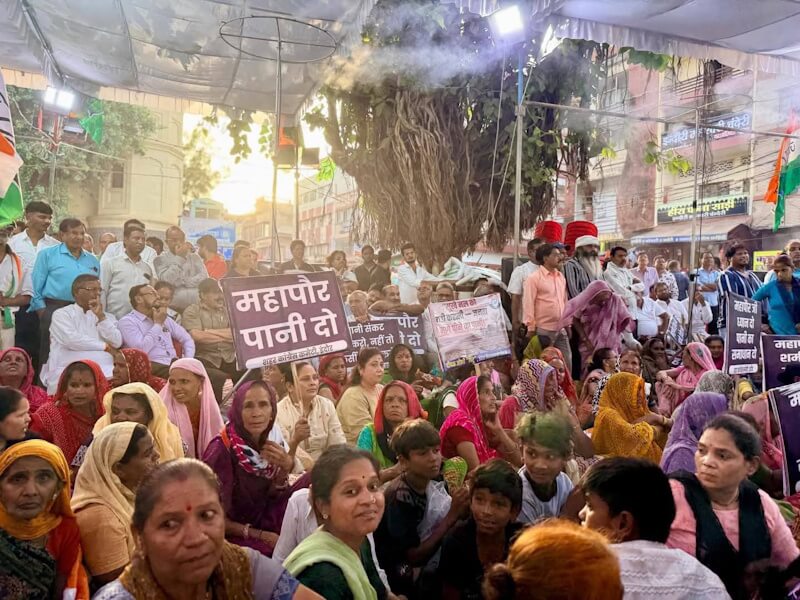
Photo: Indore Shehar Congress Committee (Media and IT)
Kunal Solanki, Congress councillor of ward 75, who led the protests at Indore’s Palda Square, speaks.
“The Narmada tanks which were supposed to be built under the Amrit Yojana have not been built yet and this is one reason for shortage of water. So, more tankers have to be provided. Last year, too, Indore faced a water shortage. Private tankers provide around 1,500 litres of water to housing societies and high-rise buildings have increased their maintenance charge as they have to buy water. Some people fetch water from far in autorickshaws.
“There are many people who cannot afford tanker water. I, too, send tankers through the municipality on alternate days, but some get, some don’t…because the ward is large. Even getting three-four buckets of water is not enough for a household. During summer, a household of four requires at least 200 litres of water. People collect money and get tanker water to their locality. If there is good rain, boring wells will recharge.
“We are trying to build overhead tanks and provide piped water connections in all homes. People from the IT sector live here. Indore is expanding but trees are being cut and the ecological loss is huge, and it will become difficult to provide services. After we took to the streets and protested, the tanker count increased by one or two. There are around 660 tankers in Indore, and we will need more if the water problem is not solved.”
Kuttanad
‘There’s water around us but not potable’
The people of Kuttanad in Alappuzha, Kerala, have always lived between two extremes. Kuttanad, Kerala’s famed rice bowl, is defined by its vast network of canals, rivers and the Vembanad Lake. Every year, they brace for the devastating floods of the monsoon, when rising waters invade homes, destroy livelihoods and isolate entire villages. But summer brings the ordeal of intense heat, shrinking drinking water supplies and the exhausting task of surviving in one of India’s most water-rich landscapes without enough safe water to consume.
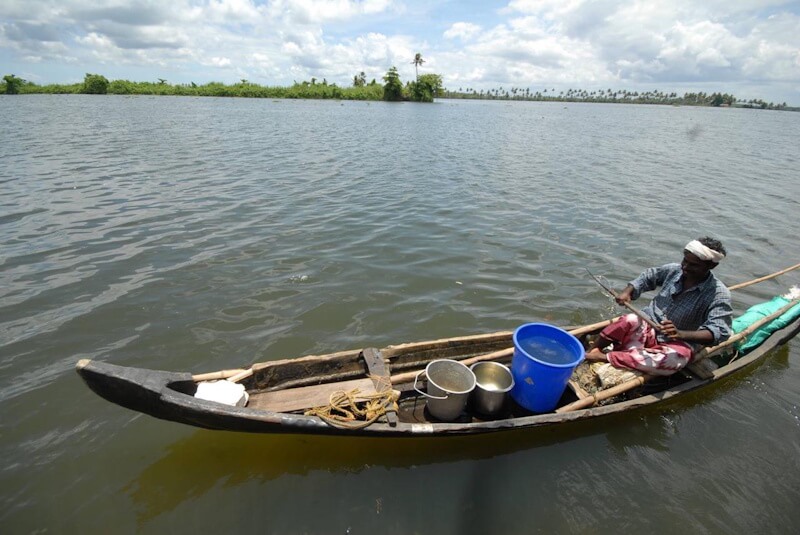
Photo: KA Shaji
Residents say this summer was different. The humid heat that gripped Kerala this year was among the harshest they have experienced in recent memory, turning everyday routines into a struggle for survival. The prolonged periods of severe humid heat; the Heat Index (combining temperature and humidity to indicate how hot it actually feels to the human body) crossed 50 degrees Celsius in several parts of the state during April. Vinodini Raju, 41, resident of Kainakary island in Kuttanad, speaks.
“Nights bring little relief, we keep sweating even after dark…There is no comfort anymore. Our greatest concern is drinking water. I rush to fill every available container during the water supply. People think we have plenty of water because they see the canal near our house. But this is not water we can drink. The heat was unbearable. All the more in the kitchen but cooking has to be done. The children have to eat. We are surrounded by canals and backwaters, but still struggle to secure enough safe water for daily use.”
(KA Shaji)
Palghar
‘People, who gave land to build a dam, are facing water problems’
Palghar, once a languid place, is among Maharashtra’s fast urbanising districts; a stretch of Mumbai’s coastal road is projected to culminate here. It has housed small dams for years, dams used to supply water to the Mumbai Metropolitan Region. But the villages in Palghar face water scarcity every summer. This year the situation worsened as heat increased. The water of Sakhare, Kavdasa and Surya projects in the taluka is used for drinking and for agriculture. The Rs1000-crore Har Ghar Jal scheme, launched three years ago, aimed to provide piped drinking water to rural and isolated areas but it hangs fire, leaving the villages high and dry.[7] Relying on tanker water too became increasingly expensive and difficult this year. Vinit Pratibha Prabhakar Patil, 42, farmer and long-time resident, speaks.
“We are a family of six. Every year, we face water problems. We have a borewell, and boadi (small well dug on premises). These haven’t dried up in the summer but the water is not enough. The most affected are the people living around Sakhare dam; they recently took out a rally over the water problems. The water of Dhamani dam goes to Vasai-Virar and Mira Bhayander. But, the 13 villages that were shifted to build the dam 42 years ago have neither got the land documents nor water. Around 6,000 people were shifted to Palghar’s Hanuman Nagar and Dahanu’s Chandra Nagar. Now, they are affected by the bullet train and Vadhavan Port. They gave their own land to build a dam and they are the ones facing water problems.
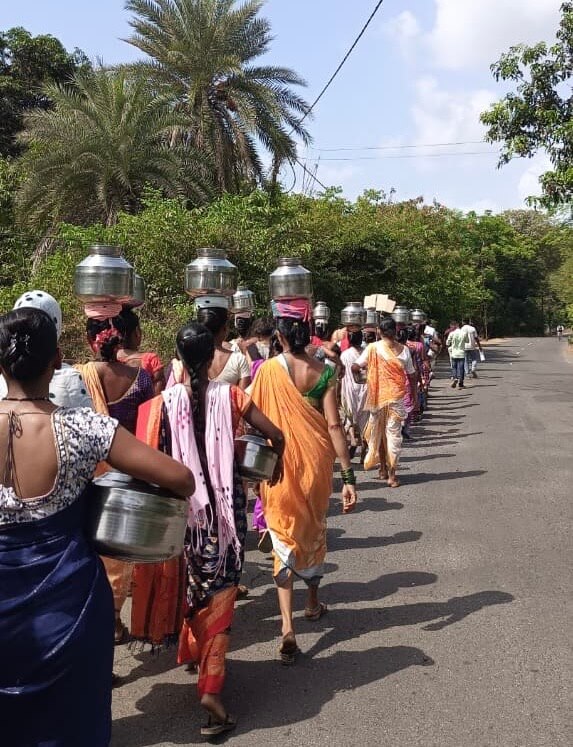
Photo: Vinit Pratibha Prabhakar Patil
“I live west of the railway line. My village, Varor, is also in Dahanu taluka where the Vadhavan Port has been proposed to be built. The water problem has worsened in the past two years and there have been small protests. Residents of Sakare village where the dam has been built, protested over water in May. From here, water is given to 26 villages but the village itself does not get water. The village of around 9,000 people is near the sea and the residents get water once in 10-15 days. There is no water now. We use tubewell water for farming.
“Residents of Dhamni dam village in Palghar district had to dig a 10-foot hole in every house where there is a water line as water does not reach them. This is the fault of the government and the fault of engineers. If you have spent a lot of money and built a water tank, then the water should go there, but it doesn’t.”
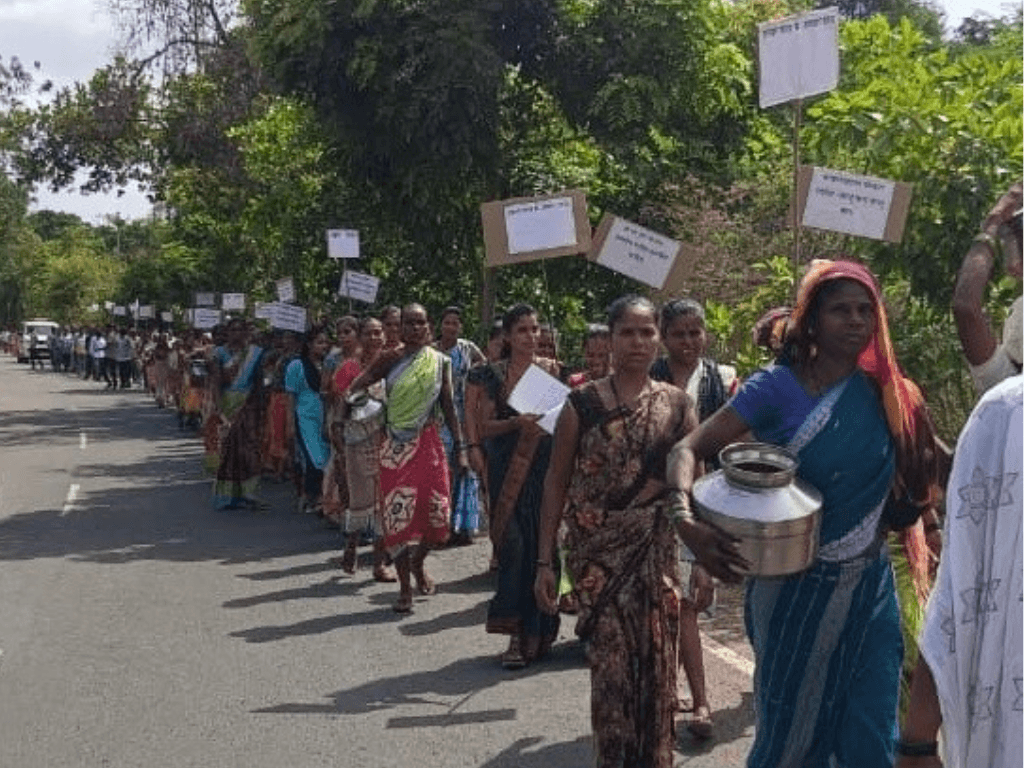
Cover photo: Women march in Palghar with empty pots, demanding potable water.
Credit: Vinit Pratibha Prabhakar Patil