
On May 21, as Hyderabad recorded its highest temperature of the season, with many parts of the city touching 43 degrees Celsius,[1] what would have made a fundamental difference was shade – a cooler, darker area away from the harsh direct sunlight, preferably with a canopy of trees.
In Hyderabad, the natural shade of trees and green cover has been sacrificed in the pursuit of construction of concrete and glass buildings. The city has lost 1.61 square kilometres of forest cover in only two years till 2023.[2] As Telangana records rising heatwave deaths and the crisis of extreme heat unfolds on streets of its cities, the absence of shade, among other heat mitigation measures, leaves thousands of informal workers vulnerable to the killer heat.
Outdoor informal workers including street vendors are the most affected as day temperatures break all records in the summer months. Without designated covered work spaces or shade in public spaces where they work, they are forced to brace the heat. Urban planning across India’s cities is yet to account for heat and heat-related factors; shade and, specifically, shade as public infrastructure is far from becoming a priority. Usually seen as a naturally-occurring phenomenon or luxury, there’s a long way to go for shade to be perceived as necessary public cooling infrastructure.
Internationally, shade is being recognised as public infrastructure. Studies in Tempe, Arizona,[3] show that shade is one of the key factors in making spaces comfortable, with “both tree shade and built shade reducing heat stress and improving people’s perception of outdoor comfort”.[4] Author Sam Bloch in his book, Shade: The Promise of a Forgotten Natural Resource,[5] writes, “Every time we weaponise sunlight, we make shade more of a private luxury and less of a public resource to be shared by all.”
No community needs shade more than outdoor workers and vendors who battle a toxic mix of heat and pollution every day. Heat and pollution are not separate crises; they collapse into and exacerbate each other through exhaustion, dehydration, dust, and prolonged exposure. My qualitative field research conducted across selected vending corridors in Hyderabad’s Mehdipatnam, Charminar, Koti, and Secunderabad shows the lived experiences of street vendors in the searing heat and why shade is necessary.
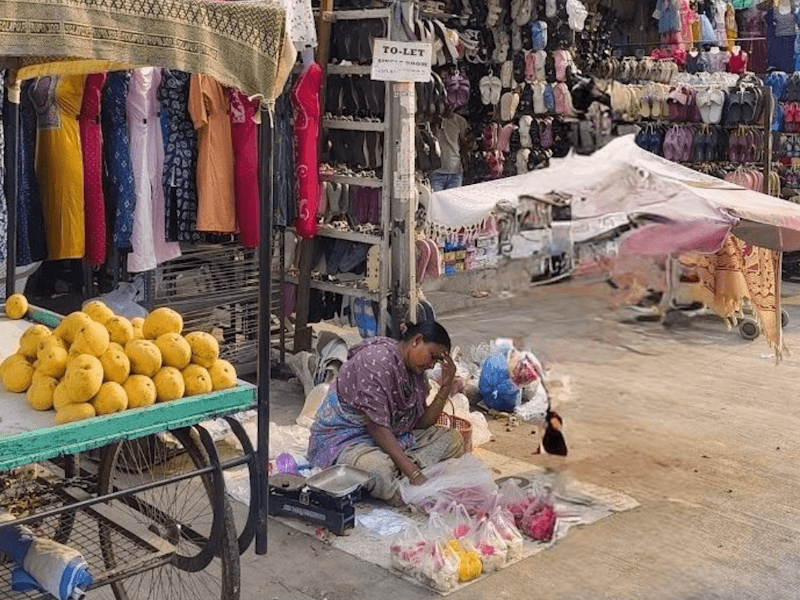
Photo: Malladi Vaishnavi
When heat becomes workplace
The Secunderabad station-cum-bus stop is one of the most crowded transit corridors. A number of street vendors operate in zero-shade areas. Bus stops are dilapidated, almost unusable and hardly offer any protection from the sun. Balakrishna, a corn seller vending here for five years, describes how physical exhaustion has gradually become normalised. “It’s tiring…really tiring,” he says. Sarwar, who has been selling samosa for 13 years, is aware that the long-term environmental burden of his work “is not healthy because of the extreme heat and constant dust from vehicles”.
The workers have no option but to put up stalls on the roads that have no shade and quickly turn into heat hotspots as the day goes by. In Mehdipatnam, an elevated pedestrian skywalk under construction is the only available temporary shelter for vendors, offering them some respite from the scorching sun. A woman migrant from Karnataka has been vending fruits along Mehdipatnam’s traffic corridor for the past 15 years. The non-shaded and dusty road adds to her exhaustion; she suffers from “fatigue and back pain” which renders her unable to do household chores when she returns home. But this is the only work she knows.
Just as severe discomfort during the day has been absorbed into their everyday survival, the lack of basic public services like water, and the absence of shade have been normalised too. “Discomfort has become a habit. I can no longer tell what’s wrong,” said Nathu Ram. Vendors complain about the frequent illness but they have taken it in their stride but few showed awareness of vendor associations such as the National Association of Street Vendors of India (NASVI), government welfare schemes, or local organisations addressing their concerns. Their ‘illegality’ or non-legitimate claim to the space they occupy, they believe, makes them undeserving of government aid or basic facilities. “Hum toh yahan illegal hain… kya scheme humare liye? (We are illegal here…what scheme for us?),” asks Maqbool, who has been selling bangles for 15 years.
Studies on urban heat stress and outdoor labour have shown that low-income workers in Indian cities face disproportionate physical exposure to rising temperatures and environmental stress. In this sense, the vendors’ experience is part of a broader structural condition where climate vulnerability is reflected directly in the lives and bodies of informal workers.
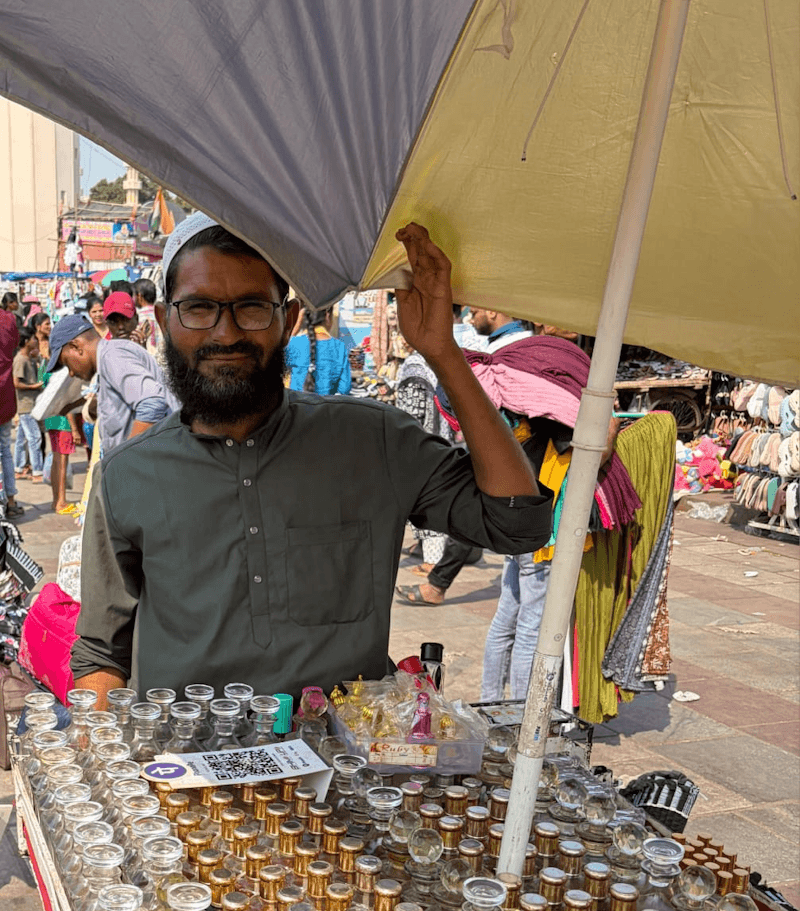
Photo: Malladi Vaishnavi
When heat affects daily income
Besides health, sustained exposure to heat has a direct impact on a vendor’s livelihood, both when customers avoid coming in the sun and produce wilts fast. Kiran Kumar, a vegetable vendor, speaks of how the Hyderabad heat “changes the colour within hours” of what he sells and is forced to absorb “the daily loss” of what the customers reject. Would vending under natural or built shade not have protected his health and income?
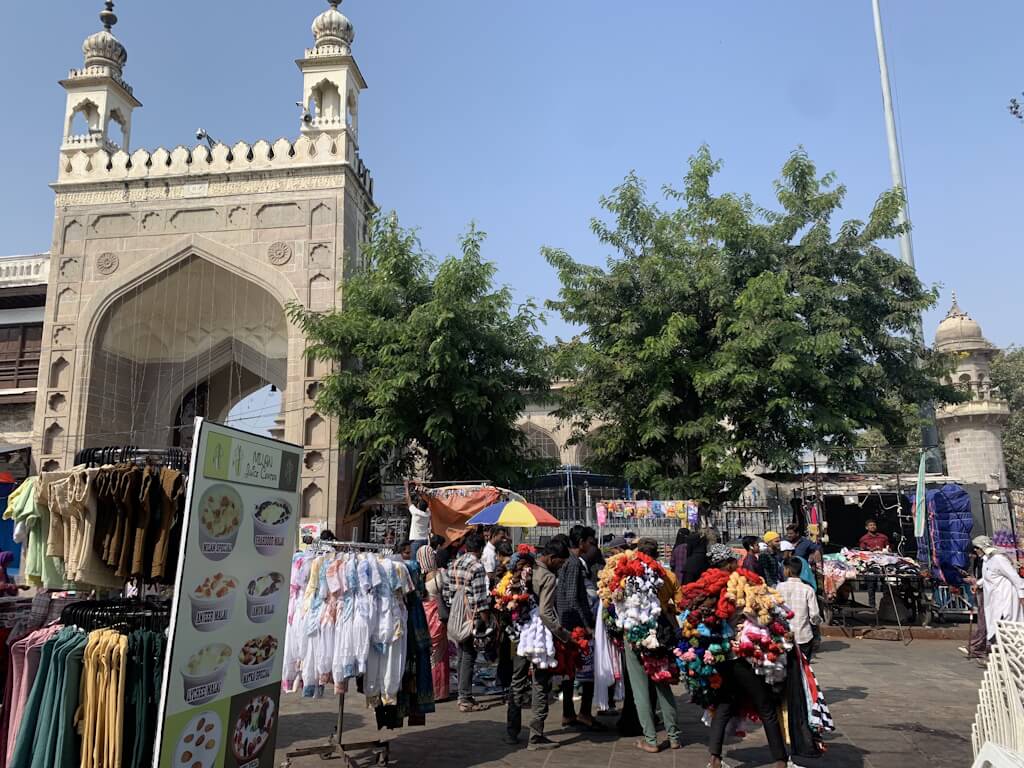
The Greater Hyderabad Municipal Corporation (GHMC) identified around 1.63 lakh street vendors across the city and proposed or demarcated 81 to 123 vending zones under the Street Vendors Act, 2014[3]. Though these may organise vending activities, provide safer and regulated spaces for vendors, and offer shade from heat and rain, all vendors cannot use them because the zones can only accommodate a few. Sultan Bazaar in Koti, an urban market that traces its history to the British and the Nizam of Hyderabad, has a dense layout but it does not shield vendors; instead, its urban morphology traps ambient heat and air pollution.
This localised microclimate presents challenges for the generational vendors here – the formal market has structure and shade but the roadside work does not. Structured municipal shade infrastructure is what all vendors here need. Yadaiyya, who has been selling fruits for more than 40 years here, works inside the formal market for nine hours and the rest outdoors at his stall. In Mehdipatnam, despite a formal Rythu Bazaar (vegetable market), vendors perch on the road or pavements because many are not allowed inside. When there is shade built, not all can claim it.
Negotiating heat, space and survival
Urban planning often undermines shade of all kinds – trees, covered sidewalks, canopy structures. A connected network of shaded surfaces distributed across public spaces can make all the difference during scorching heat. When building density is high in cities like Singapore, “the public realm can rely more heavily on covered sidewalks, building overhangs, and orientation to extend shade across daily routes”.[6]
In their everyday work, vendors inevitably negotiate with two aspects – space and heat. Finding a shady spot to sell is one challenge; ensuring that they are constantly visible to the customers is another. This comes with the risks of being evicted or losing the coveted spot. “I got beaten up by the police multiple times; it’s common here,” says Vinod Kumar, who has been selling trinkets near the busy Charminar.
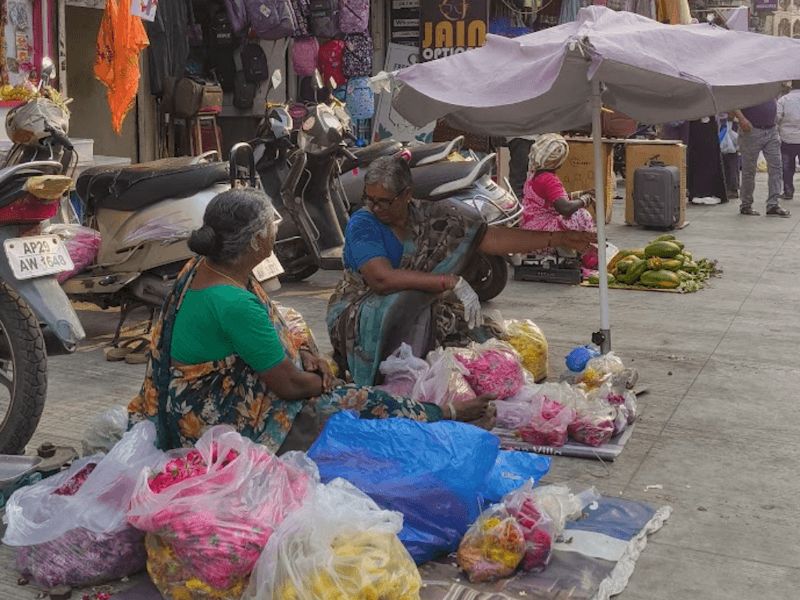
Photo: Malladi Vaishnavi
But what use is the coveted spot if it is on a hot stretch without any shade? Even customers look for a cool space to shop. Hawking space under a tree or under a large umbrella typically does better business.
Fatigue and tiredness were reported by 75 percent of the respondents and remains the single most dominating experience in all areas. This parallels what heat stress research identifies as the primary physiological response to sustained thermal load. Sixty percent reported body and joint pain, and 55 percent reported headaches and dizziness, both conditions associated with dehydration and circulatory strain under prolonged exposures.
Every year, Hyderabad – and Telangana – issues heatwave and red alert warnings as temperatures cross 40 degrees Celsius. But the policy debates on heat as an occupational and public health problem are less prominent[6] and receive little attention in public debates. These can, and must, reflect in the policies and appeals of the Telangana Street Hawkers Vendors Union (TSHVU) which plays a role in raising awareness on eviction and relief measures for vendors. The Lancet Countdown on Health and Climate Change reported in 2023 that every person[7] in India was exposed to more than 2,400 hours, nearly 100 continuous days, of conditions where even light outdoor activity posed moderate heat stress and involved standing on asphalt for 8 to 12 hours without shade, rest, and access to clean water.
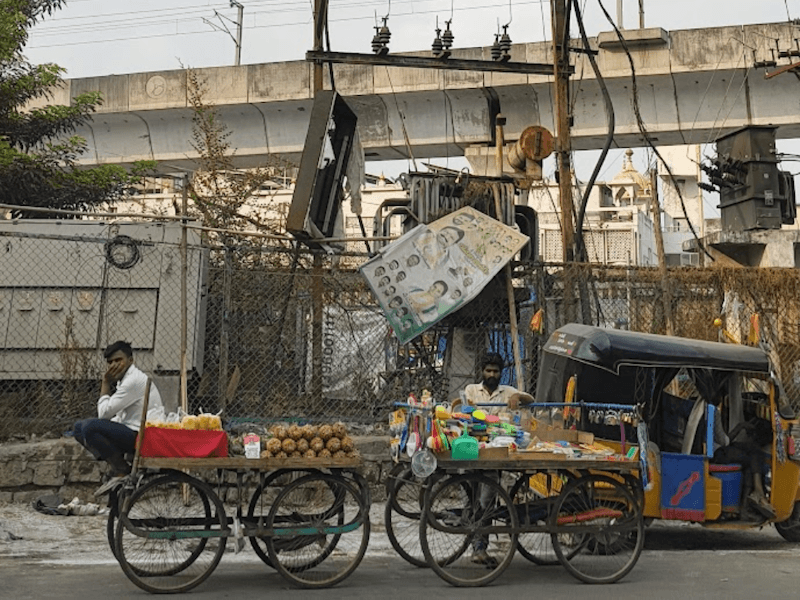
Photo: Malladi Vaishnavi
The gaps, the ways forward
The Greater Hyderabad Municipal Corporation (GHMC) has issued street vendor identification cards to over 1.69 lakh vendors and provided them access to eight schemes. But most of these are insurance or accident schemes; none of them consider occupational health hazards or respond to the daily stresses. Telangana’s climate and vendor welfare frameworks already recognise vulnerable livelihoods, high heat risk zones and vendor information in silos, leaving occupational heat exposure largely unaddressed.
Cooling centres at major vending clusters, shaded rest infrastructure, and access to potable water at vending sites are immediate needs that require no new policy frameworks. Existing bus stops, metro edges, and community halls can be rapidly converted into temporary cooling points or shaded areas during extreme heat periods by the GHMC in coordination with Town Vending Committees (TVCs).
Second is the need for an integrated framework. The Telangana Heat Action Plan identifies heat risk and vulnerable zones, while PM SVANidhi — launched in June 2020 to provide affordable working capital to street vendors — has geo-referenced locations of more than 77,000 street vendors across Hyderabad. The Street Vendors Act, 2014 and Town Vending Committees (TVCs) also provide institutional outreach mechanisms. The issue is not the absence of frameworks but the absence of integration between them.
Given their direct institutional linkage with vendors, TVCs should also be assigned occupational health mandates, including periodic health tests, monitoring heat-stress, and providing formal feedback mechanisms to report recurring environmental and health issues among vendors. Along with tackling infrastructural inequality, TVCs must also demand the provision of shade for immediate relief to vendors. It’s the bare minimum.
References:
- Telangana Today. (2024, May 25). Telangana reports 16 heatwave deaths, govt announces Rs 4 lakh ex-gratia. Telangana Today
- Arunab, K. S., & Mathew, A. (2023). Geospatial and statistical analysis of urban heat islands and thermally vulnerable zones in Bangalore and Hyderabad cities in India. Remote Sensing Applications: Society and Environment, 32, 101049. https://doi.org/10.1016/j.rsase.2023.101049
- Kjellstrom, T., Briggs, D., Freyberg, C., Lemke, B., Otto, M., & Hyatt, O. (2016). Heat, human performance, and occupational health: A key issue for the assessment of global climate change impacts. Annual Review of Public Health, 37, 97–112. https://doi.org/10.1146/annurev-publhealth-032315-021740
- Deccan Chronicle. (2022, October 31). Street vendors policy shelved. Deccan Chronicle Report
- Kjellstrom et al. (2009) — Global Health Action & Kjellstrom, Briggs & Freyberg (2016) — Annals of Global Health
- Insights from Researcher’s Qualitative Analysis
- Telangana Street Hawkers Vendors Union. (n.d.). Acts & policies. Telangana Street Hawkers Vendors Union.TSHVU Acts & Policies Page
- Discover Public Health, Springer Nature. (2025). Unveiling the link between occupational heat strain and productivity loss: evidence from South Indian informal sectors.
Malladi Vaishnavi is a qualitative researcher and Master’s student in Cities and Governance at the Tata Institute of Social Sciences, Hyderabad. Her work focuses on informal livelihoods, environmental justice, and the lived experiences of vulnerable communities within Indian cities.
Cover photo: QoC file