

In April, Oracle, a US-based enterprise software giant, cut around 12,000 jobs in India — 50 percent of its workforce in the country —even as it invests billions of dollars in Artificial Intelligence (AI).[1] Global companies such as Accenture, Amazon, and IBM have taken similar steps to reshape for AI, cloud, and product-focused services.
Although AI may not be the only factor for the restructuring, the fact that it is drastically changing the way people work cannot be overlooked. The embrace of AI across sectors of the industry has, and is reckoned to have, a far-reaching impact on work and workers. Typically, software and technology developments tend to create shifts in knowledge work and systems, but whether the seemingly unstoppable march of AI will disrupt jobs and job markets as it has been for the past few decades is an open question so far. There are arguments on both sides and the jury is out.
What then is the future of jobs and the impact of AI on employment? With automated tasks, manpower is slashed as fewer employees are needed. The International Labour Organisation (ILO) has weighed in on this subject with studies and Working Papers over the past year or so (two links at the end of this compendium). The International Monetary Fund (IMF) discussion note on AI’s impact on work projects that AI will affect 40 percent of global employment. In India, AI is likely to impact 26 percent of jobs. Researchers have, however, pointed out that AI is being used as cover by companies that anyway wanted to downsize.
This compendium of reports, studies, and articles shows the spectrum of AI’s global impact on employment, whether it will impact the blue-collar workers or knowledge-intensive workers, and whether it will displace the workforce itself. Most studies point to entry-level and lower-paying knowledge jobs being affected.
How AI Is Changing the Labour Market
Ana Elena Azpúrua, Harvard Business Review
This working paper, “Displacement or Complementarity? The Labor Market Impact of Generative AI”[2] by Suraj Srinivasan, Wilbur Xinyuan Chen, of the Hong Kong University of Science and Technology, and Saleh Zakerinia of Ohio State University, sheds some light on how AI has impacted the United States market. The evidence shows that Generative AI is reshaping, not uniformly erasing white-collar work. The study across nearly all United States job postings from 2019 through March 2025, shows that openings for routine, automation-prone roles fell 13 percent after ChatGPT’s debut. At the same time the demand for more analytical, technical, and creative jobs grew by 20 percent. The study argues that choices by firms—especially around reskilling and integrating AI as an augmentation tool—will determine whether workers face displacement or new opportunities ahead.
“Rather than solely eliminating jobs, generative AI creates new demand in augmentation-prone roles, suggesting that human-AI collaboration is a key driver of labor market transformation,” writes Suraj Srinivasan, faculty at Harvard Business School. The occupations that can be automated with AI augmentation show usage of generative AI alongside human involvement. The findings indicated that the number of skills required for roles prone to automation are shrinking. These detected 7 percent fewer skills and increased AI-related skill requirements like prompt writing. Srinivasan through the study findings guides that firms must see this as an augmentation tool that could support work rather than a cost-cutting measure and also align training programs regarding the same.
Photo: Wikimedia Commons
Labour market impacts of AI: A new measure and early evidence
Maxim Massenkoff and Peter McCrory, Anthropic
The paper aims to test the impacts of AI’s labour market and establish a method to measure how AI is affecting employment. The authors establish that they aim to also revisit these analyses periodically for future findings to identify economic disruption more reliably. This massive data driven exercise flags off the gap between “theoretical capability” and “observed exposure”. The study finds that unlike any other previous technological or software automation waves, the AI wave does not affect blue collar workers as much, instead it is knowledge-intensive and high-exposure jobs like programmers, financial analysts, which seem to be more affected.
“By tracking how that gap narrows, observed exposure provides insight into economic changes as they emerge. Our measure qualitatively captures several aspects of AI usage that we think are predictive of job impacts,” the authors explain in the paper using the ‘Theoretical capability and observed exposure by occupational category’ chart, largely circulated and talked about online.
The report summarises that the gap between what AI can do in a workplace and what it is currently doing is slowly closing in and entry-level jobs are soon to shrink, although it does not seem to be a huge crisis currently.
The AI Layoff Trap
Brett Hemenway Falk, Gerry Tsoukalas, Brett Hemenway Falk, Gerry Tsoukalas
The AI Layoff Trap has gained significant traction, since it goes beyond the good or bad debate of AI to offer a structural economic argument and solutions. In the paper, the authors develop a task-based automation model inspired by Acemoglu and Restrepo (2018), but refocused from the labour market to the product market, in order to answer questions related to automation of work in companies, policies surrounding it, and what determines the extent of this automation. They point out the risk of the consumer demand being dismantled if AI displaces human workers faster than the economy can re-absorb them. They point out that just knowing this is not enough but the companies need more to actually stop this displacement. The authors tested several popular policy proposals through the paper and found they fail to stop the cycle.
“In a competitive task-based model, demand externalities trap rational firms in an automation arms race, displacing workers well beyond what is collectively optimal. The resulting loss harms both workers and firm owners,” they point out. The factors of increased competition and “better” AI seem to amplify the excess automation and it cannot be eliminated by wage adjustments, free entry, capital income taxes, worker equity participation, universal basic income, upskilling, or even bargaining. What does work, the authors suggest, is the Pigouvian Automation Tax[3], which basically makes companies pay tax for the negative externalities. The paper throws light on how policy must not only look at the aftermath of displacements by AI but also the competition that demands companies of the implementation.
Photo: Wikimedia Commons
Meta and Microsoft have joined the tech layoff tsunami. Is AI really to blame?
Kai Reimer and Sandra Peter, The Conversation
Meta and Microsoft are the latest large companies to announce large scale layoffs and cuts in their workforce, while also investing large amounts in AI. The essay lays down three views, often presented as mutually exclusive: that AI is superintelligence, that it is mostly hype, and that it is a useful tool. To understand these lay offs, the authors explain, one must understand what AI really means and what implications it would have.
“In the first view, AI is an emerging superintelligence. It is a new kind of mind that learns, reasons, and will soon outperform humans at most cognitive tasks (hint: it’s not!)…The second view sees the conversation around AI as mostly hype. AI is being invoked as cover. Companies that hired aggressively during the pandemic boom, and now face financial pressure, are blaming AI as the more palatable explanation…The third view is more nuanced. It sees AI as a powerful tool, but one that companies will need to transform themselves to take advantage of.”
The essay concludes that usually software and technology developments tend to create shifts in knowledge work and systems. It indicated that the workers at risk are not necessarily those whose jobs can be replaced by AI but those who work in alignment with external pressure before moving forward. The understanding of AI replacing jobs and its usefulness, the authors claim, can only be understood in the next few years depending on whether large corporations like Meta and Microsoft pocket the payroll savings or redesign and hire staff with different skills.
Workers’ exposure to AI: What indicators tell us and what they don’t
Rossana Merola (ILO), Ekkehard Ernst (ILO), Daniel Samaan (ILO), Maria del Rio-Chanona (University College London), Ole Teutloff (Oxford University)
This report by the International Labour Organisation (ILO) examines how workers’ exposure to AI is currently measured and what the present indicators say about the potential transformation of jobs. It explains that the current methods and approaches can be seen as a heads-up for potential changes instead of forecasts for future employment losses. AI exposure indicators are basically metrics used to determine and analyse the extent to which AI systems can augment or substitute specific tasks. These indicators do not predict job losses directly, instead they act as warning signals of how roles and methods of work can be transformed with the introduction of AI.
The occupational groups projected to be affected by AI exposure show a vast range, among which higher-skill and higher-wage occupations emerge as the most exposed. Business, finance, computing, and such occupations show highest exposure. “Because these jobs are closely connected to many others through shared skills and career transitions, shocks affecting them can spill over to related roles, indirectly affecting workers whose own jobs do not appear directly automatable.” So these indicators are basically determined to be only heads up of job transformations but not clear predictions of job displacements, productivity or reskilling needs.

Photo: Wikimedia Commons
How might generative AI impact different occupations?
This Working Paper from May 2025 was among the ones that set the tone for examining the impact of AI on jobs – and what kinds of job skills. Much of the interest on AI and work concerns its possible effects on job losses: will jobs be replaced by AI or will they be transformed? While it is not possible to predict the future – particularly as the technology is still evolving – ILO researchers first developed a methodology in 2023, and later refined it in 2025, to estimate the potential effects of generative AI on existing occupations, and then in a second step, on employment. The study and analysis were based on a global assessment of the 436 detailed occupations that comprise the International Standard Classification of Occupations.[4]
The analysis evolved a framework to track or project jobs and job losses, after all the occupations were grouped into six gradients and four task variabilities — ‘highest exposure, low task variability’ jobs with a high potential for automation; ‘significant exposure, high task variability’ in which the overall impact was growing; ‘moderate exposure, high task variability’ where the impact was uneven because there was a mix of tasks exposed to AI and others not so; ‘low exposure, high task variability’ where occupations had low overall AI exposure but showed elevated automation potential; ‘low exposure, moderate task variability’ with occupations that showed minimal exposure to AI; and ‘not exposed’ to AI occupations.
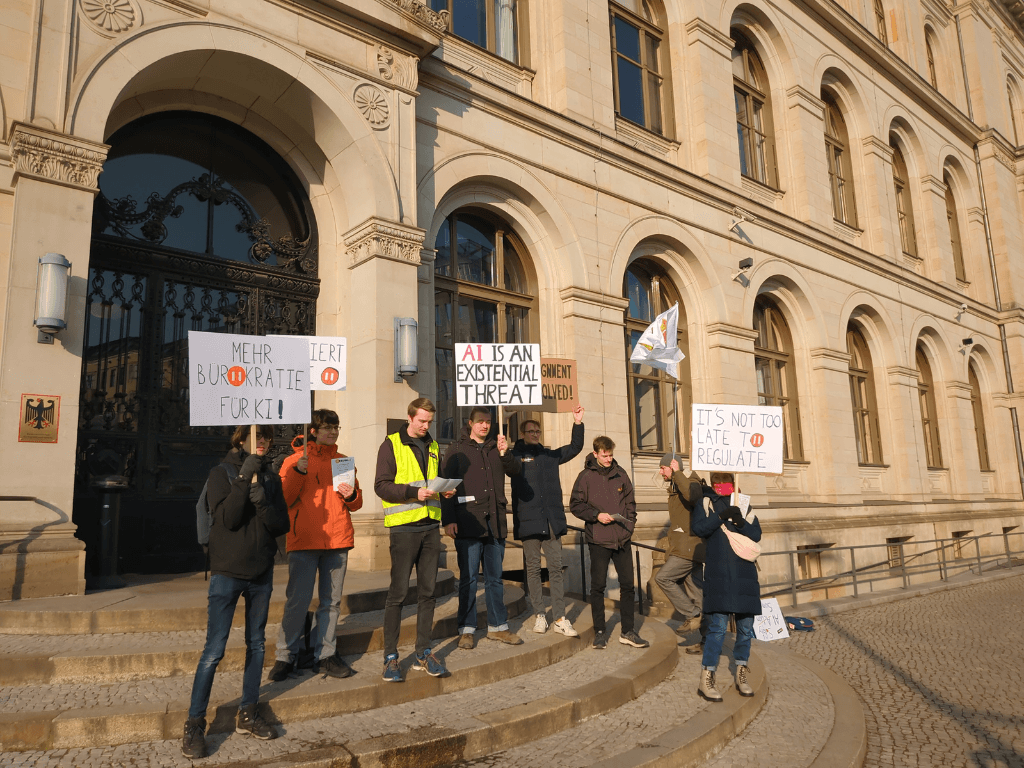
Cover photo: Protest against the Artificial Intelligence Action Summit in Grand Palais Paris in February 2025 at BMDV in Berlin; Credit: C.Suthorn cc-by-sa-4.0 commons.wikimedia.org