

Heritage illumination is not new but Kolkata has written an innovative chapter in the narrative. In about two years, as many as 103 heritage buildings of the city have been bathed in lights, thoughtfully and expertly executed, to show their grandeur and detail. This is important from two perspectives – bringing a glowing night aesthetic to the city to showcase its colonial architecture in all its splendour, lending a different look and feel to the city in the dark; and demonstrating that something like this can be done through the efforts of philanthropists and citizens without hierarchies and governments.
From the Raj Bhavan and St Paul’s Cathedral to the Victoria Memorial’s angel, the General Post Office, Greek Orthodox Church in Kalighat, Kalachand Jew Temple, Eastern Railway in Fairlie Place, and Belgachia Jain Temple among the landmarks, illumination has lent them all a quiet dignity and an invigorating glow that evokes the sense and feel of any international city, especially in Europe. Gradually, the city has acquired a lustre in the dark, bringing into relief the buildings and structures that were hidden in plain sight, and giving Kolkata a different warm character in the night.
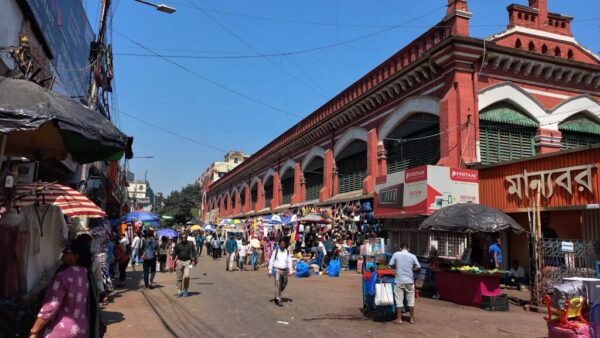
The Calcutta Illumination Project, as it’s called, started in 2023 as one man’s idea and one building project to be aesthetically lit up. Philanthropist Mudar Patherya rolled out his idea with the dome of Maniktala market, his purpose straightforward and simple – to make the people of Kolkata ‘see’ the building anew. “I hope the project attracts more public participation and interaction with spaces around the heritage buildings. Most people are inward looking. They see and move on,” says Patherya to Question of Cities, “Merely educating them on the innards of North Calcutta, the by-lanes and lanes won’t work. You have to take them there, tell them why it’s different. And sometimes it becomes a little difficult to see through the grime and to see through the general decay.”
Eventually, a group was formed on WhatsApp as a broadcast group, without a structure or hierarchy. Called The Kolkata Restorers, the collection of donors ranges from young students to the city’s philanthropists, making it a truly civic and participatory activity, the people claiming their buildings to illuminate. “The true innovation of The Kolkata Restorers is governance—proving that aesthetics and accountability can coexist, and that heritage transformation can be transparent, frugal, citizen-driven and visibly transformative…The city’s facades glow today not merely because of LED lamps but because of the governance that has gone behind them,” wrote Patherya in The Telegraphn Online.[1]
Lighting, especially of public spaces and buildings, has been a low-priority activity in several municipalities, not considered as significant or substantive work in cities where water supply and solid waste management claim attention and funds. But this approach, while understandable, has also led to disregarding good lighting as an influential aspect in shaping urban aesthetics. While private buildings may be out of the ken, pleasingly lit public buildings and spaces including some in the older commercial districts in cities with history, influences everything from the appearance of architectural landmarks to their vibrancy enabling the city to develop a night-time identity.[2]

Photo: Sujoy Sen
How they were lit
Some of the structures such as St Paul’s Cathedral look stunning in the night, when lit. “Lighting has added a completely new layer of beauty to Kolkata,” says Sujoy Sen from the tour firm, Travel Together Everywhere, who has been organising evening tours of these structures since June this year. “Earlier, many of these heritage buildings were hardly noticed at night—they remained dark, dull, or invisible. After illumination, their architectural details, colour, and shapes stand out. People now stop to look at them, and appreciate their history.”
The evening tour takes visitors to some of the historical structures, sharing interesting stories and explaining the architecture. “The lit-up buildings are more noticeable and visible now. People should know the interesting architecture that we have around the city,” says Monami Goswami, senior executive, digital content and research, DAG. Sen adds that lighting has also made certain stretches of the city feel safer and more welcoming after dark too. Areas that were once deserted now look lively and cared for.
The buildings are cleaned, restored and then illuminated. “The illumination has been done thoughtfully by focusing on soft, warm tones that highlight a building’s original character, not overwhelm it. Nothing flashy or out of place has been used. The idea has always been to respect the heritage, not alter it,” says Sen, “Lighting has helped people reconnect with the city’s architecture and has made Kolkata look more vibrant at night while still keeping its classic charm.”
Typically, even when they were lit by authorities, different buildings used different intensities and lighting styles or a flat white light that ruined the intricate features of buildings drowning them in the same lux levels rather than highlighting their best aspects and details. Some buildings ended up being over-lit, while others were minimally lit, leading to an uneven visual narrative. “There was a lack of proper maintenance and monitoring. Dust, rain, and pollution reduced brightness over time and the lights deteriorated or became uneven,” says Sen.
The United Nations Educational, Scientific and Cultural Organization (UNESCO) recommends that monuments should not be illuminated from the bottom up, except for historic buildings. Lights should be intercepted by the building façade to prevent light from straying away. It recommends using luminous flux reducers that have an automated or self-timing mechanism that can switch off automatically during the day.[3] Keeping this in mind, Mudar Patherya started off with the dome.

Photo: Sujoy Sen
Illumination enhances
Illumination sharpens the eyes-on-the-street perspective, opines architect and urban designer Saheli Ghosh. “In Kolkata, which has a colonial past, the illumination project is enhancing the city’s overall aesthetics. When we talk about heritage structures, we do not only talk about the building’s architecture but also its relation with its surroundings and how people perceive it. Illumination enhances a city’s overall visibility, enhances its relation with the surroundings,” she says.
Monami Goswami goes a step further to say that Kolkata is becoming a night city and highlighting the buildings looks good “but it has to be done tastefully, and sensitively”. Some of the buildings could have been done better, she thinks. “The way some have been lit up does not do justice to the historic structures. It looks gaudy. From a distance, the Victoria Memorial looks nice but from closer, the lighting looks gaudy and the lights do not compliment the building’s façade,” she weighs in.
Still, the lighting has done Kolkata some good. As Ghosh says, “the lighting has a lot to do with the city’s image itself. If buildings are being illuminated, it is definitely adding value to the city’s overall image, especially at night. This also boosts tourism and the economy.”
Mumbai disappoints
The other colonial city, Bombay/Mumbai, too has seen public and private buildings illuminated at night for many years, especially on nationally significant days, but the warm yellow glow that made for dignified luminosity of chosen buildings – mostly done through private donations or by the Brihanmumbai Municipal Corporation – has given way to something less flattering. For one, the buildings like the BMC headquarters itself and the stately Chhatrapati Shivaji Maharaj Terminus have been bathed in lights of different gaudy colours or often a single hue that glazes over or conceals their finer architectural aspects.

Photo: QoC file
Importantly, the BMC went where few fear to tread in 2023, the same year that the Kolkata Illumination Project took shape. It called for tenders and issued work orders to illuminate 15,000 trees across the city, especially on five arterial roads that were to transport delegates for the G20 Disaster Risk Reduction Working Group hosted in Mumbai as part of the G20 Summit in Delhi. This turned into the civic body’s ‘beautification project’ costing Rs 1,500 crore,[4] expanding the footprint of psychedelic-coloured lights on trees across the city, some in butterfly shape.
The lighting on trees had the city’s environmentalists and architects in an outrage. This ill-advised lighting will not only harm the trees turning their natural appearance into a kitschy and synthetic one, but also disturb the nocturnal birds and other life, they pointed out. However, the then municipal commissioner Iqbal Singh Chahal replied that the multi-coloured lights had a near-zero lux level and did not emit heat which could be hazardous to the trees or birds.
“One has to be extremely careful how you illuminate a building,” says well-known heritage architect Vikas Dilawari, “Often, lights are fitted in such places that you can’t service them. It’s a specialised art. It helps in glorifying the city, making it look good provided it has undergone good conservation.” Significantly, Dilawari points out that mere lighting is not enough; lighting is the final touch after a building has undergone good conservation. “It has to be done with sensitivity and keeping the overall city in mind rather than individually,” he says.
Dilawari has restored many heritage buildings in Mumbai such as the Chhatrapati Shivaji Maharaj Terminus, Rajabai clock tower, the Bhau Daji Lad Museum, Wellington Fountain, and Christ Church in Byculla. “Historical buildings should be respected, they are not billboards, they are not signboards…Except for a few buildings, it’s mostly tacky lighting in most buildings. I call it tacky but it appeals to the masses, everyone likes to see their buildings in multi-colour,” he rues. The lighting not treating the buildings as message boards is an important point.
Taken to court
Mumbai’s ‘beautification project’ that focused on multi-coloured lights on trees overlooked basic street lighting, clean neighbourhoods, reviving the green areas and so on. And it was carried out without a thought to the aesthetics that would accrue at night in a city that is anyway over-lit by its commerce. Trees ‘decorated’ with multi-coloured lights made the roads look like a cheap discotheque, said commentators.[5] Installing lights on trees disrupts the natural day-night cycle of the trees, affecting their growth and reproductive patterns, added experts.[6]
As with contentious projects, the issue was taken to the Bombay High Court by environmental activists like Rohit Joshi.[7] The grounds were that the illumination of trees violated Section 2 (c) and 8 of the Maharashtra Protection and Prevention of Trees Act, 1975. Also, an order by the National Green Tribunal (NGT) in the Aditya Prasad vs Union of India case came down heavily against the use of electric wires on trees.
Activists demanded that the civic body, and the two other civic bodies in Navi Mumbai and Thane too, take down the lights. In August 2024, almost a year later, the BMC told the Bombay HC that it had taken down, or would do so, soon.[8] Ironically, in April this year, the Navi Mumbai Municipal Corporation (NMMC) fined a bar-restaurant Rs 10,000 for putting up electric lights on trees around the property.
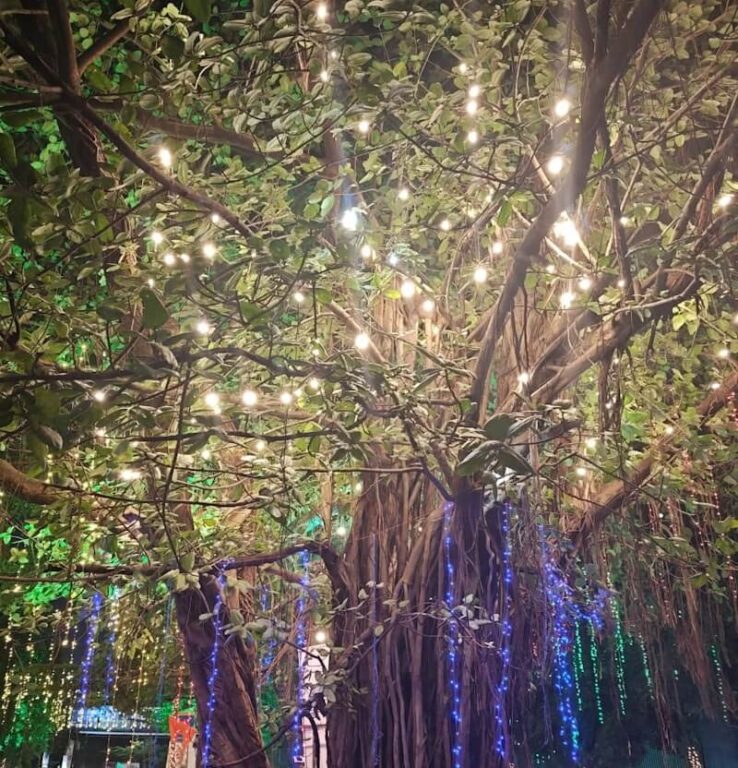
Photo: Rohit Joshi
The way ahead
Aesthetically, the verdict is clear. Kolkata has shown how to turn public buildings and spaces into aesthetically appealing ones at night while Mumbai went the other way and demonstrated what should not be done by way of lighting public places. But this is not merely about aesthetics; it is equally a story of people claiming the buildings and public spaces as their own to participate in improving them, lighting them, bringing them to the forefront of the city’s landscape.
The Calcutta Illumination Project, despite the tumbles it may have had, has shown that persistent and thoughtful participation by people is possible, that civic transformation is possible even if it’s about lights. “By combining beauty with accountability, frugality with transparency, the Kolkata Restorers have created a heritage conservation model possibly unique in India. They have shown that governance need not become a bureaucratic burden but the engine of trust,” wrote Patherya.
Mumbai could learn a lesson or two.
Cover photo: Maniktala Market Dome, Kolkata; Credit: Sujoy Sen