
The landscape of Indian cities is undergoing a rapid transformation in a bid to cope with increased urban populations and densities. However, decline in natural areas, increasing air pollution, and the devastating floods of the kind that Kolkata witnessed before Durga Pujo – with streets in waist-deep water in some areas, power and water supply cut off for days[1] – compel us to reimagine the form our cities must take to be ecologically sustainable. It could be argued that New Town in Kolkata meets the standards of a well-planned green city.
A well-planned city, by textbook definition, is dense, walkable, compact, has mixed use and mixed-income developments, efficient public transit, strong public and open spaces, and resilient infrastructure. New Town was designated a Smart City in 2017 and, in 2020, it became a Platinum Rated Green City, one of only five cities in India to receive this honour[2] conferred by the Indian Green Building Council (IGBC). While the plan on paper ticks off all the boxes and some implementation has been done, issues remain.
A satellite city rapidly developing as an IT and residential hub, on the north-eastern fringes of Kolkata, New Town is spread over 7,628 acres from the end of Dum Dum Airport to the East Kolkata Wetlands. When fully developed, it will accommodate 8.78 lakh residents and 7.4 lakh floating population. Of the planned three Action Areas – I, II, III — and Central Business District, Action Area I is almost complete while others are in progress. The project was undertaken by the West Bengal Housing Infrastructure Development Corporation Limited. Importantly, when the work for the Green City Rating commenced, a large part of the planning had already been completed but various departments pulled together.
How it fares on the framework
The Green City Rating embodies a framework of seven parameters to critically assess a city’s adherence to green principles: Eco Vision; Land Use Planning and Built Environment; Health and Wellbeing; Sustainable Mobility; Water, Energy and Infrastructure management; Information and Communication Technology; and Innovation in City Planning. Each parameter has sub-parameters – some mandatory and others, while not mandatory, contribute to the overall points out of a total of hundred. This value determines whether a city gets a Certified (Good Practices), Silver (Best Practices), Gold (National Excellence), or a Platinum rating (Global Leadership).
The Eco Vision, a mandatory requirement, calls for formulating overarching goals that the city wishes to achieve. New Town set out 28 goals including objectives like housing for all, efficient last-mile connectivity, balanced mixed-use, and preservation of ecological areas. The parameter of Land Use Planning and Built Environment proposes good land use mix and higher densities to ensure compact city planning. New Town was planned with a high density of 443 persons per hectare. Compact cities can have benefits – transit systems are effective, walking and biking are more feasible, urban sprawl is curtailed which, in turn, reduces fossil fuel usage and greenhouse gas emissions.
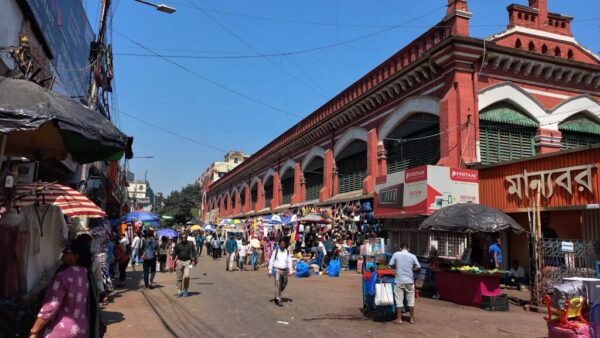
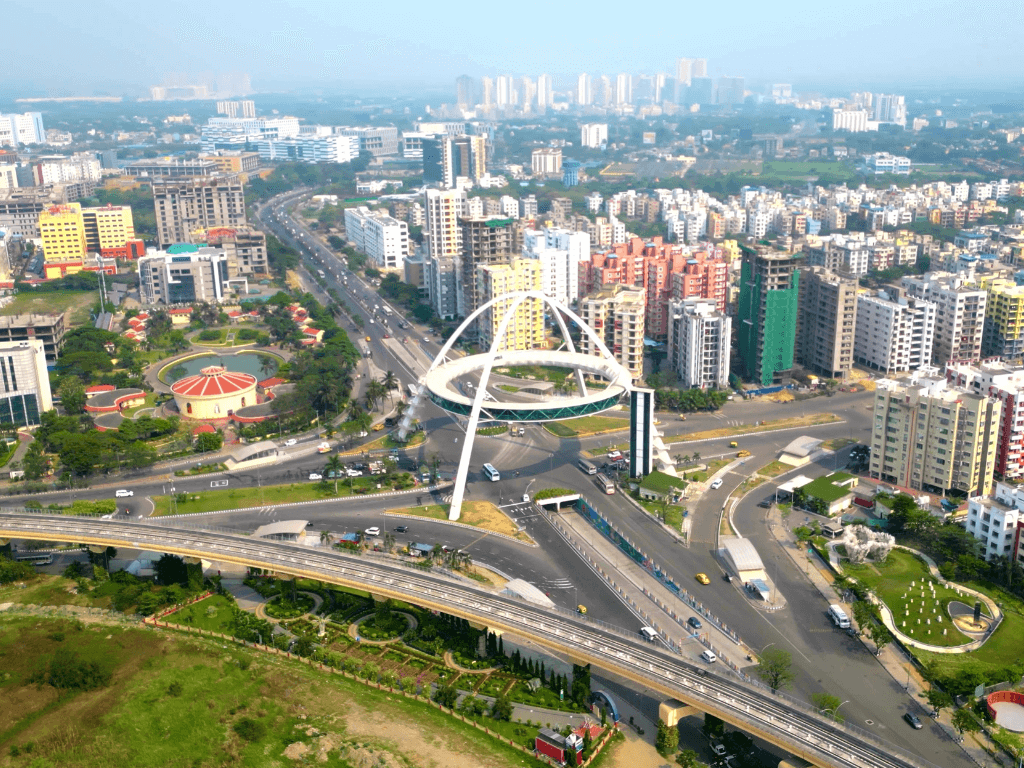
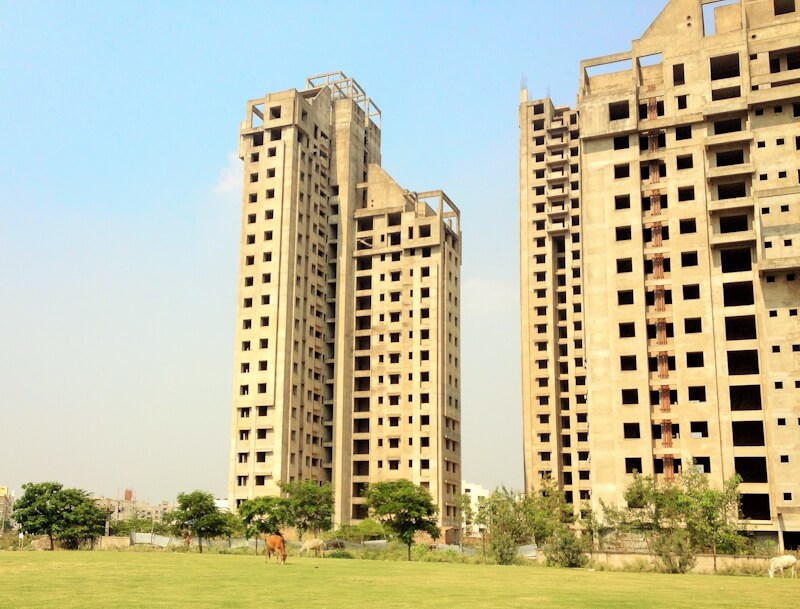
However, while these numbers are commendable, the density mostly takes the form of high-rise buildings within large complexes, distant from one another.[3] Juxtaposed with the bustling paras in old neighbourhoods of Kolkata, where the more traditional houses foster and encourage social connection, these new developments seem socially individualistic and introverted, with weak cohesion within the community. (Dasgupta, S., Tyagi, M., 2021).
This plays out in daily life too. “I can say hello to someone on the streets only if I know them. This is heavily in contrast to the older parts of Kolkata, where if you go to the market, it is highly likely that you may linger another hour simply because you found someone to talk to,” says Aaheli Ray Chaudhuri, a resident of Uniworld City, New Town.
The provision of economically weaker section housing is an important component of this parameter. In New Town, more than 45 percent of the total dwelling units have been allocated for economically weaker sections of society. Other measures include encouraging the construction of green buildings by providing extra Floor Area Ratio, Urban Heat Island mitigation by shading 66.24 percent (minimum is 50 percent) of carriageway areas and service roads, and covering exposed roofs with reflective materials.
The Health and Wellbeing parameter contains a mandatory requirement – the preservation and restoration of waterbodies and eco-sensitive zones. This is important since New Town is bordered by two canals and has traditional bheris which are part of the East Kolkata Wetlands (EKW). Bheris are shallow fish ponds into which the city’s untreated sewage is fed[4] and it becomes fodder for the fish, which in turn, treat the wastewater, thereby supporting the ‘largest sewerage-fed fishing enterprise in the world’.[5]
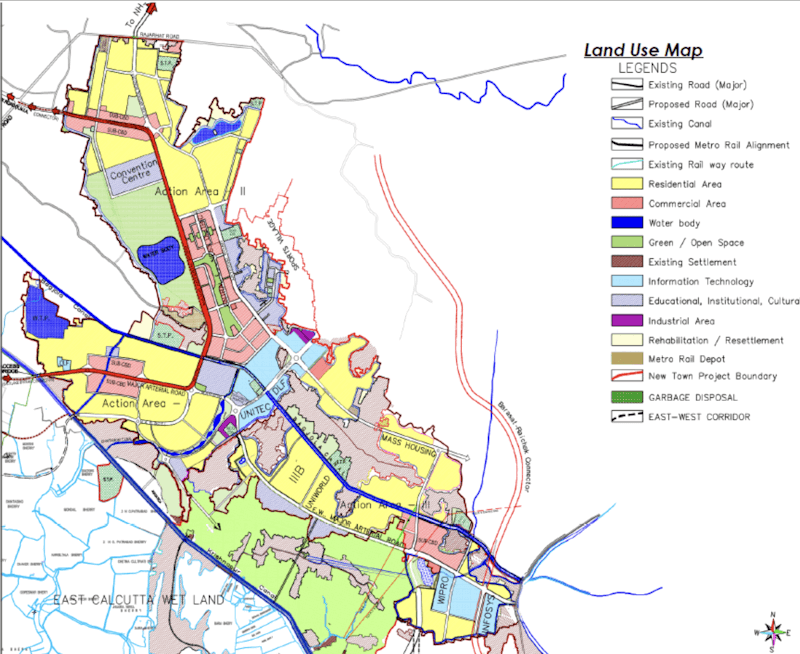
Land use and East Kolkata Wetlands
Concerns have been raised regarding New Town’s construction and the damage to the wetlands with allegations that some areas of the Ramsar-protected EKW were filled for building the township (Karmakar, J., 2015). Extensive reclamation had also been done for Salt Lake and Kalyani, older satellite cities of Kolkata. A geospatial analysis of New Town found that “the transformation of the wetland to aquaculture, eutrophication and pollution, road proximity, waste dumping, population density, and growth are the main factors for the deteriorating health, quality, and environment of the EKW.”[6]
Known as “the kidney of Kolkata,” the EKW absorbs large amounts of contaminants from the city. “The land conversion of the EKW is affecting the efficiency of the natural treatment of wastewater, hampering the flow of sewage to the fisheries, shrinking their conventional advantage, and eventually leading to a change in the livelihood pattern of the local population through an interlinked chain of vocational mutation,” the 2022 study showed. Geographers in Presidency University also flagged shortfalls in water body restoration as their study found that authorities developed only 5.5 percent of the 20 million cubic metres target set under the New Town Master Plan 2017 to make up for wetland losses.[7]
Open and green spaces
The most important sub-parameters under the Health and Wellbeing parameter include the provision of public green and open spaces with accessibility to them. In New Town, green and open spaces occupy 18 percent of the total developed area which is above the minimum recommended 15 percent but these also include sports areas and recreational zones around water bodies. Nearly 80 percent of New Town’s developed area is within 400 metres of a public green or open space, as mandated.
Action Area I has planned and well-distributed small open spaces in all neighbourhoods which include parks, mela grounds, and open spaces along water bodies. The provision of green spaces is only the first step. In some parts of Action Areas II and III, the large scale and quality of these spaces are such that they may not be as frequently used as those which are better integrated into the city’s urban fabric as in Action Area I.
Despite this, the land surface temperatures have been rising. “Even after New Town Kolkata became a smart city, high LST has been observed,” noted the 2024 study on the impact of land use/land cover.[8] The study “noticed that the area percentage of built-up land increased rapidly from 21.91 percent to 45.63 percent during 1991–2021, with a maximum positive change in built-up land and a maximum negative change in sparse vegetation. The mean temperature significantly increased during this period from 16.31°C to 22.48°C in winter, 29.18°C to 34.61°C in summer, and 19.18°C to 27.11°C in autumn. The result showed that impervious surfaces contribute to higher land surface temperature whereas vegetation helps decrease it.”
Other sub-parameters under Health and Wellbeing include environmental monitoring and solid waste management. New Town has mandated 100 percent waste segregation at source which has reduced the amount going to landfills; only 4 percent is sent to landfills.
Mobility
The Sustainable Mobility parameter has two mandatory requirements – the first is a Sustainable Mobility Plan including strategies for promoting Transit-Oriented Development (TOD), integrating land uses with the transport network, and creating a provision for public transport systems such as Bus Rapid Transit, Light Rail Transit, and Metro rail. The second is that the city provides barrier-free accessibility in public spaces including pedestrian pathways, road crossings, public buildings, public toilets, parks and recreational areas.
An important sub-parameter is access to mass transit facilities. IGBC mandates that a minimum of 40 percent of the total developed area is located within a radial distance of 800 metres from a mass transit hub. New Town is planned such that 81.3 percent of its developed area is or will be within this radial distance.
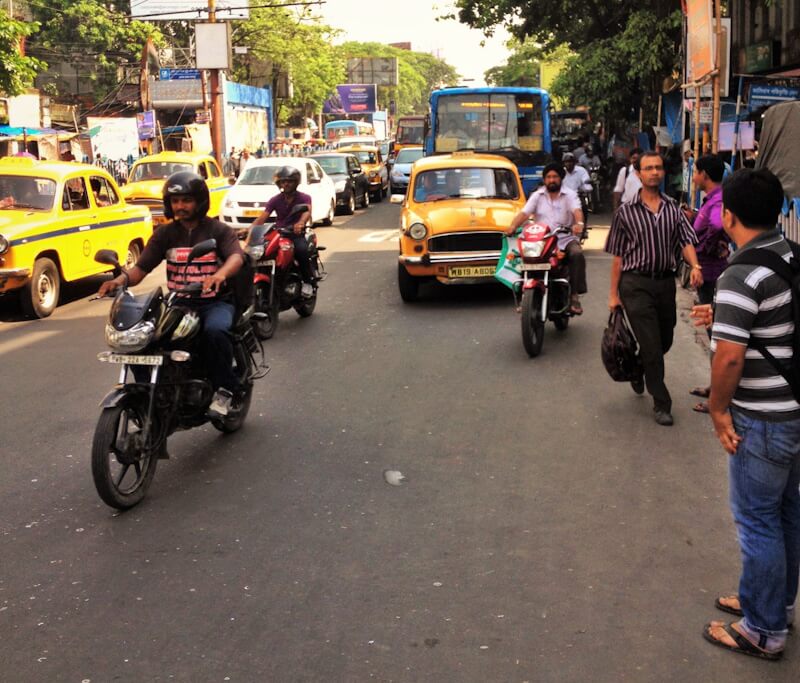
The pedestrian and bicycle lane networks, two other sub-parameters, have been fulfilled. All roads have designated pedestrian pathways, adequate street lighting, tree shade, and designated spaces for hawkers, trees and street furniture. New Town also has a planned bicycle system and networks along all roads with lighting and parking stations. The roads have been planned with widths large enough to accommodate mass transit but they lack the character (albeit, also the chaos) that define the streets of Kolkata.
The three most heavily weighted sub-parameters under the Water, Energy and Infrastructure management are wastewater treatment and reuse, energy efficiency plan, and renewable energy. In New Town, all the wastewater is treated before discharge, while 95 percent of the treated wastewater is reused. It has implemented 100 percent LED use for street lighting, public spaces lighting and hoardings. Renewable energy systems currently serve 10.4 percent of the total energy demand and there is still scope for improvement.
In New Town, 95 percent of stormwater is harvested at city level. For water efficiency, it has capped limits for potable water consumption at 120 litres per capita per day (lpcd) for residential population, and 40 lpcd for floating/ non-residential population – both lower than the baseline recommended.
New Town has implemented a number of innovative ICT applications such as real-time traffic monitoring, automatic on-off controls for streetlights7, ramping up e-governance and m-governance to establish a timely grievance redressal system, smart metering for water consumption and a smart power grid system. Finally, under the parameter of Innovation in City Planning, New Town has implemented strategies such as revitalizing traditional bheris, installing water ATMs in public spaces, and planning waste-to-energy systems.
Ways ahead
New Town has chalked out sustainable measures within the constraints of a city already planned out and attempts to implement them. To that extent, it could be considered as a template for similar urban developments in the future. However, it is indisputable that in order to be a truly ecologically-sound and sustainable city, it is important – even necessary — to adopt sustainability guidelines or the Green City Rating system at the time of formulating the plan rather than work backwards to it.
That said, it is one thing to plan for a green city; however, it is an entirely different thing to ensure that what is planned is indeed implemented. In New Town too, for many of the parameters and objectives under the Green City Rating system, provisions have been made so that execution is possible in the future. This necessitates regular evaluation and monitoring. Much depends upon what comes to pass.
A high rating by itself does not necessarily mean ecological health of the city forever. Geographers from Presidency University identified a 11-fold increase in the built-up area in 30 years in Rajarhat, New Town and adjacent areas which “could accelerate groundwater depletion, increase flood risk and raise the local temperatures through the heat island effect.”[9] Moreover, a city is more than the sum of its parts and no amount of planning can fully bequeath to a city its essence, its very soul, which is created by lived experiences of its citizens, multifaceted ways in which they appropriate space, and the ecological sustainability and protection of natural areas. New Town is not quite there yet.
Sashwati Ghosh is an architect and urban planner. She received her Masters in Urban Planning and Policy Design from Politecnico di Milano, Italy in 2022, graduating with Summa Cum Laude honours. Her Masters thesis focused on a gender inclusive planning approach, including tangible urban design strategies, for safer and more liveable cities for women, with Kolkata as the template. She then worked at One Works, Milan, among Italy’s leading architecture and design studios, where one of her notable projects was to develop a reconstruction masterplan for one of Ukraine’s leading cities post-conflict. Besides this, she has worked on masterplans for port cities and urban redesign proposals to make areas around schools safer for children. Sashwati is Partner at Ghosh Bose and Associates, Kolkata.
Photos: Sashwati Ghosh