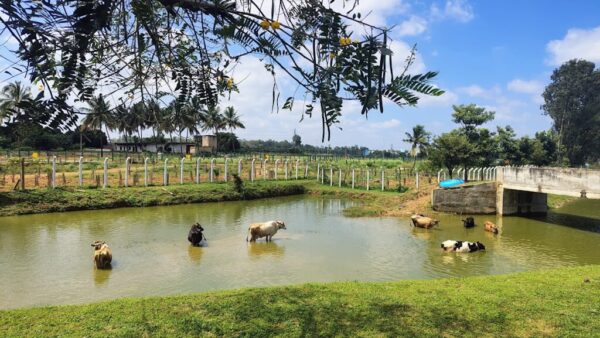

Off the busy, hustling streets of Najafgarh and across the Dhansa Bus Stand in southwest Delhi, the city’s landscape dramatically changes. Lush green fields line both sides of the road and names of villages flash on signboards. Rawta. Daurala. Ghumanhera. Jhuljhuli. Surehra. Kharkhari Rondh. Kair. Ujwa. Names that rarely make it to the mainstream media. Almost nothing in these villages suggest that they are a part of India’s national capital that carries nearly 23 million people in its fold. But these villages are on the cusp of being urbanised as the city expands its footprint.
How villages are transformed when they are subsumed into the urban fabric or re-classified as urban villages and what impact this ‘development’ leaves on the lives and livelihoods of people, as well as on the land and ecological systems, is an open book. To read the changes, drive across Chhatarpur or Devli or any of the villages in south Delhi, ‘rural villages’ that were re-classified as ‘urban villages’ in 2019, and are now an integral part of the metropolis. These and similar others are a peculiar and unique mix of the lingering rural and the advancing urban in their built form, people-place relationships, and ecology.
For the most part, the change in classification or revenue record status has not translated into an improved quality of life for the original inhabitants of the villages, efficient and urban-level amenities and services, or comprehensive planning framework used in the city. Delhi’s revenue records list 357 villages, of which 309 are now classified as “urban villages” and the remaining have been lined up for urbanisation[1] by the the Municipal Corporation of Delhi (MCD).
Rawta, sometimes written Raota, one of these remaining 48 ‘rural villages’ and a part of the Matiala Assembly constituency of Delhi, is a microcosm of the approaching urbanisation of the peripheries. Sitting on the border of Delhi and Gurugram, Rawta is both an opportunity and a challenge to the juggernaut of urbanisation. An opportunity to make the process representative, transparent, inclusive, and ecologically-sensitive. And a challenge to course-correct the mistakes of urbanising other villages in the recent past.
The re-classification from ‘rural village’ to ‘urban village’ primarily affects land issues – acquisition, market rates, speculative buying, zoning and re-zoning as business districts and residential, and so on – and the governance which determines the access that the village communities have to basic services and amenities. In the records, Delhi’s ‘rural villages’ show a predominant agricultural land-use, open fields and crops, livestock and traditional ways of life, while ‘urban villages’ are where the old settlements remain as abadi areas but get increasingly surrounded by gated complexes, commercial and residential towers, mixed-use areas with road connectivity.
Rawta in transition, on the edge
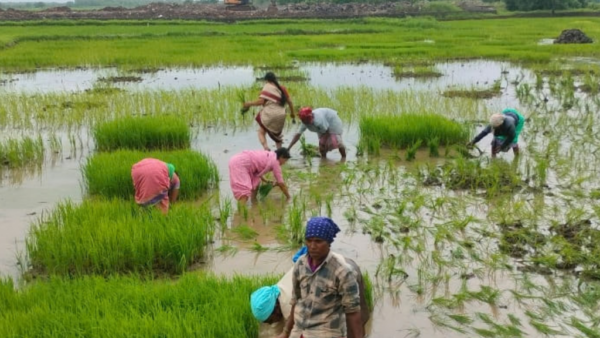
Rawta has roughly 500 acres of land where villagers farm. In 2023, the Delhi government allocated[2] Rs 35 crore to redevelop it and Daurala as ‘model villages’. The Village Development Board, set up in 2016,[3] was to oversee the work. Last year, the DDA launched 81 village development projects[4] worth Rs 960 crore to make roads, ponds, drainage, sewage treatment plants and pumping stations, drinking water facilities, rainwater harvesting, parks, playgrounds, and community halls.
The interventions have been on paper so far and have done little to improve the difficult conditions of life of around 800 families (Census 2011 counted 545 households). Their demand is not for ‘development’ that they have seen in the peripheries, but for fundamental issues such as fair compensation for their land that they will not be able to cultivate, the subsistence crops lost, and the livestock pared down as land is re-zoned for construction.
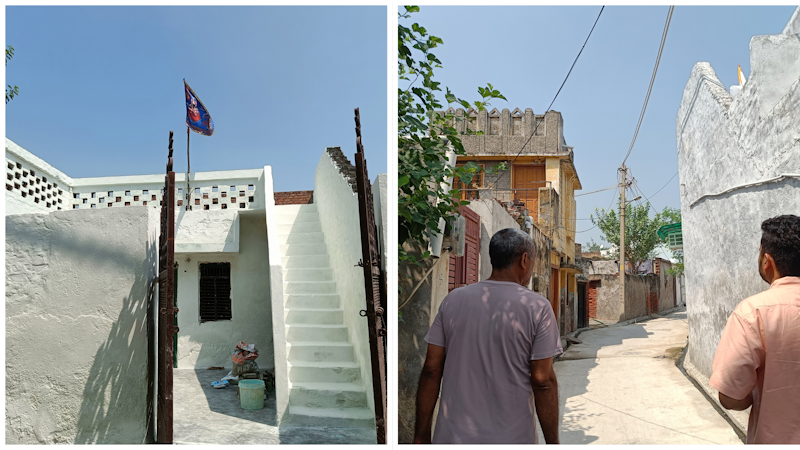
As you enter Rawta, there is little to suggest that the sprawling fields and typical rural houses will soon yield to the prevailing development model of towers, gated complexes, roads, glitzy signboards and neon lights. The village carries traces of an older built form – a few havelis, traditional imposing doors, walls made of traditional Lakhori bricks, a 700-year-old shrine to a local deity and other such markers of any village settlement. The houses are in a layout informed perhaps by caste and status, but have open space between them and most feature a courtyard within.
As Puneet Singh Singhal, founder and curator of the Delhi Dehat project,[5] eloquently writes[6] “Delhi’s urbanisation was never simply a story of growth. It was also a story of unequal conversion: Agricultural land into colonies, commons into enclosed property, sacred routes into regulated access, and community memory into silence…for many communities, it describes a condition of being neither fully recognised as rural nor properly served as urban. Villages lost fields, grazing lands, water systems, and livelihoods, but did not always receive infrastructure, documentation, heritage protection, or meaningful participation in planning. They became internal peripheries inside the capital. Devli, my village, illustrates this contradiction.”
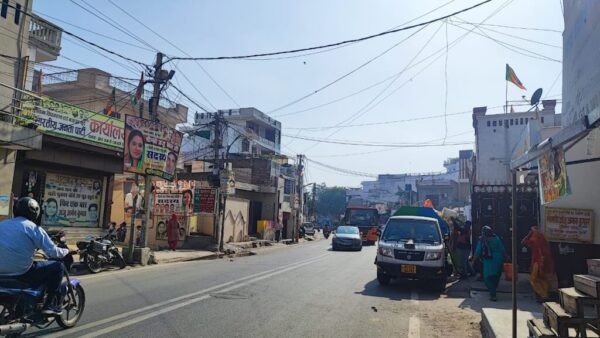
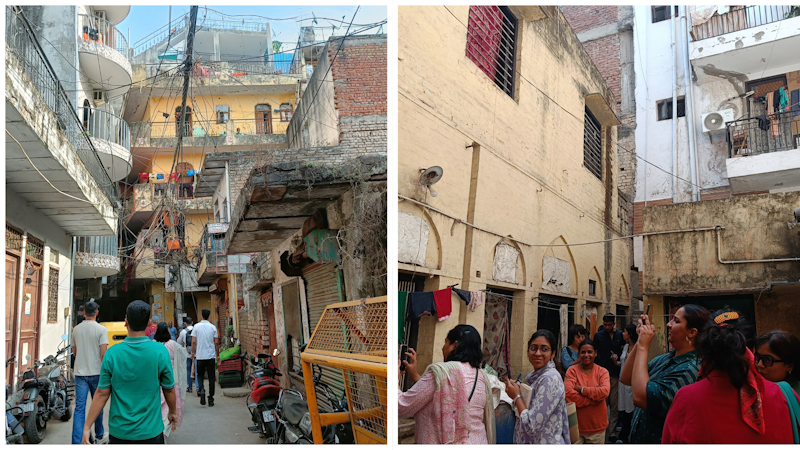
The dense clusters of shops, cars parked on roads with barely enough space to walk, twisted electrical wires overhead, and constant traffic that mark Delhi’s landscape will begin to appear here as Rawta is re-classified and subsumed into the city. But right now, the villagers want water issues to be resolved – access to clean water, and remedies for the sludge and filth flowing into and across the village.
Water, stink, and life
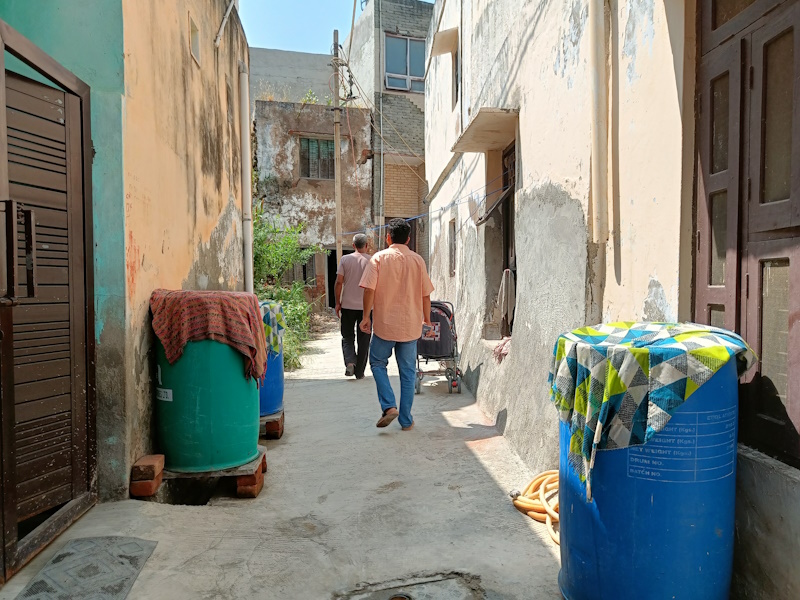
Rawta’s water situation is reflected in the ubiquitous blue water drums that sit outside most homes. Villagers here, like in Daurala and Ghummanhera, depended on the Sahibi river for their irrigation needs. But as Delhi’s urban footprint expanded to the peripheries – primarily Gurugram – the villagers’ access to irrigation water suffered. Alongside, as Rawta villagers told Question of Cities, access to potable water has been a major issue; although the Delhi Jal Board (DJB) is supposed to supply water, the quantity is never enough and it is hard (saline) water.
Water tankers cater to their needs but the inner lanes of the village are too narrow for the tankers. Villagers are forced to lug their buckets and drums for at least 200 metres. Rawta gets approximately six tankers every week, each of 10,000 litres. “Modi sarkar ne kaha har ghar jal, par aisa hamare gaon mein toh nahi hai (Modi government had promised water in every house but it’s not there in the village,” rues Bijendar Singh.
The task of collecting and storing water, and ensuring it is sufficient for the family, is the burden of women. Naresh Devi wakes up at 5 am for her daily run to fetch water. The DJB supply is not regular. “Har do din ke baad aata hain. Aur bas 12 am se 2 am tak, thoda bohot meetha paani aata hain. (Water comes after every two days, from 12 am to 2 am. We get some drinking water),” she tells us. They use this hard water for washing utensils and clothes, and for the cattle. For drinking and cooking, there’s tanker water that is stored in drums and buckets. Though free, villagers rue that it takes “three-four hours” for their turn in the queue.
Rawta is mapped to receive water from the Dwarka Water Treatment Plant; it currently supplies 50 MGD per day which, Manoj Malik, DJB Executive Engineer, acknowledges is insufficient. “We have one more 50 MGD plant but that has not been commissioned. It’s awaiting raw water,” he assures but apparently this plant has remained non-functional for the past 10 years.
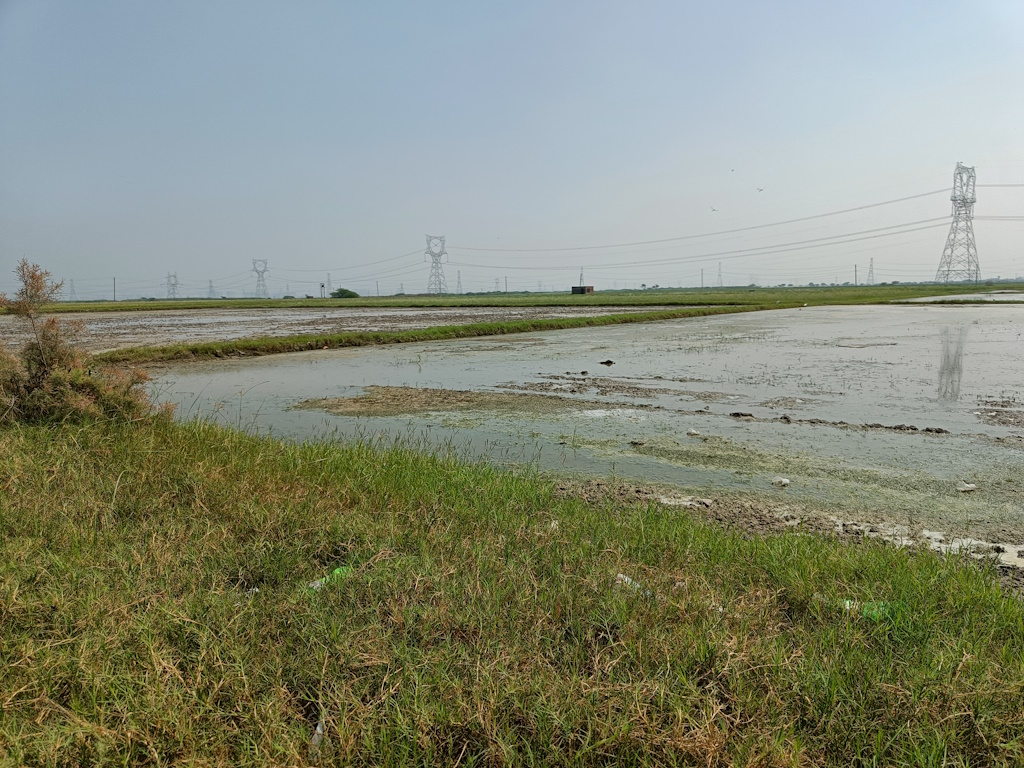
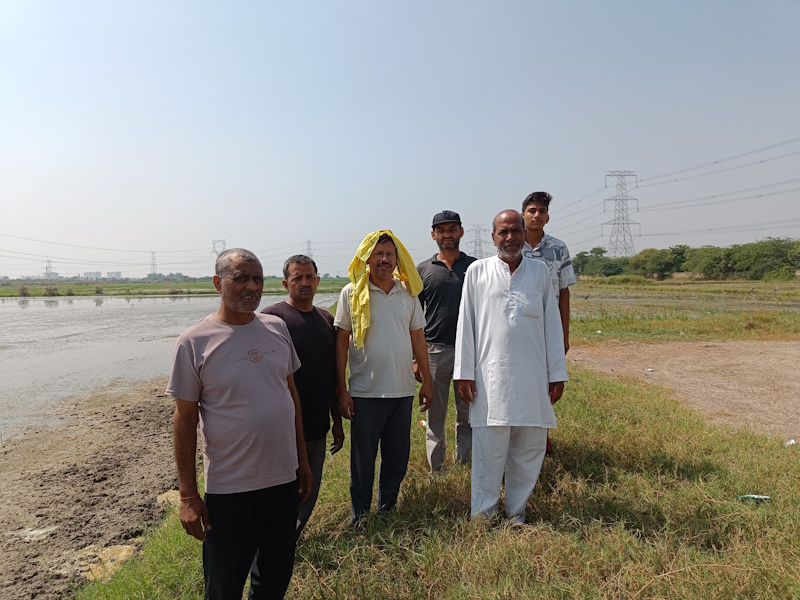
Sewage has turned out to be an even filthier and stinkier problem. For the past 20 years, the fields in Rawta get inundated with wastewater from the Najafgarh drain of the Sahibi river that separates Delhi and Haryana. The wastewater originates[7] from the residential areas and industries in Gurugram. In fact, most of the Yamuna is polluted because of the Najafgarh drain, since it constitutes over 65 percent[8] of the total flow in the 22 drains that outflow into the river in Delhi. The sewage has made it increasingly impossible for the farmers of Rawta, and nearby villages, to cultivate land. “Humara sab fasal barbaad hain, koi income nahi kar pa rahe hain (all our crops are damaged, we can’t earn any income),” says Kamla Devi, a resident.
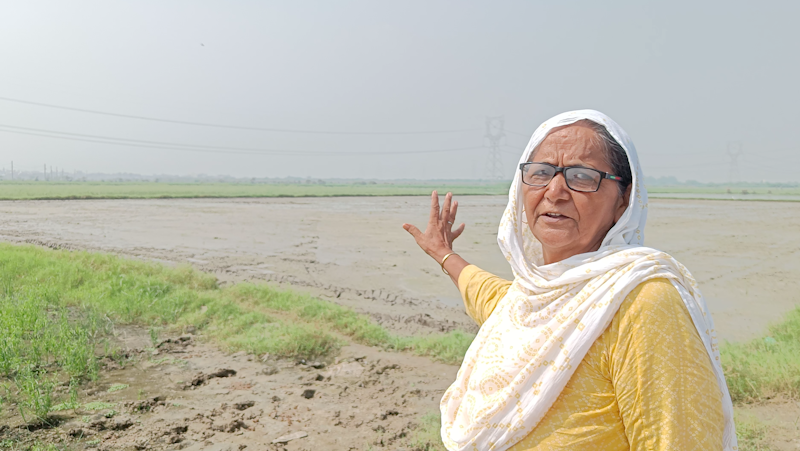
That the Najafgarh drain, which brings the sewage here, was once their source of irrigation is immaterial now. Urbanisation in peripheral areas has meant that it is failing their farmlands. They, on the outer periphery of Delhi, are paying the price of an urbanisation process they had nothing to do with – geographically, administratively, and in the city’s imagination. The village and its problems remained largely out of sight till the land became coveted for Delhi’s expansion.
Rawta. Daurala. Ghumanhera. Surehra. Kharkhari Rondh. Kair. Ujwa. Each village treated as a place waiting to be urbanised in glitzy neoliberal ways rather than the self-contained settlement with its own history, needs, livelihoods, and culture. If this model of urbanisation did not improve people’s lives or secure the ecology of the already urbanised villages, how would Rawta be different, villagers ask.
Transition for whom?
When urbanised, on paper, Rawta will no longer be governed by the agricultural land-use norms of the Delhi Land Reforms Act, 1954, which prohibits landowners from using agricultural land for housing, commercial and industrial activity. It will come under the purview of the DDA Act and the Delhi Municipal Corporation Act. The genesis of “urban villages” goes back to the immediate post-Independence years when Delhi had to house refugees. The DDA acquired agricultural land of villages while leaving their core (abadi areas) untouched.
In the 309 villages urbanised, neither was land brought into the city’s plans nor did living conditions in the abadi areas improve. Instead, the people-land relationship worsened and villagers lost many intangible aspects of life. The Delhi Dehat Project has archived the loss here[9] along with Ambedkar University of Delhi Professor Dr. Shekhar Tokas’ Delhi 360.[10] In 2019-20, more than 100 villages were declared urban but nothing changed on the ground, says Paras Tyagi, co-founder of the Centre for Youth, Culture, Law and Environment who has written extensively on Delhi’s urban villages, “The villagers are left to fend for themselves, there is haphazard construction, and neglect of civic services.”
Naraina was notified as an “urban village” in 1969 but it took almost 20 years for it to catch up with the rest of the city, says Saleha Sapra, urban geographer, researcher, and co-founding member of City Sabha. Even so, it is a free-for-all. It was in these “urban villages” that recent building collapses and fires unsettled the capital. In Saidulajab, a five-storey commercial building collapsed killing six[11] people; three[12] people died after a fire broke out in a residential building in South Delhi’s Tughlaqabad; in Hauz Rani, a fire broke out at a bed-and-breakfast venue killing 23 people.[13]
Understandably, residents of Rawta are not looking forward to this model of urbanisation. Focused on the sewage problem, they have been knocking on the doors of the authorities for years[14] – in vain. Two months ago, say residents, Water Minister Parvesh Verma visited and the Delhi government promised[15] Rs 860 crore for 12 decentralised sewage treatment plants to clean the Najafgarh drain. There are presently 27 STPs. “Sarkar ko hamari zameenein khareed leni chahiye aur humein muawza dena chahiye, taaki hum kahin aur zameen khareed sake. Ab hum yahan kuch bhi nahi uga sakte. (The government should buy our land and give us compensation, so we can buy elsewhere because nothing grows here),” says a farmer.
Farming is already not viable. “We sell land to get our daughters married. I had to sell at very low rates,” says a farmer. Most have become dependent on their children who have private jobs outside the village. Besides the sewage from the Najafgarh drain, the wastewater and agricultural runoff from surrounding villages also accumulate in Rawta. “Our village has become a dumping ground,” says Jagbir Singh, a farmer. The Najafgarh drain is also at the centre of an environmental case[16] before the NGT.
Rawta hopes that it does not go the Kanjhawala way, designated an “urban village” in 2017 where residents are still protesting[17] the compensation for land acquired for the Urban Extension Road-II, dubbed as Delhi’s third Ring Road. The Rs 53 lakh per acre rate is nearly 18 years old, they say. Unviable low rates for land acquisition is where the tension between the rural and the urban begins – and lingers as the periphery is subsumed into the city.
Ankita Dhar Karmakar, Multimedia Journalist and Social Media in-charge at Question of Cities, has reported and written at the intersection of gender, cities, and human rights, among other themes. Her work has been featured in several digital publications, national and international. She is the recipient of the 4th South Asia Laadli Media & Advertising Award For Gender Sensitivity and the 14th Laadli Media & Advertising Award For Gender Sensitivity. She holds a Master’s degree in English Literature from Ambedkar University, New Delhi.
Cover photo: One of the fields in Rawta flooded with sewage water.
All photos: Ankita Dhar Karmakar