
It is estimated that children spend between 1,000 and 1,200 hours[1] in school every year. So, what happens when classrooms in most parts of India become unbearably hot boxes of concrete for most of the year?
In view of extreme temperatures, several states, including Tamil Nadu[2] and parts of Delhi-NCR, Uttar Pradesh and Haryana have either extended[3] vacation days or modified school timings. A report by UNICEF highlights that over 170 million[4] children had their schooling disrupted by heatwaves in 2024, with India being one of the most affected regions across the world. As global temperatures continue to rise, many parts of India are projected to have over 70 days of extreme heat, with some states facing over 100 days in a calendar year.
These headlines quietly assert that heat is no longer a seasonal or temporary disruption that can be abated by summer vacations alone. An analysis[5] of Delhi’s heat index from 2014-23 confirms as much: the city saw an average of 58 extreme caution (32.5 to 40 degrees Celsius) days and up to 20 danger days (40 to 52 degrees Celsius) between the months of July and September, months when schools are in operation. In short, our ability to guarantee safe and comfortable education to children is likely to be compromised in the long-term unless urgent planning and adaptation actions are undertaken across schools in the country.
In this article, we centre the idea of thermal comfort as a key principle that needs to inform adaptation efforts in schools. We demonstrate that schools need to be viewed as unique sites of heat risk as they combine physiological, spatial and social layers of vulnerability, thereby shaping children’s ability to learn, participate and remain safe. We then show that thermal comfort and heat adaptation remains poorly recognised in school building codes, educational infrastructure standards and safety policies.
We further argue that heat remains out of policy imagination for education as safety responses focus on fast-onset disasters, limiting long-term adaptation action for slow-onset risks like heat. We also highlight how the continued treatment of comfort and safety as distinct domains is untenable in a warming world. In urban areas, where the effect of heat is more pronounced and differentiated, lack of attention to thermal risk could severely impact children’s long-term health, learning outcomes and educational equity.
Comfort is a pre-condition for learning
Imagine a hot day in mid-June when the school is in session. Inside a classroom of roughly 500 square feet, around 40 students are packed into benches of 3 or 4 each. Each child is guaranteed 1 square metre of personal space, roughly the size of a large square tile, according to several school building guidelines. There are three fans unevenly distributed across the classroom and windows are shut to prevent outdoor sounds from streaming inside and disturbing the class. As the day progresses, uninsulated concrete walls slowly release heat into the classroom.
Children’s movements are closely controlled and monitored. Uniforms are itchy and uncomfortable, and access to water and toilets is restricted. There is a visible drop in concentration and energy amongst students, but teachers have no choice but to continue. As heat builds up in the room, teachers and students alike grow irritable, becoming increasingly impatient as they wait for the bell that finally brings relief.
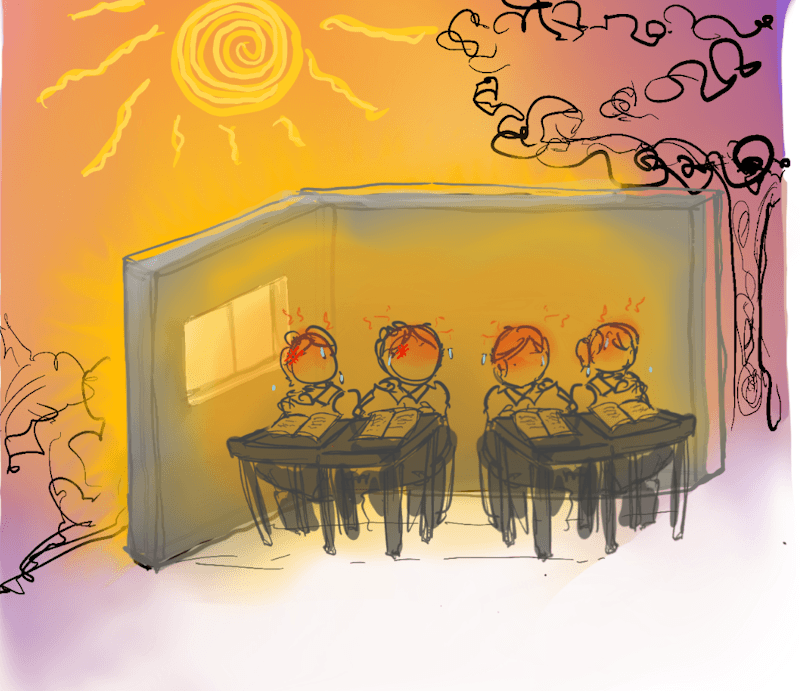
Illustration: Malavika Sanil
While private schools in India are able to provide air-conditioned classrooms to mitigate the heat, the picture is dismal in public or government schools. Providing cooling solutions is the last of their priorities, if at all. Data shows that over a lakh of these schools are ‘single-teacher schools’[6]; many thousands do not even have basic facilities like proper classrooms, toilets, and drinking water. Extreme heat will further hinder these schools from being able to provide safe and quality education.[7]
Children spend over a third of their day in schools and other learning environments. Yet we pay little attention to how they feel within them. In schools across the country, discipline, not comfort, dictates design; schools prioritise control, surveillance, and rule enforcement over the physical and emotional well-being of students. However, poor thermal comfort can significantly impair health and learning outcomes in a number of ways. Children are uniquely physiologically more vulnerable[8] to heat since they heat up faster, sweat less efficiently and often lack the awareness to recognise their bodies’ distress signals. In fact, research[9] suggests that thermal comfort preferences of children are significantly different from adults.
Furthermore, heat can exacerbate pre-existing vulnerabilities like chronic illness and disabilities. Its effects on menstruation[10] and neurodivergence[11] remain poorly understood. Unlike adults, children also lack the agency to modify their surroundings or behaviour to counter the bodily heat build-up. In schools, this issue is compounded by the fact that several schools follow strict norms and rules that prevent them from taking sufficient action to protect themselves.
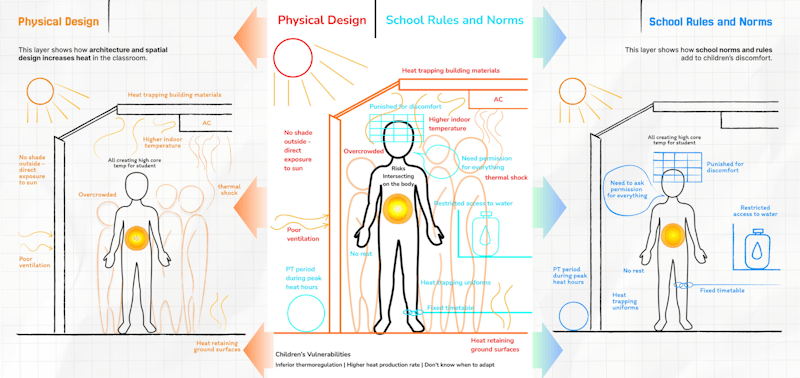
Diagram: Malavika Sanil
A combination of these factors makes schools a unique site of heat risk. While comfort could be treated as an afterthought earlier, rising heat forces us to place it front and centre in schooling pedagogy and design. In a warming world, comfort becomes the pre-condition for safe and disruption-free education.
Comfort and the built environment in schools: A policy view
A critical factor that dictates how children experience heat in schools is the built environment. Buildings serve as the boundary condition that mediates how heat is transferred, trapped or released in a space. Poor ventilation, use of heat-absorbent material and lack of shading and cooling services can significantly exacerbate heat stress.[12] On the other hand, climate-friendly design strategies[13] like proper site orientation, use of thermally insulating materials, suitable shading devices, and adequate ventilation can greatly improve the indoor environmental quality and reduce heat risk. In the context of rising heat, therefore, the design of the built environment can prove to be a crucial element in long-term adaptation.
But how do school-related policies and guidelines understand the role of building design? We examined a range of codes, policies and guidelines to understand the current imagination of what makes for a safe and comfortable learning environment. Across these documents, the built environment in schools is predominantly understood as a passive backdrop rather than an active determinant of well-being and learning.
School infrastructure guidelines are complex, and require navigating national and state building codes as well as local development control guidelines. While state building bye-laws are expected to modify the codes according to their own climatic realities, many largely follow the guidelines set by the national code. Within this policy landscape, thermal comfort is not entirely absent.
The National Building Construction Standards (NBCS)[14], for instance, explicitly defines thermal comfort as ‘that condition of mind which expresses satisfaction with the thermal environment and is assessed by subjective evaluation’ and asks for it to be included as a consideration in all building designs. It further discusses heat balance of the human body, introduces various thermal comfort indices — Effective Temperature (ET), Tropical Summer Index (TSI), Adaptive Thermal Comfort — and provides design guidance for passive cooling.
Yet despite its detailed coverage of thermal comfort, the code does not translate these considerations into school-specific standards nor do they discuss thermal comfort standards or frameworks applicable to children of different age-groups. In short, thermal comfort is not recognised as a core requirement but an auxiliary consideration that improves building performance.
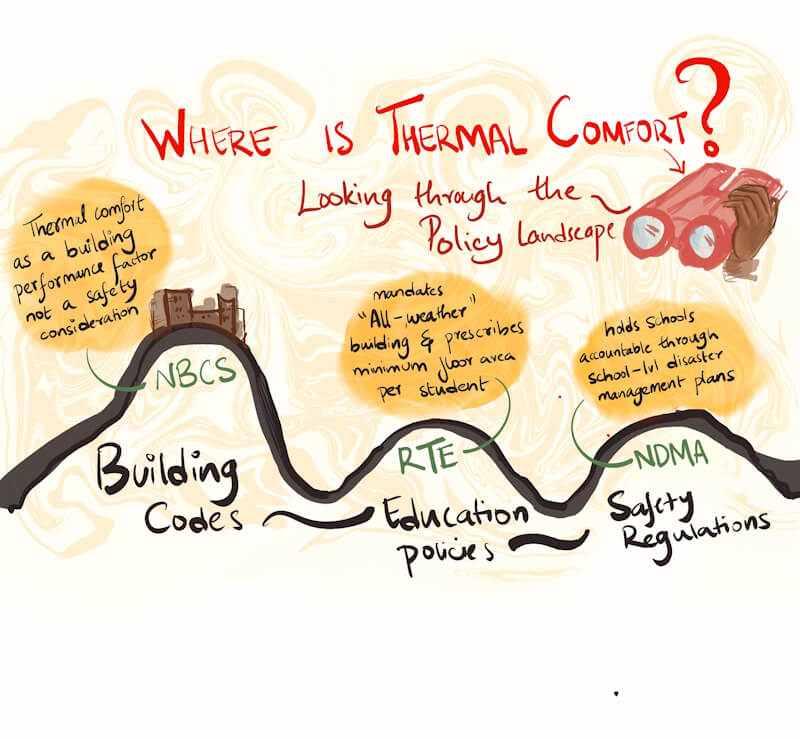
Illustration: Malavika Sanil
While National Building Code takes cognisance of thermal comfort as an important design consideration, educational infrastructure standards and norms make no mention of it. The Right to Education (RTE) Act, for instance, mandates that schools need to be an “all-weather building” without defining what that entails and outlines five other conditions including separate toilets, barrier-free access and boundary wall. The guidelines for Kendriya Vidyalayas and CBSE-affiliated schools, which are often considered more stringent, prescribe a minimum floor space of 1 square metre per student and a minimum size for classrooms depending on the grade.
In all these cases, however, considerations of thermal comfort or climate-friendly building design are notably absent. Instead, school infrastructure is largely framed in terms of minimum viable standards and maximum capacity rather than comfort. In a warming climate, however, occupancy needs to incorporate thermal realities to define adequacy of learning environments.
Policies focusing on school safety fare slightly better. The National Disaster Management Authority’s 2016 guidelines[15], later included in the Ministry of Education’s (MoE) Guidelines[16] for School Safety and Security, asks for schools to make school-level disaster management plans and take necessary protective measures. MoE’s guidelines place accountability on schools to protect children from physical, social-emotional, cognitive and disaster-related risks and adopt a “whole-school approach”, thereby expanding the scope to commute and areas around the school. Yet the focus of safety standards is limited to visible and episodic hazards such as fires, cyclones and earthquakes.
Heat sits uncomfortably in this framework because unlike a disaster event, heat is cumulative, chronic and increasingly embedded in everyday school life. This is where comfort and safety begin to converge. While comfort is often associated with the realm of everyday convenience, safety signals urgency and visible threats. Yet a warming climate unsettles this distinction and will require new associations and frameworks. Our existing regulatory categories that treat occupancy, comfort and safety as distinct arenas are no longer adequate. Since mounting evidence reveals[17] the harms of prolonged heat exposure, schools will need to expand their understanding of protection and preparedness.
One city, many morphologies
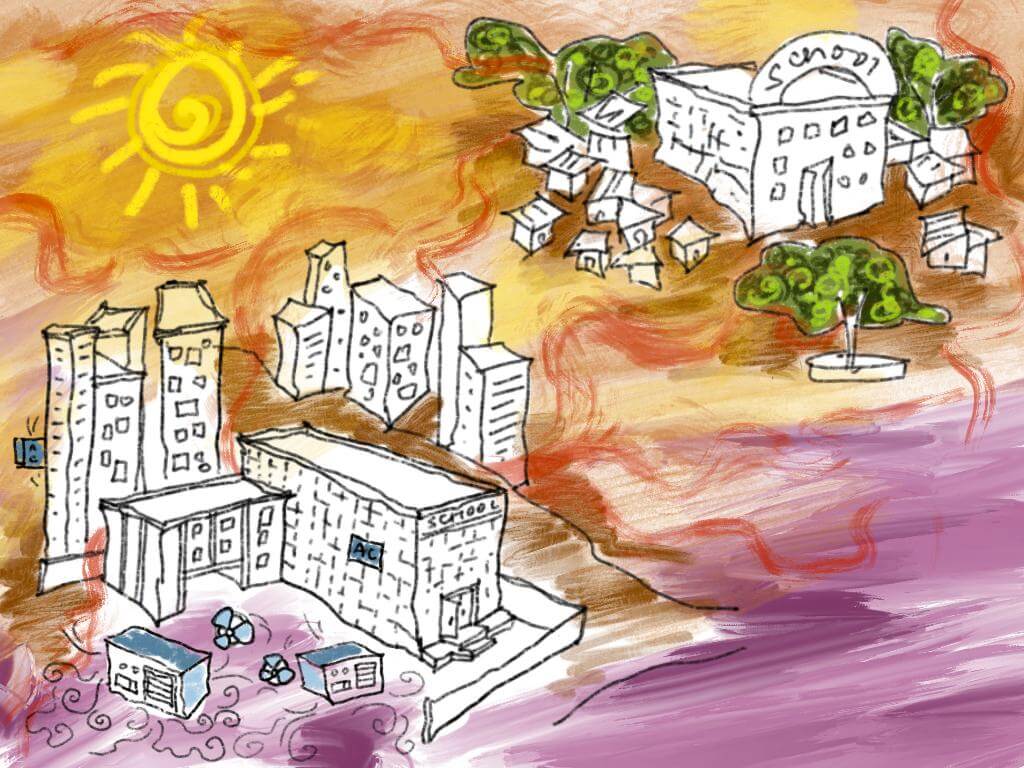
In urban environments, thermal risk inside schools intensifies depending on the thermal risk experienced by the neighbourhoods in which they are located. A private school in a neighbourhood dominated by high-rise buildings, a public school in a tightly-packed informal settlement, and a small, low-income private school in a mixed-use neighbourhood located close to a busy junction experience similar levels of heat very differently.
The urban heat island effect created by each of these morphologies of a city will be unique: its density, materials, building forms, orientations, vegetation patterns, and more will dictate the kind of thermal risk inside buildings in a particular area. This means that schools in the same city are embedded in vastly differing thermal environments.
As heat stress layers onto these contours of the urban fabric, it exacerbates existing vulnerabilities and social inequalities.[18] These effects are distributed unevenly across various scales, from individual vulnerabilities of students of differing gender, age, neurodivergence and other physiological traits, to disparities across neighbourhoods,[19] cities and climatic regions. Heat is therefore not only an environmental condition but also a socially distributed risk, structured by the uneven geographies of the city.
In a deeply caste-based society like India’s that continues to structure access to education, graded inequality shapes both exposure and the capacity to adapt. Schools serve different social groups and operate under varying material conditions which influence their ability to provide thermally comfortable learning environments. Consequently, the pathways for adaptation will vary across archetypes. A well-resourced private school may rely on retrofits and cooling technologies, while a government school in a heat-vulnerable neighbourhood may depend more heavily on redesigned schedules, shaded public spaces, and community support systems.
These differences highlight the need to reconsider how our educational policies define adequate learning environments. Since these policies reflect the needs and priorities of the country, they have historically prioritised increasing access to schooling. And rightly so. But in view of the rising heat levels, this is no longer sufficient since access to education is also a question of children’s ability to participate safely in school activities. Responding to this will require state and city governments to support both existing and upcoming schools: ensuring that new schools are designed for future thermal conditions while creating pathways for existing schools of varying capacities to progressively adapt.
As cities emerge as critical centres of heat risk, thermal comfort can no longer remain an auxiliary consideration to how we define adequate schooling. There is an urgent need for national policies and guidelines to reflect this and embed thermal comfort within minimum viability standards that shape schools. Without such a shift, rising heat risks becoming an invisible barrier to education, particularly for the schools least equipped to adapt.
Malavika Sanil is an urban practitioner with a background in architecture and communication design exploring questions of climate justice and urban futures. She is the co-founder of Project Living Cities and works with Socratus on enabling systemic transformation of complex urban challenges.
Rohit M is a researcher and educator exploring climate adaptation in urban India, and is the founder of Project Living Cities. He is currently with Socratus where he works on questions of urban transitions through a systems practice lens.
Cover Illustration: Nikeita Saraf