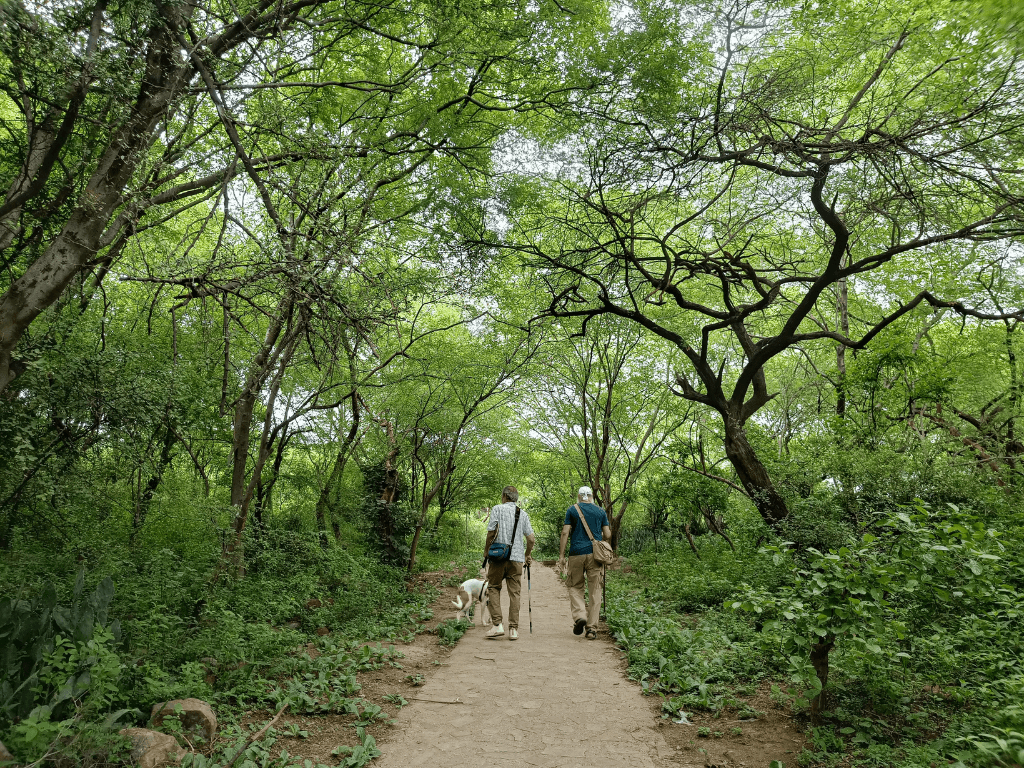

Recently-unveiled plans for the Delhi Ridge follow a familiar pattern – afforestation or constructing a forest, clearing acres and acres of forest land to make specially art-themed ‘van’ or forests, 70 lakh plantations under the Ek Ped Maa Ke Naam campaign, replacing invasive species with ‘native’ species of trees, mechanised excavation and canopy pruning, and so on. Four of the themed forests will be in the Central Ridge; the Panchvati Van is ready to be opened to the public any day now.
When the Union Home and Cooperation Minister announced[1] the plan, on July 7, to transform the Ridge into the “lungs of Delhi” over the next three years and positioned it as a vision of a ‘Green Delhi,’ it looked ecologically-sound – but only on paper. As the people in power move with a new-found energy in this greening mission, the Ridge asks Delhi a question. Can humans build a true forest with its biomes, rich biodiversity, and complex self-sustaining ecosystems by planting a few ‘native’ species and creating art-themed woodlands?
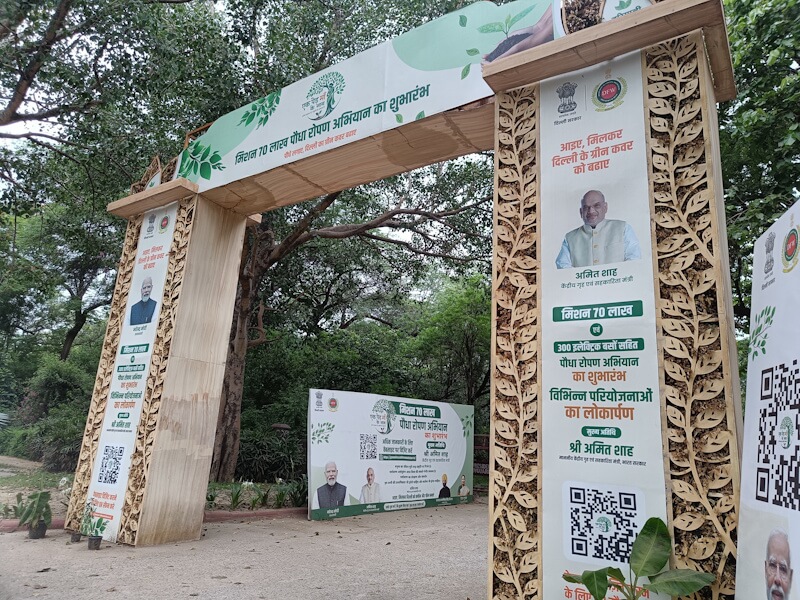
Photo: Ankita Dhar Karmakar
From March,[2] when the news of creating the special themed forests first came to light with a tender of the forest department, to now when the first of the 70 lakh saplings were planted, the question has not even stirred a debate among those who make plans to build a forest, ironical as it sounds. Environmentalists say this will be highly dangerous to the ecology of the Ridge.
Between the lack of ecological awareness and the continuing concern for the ecological health of the Ridge lies a wide chasm – and its future.
‘Building’ a forest and ecological coherence
The Ridge is an extension of the ancient Aravalli hill range, said to be 1.5 billion years old, and extending from Gujarat through Rajasthan to Haryana and Delhi. In the national capital, the Ridge stretches across nearly 35 kilometres from Bhatti Mines in the southeast to taper towards the northeast near Wazirabad on the western banks of the Yamuna. It is possible that the Ridge was once a contiguous forest till anthropogenic factors of urbanisation, construction, quarrying, encroachments, and garbage dumping interfered with its natural landscape.
The fragmentation gave us five zones – Northern Ridge 214.9 acres, comprising old Delhi and Delhi University; Central Ridge 2,134.9 acres which is largely New Delhi; South Central Ridge 1,546.8 acres across Mehrauli and the forested area near Sanjay Van and Jawaharlal Nehru University; Southern Ridge, the largest at 15,320.5 acres comprising Tughlaqabad and proximate areas; and Nanakpura with 17.2 acres. The five zones, with a total area of 19,234 acres (7,777 hectares), are spread across the national capital. Delhi’s urban expansion, to an extent, has come at the cost of intrusions – legal and otherwise – into various parts of the Ridge.[3]
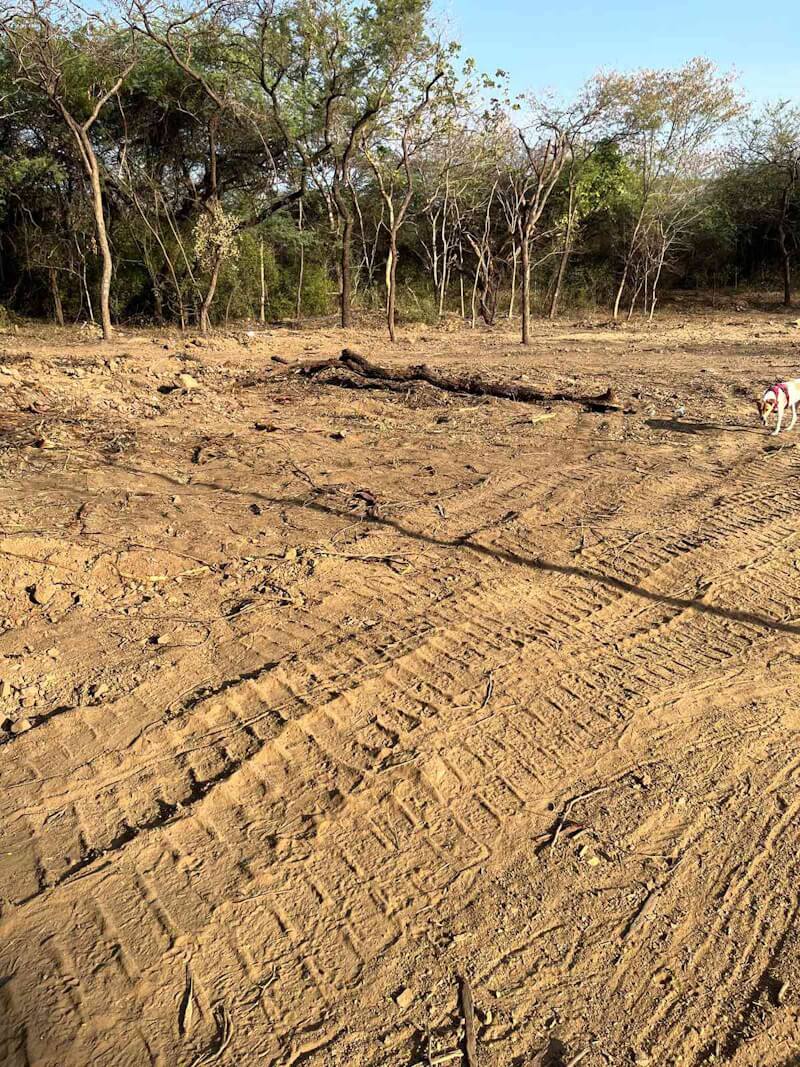
Photo: Ghazala Shahabuddin
The fragmentation and creeping urbanisation would have caused ecological disruptions as the open forests and scrub areas were cleared to build the city. Ecological awareness led to the famous MC Mehta vs Union of India case in the Supreme Court which mandated the creation of the Ridge Management Board in 1995. Three decades later, the Ridge is in no better ecological health. Restoring it now should have meant that all plans furthered the idea of ecological coherence. The plans for the Central Ridge show anything but coherence. In fact, they violate key environmental laws including the Forest (Conservation) Act, 1980.
The Delhi government is also planning to “integrate gaushalas with Delhi’s ridge and forest areas, allowing cattle to inhabit a more natural environment” as Delhi Chief Minister Rekha Gupta stated. This makes little ecological sense or coherence. The Central Ridge is governed by multiple agencies including the Army and the Delhi Development Authority. Only about half of its entire area has been demarcated as forest and geo-referenced.
Commenting on the plans to make a forest, Prof KT Ravindran, former Head of Urban Design at the School of Planning and Architecture, New Delhi, told Frontline[4]: “Urban design cannot, and should not, override ecological logic; ecological logic constitutes the foundation of urban design…The [downward] trajectory [in forest conservation] is a combined result of institutional inertia and a failure to reform the mechanisms through which forests are managed. The notion of ‘eco parks’ has been repeatedly invoked to mask large-scale ecological damage. Vast tracts are degraded so that smaller parcels can be rebranded as eco parks.”
Could the plantation and themed ‘forests’ be a part of a grand design of land acquisition in the Ridge? Doubts linger given that there were proposals in the past to locate housing projects here[5] and the Ridge Management Board itself approved the construction of a road and forest department headquarters within it. This study[6] showed that, in 1989, open forest and scrub areas in the Central Ridge comprised 77.5 percent; by 2020, these had shrunk to 33.4 percent while the built-up area had doubled from 6.6 percent to almost 12 percent.
The anthropogenic built environment has crept into the Ridge; now the attempts are to do plantations and build themed forests under the guise of green.
Plantations and native plants
The plan for the Ridge is to remove the invasive tree species – there for decades and spawning their ecosystems – and replace them with native tree species such as Peepal, Banyan, Neem, Arjun, and Jamun – these trees may be ‘native’ in the sense that they are Indian, but they are unsuited to the dry ecology of the Ridge. More than a crore of these ‘native’ saplings are proposed to be planted. This thrust towards ‘indigenous’ species is tied to the themed forests that draw their names from Hindu mythology or season words including Nakshatra Van, Mel Van, Rishi Van, Tirthankar Van, Shankar Van, Vaman Vriksha Van and Purani Vatika. These will have more than 70 artificial ponds and small restaurants too.
Well-known ecologist and author of Trees of Delhi Pradip Krishen, speaking extensively to Question of Cities avers that most of these planned so-called ‘native’ species are not part of the ecosystem of the Ridge. “It’s important to get rid of invasive species, it’s important to plant the right things, and this is something the Forest Department gets wrong again and again,” says Krishen. The Forest Research Institute’s latest Working Plan[7] lists 34 species planted in the Ridge. Of these, 12 are not suitable to the Ridge’s ecology, says Krishen. “Trees like Mango, Jungle Jalebi, Kassod, Mahua do not belong to this habitat at all. This kind of uncritical acceptance suggests that the WP knows no better.”
Other ecologists fear that large-scale interventions, including the removal of the existing vegetation and its ecosystems followed by the introduction of new species and infrastructure could disrupt the Ridge’s existing ecology, and likely damage the very forest the plan seeks to restore. This ‘building’ or designing a forest is doomed to fail, they say.
For decades, the Ridge has been overrun by invasive species such as Prosopis Juliflora Leucaena leucocephala and Lantana which survived in the Ridge’s rocky, scrubby terrain and been successfully outcompeting the native flora and inhibiting their growth. As much as 80 percent of the trees on the Central Ridge are invasive species, says Krishen.
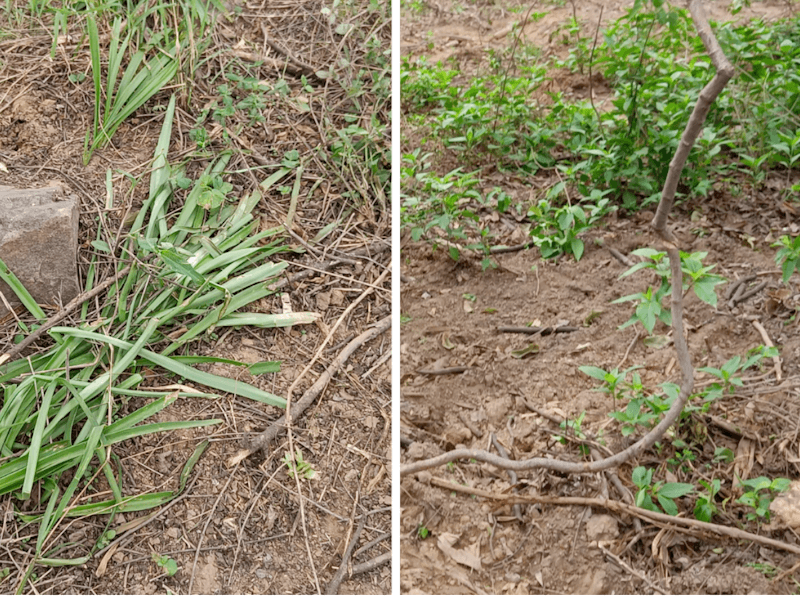
Two other factors are at play here. One, some of the ‘native’ species are water-intensive plants calling for constant irrigation. Second, according to the Plan, the planted areas will require soil work, irrigation, and maintenance for seven years. “That’s not how a self-sustaining ecological system is created. We plant with the onset of the rains, provide support during the first few months, then stop watering. That’s what makes the landscape sustainable. If a plant dies because it can’t survive without irrigation, we let it die, and replace it with a species better adapted to the local environment,” explains Krishen.
There is concern about the water used for irrigation; the Sewage Treatment Plant (STP) water contains pathogens, heavy metals and high concentrations of nitrogen and phosphorus which can damage or kill plants. However, a forest official told Question of Cities on the condition of anonymity, that the STP water would be safe to use and that newly planted saplings would be watched for three-four years to assess their growth, and then changed if they cannot be sustained. There’s cause for low confidence – the Working Plan says the DDA will plant 200 native flora but a Draft Citizen’s Report on the Central Ridge claims not a single plant mentioned is suitable to the area.
Then, there is the issue of turning parts of the Ridge into themed forests[8] or vans which worry environmentalists. Vikram Iyer, pursuing his PhD at Indian Institute of Science Education and Research (IISER) Mohali, says that the Ridge is a forest fragment that has survived for centuries and supports a unique biological diversity; replacing this with ornamental landscaping and native species could lead to the local extinction of several other species. Adds Ghazala Shahabuddin, who teaches Environmental Studies at Ashoka University, about integrating gaushalas with the Ridge: “Cattle voraciously eat young saplings that emerge naturally. Plus this whole idea of people going there and feeding them, and monkeys and peacocks, further alters the ecosystem and has repercussions on other species.”
These efforts, Shahabuddin asserts, move away from what ecological restoration should be which is “the revival of a functioning ecosystem, not just about planting a set of trees…an ecosystem depends on the complex relationship between species – for instance, raptors prey on smaller birds, birds and mammals which disperse seeds, and their excreta helps fertilise the soil. But planting a set of trees not native to the Ridge’s ecosystem ignores these relationships, and will hurt the native fauna… There is also a push towards concretisation in India; we are no longer leaving these places wild as we did earlier.” An example is the conversion of forests in the Faridabad Aravallis to a zoo-safari[9] with expansive construction.
A major part of the Ridge restoration campaign is the removal of Neltuma Juliflora or Vilayati Kikar, an invasive species, introduced by the British during the colonial times that has overrun the Ridge. The Forest Department plans to remove it by cutting its rootstock and biologically suppressing it. “The vines grow rapidly, climbing up the Prosopis trees, and eventually covering them,” says the WP. This was proposed also in 2021 but the plan never took off. “It was because we had serious differences with this approach,” explains Krishen, also a member of the Supreme Court-nominated Committee of Experts. Shahabuddin is apprehensive too. The Vilayati Kikar is extremely hardy and resilient, and could simply grow back. Another worry is the use of earthmovers to remove it, which they feel is absolutely detrimental to not just the living soil, but other shrubs and grasses.
The process has already begun. Inside the Central Ridge, this week, the JCB tracks, remnants of native trees, woody shrubs, and upturned Vilayati Kikars were seen strewn all around. Krishen explains that such mechanical impact damages the biocrust which forms a protective layer over the soil and prevents erosion “Even foot traffic can destroy these fragile communities,” says Krishen. The best way to remove them is by hand. CR Babu, who is part of the restoration of several biodiversity parks in Delhi agrees and says it’s being done in the Kamala Nehru Ridge. He, however, refused to comment on the JCB approach in the Central Ridge.
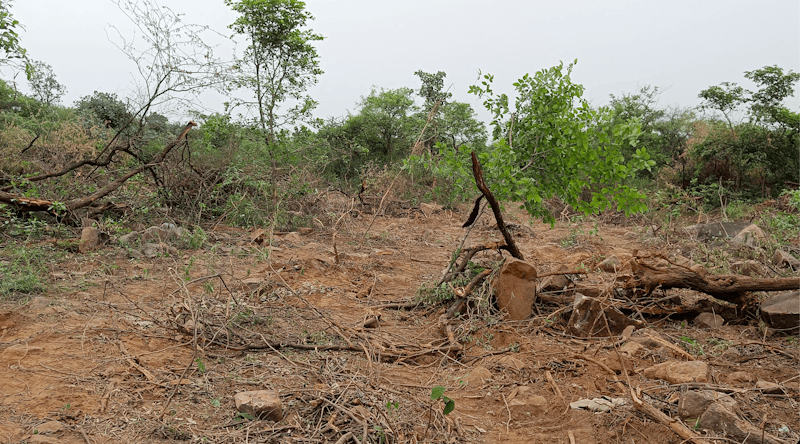
Nidhi Batra, architect, environmental urban designer, and environmental law and policy practitioner, points to the loss of a small native tree called Gangeti, which grows in the understory and bears lovely red berries, being razed. “When a JCB is rolled in, it does not uproot selectively. So, these are also gone.” Capparis sepiaria (Heens), a common climbing shrub important for wildlife and fodder, was also destroyed. Shahabuddin too says this approach to building a forest is unecological: “Such methods change the whole ecology abruptly, without consulting scientists and local communities who use the forest, without looking at the long-term floral and faunal impacts.”
What are the alternatives?
The restoration of the Ridge is a complex process. The first step, Krishen says, should be a careful assessment of the site to evaluate its slope, trees, shrubs, and soil followed by identification of a reference site that can be like a perfect model or a template for the proposed landscape. “None of this has happened. There’s no reference site, no proper lists of species, and no understanding of where plants belong in this landscape. For the Forest Department, ‘restoration’ means just planting trees closely and in dead-straight lines, so that it will become a dense woodland plantation with no resemblance to natural landscapes of the northern Aravallis.” The forest official said he had no knowledge of a reference site – it tells how serious the ecological restoration plan is.
There is a push for large-scale tree plantation in all of Delhi. However, an uncritical assessment of plantation under the guise of creating dense forest cover while neglecting the needs of the specific ecology is problematic. The Ridge is characterised as a dryland ecology with open rocky terrain, scrubby vegetation, and seasonal grasses. “The area has certainly been invaded by Vilayati Kikar and Subabul but the decline was not caused only by their proliferation. It comes from the mindset of the agencies responsible who see these landscapes as wastelands or land with high real estate value. So, the decay is more a matter of governance than ecology,” says Shahabuddin.
An urban forest is a delicate thing. Keeping human interference to a minimum and allowing the forest ecosystem to sustain itself naturally would be the best. “A forest is not less of a forest because it sits within a city. Its urban location does not give us permission to manicure or domesticate it,” says Batra emphatically. Yet, urban forests are expected to serve multiple purposes be it absorbing pollution, recreation, or offering beautiful landscapes and cafes. Batra argues that we need to rethink the relationship. “We need to go beyond our anthropocentric lenses and see a forest for what it is — an ecosystem with intrinsic value…we must embrace the idea of wild forests and respect wilderness within our cities.”
Delhi’s Ridge has a lot to catch up.
Ankita Dhar Karmakar, Multimedia Journalist and Social Media in-charge in Question of Cities, has reported and written at the intersection of gender, cities, and human rights, among other themes. Her work has been featured in several digital publications, national and international. She is the recipient of the 4th South Asia Laadli Media & Advertising Award For Gender Sensitivity and the 14th Laadli Media & Advertising Award For Gender Sensitivity. She holds a Master’s degree in English Literature from Ambedkar University, New Delhi.