
The Godavari, once Nashik’s central ecological and spiritual system, moves through the city carrying the cumulative burden of urbanisation, religious use, and administrative neglect. The ghats at Panchavati and Ramkund still draw pilgrims, and everyday life is structured around the river, but the water reflects long-term stresses that have not been reversed by successive interventions.
To rejuvenate the river, the Nashik Municipal Corporation initiated the Rs 2,800 crore Namami Goda project,[1] the largest riverfront intervention in the river’s history. Rs 1,823 crore was approved in 2021 and implementation began in 2023. The project, as most such projects span, is a combination of sewage treatment, riverfront construction, and heritage conservation in preparation for the Simhasta Kumbh Mela next year. It promises improved water quality in a fixed event-driven timeline; ecological repair and visible infrastructure.
The riverfront project runs parallel to the Maharashtra government’s larger Rs 25,055 crore infrastructure plan for the Kumbh Mela;[2] its allocations are heavily weighted toward roads, ring roads, and ghats construction rather than the Godavari’s ecological restoration. The Namami Goda project is being implemented by the engineering and sanitation divisions of the Nashik Municipal Corporation (NMC) in coordination with the Kumbh Mela Authority. This has created a fragmented system where river health is managed by multiple, often unaligned, institutions.
The ‘beautification’ work of the Namami Goda project is underway even as untreated sewage continues to enter the Godavari at multiple points along the Panchavati–Tapovan stretch, the Biochemical Oxygen Demand (BOD) levels of 7-8 mg/L at Ramkund remain above safe limits, and several completed riverfront assets do not have an assigned agency for maintenance. Three fault lines run through the riverfront project—design logic derived from real estate rather than ecological restoration; a governance structure in which no single authority owns the river’s ecology; and an event-driven deadline.
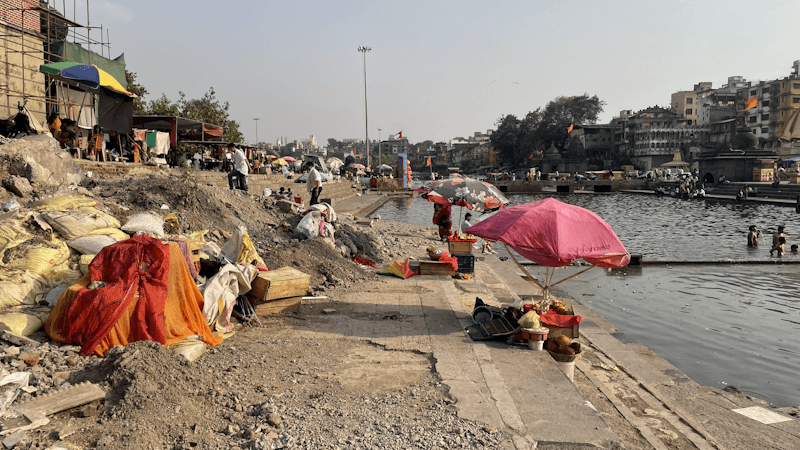
Photo: Naitri Kale
The gaps in Namami Goda
The NMC is committed to the Namami Goda project. It is structured across two phases with distinct priorities, says Sandesh Shinde, executive engineer in the NMC. Phase I addresses sewage treatment, drainage interception, solid waste management, and riverbank stabilisation while Phase II focuses on riverfront development with walkways, LED lighting, and new ghats, a bubble jet fountain, a rose garden, a water screen laser show, and a park with boat rides, according to Smart City project documents. He describes the project as “an ecological and infrastructural challenge”.
The ecological restoration is not on the agenda; the completion of visible structures for the Kumbh Mela calendar is.[3] On the ground, Phase II has become visible. At Ramwadi, for example, the Goda Park has reorganised the stretch of the river into a structured public space. In a city where such public spaces are limited, the park has a strong social presence but its location within a degraded river system seems to not draw attention.
Started in 2019, the ‘beautification’ project was completed in January 2024, three years behind deadline; the cost escalated from Rs 64.96 crore to Rs 83.19 crore—nearly 28 percent increase.[4] But its operational control and maintenance are unclear. Internal municipal records from January 2025 show that the Goda Park, Goda Walk, Sambhaji Udyan, and Goda Ghat, though completed under the Smart City authority, have not been formally handed over to any other for long-term maintenance.
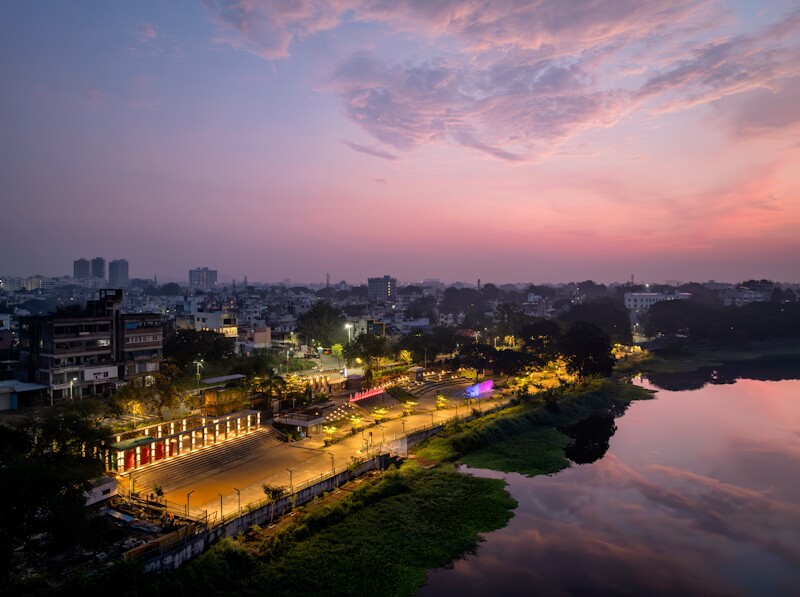
Photo: Nashik Municipal Smart City Development Corporation Limited
Construction towards destruction
The present condition of the Godavari is shaped by a long sequence of Kumbh Mela-driven interventions that altered its physical structure. In preparation for the 1992 Kumbh Mela, large portions of the riverbed and ghats were concretised. Seventeen traditional kunds — natural water-retaining depressions that supported infiltration and seasonal flow—were levelled or filled, shifting the river from porous systems toward hard infrastructure.[5] The 2003 Kumbh Mela reinforced this, burying natural springs and weakening groundwater recharge. The river became increasingly dependent on regulated dam releases for its flow.
In 2015, Devang Jani, president of the Godapremi Seva Samiti, filed a PIL in the Bombay High Court demanding de-concretisation, restoration of kunds, and improvement of water quality. His petition drew on studies from the National Environmental Engineering Research Institute; in February 2017, the HC directed the NMC to act within a fixed timeline.[6] Only four of the 17 kunds opened under the Smart City programme. In August 2025, the HC issued contempt notices to the Nashik municipal commissioner and the Maharashtra Pollution Control Board for continued non-compliance. The order points to repeated failures by the NMC and the Smart City initiative across multiple efforts of river restoration.
Old problems persist
Nashik generates approximately 323.3 million litres daily (MLD) of sewage, while installed treatment capacity stands at roughly 392.5 MLD.[7] Gaps in collection, transportation, and plant performance allow untreated sewage to enter the Godavari at multiple discharge points, particularly along the Panchavati-Tapovan stretch. The Central Pollution Control Board (CPCB), in October 2025, classified this stretch as Priority III pollution with BOD levels 10.1 and 20 mg/L—over three times higher than the limit for safe bathing— at Ramkund despite the expenditure. The Godavari has seen a pattern of interventions that does not improve the river’s ecology.
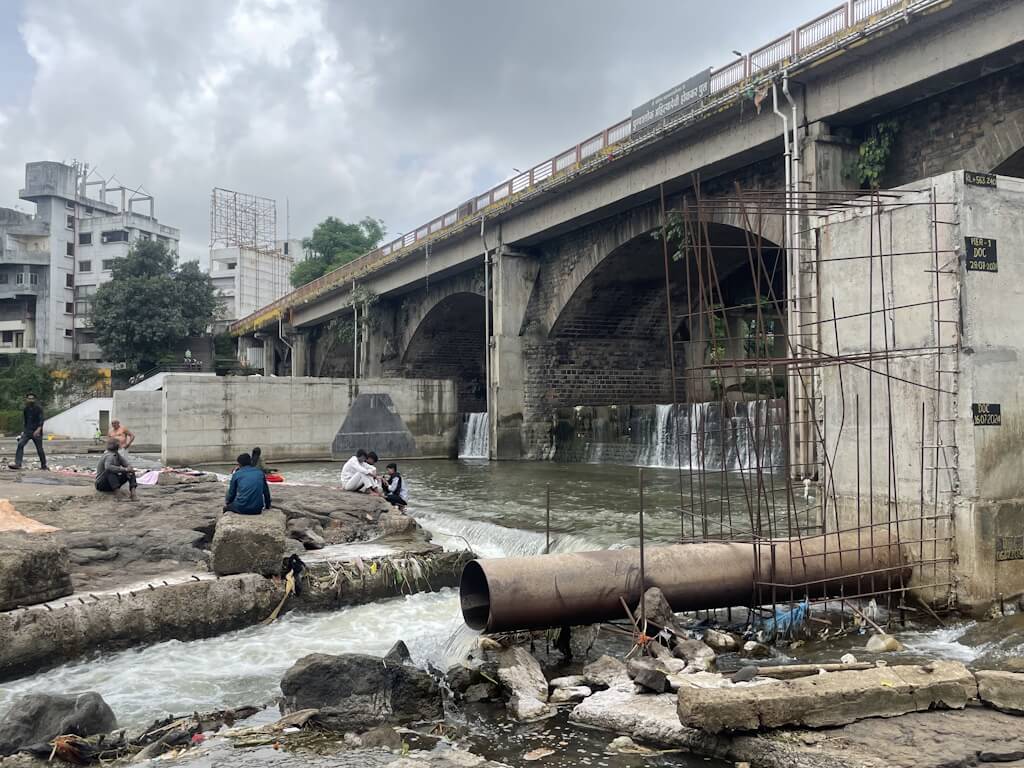
According to Jani, the STPs have failed consistently. At Panchvati-Tapovan, it is a common sight to see floating plastic and algae over stagnant patches, with the accompanying stench. What is happening along the river’s edge is equally disturbing. Over the last six months, tree-cutting linked to road widening, civic infrastructure work, and Kumbh Mela preparations has triggered concerns and legal scrutiny. Activists filed petitions in the National Green Tribunal (NGT) which stayed further felling. They alleged that the NMC had approved 1,800 trees for cutting but the number may be over 5,000 trees. Nearly 1,500 had already been cut without due process, as ghat construction and riverfront work reshaped the riverscape.[8]
These projects are framed as development or beautification but they directly reduce the tree cover along the river’s edge, weakening the natural buffer that slowed runoff, supported groundwater recharge, and protected soil stability. With more concrete edges and fewer permeable zones around it, the river now receives higher silt loads and direct urban runoff. Rajesh Pandit, president of Namami Goda Foundation, river conservation NGO, connects this to the failure in river management. “The biggest problem is the flow, the river has to flow. If there is no flow, the river cannot revive,” he told Question of Cities, adding that the flow depends on groundwater recharge and natural absorption systems which are lacking.
Many agencies but one ‘Sabarmati’ vision
The Godavari is governed by a fragmented governance structure; multiple institutions control different aspects without a unified ecological vision or accountability. The NMC manages sewage infrastructure and executes the riverfront plan while the Kumbh Mela Authority has a parallel mandate to prepare the riverfront for Shahi Snan during the event. The Maharashtra Irrigation Department controls water flow through dam releases, influencing the river’s hydrology outside Nashik which shapes the river in the city. Agencies associated with the Smart City Mission sanction projects while HCP Design, Planning and Management Pvt. Ltd. is responsible for the design of Ramkund and Panchavati stretch.[9] Other sections are handled by other contractors and consultants.
The work on the river is being designed and executed in segments, with each agency carrying out a different mandate rather than a shared ecological objective. Activists express concern at the involvement of HCP, the Ahmedabad-based firm[10] that led the Sabarmati Riverfront in that city, a project widely discussed for transforming the river into a controlled embanked corridor, prioritising public promenade and real estate. Nashik authorities decided to consult the Sabarmati Riverfront Detailed Project Report before initiating Namami Goda.
Activists point out that, if the riverfront development must be done, a model has been imposed rather than evolving a Godavari-specific ecological framework. Architect and urban designer Ulka Pawar critiques: “Each river carries its own ecological and cultural conditions; applying pre-existing models without understanding the local systems risks weakens environmental and social outcomes”.
Jani also warns that Sabarmati-style interventions could prove disastrous. “They turned the Sabarmati into a canal, cutting it off from its floodplains. It’s visually clean but biologically dead,” he says. Instead, he advocates London’s Thames-like restoration which rebuilds wetlands, revives biodiversity, and centres community involvement.
The Smart City documentation reveals further fragmentation between ecology and the implemented design with biodiversity reduced to potted trees alongside fountains, lighting systems, promenades, and leisure infrastructure. Shinde defends sewage treatment saying, “Nashik’s STPs are the most effective” and adds that other proposed work includes a ropeway between Someshwar Temple and Balaji Temple, water taxis connecting Holkar Bridge to Someshwar, and a suspension bridge modelled on the Laxman Jhula concept near Someshwar waterfall.[11]
To activists, it sounds like a tourism brochure. What remains largely absent is an integrated plan for wetlands, floodplain recovery, biodiversity restoration, and long-term water quality improvement.
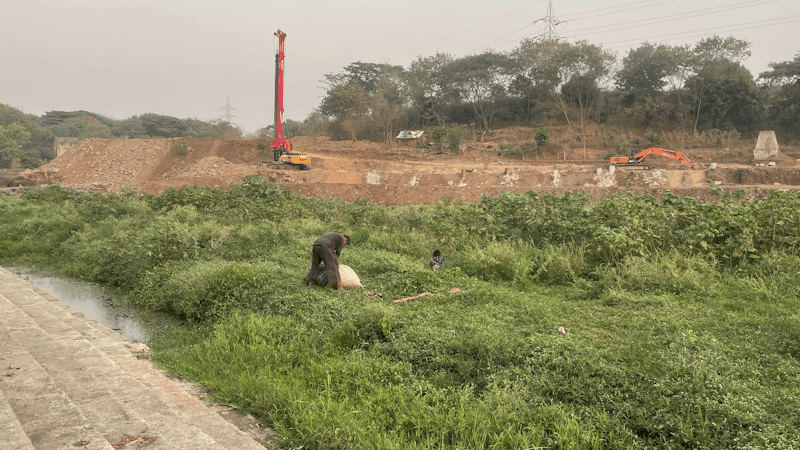
Photo: Naitri Kale
Affected people not consulted
Despite the scale of the project, structured public consultation has been limited. Chandrashekhar Panchakshari, chairperson of the Godavari Purohit Sangh, says, “Till now, no one from the administration has reached out to us priests or traders near the river.” They, like residents, have been largely excluded from planning processes though riverfront changes directly affect their livelihoods and use of ghats. Small traders have also been evicted in periodic anti-encroachment drives despite lack of rehabilitation. Ironically, initiatives such as the ‘Aapli Goda’ contest attempt public participation—a symbolic engagement.
Pawar points to a deeper flaw in the planning: stakeholders not being properly identified and planning with abstract design visions rather than with existing communities. “Not every land is real estate, and not every river is public space,” she says, underlining how the plan did not recognise cultural and ecological ownership of space.
The Kumbh Mela brings in its own cycle of interventions in the river which Jani describes as recurring: “The pre-Kumbh phases trigger large-scale construction, dredging, and beautification drives, while post-Kumbh periods see reduced attention to maintenance and ecological follow-up.” Along the banks today, remnants of earlier Kumbh Melas linger—broken bollards, concrete ghats, incomplete river edges. Kumbh-linked budgets are hastily absorbed into work timelines, whether a transparent long-term plan exists or not. Expenditure moves faster than capacity. These rarely support sustained ecological repair. The urgency of 2027 is now accelerating construction across the river.
The Godavari’s future hangs between two approaches to restoration. One is driven by hard engineering, large-scale construction, timelines, visibility, creation of land and leisure avenues. The other is ecological—treating the river as a living system, defined by flow and floodplains, which calls for sewage treatment before it enters the river, functioning treatment plants, restoring the river flow, and treating the river basin as a connected ecological system.
In Vadodara, the proposed Vishwamitri riverfront work, with sustained public pressure and legal interventions, moved away from large-scale concretisation. When citizens, experts, and institutions worked together, change became possible[12] but this seems remote in Nashik that sees isolated interventions. A recurring gap, as Pawar notes, is the absence of river-specific research such as “ground-level data on hydrology, land use, and how communities actually interact with the river.”
The Godavari in Nashik, before and after the Kumbh Mela, has a long path to recovery, if at all.
Naitri Kale is a multimedia journalist based in Nashik. A recent graduate of Sophia College, Mumbai, she covers civic journalism and public policy, with a focus on the institutions and systems that shape urban life.
Cover photo: Punyashlok Ahilyadevi Holkar Bridge at Panchavati which overlooks the Ramkund. Credit: Naitri Kale