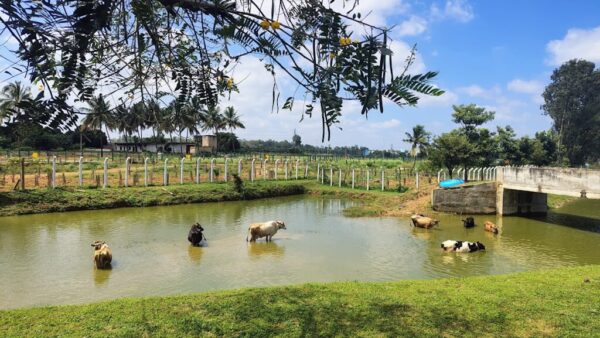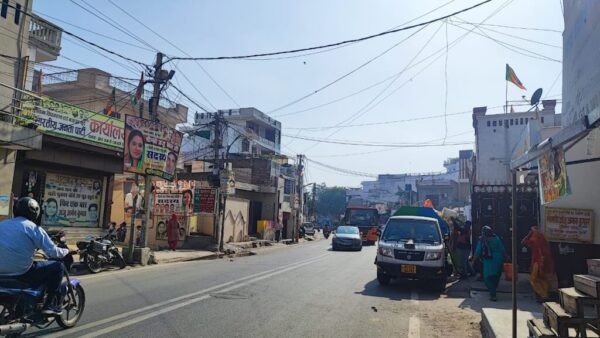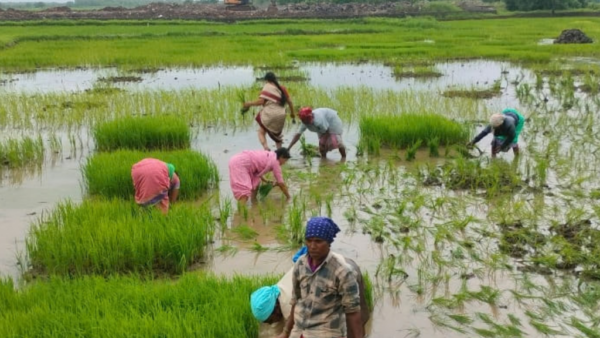
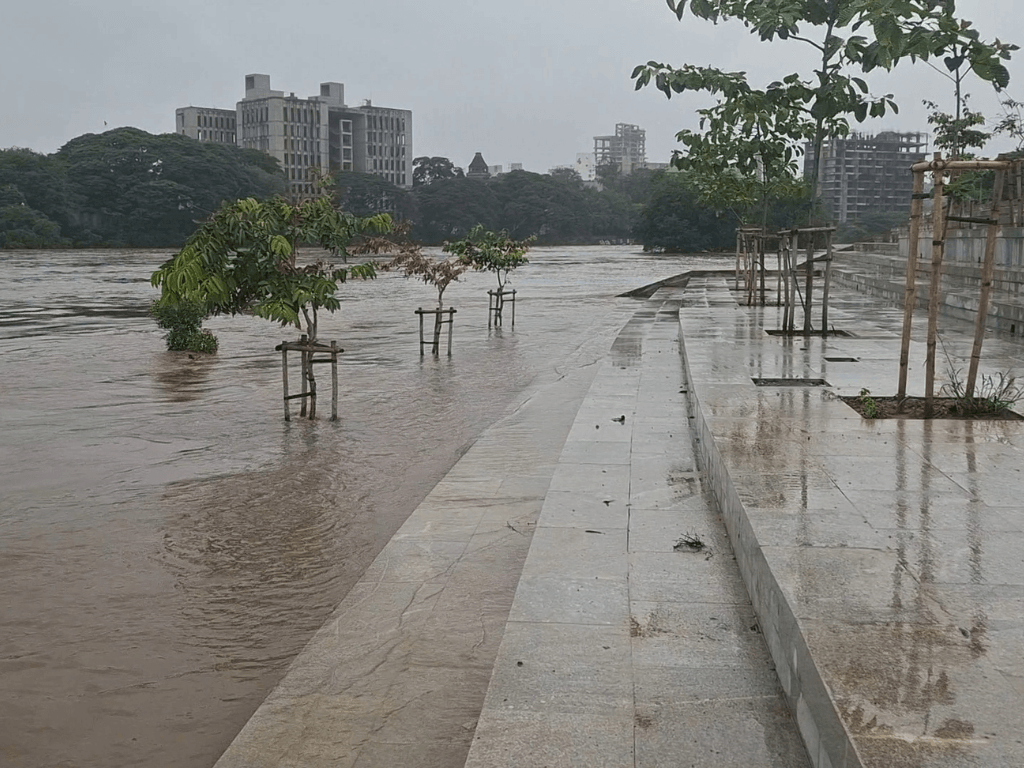

The real question about Pune’s rivers is the riverfront development that threatens them. A river, as we know, is the mother of a civilization; hardly any human society has evolved away from a natural water source. Pune’s political leaders, bureaucrats and planners have either failed to understand this fundamental relationship or choose to disregard it as they subject the city’s rivers and river banks to the failed idea of modern commercial ‘development’.
Pune flourished in the lap of not one but five rivers[1] —Mula, Mutha, Pawana, Ram Nadi and Dev Nadi. As they flow through the city, they converge with each other to form the Mula-Mutha. There are seven dams on these rivers on the immediate upstream of Pune at Khadakwasla, Panshet, Warasgaon, Temghar on Mutha River, Pawana Dam on Pawana River, Mulshi on the Mula, and Kasar Sai Dam on its tributary. The spillway releases from these dams pass through Pune. As these rivers originate in Sahyadri Range, their catchment areas upstream of Pune get very heavy rainfall. Combined with the hilly terrain with steep gradients, this means voluminous and fast surface runoffs resulting in floods during heavy rains.
The network of rivers, from their origin and along their course, create and sustain life of plants and animals alike. Their banks, riparian zones, and channels (not canals) are functional spaces not just for humans but also for the flora and non-human fauna that have evolved for eons and have developed certain characteristics. One such characteristic of the flora is the wood wide web, or the mycelium network, which is the way trees communicate with each other for food and send alarms.
The tree-rich river banks have their wood wide web; the manicured plantations of the riverfront development might or might not. The river ecosystem is an entire world of life in itself, an eternal ecological truth that the riverfront development does not recognise or respect. Birds like lapwings live and nurture their eggs on the banks, in the river is Mahseer (Tor khudree), the apex predator, endemic and found in Mula and Mutha swimming[2] and keeping the aquatic ecosystems in check. The Mula-Mutha was filthy, swollen with untreated sewage and other discards, but the rivers still meandered through the city.
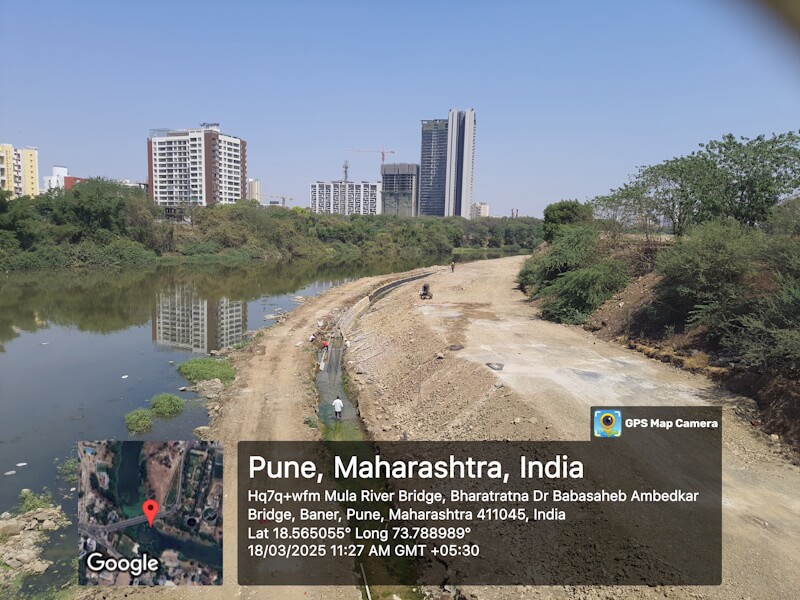
Photo: Sarang Yadwadkar
Why the riverfront ‘development’ fails
Into this frame, the riverfront development was introduced in 2015 with various bids and plans, but the project was eventually finalised on the lines of the Sabarmati Riverfront in Ahmedabad. Like there, here too, unmindful of the needs of the river, the hydrology, topology and terrain, the rivers’ network and their ecology, the riverfront project has meant the following: rivers channelised with concrete embankments, promenades on river banks for people to enjoy, stepped ghats, no rocky beds, no raanjankhalge (potholes).
This will turn the Mula-Mutha from a flowing water body into a canal to transport partially-treated sewage and solid waste downstream, disturb the river biodiversity and, of course, kill most of the 44.4 kilometres of it. From kingfishers, ruddy shelducks, herons and storks that were the indicators of a healthy river ecosystem, the scavengers and indicators of polluted water like kites and crows abound. Perhaps, an occasional sighting of an ibis or lapwing. Seldom a butterfly. Dragonflies disappear and only mosquitoes are left. Turtles or snakes can scarcely access the river banks which have been transformed into steps.
Most of all, the trees. Thousands of trees will eventually be sacrificed[3][4]; 689 were cut in the Wakad Sangvi belt.[5] Many have already been. The signs are around us in the first three of the 11 planned streches. The stretch at Sangamwadi has been nearly completed. In March, the Pune Municipal Corporation (PMC) invited objections to cut down 689 trees for a two-kilometre stretch of the riverfront project.[6] Sangamwadi is today a barren grey stretch ‘reclaimed’ with all its green cover gone,[7] despite the opposition from tree lovers and others who appealed to PMC to have better sense.
The official response was to change the name from riverfront development to ‘River Rejuvenation Project’. This neither reduces the estimated spend of Rs 5,000 crore nor protects the river ecosystem.
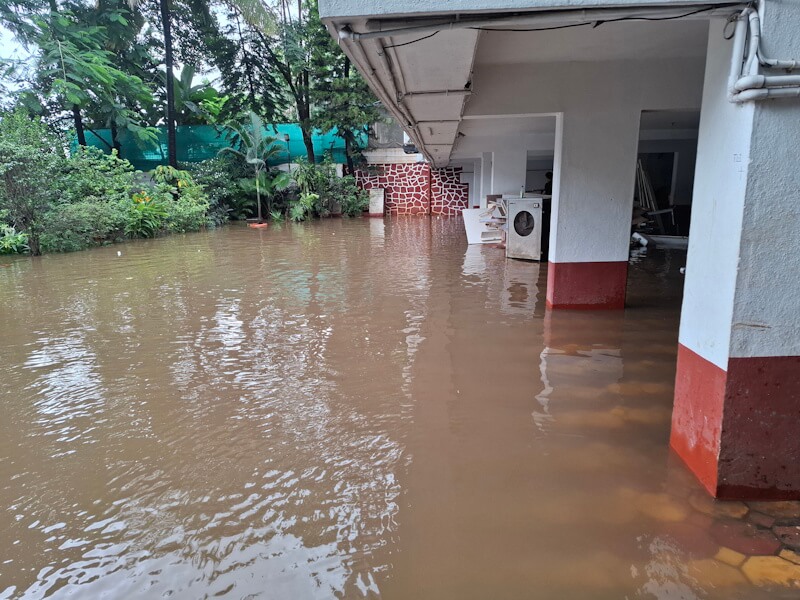
Photo: Sarang Yadwadkar
Setting up Pune for more floods
The Mula-Mutha riverfront project is hazardous for both the rivers and the city; Pune’s floods are likely to worsen, exacerbated by increased concretised surfaces and reduced river width throughout the length of the project. In its 2014 report to the Maharashtra government, The Energy and Resources Institute (TERI)[8] specifically highlighted that in next few decades, Pune is likely to see 37.5 percent rise in annual rainfall with reduced rainy days and more frequent occurrences of cloud bursts. The last few years have shown that barely a couple of hours of rain was sufficient to flood the city.[9]
Narrowing the rivers by way of reclaiming the floodplains will obviously lead to reduction in their flow areas and, consequently, a steep rise in the flood levels in densely populated localities. In addition to the concrete embankments being constructed on the riverbed, three barrages will be constructed which together will only obstruct the natural flows of the rivers. The part of the riverbed beyond the embankments is being ‘reclaimed’ by dumping tens of thousands of dumpers of debris. This artificial ‘land’ will be used for commercial purposes including vehicle parking and food malls. Trees razed to make space for car parks.
Importantly, there are questionable gaps in the hydraulic studies of the project; its values differ from those of the Water Resources Department but the project was cleared. To compute flood levels, the project consultant considered floods that may occur once in 25 and 100 years without considering a single drop from the free catchment area of a few thousand square kilometres.
As per the norms of the Water Resources Department,[10] it is mandatory to take into account the peak spillway discharges of dams and the surface runoffs flowing into the river from the free catchment area between the dam and the city. This is a huge flaw—either an oversight by the consultant and the PMC or willful neglect. The comparative chart (below) of the flood values used for the riverfront development (RFD) project and those of the Water Resources Department (WRD) tells the true story (all figures in cubic metres per second):
| RIVER | BLUE FLOOD LINE
(once in 25 years flood) |
RED FLOOD LINE
(once in 100 years flood) |
||
|
IN RFD |
AS PER WRD |
IN RFD |
AS PER WRD | |
| Mutha | 1,700 | 3,050.80 | 2,835 | 7,213.80 |
| Mula up to Pawana | 1,536 | 2,796.80
|
1,670 | 4,517.60 |
| Mula-Mutha | 3,343.96 | 6,654.30 | 4,760.89 | 12,868.80 |
Another crucial flaw is the non-consideration of confluence effects[11] while computing the flood levels. When two rivers meet at the confluence, their momentums collide with each other, slowing down the velocity of the flow in both. This results in afflux in both the rivers upstream, which could also lead to floods. This critical aspect has been ignored in the hydraulic studies of the project.
One of the major reasons to justify the riverfront project is the pollution in the Mula-Mutha. The PMC is working on a project to install Sewage Treatment Plants (STPs) with Japan International Cooperation Agency (JICA) to address the untreated sewage. According to official figures, Pune’s total sewage generated is 1,634 million litres per day (MLD). After the ongoing project to treat sewage[12] is done, as we have repeatedly shown, there will still be a deficit of 629 MLD in treating the sewage.
In fact, the Detailed Project Report mentions that river clean-up is dependent on the JICA project, which is lagging far behind since 2022. How the river will be free of pollution and sewage remains a mystery.
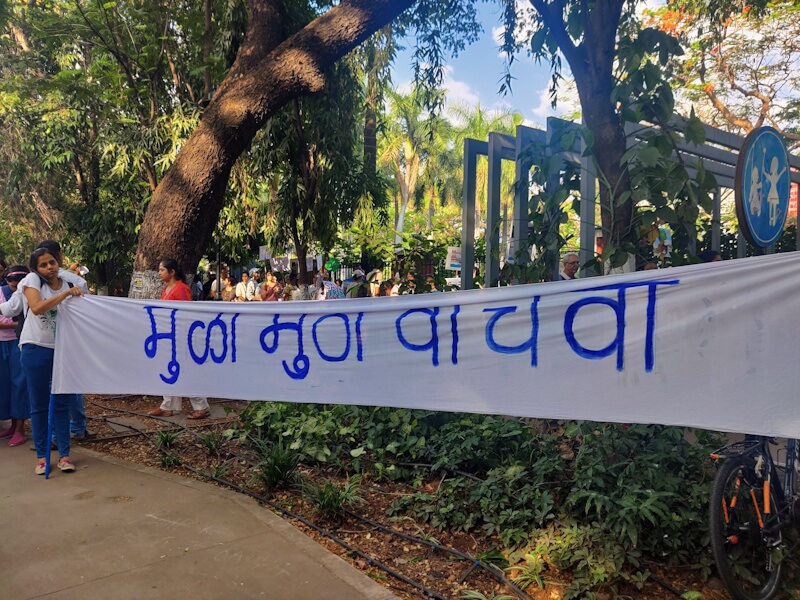
Photo: Wikimedia Commons
People’s pushback
People of Pune have not sat back watching the ‘Sabarmati model’ unfold. The anti-riverfront development campaign started with a few volunteers on the ground creating awareness about the project as ‘RFD Hatao, Pune Bachao’ which eventually evolved into the Pune River Revival movement, a network of more than 80 organisations and thousands of individuals. Despite being labelled “anti-development,” the group has stood firm against the project.
Volunteers have conducted activities like tree mapping, Chipko movement, chain fasting, awareness campaigns, writing to and attending meetings with officials and so on. One of the organisations in the network, Jeevitnadi Foundation, ‘adopted’ several river stretches since 2017, documenting biodiversity with data collection. Citizen campaigns helped trigger two site visits and a Supreme Court order halting riverfront work at the Ram-Mula site[13] to protect an old sacred grove (Devrai).
Besides the multiple litigations and public protests,[14] activists even managed to secure a stay order,[15] but the riverfront work continues. A snapshot of the litigations:
- The Environmental Clearance (EC) issued to the project in 2019 was challenged in the National Green Tribunal. The case dragged on for a long time. Finally, the court directed the Pune Municipal Corporation to amend the EC and stayed the construction till it was done.
- Another case was filed to stop tree felling. Initially, the PMC projected that not a single tree will be felled for the riverfront development but subsequently decided to cut 22,150 trees along the river banks. The NGT stopped the tree felling till the EC was amended.
- The amended EC in 2024 was also challenged in the NGT; the petition is pending.
- There are grounds to demonstrate that the work in multiple stretches continues in violation of the EC. For example, it specifically says that the project must not alter the cross-section of the riverbed but the work is reducing the cross-section/flow area along the entire length.
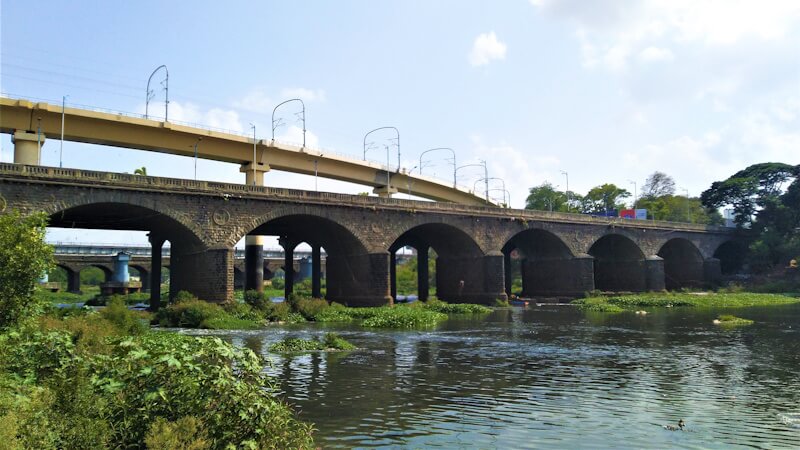
Photo: Wikimedia Commons
So, Pune must brace for more floods. Birds seem to have given up already; with the trees gone, birds that nested there are migrating to other locations. The river banks have fallen silent. Like key species on river banks is an indicator of a healthy river, people spending their time near rivers is too.
The natural riverfronts were a part of Pune for ages—the samadhis, temples, ghats, crematoriums, even farm lands. The river basin during the non-monsoon months was used as a playground. The socio-religious-cultural fabric of Pune was sewn by the Mula-Mutha. Temples of local gods like Mhasoba, Sati Asara, Mavlaya, Shankar and Datta were established on river banks at multiple places. Ghats leading down to the river were also developed and used by people across centuries; Ghorpade Ghat, Siddheshwar Vruddheshwar Ghat, Omkareshwar Ghat, Waghacha Ghat are a few examples that people use even today.
In the riverfront project, these ghats would be “conserved”, probably like in Varanasi, and transformed into exclusive spaces with access only for certain economic class/classes. This has already manifested on the Sabarmati Riverfront. However, if these are saved and rejuvenated as spaces of the rivers with an eco-anthropocentric lens—not as per the consultant’s model—the people of Pune will not only have eco-social benefits, but also physiologically and psychologically healthier spaces.
The renewed ghats can host picnics in the afternoons, study sessions after college, a nice jog before or after office. It will not require thousands of crores and the destruction of biodiversity. If the PMC has Rs 5,000 crore—perhaps increasing to Rs 7,400 crore—of tax payers’ money to spare, the entire stretch and ghats of the Mula-Mutha can be spruced up and managed.
Even today, the fishing communities, the herding communities, and the nomadic communities depend on the rivers to a certain extent for their livelihood. Most of them struggle to find jobs in other fields. The riverfront project threatens to displace them and worsen the situation. Invisibly, there is also the decline—or loss—of generational knowledge and wisdom of these communities. Just one project is axing so much.
Despite the loud and consistent noise made, the people’s network is still a few thousands, a fraction of Pune’s population of over seven million. This is a challenge for all Punekars to come on the streets as a large public pressure group. Perhaps, this will help decide the fate of the rivers which cradled Pune for so many centuries.
Sarang Yadwadkar is a Pune-based environmentalist, working on the issues of river pollution and urban floods. A strong voice against the Pune riverfront development, he launched the ‘Pune Bachao Mohim’ (Save Pune Campaign) to stop the project. An architect by training, he is now a full-time activist. He was also a state government-appointed member of the Planning Committee for Pune City’s Development Plan.
‘Tara’ Tanmayi S. is Network Coordinator with Upper Bhima Collective. Volunteering with Jeevitnadi for the past eight years, she has also been part of Pune River Revival Movement since its inception. She is currently pursuing a Masters in Journalism and Mass Communication. She has completed a course in Sustainable Management of Natural Resources and Nature Conservation by Ecological Society, Pune.
Cover photo: The first phase of Pune riverfront development project
Credit: Sarang Yadwadkar