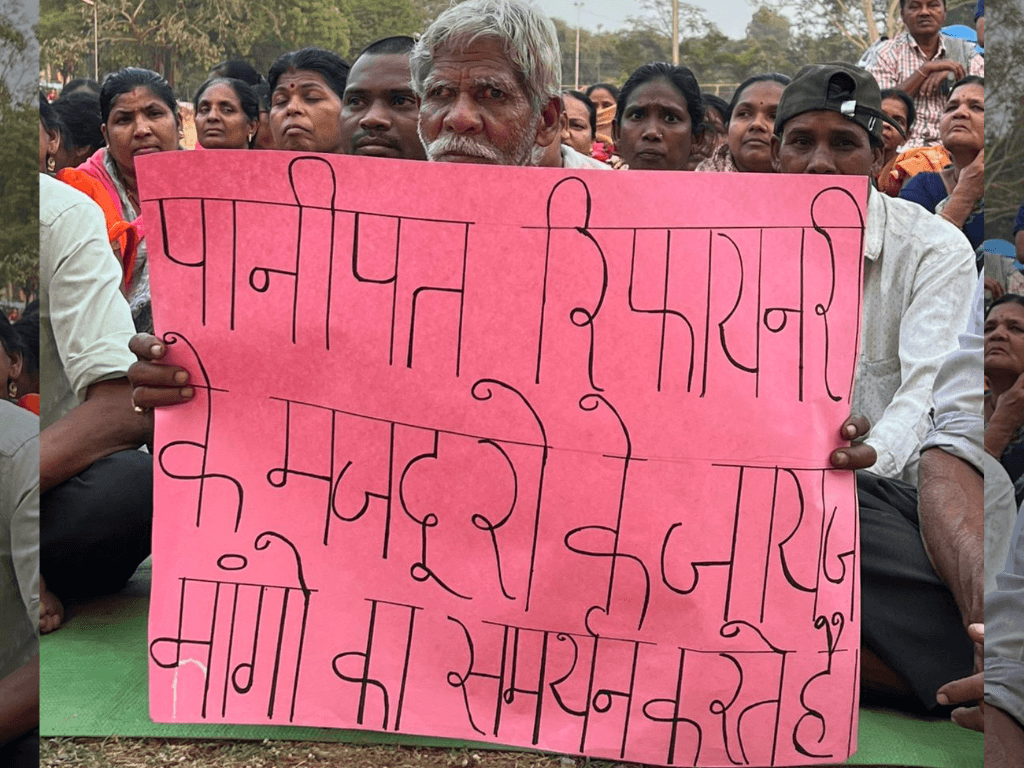

Away from the headlines and India’s public discourse, nearly 30,000 workers of the Indian Oil Corporation Limited and its contractors in Panipat resorted to one of the old time-trusted tools of protest: a sit-in. Their demands were equally long-standing: an 8-hour workday and higher wages which workers of the world had agitated for more than a century ago. As they refused to budge from Gate 4, operations in the Indian Oil Corporation Limited’s (IOCL) Panipat Refinery & Petrochemical Complex[1] came to a standstill for five days from February 23.
The plant is India’s largest government-owned oil refinery and the third largest in South East Asia. In its 28-year history, this was the first large protest and one, workers and trade union leaders, say occurred spontaneously. Workers’ struggles may seem a thing of the past in New India but, evidently, they are not. Only in 2025, there were dozens of protests and strikes – lakhs of workers, agri-workers and farmers joined a general strike in July; bank employees and insurance staff also struck work that month;[2] the demand for the repeal of the New Labour Codes brought lakhs on the streets in November;[3] and gig[4] and sanitation workers[5] continued their protests.
Some of these issues were on the minds of the IOCL workers too but the trigger was the slow build-up of resentment over the working conditions which was fuelled by an unverified news about the death of two workers. From Panipat, the arc of resistance reportedly travelled to Hazira, Surat, where around 5,000 contract workers of Larsen & Toubro (L&T) at the ArcelorMittal Nippon Steel project[6] struck work demanding higher wages and reduced working hours; 48 workers were arrested, according to Naishadh Desai, President of Indian National Trade Union Congress (INTUC).
Workers in IOCL Panipat were clocking 12-hour shifts. Besides the 8-hour shift, they demanded timely payments of salary, accountability from the company and contractors for workplace accidents, double overtime wages, recognition of national holidays, a 26-day work cycle instead of the current 28 days, and basic facilities such as toilets and drinking water within the refinery. That these demands had to be fought for is a comment on how the working class is treated. Their negotiations with the Assistant Labour Commissioner yielded little; wage revision was not accepted. Contract workers demanded a minimum monthly wage of Rs 30,000. Depending on their skill level, they make between Rs. 14,066 and Rs 23,218 a month.
Credit: Mazdoor Adhikar Sangharsh Abhiyan
The built environment
The refinery, along with the textile industry, defines the industrial side of Panipat city where the population is estimated at six lakhs. Its economy and labour patterns are that of any industrial city which includes migrant workers, here mainly from Uttar Pradesh and Bihar. The refinery is about 10-15 kilometres from the city centre but is a core element of what makes the city. The protest may not have greatly impacted Panipat downtown but the roads to the plant and Gate 4 became spaces of intense resistance for five days.
The built environment of the refinery with limited basic facilities lent credence to their demands. For instance, workers pointed me to the solitary toilet near Gate 4, the lack of adequate drinking water points inside the plant, and the absence of dedicated vehicles to move within the refinery. “It is nearly eight kilometres from Gate 1 to Gate 4. In the heat, it’s very difficult to walk,” a worker said.
Outside the gates, small eateries and shops are clustered. The weekly Palla Market caters largely to the workers. After their shift ends at 1 pm on Sundays, they come here to buy essential commodities including meat and fish. They get two Sundays off a month; March 15 was one. Most workers live in rented rooms nearby which have dismal amenities. During the five days of the protest, they say, the landscape briefly shifted with the road leading to the refinery turning into a vibrant site of speeches, slogans, and mass meetings.
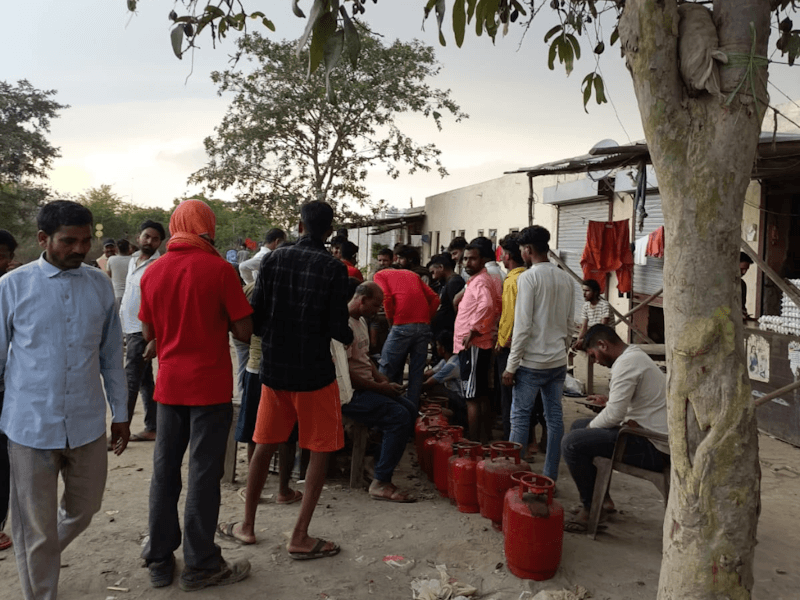
Photo: Ankita Dhar Karmakar
On March 15, I saw a queue of workers struggling to buy LPG cylinders. There was a new urgency given the rumoured shortage. “It’s being sold for Rs 400 for a kilo,” said one, “It used to be Rs 100.” Typical of a migrant worker city, perhaps scarred by the Covid-19 lockdown, the discussion turned to the big question: Should they head home given the threat of no cooking gas or continue working to earn? Here, in the market rush, speaking to workers, it was possible to piece together the protest.
It started with a rumour. On February 21-22, word went out that two workers had died in an accident in the refinery. An official, on the condition of anonymity, denied this. Still, it sparked off workers already agitated by the pathetic work conditions and events elsewhere. Nearly 1,200 kilometres away, in Bihar’s Barauni IOCL refinery, employees went on strike[7] on February 1 for two weeks over delayed wages and long working hours. The videos circulated on the workers’ phones in Panipat. Similarly, videos from Odisha’s Paradip Oil Refinery,[8] where workers stopped work after a colleague’s mysterious death, showed up on their feeds. For the men in Panipat, it reinforced the pattern of contractual work and exploitation.
Credit: Mazdoor Adhikar Sangharsh Abhiyan
“We work 12-16 hours a day with no overtime,” said a helper who did not want to be named. “There are no proper bathrooms, no drinking water inside. We earn around Rs. 14,000 a month. How is that enough? If a worker meets with an accident, no one takes responsibility.” Workers say they have no job security; the only evidence that links them to their work is a gate pass that’s renewed every three months, often arbitrarily. A worker I spoke to said his, and that of five others, had not been renewed despite filing the paperwork.
The urban living conditions are no better than back home — cramped rooms of 8 x 10 feet, shared by three-four men, little ventilation, monthly rent of Rs 4,000, and water from the borewell that’s “not fit for drinking”. As one of them lamented, “There is no value for workers’ lives”.
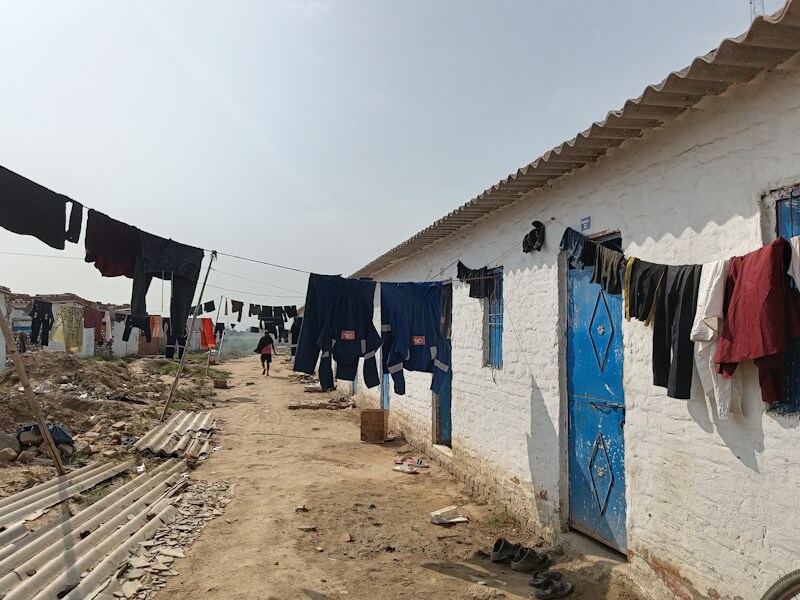
Photo: Ankita Dhar Karmarkar
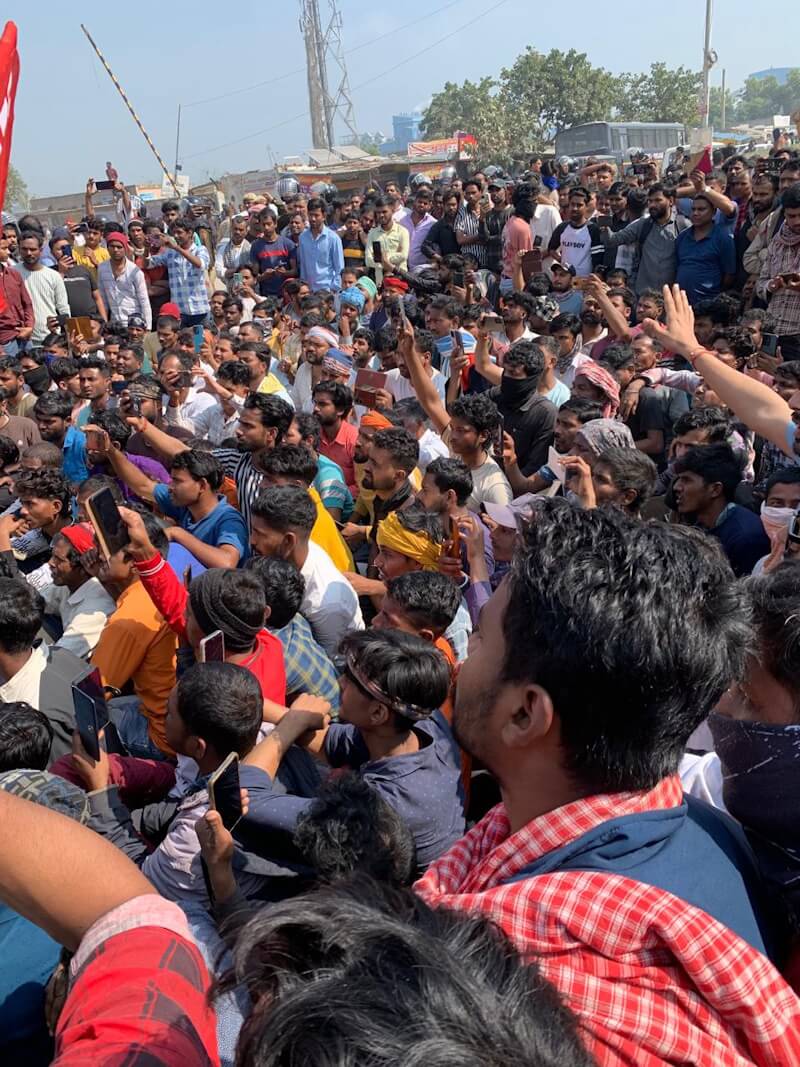
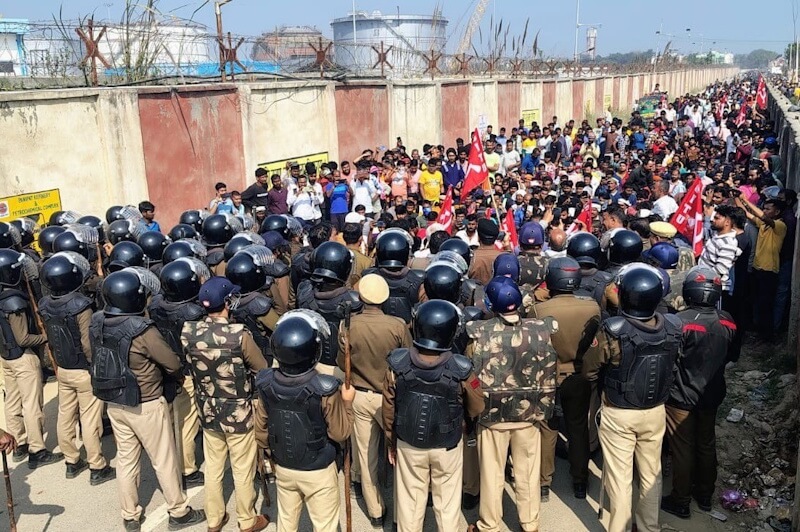
On the morning of February 23, protesters gathered outside Gate 4; by late morning, they had blocked it completely. Says Sunil Kumar, a helper, “Thousands of us sat on the road, raised slogans, and demanded that the management meet us.” But clashes[9] between the protesters and the police soon erupted. News reports claimed that the workers threw stones damaging vehicles. Workers said this happened due to the provocative abuses allegedly hurled by the Haryana police and CISF personnel. Lathi-charge followed; several workers were injured and FIRs were filed against 2,500 of them.
More joined the protest the following day. On the morning of February 25, the management conceded to some demands but refused immediate revision of wages although it directed contractors to meet the workers’ demands. The company is streamlining the payment process so that salaries reflect by the 7th of a month, says an official. Then, negotiations between the protesting workers, IOCL, and Assistant Labour Commissioner began. The workers’ representatives held strong on the demand for revised wages. A verbal assurance by the company was the end of the strike. Many workers then left for home to celebrate Holi.
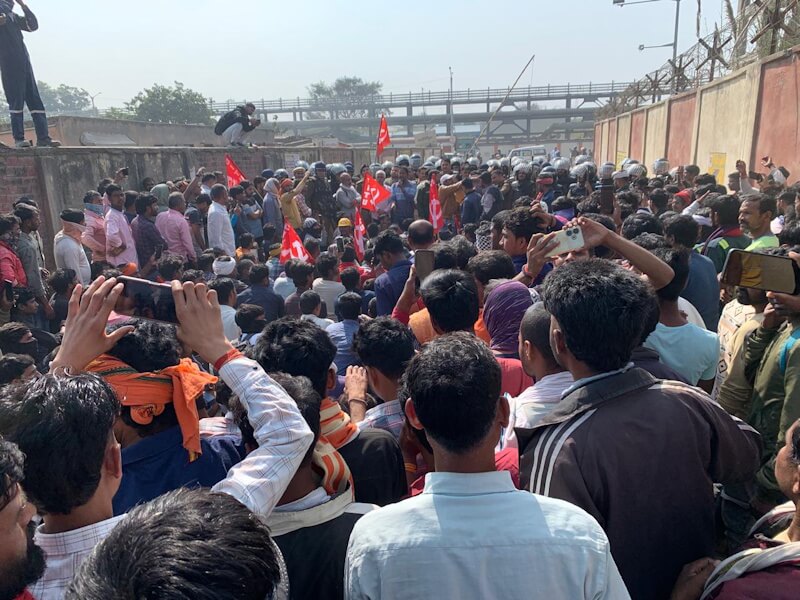
Photo: Mazdoor Adhikar Sangharsh Abhiyan
How a city determines wages
A key demand was that they be paid minimum wages according to a higher category than the one applied. This points to how urban classification governs wages. The refinery in Panipat, explains the IOCL representative, is classified as Category C based on Haryana’s industrial block categorisation which comprises industrially backward areas. However, workers and trade unions argue that this classification does not reflect the city’s reality and demand that Panipat is classified as Category B – comprising areas of ‘intermediate development’ – to improve wages.
“Our demand and that of workers is that Panipat is close to Delhi and, in effect, a part of the NCR which means it should not be Category C,” explains Shreya of the Centre for Struggling Trade Unions, “It should be placed in a higher wage category. The board wages announced by IOCL do not reflect the actual cost of living in Panipat and there have been no revisions for years.” Working overtime without pay also angered workers which the IOCL official said was incorrect. “The reality is that their basic salary is Rs 14,000 but they get a lump sum of Rs 21,000 which includes overtime. Many workers think it is the wage for an 8-hour shift like in Delhi but, here, it’s Rs 14,000 for eight hours,” he says.
Violations and issues pile up
The Building and Other Construction Workers (Regulation of Employment and Conditions of Service) Act, 1996,[10] mandates that it is the responsibility of the employer to provide drinking water, bathroom facilities, accommodation free of charge, and canteen. The workers say these are not suitably provided. Their angst comes also from the contractualisation of work which allows employers to shift the responsibility to contractors.[11] The Contract Labour (Regulation and Abolition) Act of 1970[12] stipulates for the abolition of contractual work if the work is of a perennial nature.
“This is the state everywhere; it’s a long-standing contradiction,” remarks Shreya. Adds Somnath, associated with the Mazdoor Adhikar Sangharsh Abhiyan, Thekedaari toh bandh honi chahiye. Thekedaari ka matlab hain mazdooro ke shoshan ki matra ko badhna” (Contract work should be abolished. It only means more exploitation for workers).” The Panipat protests must be seen in the context of the weakening labour laws in the country, notes Akash Bhattacharya, historian and trade unionist affiliated with All India Central Council of Trade Unions.
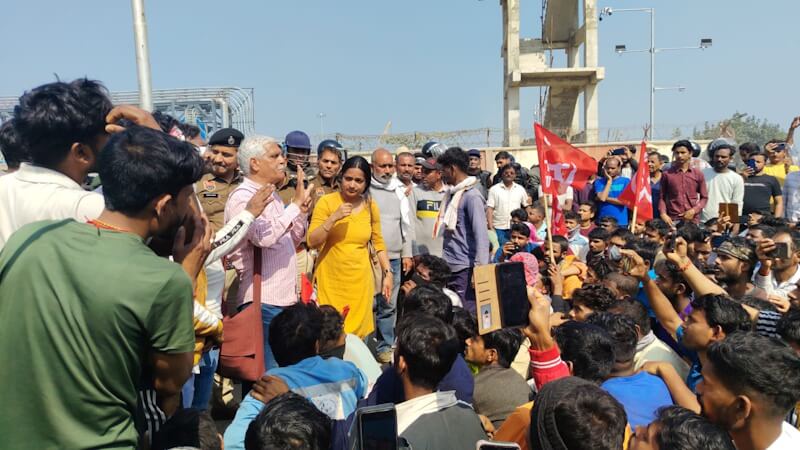
Photo: Mazdoor Adhikar Sangharsh Abhiyan (MASA)
On November 21 last year, the Union government notified the new labour codes including on wages, industrial relations, social security, and the entire gamut of occupational safety, health and working conditions. These will become operational by April 1.[13] Major trade unions strongly opposed[14] this – ten of them called for a general strike in February – on the grounds that they make it easier for employers to hire and fire workers, and dilute long-standing safeguards. “It is important to note that the labour codes effectively normalise practices that were earlier illegal. What we are seeing now is the result of long-term resentment among workers from repeated violations of even earlier labour laws,” says Bhattacharya.
Workers rekindle movement
The long-term resentment against exploitative working conditions worsened by the dissolution of the old labour laws that offered some protection explains recent protests. In Odisha, Barauni, Surat, and Singrauli (on March 13, the death of a worker in an Adani power plant[15] triggered large-scale protests that led to a fire), the pattern has followed — immediate triggering events bringing underlying grievances to the fore. Bhattacharya says this moment carries a certain sense of possibility in the arc of workers’ struggles. “They are looking to coordinate with various state unions and national level organisations to build something,” he says. The possible privatisation of IOCL[16] has also raised red flags.
Panipat is not merely one incident; it is a part of a pattern. It lies barely 140 kilometres from Manesar where the Maruti Suzuki workers’ movement[17] more than a decade ago stunned the nation. Bhattacharya says the spatial conditions in Panipat are more challenging than in Manesar.
“The IOCL refinery is a bit isolated; it is more difficult to organise. Local contractors and mafia have great sway in the area, making it harder for unions. In Manesar, the 2006 strike in Honda (Gurgaon) impacted surrounding industries, and the Manesar strike in Maruti Suzuki inspired further action by workers in the area. Solidarity of workers from other industries in Gurgaon-Manesar helped sustain both strikes, as Advocate Nandita Haksar notes in her books,” he adds.
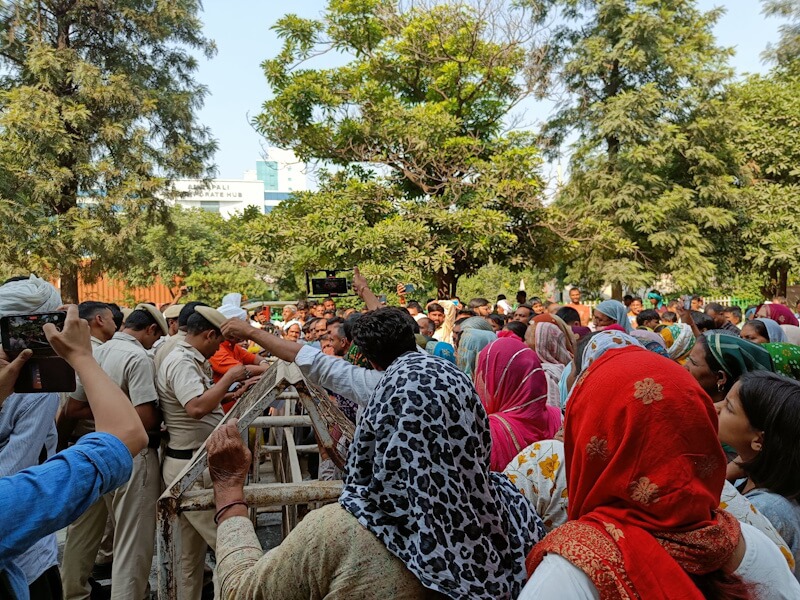
Photo: Ankita Dhar Karmakar
After the Panipat protest, there appears an effort by several unions to build a broader coordination between the workers and unions. This could renew union-based activity in a sector where unionisation has long remained weak, Bhattacharya adds, “This is a real opportunity to revive plant-level unionism in North India”. The workers are hopeful too. Manish Kumar, a rigger in the Panipat refinery who protested, says the workers will strike again if wages are not revised by May. “We will also make a union,” he signs off.
Ankita Dhar Karmakar, Multimedia Journalist and Social Media in-charge in Question of Cities, has reported and written at the intersection of gender, cities, and human rights, among other themes. Her work has been featured in several digital publications, national and international. She is the recipient of the 4th South Asia Laadli Media & Advertising Award For Gender Sensitivity and the 14th Laadli Media & Advertising Award For Gender Sensitivity. She holds a Master’s degree in English Literature from Ambedkar University, New Delhi
Cover photo: Contractual construction workers protesting for higher wages and basic facilities within the Panipat refinery. Photo: Mazdoor Adhikar Sangharsh Abhiyan (MASA)