
When light, shadow, and texture work in rhythm, people navigate with ease rather than anxiety. This paper examines the role of lighting in shaping psychological wellness and civic experience in urban environments. Drawing from insights shared at LEDucation 2025[1], AWA Lighting Designers (AWA)[2], highlight the growing issue of cognitive dissonance caused by fragmented lighting systems, uncoordinated shadows, and excessive illumination in dense cities such as Mumbai and New York.
Cognitive dissonance[3], a state of mental strain arising from conflicting stimuli, manifests in urban lighting[4] through erratic shadows, clashing colour temperatures, and visual overload. These conditions undermine spatial legibility, elevate stress, and reduce the inclusivity of public space.
We explore shadow mechanics, particularly the interplay of umbra and penumbra, and demonstrate how their disruption generates perceptual ambiguity. Case studies of Mumbai’s under-planned lighting landscape and New York’s over-lit complexity underscore the spectrum of dissonance in contemporary cities. To address these challenges, we propose the ‘Our Civic Intent’ framework, emphasizing lighting as ethical infrastructure that fosters coherence, equity, and cultural resonance.
Strategies include directional lighting, harmonised colour palettes, and parametric design that spans scales from city-level planning to spectral wavelengths. The paper concludes by proposing lighting hubs for Mumbai, advancing emotionally intelligent, context-sensitive masterplans that restore legibility, dignity, and psychological ease to urban life.
Cognitive dissonance as a design flaw
Cognitive dissonance occurs when an individual is exposed to conflicting stimuli that the brain struggles to reconcile. In lighting, it manifests through erratic shadows, clashing colour temperatures, and glaring inconsistencies in direction and intensity. The nervous system depends on continuity and stability; when these are disrupted, people experience subtle but constant strain, turning everyday navigation into low-grade mental challenges. This compounding effect leaves people unsettled, fatigued, and overstimulated, often without consciously realising why.
Shadow mechanics: Umbra and penumbra
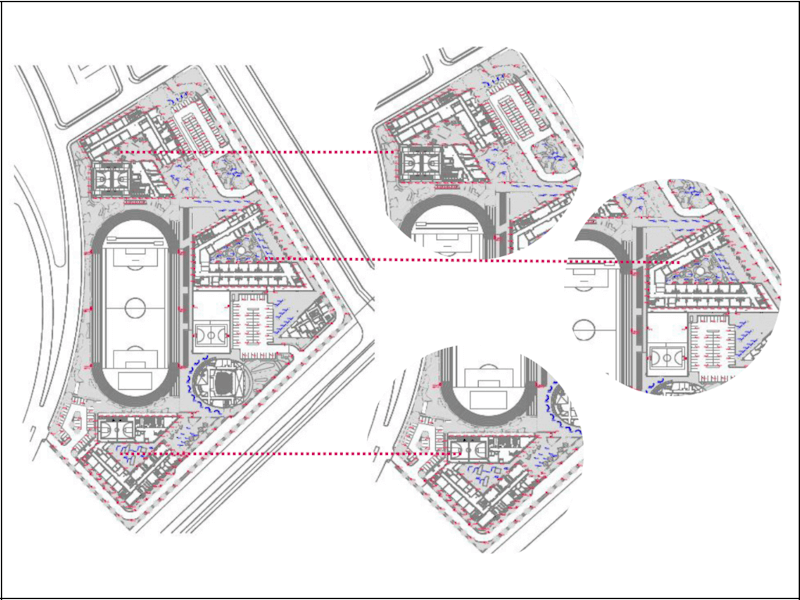
A major source of visual confusion in cities stems from mishandling shadows; particularly the neglected interplay between umbra (full shadow) and penumbra (partial shadow). In optical terms, the umbra is the zone of complete shadow where direct light is fully obstructed, while the penumbra represents the gradient where only part of a light source is obscured. When transitions between the two are blurred or disrupted, surfaces lose contrast, depth perception weakens, and the visual field flattens. This creates perceptual ambiguity, forcing the brain into constant overdrive to decode depth and motion. Over time, the result is chronic cognitive dissonance: quiet, persistent stress that leaves individuals uneasy and mentally fatigued.
By restoring clarity to shadow behaviour, respecting the distinct yet connected roles of umbra and penumbra, designers can reduce perceptual fog. The objective is not hyper-real sharpness but visual balance: depth should be discernible, textures legible, and the city comprehensible.
Case studies: Mumbai and New York
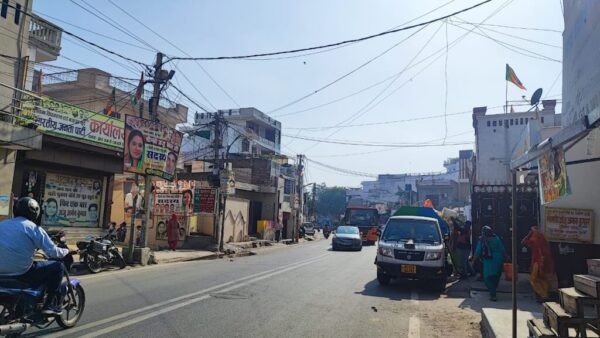
Mumbai lacks a nighttime masterplan, resulting in disjointed lighting. Informal settlements and markets often add lighting as an afterthought, producing unpredictable spill light. Shopfronts and signage compete visually, and uneven pavements reflect light in complex ways, multiplying shadows. For pedestrians, especially the elderly or neurodivergent, this creates anxiety, disorientation, and even physical danger.
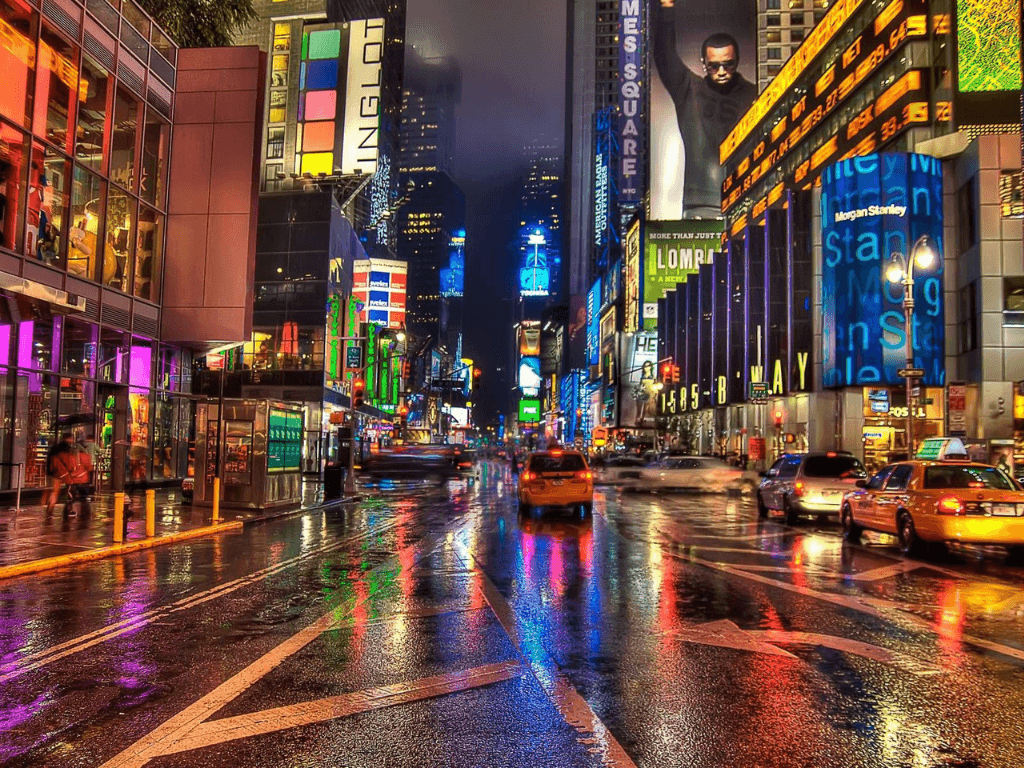
New York, despite robust infrastructure, demonstrates over-illumination.[5] In Midtown Manhattan and Brooklyn, overlapping storefronts, billboards, and vehicle lights create overload. Colour temperatures vary drastically, and reflections multiply on glass and metal. Instead of clarifying, excess light flattens cues and increases glare, diminishing depth perception. This is not a matter of infrastructure but of cognitive design.
Civic intent in urban lighting
AWA’s ‘Our Civic Intent’ framework treats lighting as ethical infrastructure—a civic gesture aligned with cultural rhythms, geography, and public memory. Projects begin with observation of human activity such as walking, waiting, gathering, pausing. Instead of spectacle, the aim is calm, legible environments. Colour palettes are harmonised, luminaires shielded, and shadows carefully studied. When light, shadow, and texture work in rhythm, people navigate with ease rather than anxiety.
Strategies for reducing cognitive load
- Utilise directional lighting that mimics natural shadow behavior.
- Employ shielding and precise luminaire aiming to prevent uncontrolled overlaps.
- Harmonise colour temperature palettes within zones.
- Avoid equating brightness with safety; over-illumination impairs clarity.
- Align lighting systems with daily and seasonal rhythms of public life. These strategies prioritise empathy and spatial dignity over technical excess.
Towards a lighting masterplan for Mumbai
Mumbai’s current lighting environment is fragmented, shaped by disparate stakeholders. A formal masterplan could coordinate luminance levels, shadow logic, and zoning transitions, while integrating neuroscience, public health, accessibility, and design. Such a framework would foster legibility, consistency, and psychological ease.
Scale in parametric lighting design
Lighting operates across an extraordinary spectrum of scale. At the urban level (~10^5 m²), masterplans shape community interactions. At the micro level (~10⁻⁹ m), light is defined by its wavelength, with variations influencing perception and wellness. Parametric design bridges these scales, linking city-wide interventions with fixture and spectral precision.
For example, mounting heights may follow modular multiples (±150 mm, +450 mm, +900 mm, +4500 mm, +6750 mm, +9000 mm), while spectral qualities are tuned for circadian and perceptual needs. This continuum aligns environmental design with human cognition, minimizing dissonance.
Lighting hubs for Mumbai
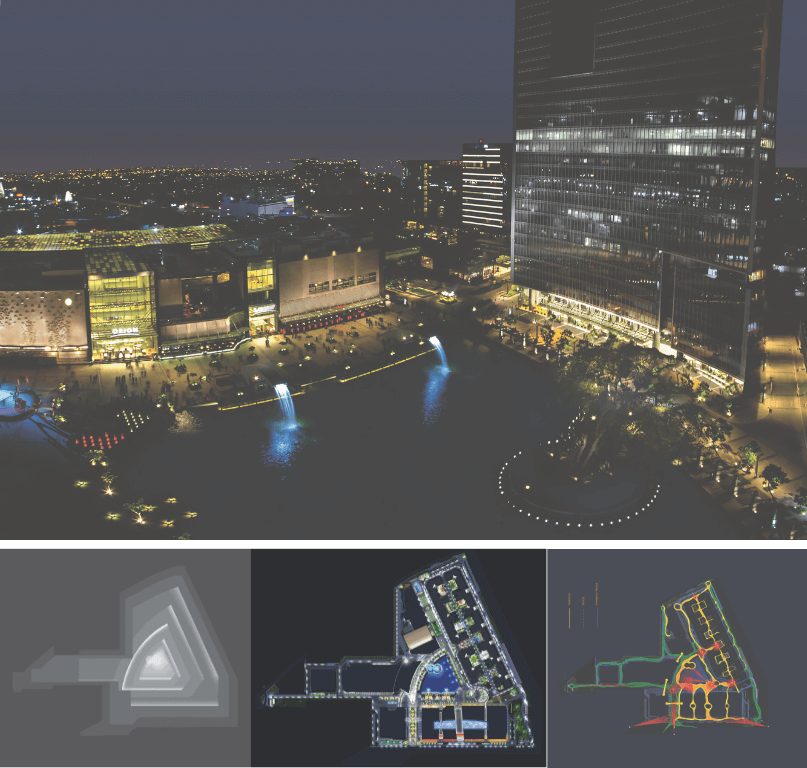
In rapidly densifying cities like Mumbai, lighting hubs; strategically designed nodes of illumination; enhance safety, legibility, and cultural resonance. They act as shared living rooms where commerce, culture, and community converge.
The direct benefits:
- Commerce: Extends nighttime economies.
- Civic pride: Reinforces cultural and social identity.
- People interaction: Encourages gathering and exchange.
- Wellbeing: Supports circadian health and reduces stress.
- Safety & security: Provides inclusive, human-scale illumination.
The principles of implementation:
- Map pedestrian and transit flows.
- Highlight culturally significant spaces.
- Design for neurodiversity, minimizing glare
- Employ adaptive, energy-efficient systems.
Parametric scaling:
- City Scale (~10^5 m²): zones anchoring wayfinding.
- Neighborhood Scale (~10^3 m²): plazas, markets, transit hubs.
- Detail Scale (~10⁻⁹ m): spectral tuning of light for perception and mood.
Light as a tool for urban wellness
AWA redefines lighting as an instrument of wellness and dignity. Public spaces that overwhelm or disorient are not truly public. When dissonance is eliminated, people regain presence—moving naturally rather than “solving” their environment. Properly tuned lighting supports memory, orientation, and belonging.
Path forward
As urban life grows more complex, lighting must become emotionally intelligent. AWA’s philosophy demonstrates how light can honour cultural memory, respect neurodiversity, and enrich the urban commons.
- Collaborative engagement: Work with municipalities and communities to embed emotionally intelligent lighting.
- Research and advocacy: Advance interdisciplinary studies on wellness, neurodiversity, and cultural memory.
References & Citation
1. Wadhwa, Abhay. LEDucation 2025 Talk. AWA Lighting Designers, 2025. AWA Lighting Designers. Our Civic Intent. AWA Blog, 2024.
Abhay M Wadhwa is Founder and Design Principal of AWA Lighting Designers, New York. He has led more than 900 projects across 25 countries, spanning infrastructure, healthcare, hospitality, and sacred spaces. A designer, inventor, and cultural thinker who bridges science and design to create environments that heal and transform, his design approach moves beyond utility to shape the spatial and cognitive futures of places and people. Working with light, colour, sound, and silence, he builds sensory ecologies aligned to human healing and performance. He is the founder of SOULSARA, the world’s first ‘DigiCal’ mental health ecosystem; the author of Contextualizing Light: Lighting Design Solutions in a Changing World; and has lectured on five continents.
Cover photo: New York City
Ref- 382240-new-york-city-street-wallpaper.jpg (1920×1200)
New York City Streets at Night Wallpapers – 4k, HD New York City Streets at Night Backgrounds on WallpaperBat
Photos: AWA Lighting Designers