
In North-west Delhi’s Sultanpuri’s Labour Colony, every summer Anita Devi, a home-based worker who stitches parts of shoes together for Rs 50 paisa per 10 pieces, struggles to work inside her house. In the unforgiving heat of Delhi, when temperatures cross 45 degrees Celsius, her home that doubles as her workplace becomes an unbearable oven. “It is hard to do any work then, be it cooking, taking care of the children, or stitching shoes,” says Devi. Sleep too eludes her, as the rooms continue to remain hot long after the sun has set. “We only get to sleep in the early hours of the morning, and by that time it is time to send out kids to school,” she adds.
India’s struggle with rising temperatures has only intensified[1] in recent years, hurting millions of the marginalised like Anita Devi the most. Heatwaves are arriving earlier,[2] they last longer and are spreading into regions once considered moderate. Extreme heat has become a national stressor that affects all aspects of human lives, be it health,[3] work,[4] food production, energy use, and the environment. This has also pushed several vulnerable communities across the country into repeated cycles of crisis — prolonged heat limits outdoor work, cuts household income and overwhelms clinics already short on staff and resources.
As data shows, Asia[5] continues to carry a heavy share of global heat impacts, with the region accounting for nearly half of heat-related deaths between 2000 and 2019. India is among the worst affected, with more than a billion[6] people exposed to heatwaves each year. In 2024, the country recorded its longest[7] stretch of extreme heat since 2010, with many states crossing 40 degrees Celsius day after day for weeks, with more than 44,000[8] cases of reported heatstrokes. Urban megacities like Delhi are among the hardest hit – and its marginalised the most.
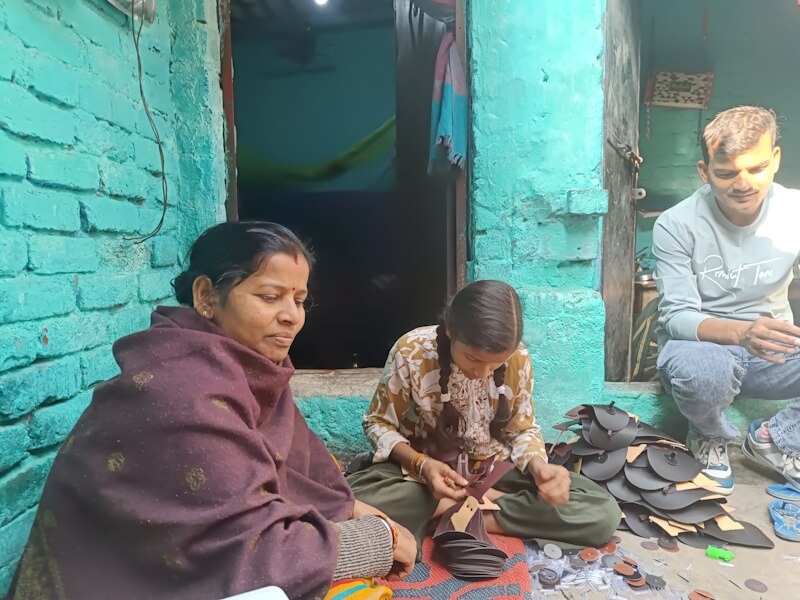
Photo: Ankita Dhar Karmakar
As heat becomes unbearable, more people in India who can afford coolers and air conditioners are rushing to buy them – in fact, data shows that in 2024 alone, India bought[9] 14 million ACs, much to the peril of its environment. Not only this, by 2050, India will have more than 1 billion ACs in operation, according to a report[10] by the International Energy Agency. However, for residents of Sultanpuri and an estimated two million in Delhi’s nearly 700 slums, buying ACs is a luxury, restricting their cooling solutions to coolers and fans.
But when the team of cBalance Solutions, an organisation working on affordable and community-driven cooling solutions, in collaboration with SEEDS, arrived in July of this year, and suggested that something as ordinary as water-filled plastic bottles could help cool their homes, many were sceptical. It seemed too simple to work. Yet within months, the results proved otherwise –- showing the temperature inside almost seven degrees Celsius lower than the outside. This is not an urban design solution but one to beat the oppressive design that the poor are forced into.
A dense settlement
Sultanpuri, a resettlement colony in Northwest Delhi came up in the 1970s, is marked by tightly packed buildings and dense occupation. Within it, the Labour Colony around the small-scale industries has made it a working-class neighbourhood. This can be traced back to the 1950s, with the setting up of the Bhalla Factory which fabricated and manufactured parts for railway trains and gas cylinders, says Vicky Gupta, a resident.
Migrants, mostly from Uttar Pradesh and Bihar, came in search of work here, and it turned into a dense settlement by the 1960s. The factory shut in the 1980s but other smaller factories had come up. The settlement gradually became home to people doing different kinds of informal labour, which is how the name came to be Labour Colony.
Walls here are mostly of unplastered brick and roofs are typically made of asbestos cement sheets, stone slabs, or tin. Ventilation is limited as narrow lanes restrict airflow and most houses share walls. This creates a heat trap[11] where the roof becomes the primary entry point for heat. During summers, these heat through the roofs make it difficult for residents to stay indoors. “We try to seek shade under trees as much as possible during summers,” shares Sahnaaj, a resident.
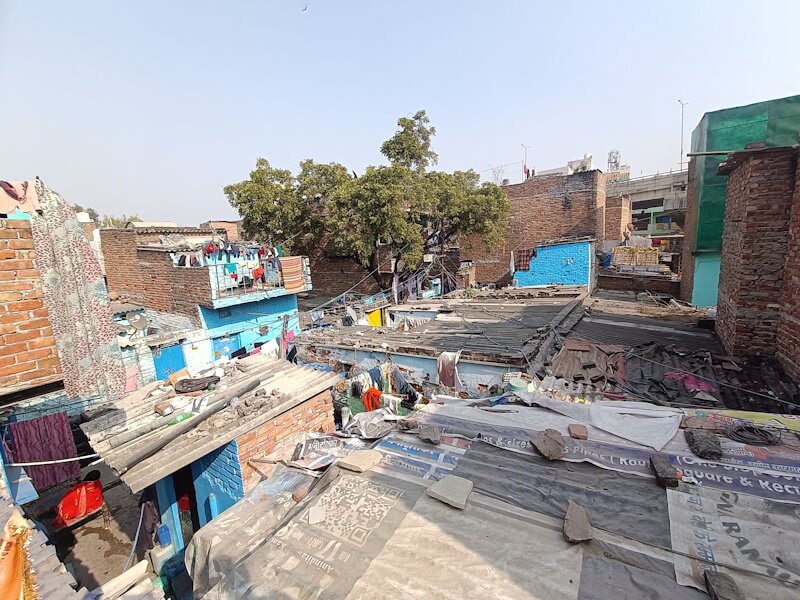
Photo: Ankita Dhar Karmakar
cBalance, which has been working on cooling solutions since 2012 and has made interventions in informal housing across Pune, Bangalore, Mumbai and Delhi’s Bhalswa landfill, expanded its work to Sultanpuri in July 2025. Current designs, their team found, are not suitable to beat the heat — asbestos cement sheets, stone slabs trap heat through the day, turning the rooms into hot boxes.
How can cooling, in such conditions, be made accessible to those who cannot afford energy-intensive solutions, was the starting point for the interventionists. Their pilots in other cities had shown that small design changes in roofs, walls, and ventilation could significantly lower indoor temperature but most cooling technologies relied on electricity, required specialised installation, or were out of reach for informal settlements. Vivek Gilani, who founded cBalance Solutions, describes this as basic design injustice. “Cooling reaches those who have the means but the people who are hit the hardest are excluded from it,” he said to Question of Cities.
“All this brouhaha about sustainable design in India and the millions of dollars coming in from aid agencies and philanthropy is serving only about 10 percent of India’s buildings because only that share is formal architecture. Most of India’s buildings and housing, self-built, happen to be informal. These receive almost no attention, especially the vulnerability to and protection from rising heat where air conditioning is not an option,” added Gilani.
The solutions
Almost every home in the Labour Colony shares its walls with neighbours which leaves the roof as the main pathway for heat. During peak summer, roof temperatures in many houses rise to levels that are 7 to 8 degrees Celsius higher than the outside. Several residents spoke of afternoons when the ceiling was “too hot to touch” and nights when indoor heat lingered long after the sun had set.
“That is why our intervention area is the roof,” says Kirti Makhija, Project Associate with cBalance. “If we could slow down the heat transfer there, residents would feel a real difference.” Low-cost prototypes that transferred heat and could be adapted to different types of roofs were preferred. The team offered five solutions to 13 homes, each through discussions with the residents. Three houses received biomass panels, made from agricultural waste foam-based material lined with a layer of multi-layer plastic made out of plastic wrappers. Geeta Devi’s house has this. She says it has provided some respite: “Kuch rahat mila hain”.
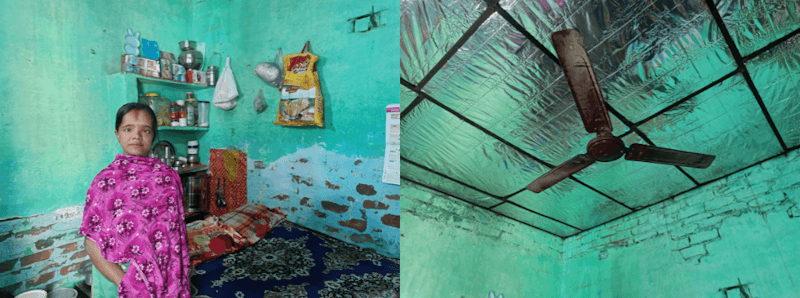
Photo: Ankita Dhar Karmakar
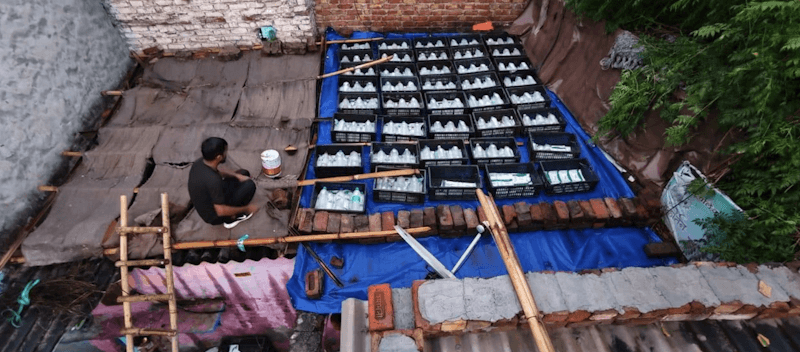
Photo: cBalance Solutions
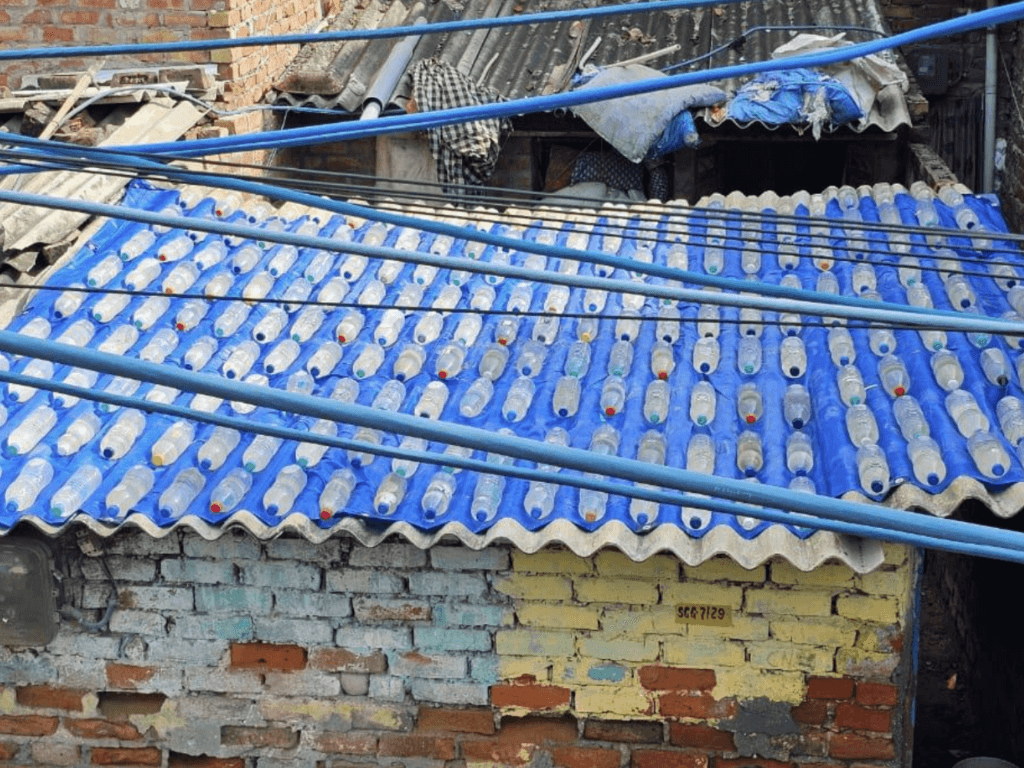
Three houses installed a system of water-filled PET bottles which were tightly sealed, cleaned, packed into plastic crates, and placed as a layer over the roof. “Water has a very high specific heat capacity, so it absorbs heat slowly,” explains Kirti, “It delays heat entering the home.” Sahnaaj, whose house has PET bottles on the roof, says, “The room now feels much cooler than before.”
One of the key lessons that the team learned is that the water must be clean to avoid microorganisms developing, the bottles must be fully filled, and they must be sealed well. Their research shows that evaporation in these bottles is minimal because the plastic slows it down. However, with time, there are chances that the water level may drop. “PET bottles are the most affordable and accessible option, and it allows residents to climb up and refill the bottles whenever needed,” says Kirti. In Pune, when they first installed this in Shindevasti in 2021-2022, it is still on. In Bhalswa too, the bottles are still there. The use of so much plastic does raise eyebrows but residents would do anything to cool down their homes.
Six houses opted for a layer of dynamic barrier made of multi-layer plastic and Silpaulin sheet: two versions of it, one is a ‘Space Frame’ installed in over the roof of three houses and another is the ‘Internal Dynamic Barrier’ installed in under the roof of other three houses. These act as insulating layer, which is to be closed during day and opened during night to access the phenomena of Night Sky Radiation. Preeti (goes by first name), a home-based worker, has this system on her roof and says it has provided her some respite from the heat.
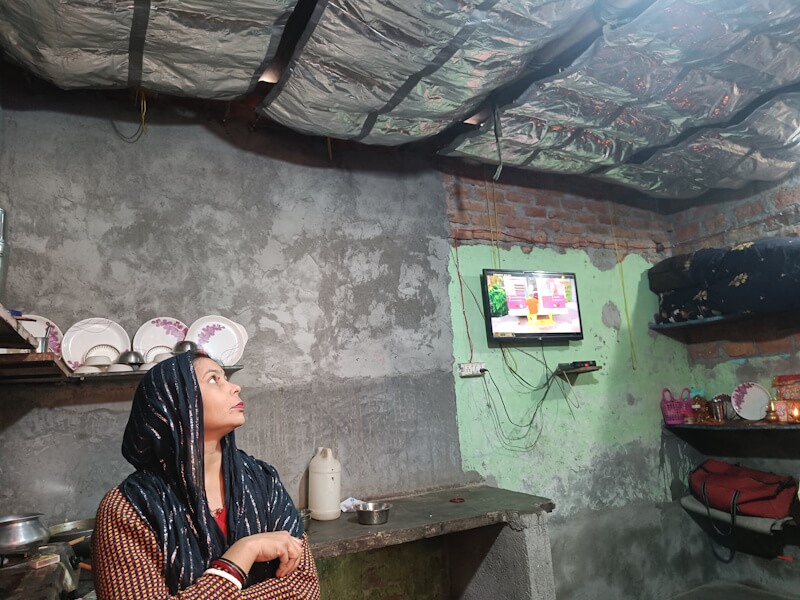
Photo: Ankita Dhar Karmakar
At Anita Devi’s house, the team introduced a small rooftop garden based on the idea of creating a natural insulation layer through soil, plants and moisture. The greenery cuts direct heat on the roof and slows down heat. Devi says this has brought a noticeable difference and the rooms feel more comfortable than before.
The results
Installed in August-September, indoor temperatures in several homes dropped by two to almost seven degrees compared to the exterior roof surface. To map this precisely, the team compared the indoor environment in houses with interventions versus those without. They used mean radiant temperatures (MRT) which captures the heat emitted by surrounding surfaces.
The difference ranged from 3.6 degrees Celsius to 6.6 degrees Celsius, depending on the solution. Most of the interventions produced a reduction of about 5.2 degrees Celsius. Simply put, these cooling solutions made a noticeable difference to most people living in these houses.
However, not all residents feel these solutions have mitigated heat. Poonam Devi shares that she feels there has been no change at all. “You can see how scorching the heat is even in this winter, during summers it’s worse. No amount of intervention saves us from this heat. Perhaps, using ACs might solve the problem,” she says. Residents also shared that since these solutions were installed almost at the end of summer, they will know its true worth only in the coming summers.
A policy gap
India’s existing heat action plans barely acknowledge[12] the realities of informal workers who mostly live in such dense, informal settlements. Ironically, these are the groups that are most impacted by rising heat hazards.
“Heat action plans mention vulnerable groups like the homeless or gig workers, but there are no real solutions, let alone long-term ones,” shares Kirti, “Most plans focus on government or high-rise buildings, with measures such as solar reflective paints known as cool roofs, but nothing on how homes in dense settlements such as these should be built while temperatures constantly rise. Architects are not involved at all, even though they have the appropriate skills to help.”
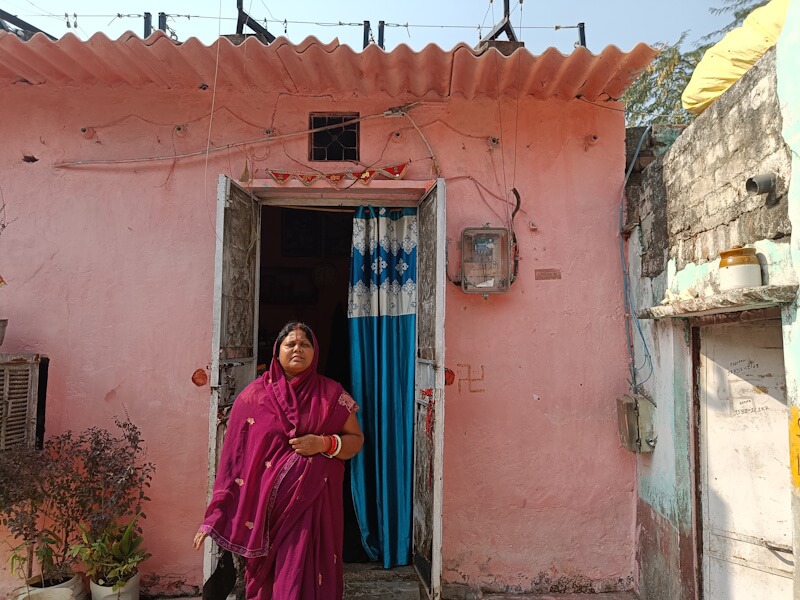
Photo: Ankita Dhar Karmakar
The interventions in Sultanpuri, with some exceptions like Poonam Devi, show the possibilities of cooling individual homes but they also reveal a large gap in how cities draft policies to mitigate heat. So what should be the way forward? Adequately spaced out tenements, use of cooling material, and neighbourhood open and green spaces can help cool such neighbourhoods. This is where policy and rules can make a difference.
“Rehabilitating entire settlements into high-rise towers is not the answer, because their lives and livelihoods are so different from ours,” says Kirti. What cities need then, she argues, is an urban design approach that prioritises improving what already exists. “Retrofitting has to become a core part of planning. We can redesign and strengthen the homes people live in without demolishing them. The question is how to make them better, not replace them.”
Till plans and policies address the extreme heat in slums clusters like Sultanpuri’s Labour Colony, residents will have to reach for design interventions – anything is better than the oppressive heat.
Ankita Dhar Karmakar, Multimedia Journalist and Social Media in-charge in Question of Cities, has reported and written at the intersection of gender, cities, and human rights, among other themes. Her work has been featured in several digital publications, national and international. She is the recipient of the 4th South Asia Laadli Media & Advertising Award For Gender Sensitivity and the 14th Laadli Media & Advertising Award For Gender Sensitivity. She holds a Master’s degree in English Literature from Ambedkar University, New Delhi.
Cover Photo: cBalance Solutions