
“…one of the most urgent problems in planning and architectural theory today is the need to develop a different social imagination – one that is not modernist but that nevertheless reinvents modernism’s activist commitments to the invention of society and the construction of the state.”
These words by anthropologist James Holston in Spaces of Insurgent Citizenship, penned in 2008, seem more urgent today as cities are re-created by private capital and governments, leaving little space for people-government dialogue, social imagination, rights and justice, and ecological sustainability. The need to return to collectively engaging with city-making, to renew the social-cultural-political imagination of a city, is critical if the future city has to hold all its people and nature in balance without sacrificing them at the altar of private profit.
Whose imagination should this be? The people’s, of course, but which people are heard – a few exclusive or many diverse voices – makes all the difference. The imagination of the exclusive set cannot be public imagination, prevailing over how a city is made. If the diverse masses have to articulate their imagination, where would this be discussed, argued, and recalibrated? In the public spaces of a city – on its streets, in its squares, in public transport, in open spaces and parks, on factory floors, in campuses and college rooms, in auditoriums, in community halls, in marginalised settlements, and in every home. Outdoors or indoors, anywhere that people can gather in small and large numbers to participate in a rally or a protest, connect across divides, challenge authoritarian powers-that-be, and openly dissent or disobey authoritarian orders and clampdowns.
Resistance and protests are intrinsic parts of city-making, especially democratic city-making and participatory urbanism. These test the character of a city, contest the dominant ideology, and confront the axis of power of elected governments and private capital. In the imagination of the industrial and tech-financial worlds, cities are still engines of growth without answering ‘growth for whom’ or ‘how the growth will benefit everyone’. In the imagination of the masses, cities are more than economic engines, or profit-making enterprises of real estate and free market. Cities are home, where their lives unfold, where they can ideally form communities without old rural rigidities, and rally together.
In that tension and negotiation between the opposing imaginations, lies the possibility of a new urban vision of a just city. Debates and protests are central to city-making. The culture of collectivisation, resistance and protest is inherent in a city, not merely the culture of accumulation and profit. India’s cities have been no exceptions to this.
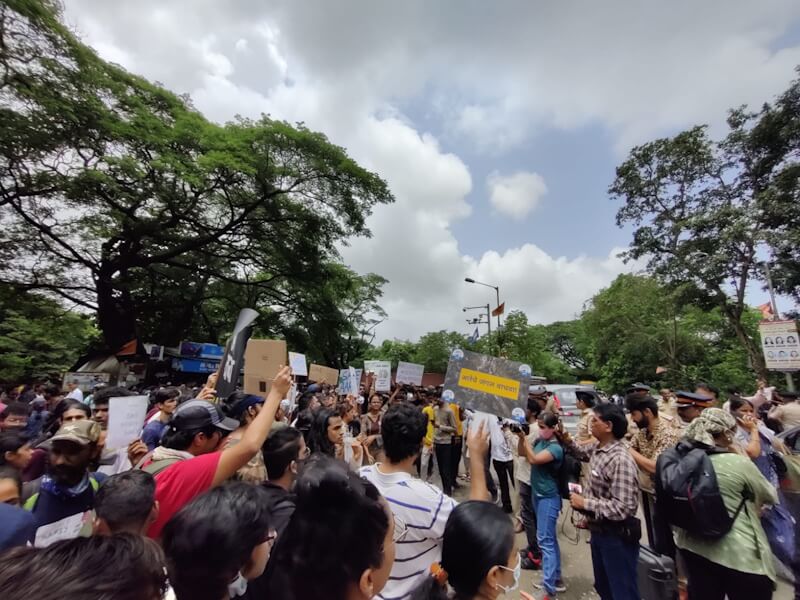
Photo: QoC File
Protests thinning out?
Against the colonial powers, ruthless capitalists, and heartless governments, protests and rallies have been the constant refrain for decades from Mumbai and Delhi to Jaipur, Kolkata, Chennai, Dehradun and more. But, in the New India, where are the protests and the protest spaces? They seem to be thinning out, compared to the massive protests that shook governments in the 1970-80-90s. People gathering in numbers to claim their rights, to expand rights into lived realities, now seem few and far between. Protest spaces have become restrictive too.
In Mumbai, protestors were stopped from approaching Mantralaya, the seat of the government, years ago, then pushed back on the roads to Mantralaya, and eventually confined to only a corner of the historic Azad Maidan nearly three kilometres away. The containment happened on the orders of the Bombay High Court that the exclusive set had petitioned.[1] Delhi has seen restrictions too. India Gate, the site of the December 2012 Nirbhaya protests, has been unwelcome recently. Protestors agitating for clean air – a basic need and Right to Life – were summarily arrested last year.[2]
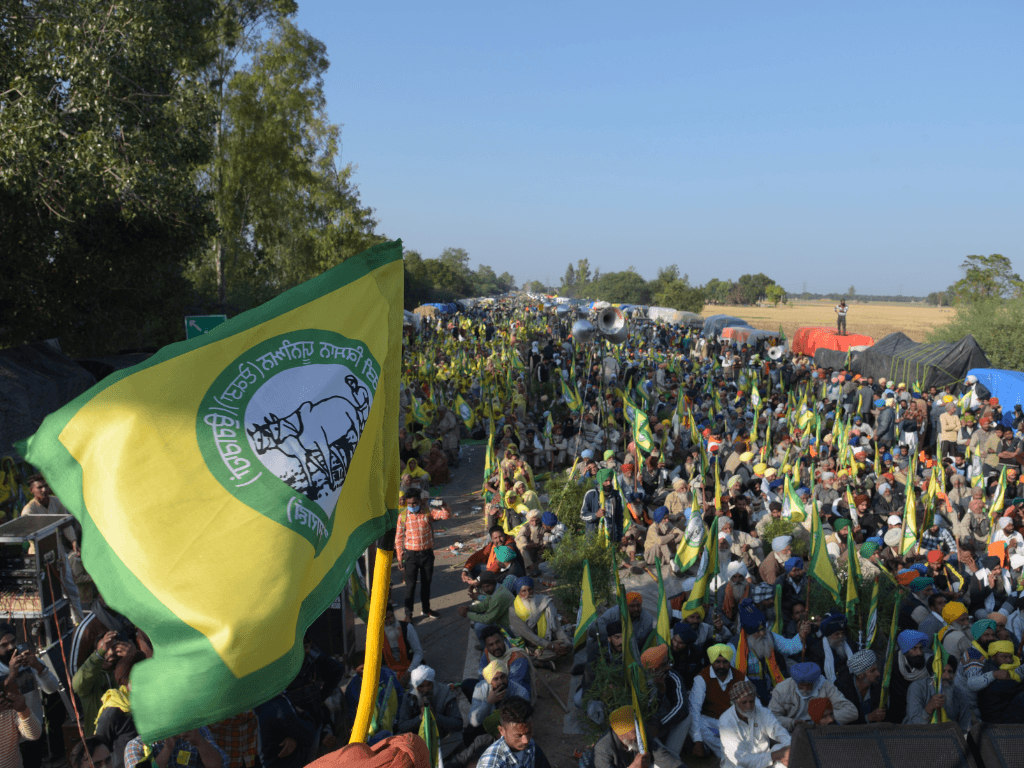
The increasingly dominant view, nurtured by the media, that protests and demonstrations are disruptive to daily life combined with the judiciary coming down hard on protestors that they must pay for damages[3] has strengthened the idea that protests are undesirable. Perhaps even noxious. The atmosphere assiduously built over the past decade is unforgiving of all protesters, especially in Delhi (farmers’ protests) but also in other cities.[4]
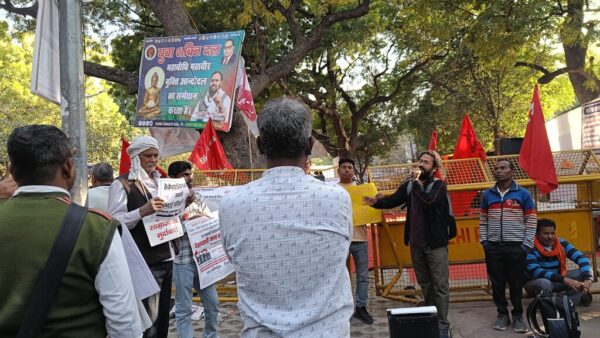
Yet, despite government crackdowns, hostile police actions, and harsh daily schedules, people have found it in themselves to convene and collectivise. Take out rallies and demonstrations to draw the government’s attention to crucial issues, using slogans and songs to highlight their causes. Price rise and inflation are among the ever-green issues that the working class rallies against; farm travails and the continuing agrarian crisis have brought thousands of farmers and farm labourers to cities to raise demands;[5] trade and labour unions have continued to organise workers on wages and, most recently, against the new labour codes;[6] environmentalists have joined forces to protest the wanton destruction of the ecology of cities for ‘development’; anti-caste activists have raised the flag against continued discrimination.
These have happened in cities across India. Protests have perhaps not thinned out; the perception has.
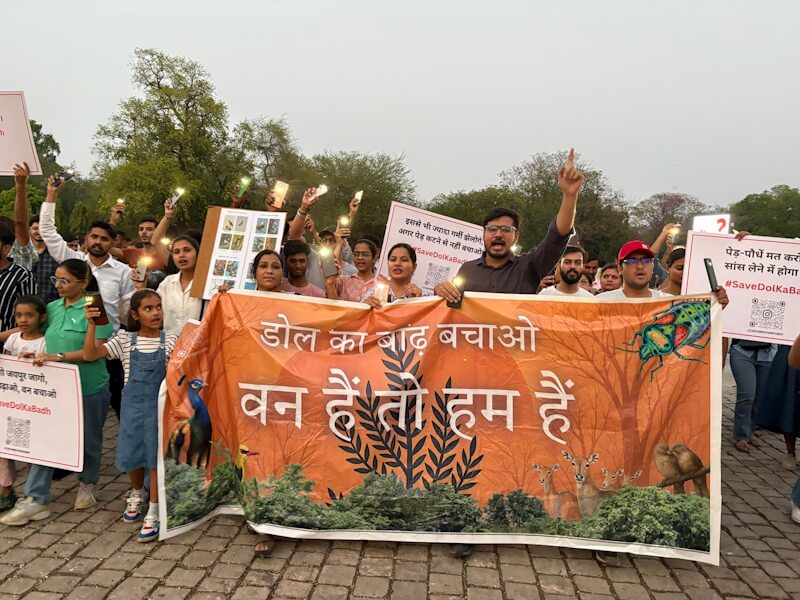
Photo: Save Dol ka Badh Collective
The framing matters
If the protests did not register on the national consciousness – except the farmers protest – it has to do with how they were framed and made visible, or invisibilised, by the mainstream media. Since protests, by their very character, are against the government of the day, the slavish and propagandist media deny them space or frame them negatively. The message is simple: Protests are objectionable, stay at home.
News of protests comes through digital and social media. Since these are algorithm-determined echo chambers, if users are not aware of an event, they are likely to remain so. A good example is the general strike on February 12 by a joint platform of ten central trade unions and federations of workers in different sectors to resist the new labour codes.[7] Thousands of workers rallied in many cities but the action hardly got media coverage. It did not help that only weeks before the Chief Justice of India, Justice Surya Kant, had remarked that trade unions were “largely responsible” for slowing down industrial growth, labelling them “jhanda unions”. It was a telling comment but not an exception.
From every institution of India’s democratic architecture, by the sheer might of power bolstered by the ever-expanding neoliberal mindset of the middle and upper-middle class, every form of protest – even silent marches and letters to the authorities – has been delegitimised. Protests are framed as unfashionable, even anti-national.[8] Pro-government voices and spokespersons of the ruling Bharatiya Janata Party have termed protests as “pollution of thought…of Marx and Mao,” drubbed protesters as “anti-development” and protests as “attempts to defame India.”[9] Never mind that the ruling party, before assuming power, relied on protests as legitimate public action against the then government.
Of course, protesters draw inspiration from the rich traditions of resistance in countries and cities around the world, traditions that are entwined with the ideology of the Left. But organisations of every ideology have used the language and grammar of protest to challenge power, to demand justice, and enforce rights. Protests, after all, have to do with democracy. As the late Howard Zinn, historian, author and activist put it poignantly: “Protest beyond the law is not a departure from democracy; it is absolutely essential to it.”
We are now being fed an imagination of democracy minus protests.
What keeps protesters going?
In the face of the pushback, protesters do what they have to do. Many stay the course in the confidence of a ‘better tomorrow’ while others are encouraged by small wins.
Across the world, protests were always for utopian futures, the archetypal ‘better tomorrow’. India’s iconic poet and lyricist Sahir Ludhianvi captured this in his lines “Jis subah ki khatir jug jug se, hum sab mar mar ke jite hain, Jis subah ke amrit ki dhun me hum zahar ke pyaale pite hain…Woh subah kabhi toh aayegi” in the eponymous film during the first flush of post-independence India in the 1950s. Those utopian futures may not have come to pass and stirring struggles by workers’ may have become fond memories but it’s not the end of protests. As the distinguished feminist historian Prof Uma Chakravarti reminds, in her film, “Voh subah hami se aayegi”.[10]
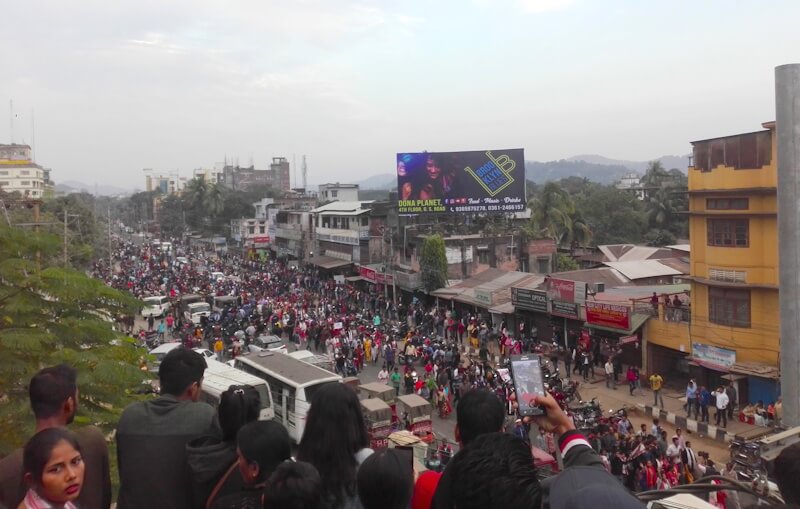
Photo: Wikimedia Commons
In industrial cities, like Manesar[11] and Panipat, workers have joined forces to demand their rights. In Thoothukudi, Tamil Nadu, the protests against Vedanta’s copper smelting plant have[12] continued for over 20 years highlighting the significant environmental damage, air pollution, and groundwater contamination. The company consistently denied these charges[13] but the protest peaked in May 2018 leading to police firing in which 13 protesters were killed.[14]
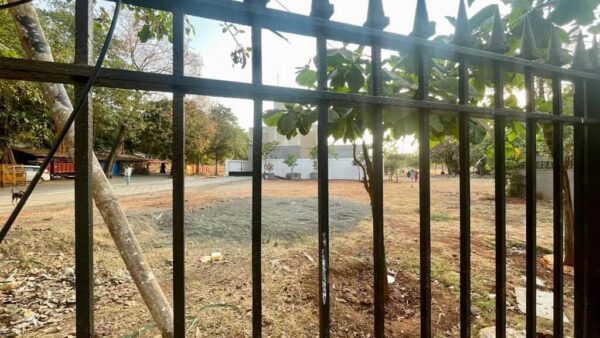
Cities across India have seen resistance on environmental issues – the midnight demonstrations at Mumbai’s Aarey[15] in 2019 against the hacking of 2,200 trees; hundreds of students and environmentalists against the felling of 400 trees as part of clearing the 400-acre forest land in Kancha Gachibowli[16] in Hyderabad; students and children protecting the Dol ka Badh forest in Jaipur;[17] residents of Pune[18] and Dehradun[19] rallying and demonstrating over the years against the proposed development projects at the cost of the hills that sustain the cities; the struggles against riverfront development projects or to protect wetlands.
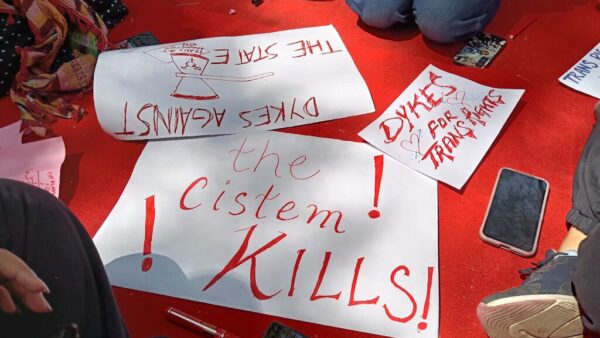
Who can forget the months-long protest by the women of Shaheen Bagh[20] against the Citizenship Amendment Act? Or thousands of students and others in a solidarity march in 2016 against the arrest of Kanhaiya Kumar, the then Students’ Union president of the Jawaharlal Nehru University, on sedition charges?[21] Or the protests this year against the University Grants Commission’s new guidelines,[22] protests in support of academic freedom in Ambedkar University,[23] and action by the Students Federation of India[24] against the Transgender Persons Amendment Bill this month?
Images of India’s international medal-winning wrestlers dragged on Delhi’s streets into police vans because they dared to protest – publicly at Jantar Mantar – in 2023 against the alleged sexual harassment by the then Wrestling Federation of India chief Brij Bhushan Sharan Singh linger in India’s collective memory.[25] Language or anti-Hindi imposition protests in Tamil Nadu[26], sanitation workers’ protests[27] in many cities, the demonstrations and rallies by ASHA workers[28] in several states including Kerala are some of the resistance actions in the past few years.
In Mumbai, the continuing protests against government-initiated projects in ecologically sensitive areas – two of the three eco-sensitive zones in the Sanjay Gandhi National Park[29] are slated to be opened for construction, two-thirds of the 60,000 mangroves across 103 hectares in the Versova-Bhayander stretch are being cut for the coastal road extension, the Mahalaxmi Racecourse will see massive construction for underground parking and overground recreation facilities[30] – have kept hopes alive. The Save Mangroves Movement began with a few individuals in February; it has expanded to include celebrities like Dia Mirza and Richa Chadha, the issue is now in the Supreme Court.[31]
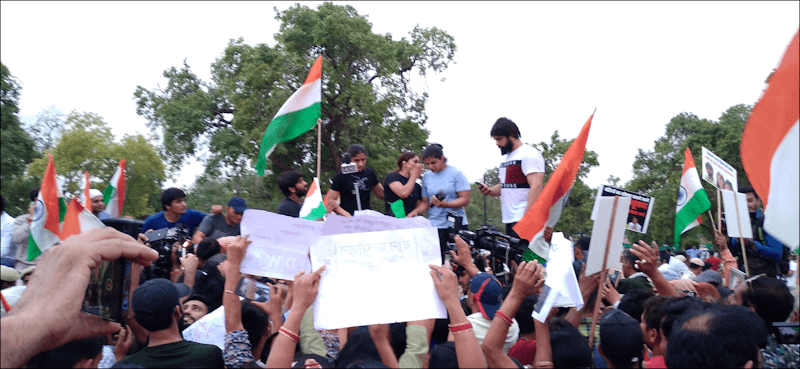
Photo: Wikimedia Commons
In each instance, the protesters knew what they were up against but took heart – and inspiration – from the faith that movements make a difference. Especially movements that also engage with the government, offer alternatives. As Holston remarked, even though nation-building projects have tried to displace the role of the cities as generators of social identity, “cities remain the strategic arena for the development of citizenship”. Resistance and protests find a home in cities.
The small wins matter. Mumbai’s Aarey protests, for example, may be framed as unsuccessful because the metro car shed was constructed there but the continuing vigil by protesters gathering every Sunday for nearly six years has meant that projects such as the zoo and tourist facilities are on the back burner.[32] The campaign to protect the mangroves has made the authorities take note.
The utopian futures that protesters once aimed for may seem distant; now, the purpose is a rollback of decisions by governments and private capital that threaten rights and the environment. From the ideological perspective of people’s struggles, this could be seen as diminished or limited. However, the alternative is to cede the ground entirely to the axis of power – the government and private capital – in city-making. The ability to plough on, including fight long and punishing battles in courts for rights and justice, must be admired. In the words of Elie Wiesel, the late human rights activist and author who survived Nazi concentration camps: “There may be times when we are powerless to prevent injustice, but there must never be a time when we fail to protest.”
There is a case for insurgent cities, even a network of protesting cities if that can be.
Smruti Koppikar is a Mumbai-based award-winning journalist, urban chronicler, and media educator. She has more than three decades experience in newsrooms in writing and editing capacities, she focussed on urban issues in the last decade while documenting cities in transition with Mumbai as her focus. She was a member of the group which worked to include gender in Mumbai’s Development Plan 2034 and is the Founder Editor of Question of Cities.
Cover photo: The farmer’s agitation in Delhi. Credits: Wikimedia Commons