
The Godavari does not disappear all at once—she withdraws quietly, slipping beneath layers of neglect until her absence is felt more than her presence is seen.
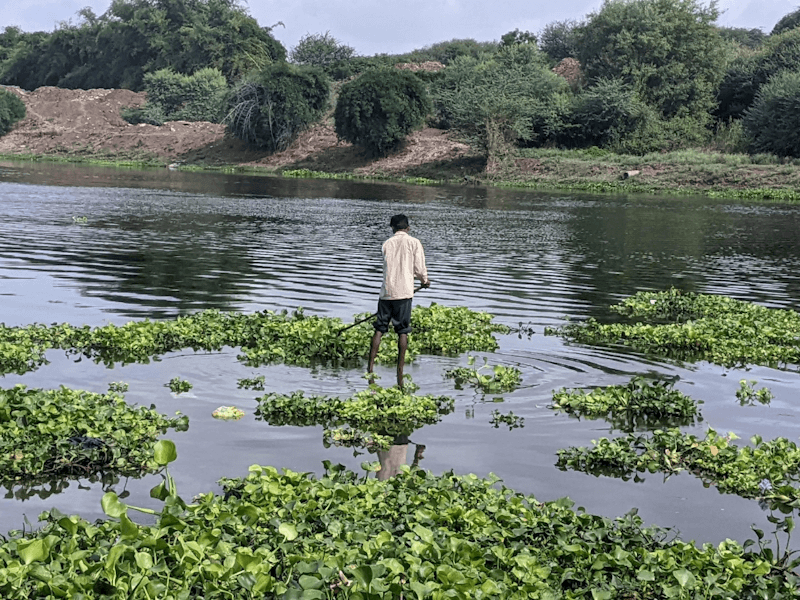
Photo: Shilpa Dahake
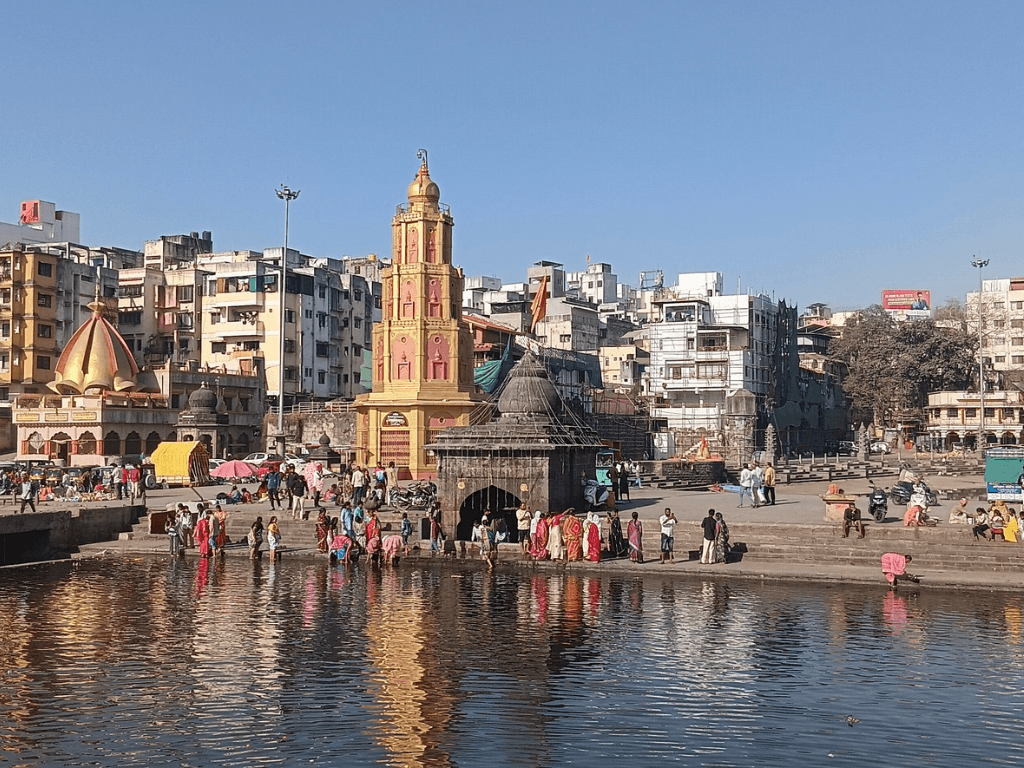
The Godavari River originates from the Brahmagiri mountains of the western ghats and plays a crucial role in Nashik’s sacred geography. It contributes significantly to the city’s status as a major pilgrimage site, one of the four centres of the Kumbh Mela cities in India. Every 12 years, during the Sinhastha or Kumbh Mela, the river transforms into a ritual landscape, as millions converge along its ghats.
The preparations for the Simhastha are not merely a logistical exercise, however massive they may be, but also an act of (re)configuring the river itself. During this time, new infrastructure gets constructed, roads are expanded, old ghats undergo repair, all in anticipation of this cyclic congregation. Yet, underneath this preparation, is a more complex reality. The Godavari as a fragile ecosystem — shaped by surging pollution levels, erratic climatic patterns, and reduced water flow – does not remain the same.
The act of preparing the river for the Simhastha thus becomes a negotiation between faith, urban infrastructure, and environmental limits. This article examines how Nashik is preparing the Godavari River for the upcoming Simhastha 2026-27, and what these preparations reveal about the city’s evolving relationship with its lively riverscapes. It begins with the current push toward a “spiritual corridor,” a large-scale effort to reorganise the river connections from the old city into a continuous and monumental landscape. It then looks back at earlier moments, including the 2015 Kumbh and the ecological crisis of 2012, to understand how the river has been repeatedly cleaned, restored, and reimagined.
Exploring the continuities of ecological imbalances, the article analyses the monsoon episode of 2025, when erratic and unpredictable rainfall patterns (re)produced a series of floods, exposing the limits of existing infrastructure and raising serious doubts about Nashik’s flood preparedness. Finally, the discussion is about the emerging discourse of the large-scale tree cutting to make space for the expansion of Simhastha-related infrastructure in Tapovan, which has triggered public demonstrations and protests. Together, the focus is on the tension and entanglements between religiosity, urban development, and the ecological materialities of a river under stress.
Recasting the Godavari as a ‘spiritual corridor’
The current cycle of preparations for the Kumbh Mela presents a distinct shift in how a riverfront is perceived and imagined. Instead of episodic cleaning or repair, the ongoing approach is guided by a top-down model of a ‘spiritual corridor’ with a continuous, monumental, and visually coherent riverfront. This model seeks to enforce (re)production of the ghats as a unified, ordered, accessible, and standardised riverfront or a ‘standardised sacred aesthetic’.
Such a vision is reflected in projects like the Ramkaal Path (Pawar 2025), which focuses on creating a structured pilgrimage route connecting key religious sites, including the Godavari ghats, by erasing the organically evolved religious geographies within Nashik. The project extends the logic of the ‘spiritual corridor’ by bringing temples, ghats, and public spaces under the singular narrative of sacred geography.
In many ways, this can be seen as an attempt to transpose the ‘spiritual corridor’ development model previously implemented in Varanasi onto Nashik’s religious landscape, adapting a template of large-scale, cohesive sacred infrastructure to a different urban and cultural context. While this vision enhances legibility and scale, it also introduces a certain uniformity.
The Godavari is no longer perceived as a continuously fluid, layered, and localised space, but as a singular flat entity. In doing so, the vision overlooks the multi-dimensional characteristics of the Godavari ghats – from organically evolving intimate riverscape to everyday ritual practices. Such a shift is further reinforced by projects like Ramkaal Path, where the riverscape and the urban fabric are increasingly (re)shaped by a unified planning logic, which is potentially flattening the diversity and lived complexities that have historically produced them.
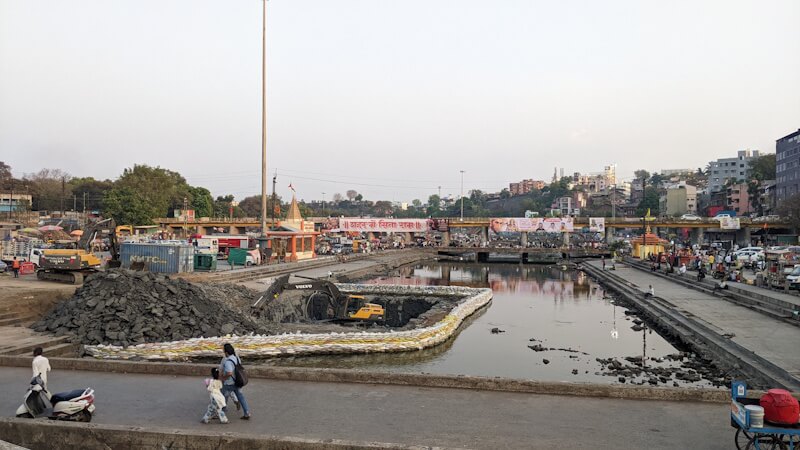
Photo: Shilpa Dahake
Godavari before 2015: A narrative of disappearance to restoration
The recent shift in the ways of engaging and imagining Godavari becomes clearer when viewed against episodes in the recent past – a cycle of decline, disappearance/forgetting, and collective recovery. A few years before the Kumbh Mela of 2015, the Godavari had reached a point of ecological breakdown. In 2012, a massive spread of invasive water hyacinth made large stretches of the Godavari invisible and diminished its flow, thus endangering its existence. It was not a sudden breakdown but a case of prolonged neglect, infused with an inflow of untreated sewage and reduced water flows that resulted in this unchecked growth.
The river did not vanish dramatically; it receded slowly, slipping beneath layers of ecological stress until it was almost unrecognisable. By the time preparations began for the 2015 Kumbh Mela, the urgency was not to redesign the river but to recover it (Dandekar 2015). The interventions were planned with a focus on restoring Godavari’s visibility and function. Importantly, this process was not a singular, top-down vision, but a moment of collaboration in the city. A wide network of participation involving local groups working with government departments, volunteers, NGOs, strengthening the on-ground efforts to prepare for the Kumbh Mela as well as to recover the physical environment of the river.
My ethnographic research documented the crucial role of local public participation through continuous engagement with the river in making the Godavari visible again during that period. These efforts emerged as distributed social processes in addition to infrastructural ones, and not a singular design intervention as we see lately. The result did not produce a perfect river but a functional one. The Godavari flowed visibly through the ghats, enabling the religiosities to take shape for the moment.
Where the preparations of 2015 Kumbh were shaped by local participation and embedded knowledge systems, the planning and implementation now is increasingly mediated by external agencies, consultants, and top-down development models. This completely shifts the process of collective (re)production of the riverscape to one that is imagined and materialised through imported frameworks. Through this transition, the river is not only at the risk of losing its ecological balance, but also the participatory and localised practices that were sustaining it.
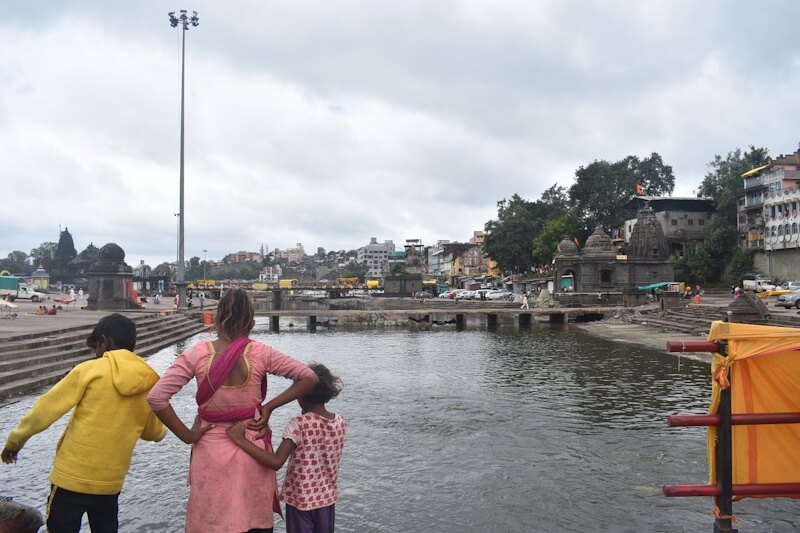
Photo: Shilpa Dahake
Climate change and its impact
The monsoon of 2025 became a moment of clarity where the impact of changing climate realities was experienced by the city. During this period, the river flooded repeatedly — caused by intense rainfall and successive releases from the Ganagapur Dam — submerging the religious ghat precinct, the bazaar areas, and rising to the chest of the Dutondya Maruti idol (a flood gauge for the people of Nashik). These imbalances did emerge in isolation rather than as part of a pattern of increasingly frequent and unpredictable flooding, disrupting everyday life as well as the religiosities along the ghats.
Despite the growing recognition of these trends, the ongoing planning approach continues to depend on rigid, tangible solutions—such as new ghats, embankments, and structured riverbanks aimed at stabilising and controlling the river (Bhotekar 2025). These approaches rely on predictability. However, the Godavari, privy to seasonal monsoons, is very dynamic. Historically, its kund-ghat systems carry this knowledge — they were porous, stepped and made adaptable, so that they can accommodate changes, not resist them. But modern interventions restrict the river’s floodplains, which only exacerbates the very floods they aim to control.
The plans for the Kumbh reveal a profound conflict. Although one would think that investments in disaster management, sanitation and an infra-push would indicate readiness, on the ground they are reactive. There is a general lack of a holistic, climate-responsive approach that would have incorporated floodplain zoning, blue-green infrastructure, real-time forecasting, among others.
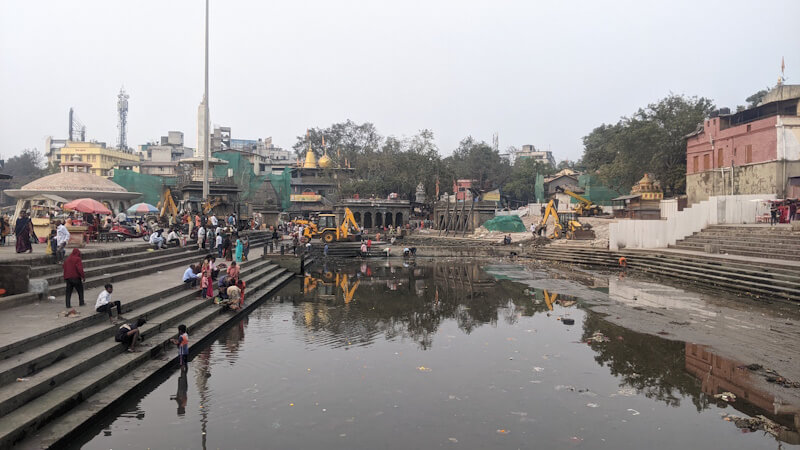
Photo: Shilpa Dahake
This is most apparent when considered alongside the ongoing dispute over tree-cutting in Tapovan (Pandit 2025), a serene forest and riverside of the Godavari where the smaller Kapila river meets it. This area was identified as a location for the development of Sadhugram (temporary settlements for the Kumbh Mela) for which hundreds of trees were proposed to be removed. This has ignited public opposition. Tapovan is a crucial ecological zone. The vegetation here plays an essential role in capturing rainfall, ensuring soil stability, and also reducing surface runoff during intense monsoons.
This is a contradiction because planning interventions are decreasing the ecological systems that reduce the effects of climate change. This is then replicated by compensatory plantation, as ‘mitigation’ measures. This also threatens the ability of the river to self-regulate.
Seen together, the 2025 floods and the strains on Tapovan show a significant gap in the way the Godavari is perceived. The landscapes that support the river’s resilience are neglected, and the river becomes something to be controlled and engineered. As the Kumbh Mela approaches, the challenge is not just to build the riverfront but also to interact with the larger ecological system it depends on.
Beyond an event
The Godavari is in a precarious position as Nashik gets ready for the upcoming Kumbh Mela; it is simultaneously worshipped, reshaped, and increasingly strained. The river is being shaped through ambitious visions of spiritual infrastructure, expanded networks of access, and large-scale interventions meant to accommodate millions. Yet, as the events of recent years reveal, these efforts often remain out of sync with the river’s own rhythms.
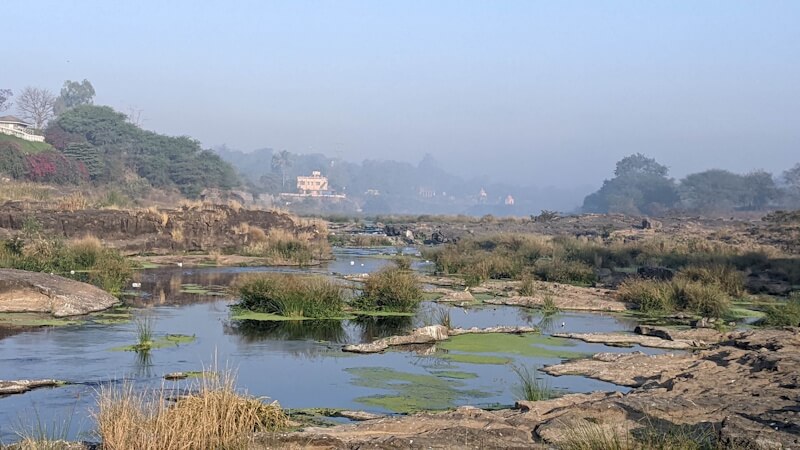
Photo: Shilpa Dahake
The shift toward a unified, monumental riverfront (extensively addressed here) supported by projects like the spiritual corridor and Ramkaal Path, signals a desire for order, coherence, and global visibility. At the same time, the memory of 2015 points to an alternative approach, one rooted in restoration, local participation, and working with the existing fabric of the ghats. The 2025 floods also highlight the risks of relying on the river as a static boundary with the inflexibility of infrastructures in the face of an increasingly variable monsoon. This is being exposed by the rigid structures in Tapovan where the ecological landscapes that sustain the river are forced to face the pressures of expansion.
Together, these moments point to a larger question: is the Godavari being prepared for the Kumbh Mela or is the Godavari being reshaped to fit a preconceived vision of the river? The answer does not lie only in how the river is built upon but also in how it is understood. The engagement with the Godavari today, therefore, necessitates moving beyond the notion of the river as the setting for an event to seeing the river as a living system that flows, floods, recedes, and regenerates.
The preparation for the Kumbh Mela, then, must not only involve building of ghats or crowd management but also the restoration of the river ecology, the reinvigoration of the river itself. If this shift does not come about, the river will continue to remain at risk. The challenge is not just organise and orchestrate a great mega-event, but also to ensure the Godavari remains seen and sustained beyond it.
References
- Bhotekar, A. (2025, December 3). Focus on making ghats safer for pilgrims. The Times of India.
- Dandekar, P. (2015, July 17). गोदावरी ध्वजारोहण: Hoisting Godavari’s flag this Kumbh. South Asia Network on Dams, Rivers and People (SANDRP).
- Pandit, V. (2025, December 13). Kumbh preparation: NGT stays cutting of trees in Tapovan at Nashik. The Hindu.
- Pawar, T. (2025, November 10). NMC floats Rs106cr bid for Ram Kal Path project. The Times of India
Shilpa Dahake, PhD is a Nashik-based architect and anthropologist whose work explores the intersection of urban governance, climate change, and participatory planning, with a focus on the urban ecologies of India’s small and medium-sized cities. She received her PhD in Humanities and Social Sciences from IISER Mohali (2021) and was a Fulbright–Nehru Doctoral Fellow at the University of Pennsylvania (2019–20). Her doctoral research examines the Godavari River as a dynamic socio-ecological system, where infrastructure, pollution, and shifting water flows produce “feral ecologies” that reshape environmental politics and human–river relationships. She is the co-founder of Studio Urban Dialogue and leads Nashik Katha, exploring natural local building technologies in response to changing climate, while documenting Nashik’s river landscapes, heritage, and urban transformations.
Cover photo: Nikeita Saraf