
‘Government is not happy with any protest, has created fear’
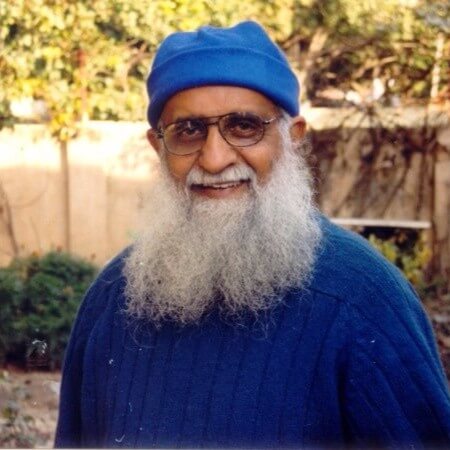
Ravi Chopra is a well-regarded environmentalist and the Director of the People’s Science Institute, Dehradun. He has been a strong voice fighting to save the fragile Himalayan ecology.
“I was involved in a couple of rallies in the 1990s for statehood and later for violence against women. More recently, I have been fighting for environmental issues primarily against the cutting of trees, the construction spree, and the destruction of rivers in Dehradun. Also, on human rights issues which are related to the freedom of expression and communal harmony. For example, the illegal detention of Sonam Wangchuk and others. Then, we have been active in the anti-drugs campaigns. And, more recently, in the major case of the murder of Ankita Bhandari. Generally, people have been receptive to our protests.”
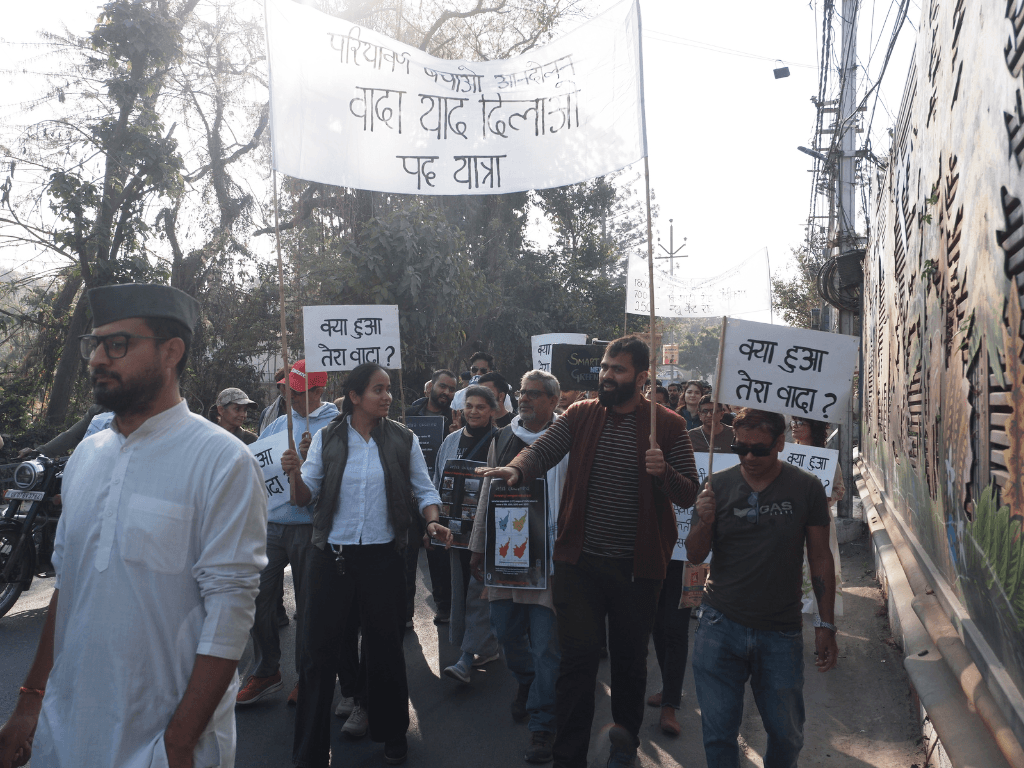
“The Citizens for Green Doon has been actively protesting the felling of trees in and around the entire Dehradun valley.[1] It has drawn a lot of response. In October 2020, thousands of people came on the streets to protest the tree felling in the Rajaji National Park for the expansion of the Doon International Airport. In April 2022, a human chain was made to oppose the widening of the extension of the Delhi Doon Expressway by hacking 10,000 or 11,000 trees — 2,500 in Dehradun and the rest before you enter Dehradun. It drew several thousand people. In 2024, when we had a heat wave and the government had planned to cut trees, that drew a crowd of about 2,500.”[2]
“The response of the people depends on four factors. One is, of course, the issue itself. It’s also related to the mobilisation effort that precedes a rally which depends on the publicity and the media. The third is the impact. If people feel one protest after another is not having an impact, their interest tapers off, the response declines. We do a lot of leaflet distribution during rallies and public meetings. Younger people tend to join us in the middle of the protests.”
“Fourth, how a protest unfolds depends on the government’s response. The current atmosphere of government aggression and threats of punishment have subdued many people. If we go to their homes, they are supportive; ask them to come out on the streets, they are less supportive. The government has created this atmosphere of fear that those who come out and protest will be punished. That restricts a lot of people.”
“We have the well-established people’s organisation – the Uttarakhand Mahila Manch – which led the protests for statehood.[3] I still remember the mid-90s when hundreds of women would come marching in two-by-two or four-by-four on main roads and maybe a few dozen men at the back. It established itself as an organisation fighting for people’s rights; it has its own network and active units, and mobilises people. Distributing leaflets or putting banners or posters in prominent places helps to mobilise people. Now, social media has taken over. On X, the responses opposed to our way of thinking are extremely negative and expressed with a lot of invectives.”
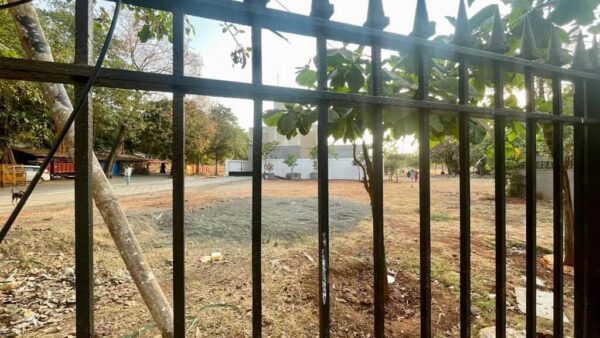
“Dehradun lies in a large Himalayan valley but, like any other Indian city, has grown haphazardly in the last 20 years. It is extremely crowded, with lots of vehicles, and people are scared for their lives. Earlier, the protests would start from the Parade Ground and traverse all the prominent streets of southern Dehradun. Gradually, especially after the protest against the Citizenship Amendment Act in 2019, the government banned the use of the Parade Ground as a protest site.[4] Then, people shifted to the Mahatma Gandhi Park in the centre of the city. Gandhi being the great leader of a protest, it’s a place of inspiration. The gate is located on the main Rajpur Road. So, it attracts a lot of viewers too.”
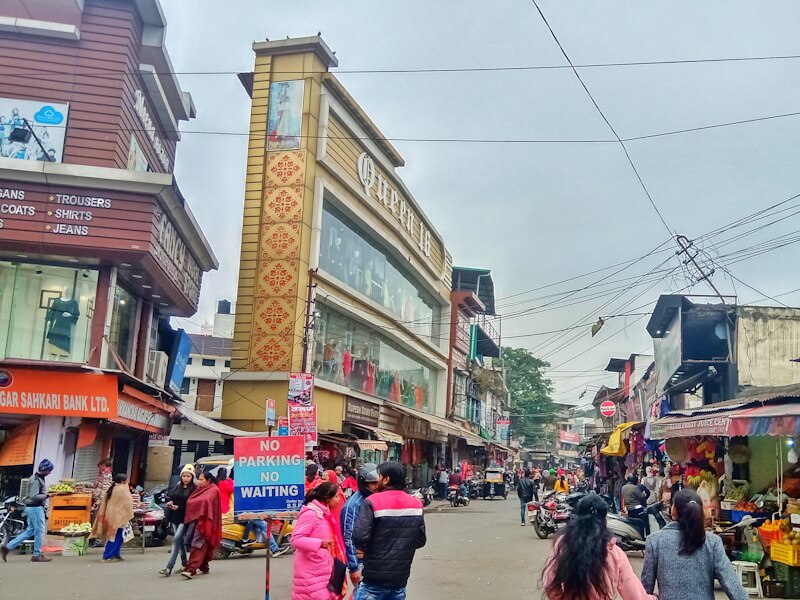
Photo: Wikimedia Commons
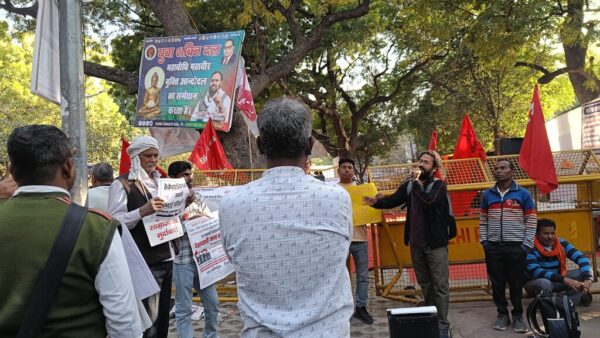
“Around a year or so ago, the government “banned” public gatherings and protests on Mahatma Gandhi Road, and allowed rallies and dharnas in the relatively less- frequented corner of the city called Kewal Vihar. But many of us continue to use Gandhi Park as a meeting point to start rallies. If it’s a march to a government office or the Chief Minister’s residence, we go through Paltan Bazaar, the main bazaar of Dehradun. The third space that the Citizens for Green Doon finds more convenient is slightly up the Rajpur Road where the street has open space. Generally, people or political parties, trade unions, women’s wings, or students’ wings have held localised protests. Our Padyatras against drugs were in particular localities or on streets and the neighbourhood is involved. The most publicised locations are still Gandhi Park and Parade Ground or the DM’s office. The efforts of Uttarakhand Mahila Manch in the 90s got us all some open space behind the DM’s office. Today, there is the Shaheed Smarak with a hall where 70-80 can sit. We often book the Press Club for public meetings or press conferences.”
“The issues to protest against have definitely increased; in recent times, the focus has been on environmental issues, violence against women. The government is not happy with any protest. In fact, officials try hard to dissuade people from organising protests. In the past, when we were a part of Uttar Pradesh and the Mulayam Singh government was followed by the BJP government, they were not aggressive. If they arrested protesters, they would release them in the evening or detain them for a day only. Today, the government first puts up rigid barriers and barricades, there’s a strong police presence too. It all depends on public sentiment; if it’s with protesters, the government response will not be aggressive.”
“Typically, the middle class and the upper class will come out on the issue of felling trees. On more political issues, like fighting against unnecessary infrastructure development, people directly affected join; people living in bastis and will be displaced for road widening or construction will join. So, there is a division between the people.
We are trying to bring both of them together.”
‘Protests are inevitable…(because) leadership is lackadaisical’
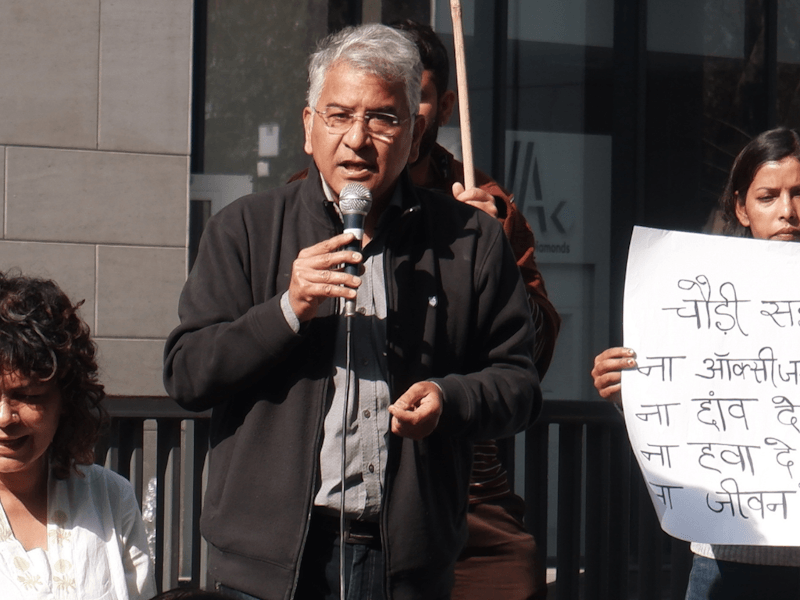
Anoop Nautiyal is a Dehradun resident and a community leader. He has repeatedly raised issues of environmental degradation and the climate crisis in Uttarakhand while pitching for an alternative model of sustainable development. He is the founder of the Dehradun-based Social Development for Communities Foundation, a not-for-profit engaged in climate and environmental conservation, sustainable urbanisation and solid and plastic waste management.
“Uttarakhand has had a culture of movements, various kinds of movements, going back decades. From an environmental standpoint, the most significant one has been the famous Chipko movement of the 1970s.[5] Another movement was for the formation of Uttarakhand which peaked in the mid-90s which finally culminated in the formation of the state in 2000. Even the current protests, I would say, have history. It is natural for our people to agitate, it’s in the DNA of the people of this state. People still feel that their aspirations about governance, law and order, or environment remain unfulfilled even 25 years later.”
“In the past two years alone, there have been several significant movements. One of them was for more stringent land laws in Uttarakhand. The state was also rocked by the ghastly murder of a young girl, Ankita Bhandari, in which there were strong allegations against the ruling Bharatiya Janata Party people. Another is the recent actions on the environment in Dehradun. We call it ‘green slaughter’. The felling of trees has considerably increased in recent years. The large-scale devastation of nature was not happening at this scale. Many mega projects such as Char Dham highway have increased in the last decade and have led to an increase in landslides.[6] There’s massive depletion of greenery, loss of shade, loss of biodiversity.”
“The impact of the climate crisis has been more visible too as extreme heat, the urban heat island impact, extreme rains, unheard of air pollution levels. Climate events have resulted in tragedies — Kedarnath landslide in 2013, Chamoli disaster in 2021 in which more than 200 died, and recently in Dharali in August 2025 and in September on the outskirts of Dehradun. For the first time in Dehradun, we witnessed consistent AQI levels over 300;[7] temperature went over 40 degrees Celsius in the summer of 2024.[8] Other places too recorded 40-45 degrees Celsius. The chief minister did not speak about either. So, protests are inevitable.”
“The credit for organising these large-scale continuing protests in Dehradun should go to an organisation called Citizens for Green Doon that’s genuinely and seriously concerned about the depleting greenery. Its single largest motivation is to act as a glue and get people together. The biggest environmental protest in the last 25 years was in June 2024. The city’s temperature had touched 43 degrees Celsius. We heard that 250-odd trees would be chopped from Dilaram Chowk to the Chief Minister’s house. People went berserk and came out in numbers; the government went on the backfoot.”
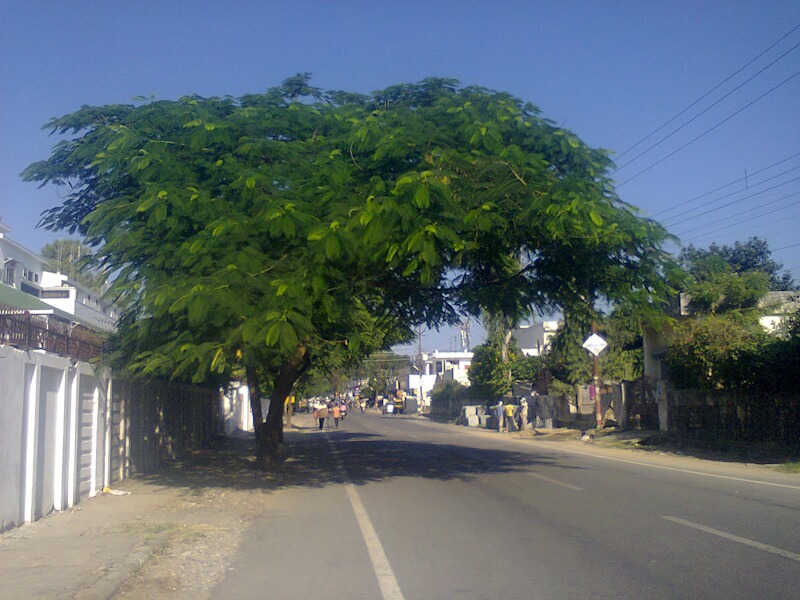
Photo: Wikimedia Commons
“Dehradun does not have a master plan; this is essentially cowboy land. The leadership is truly lackadaisical. This is collective failure. I am deeply worried and extremely anguished at the lack of holistic urban governance here. That’s why, from protests to people, everything is interlinked and interrelated with each other. If things continue this way, which they most likely will, more people will be in the streets. Other than protesting, people have no option because there is no mechanism where their voices are being heard.”
“Of course, we have the Mussoorie Dehradun Development Authority (MDDA) responsible for making urban plans, there’s a defunct town and country planning authority, the institution closest to people is Nagar Nigam or the municipal corporation. But these have zero systems for citizen interface; there’s a complete collapse of citizen engagement with the bureaucracy. The frustration and anger of the people will spill on the streets in the form of protests, for the environment or any other issue. We also formed the Dehradun Citizens Forum and prepared a green agenda for all the political parties during the municipal elections a year ago.”[9]
“In fact, more people should step out. The June 2024 protest was significant for the number and kind of people who came. Many were in their 60s and 70s, and protesting on streets for the first time. There comes a tipping point when people say enough is enough. But one concern is that the youth participation has relatively been muted. The ones driving these protests are the older lot. Since Dehradun has a large number of colleges, one expects greater participation of students. On social media, there is enormous support and encouragement. If some of this were to be visible on the ground, it would create a greater impact.”
‘People use knowledge but researchers need to break barriers too’
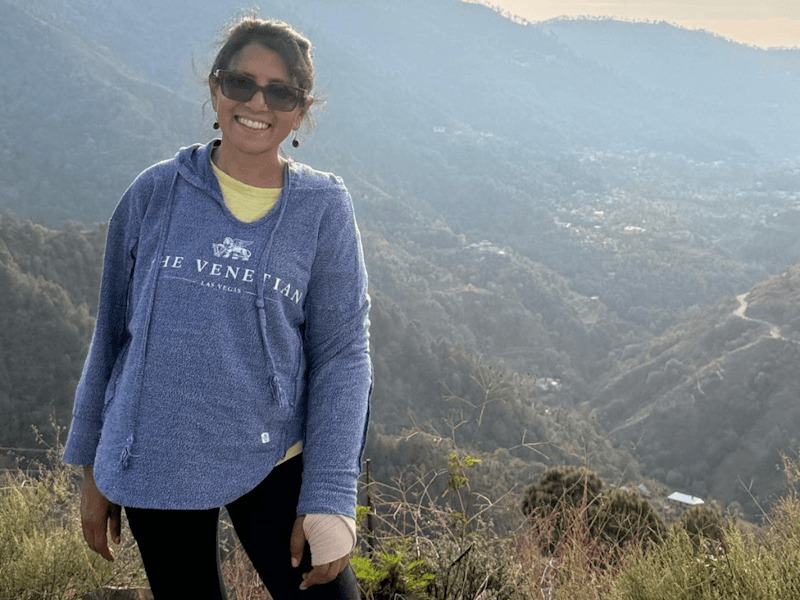
Dr Sonali Gupta, lawyer and anthropological archaeologist, is Founder-Director of the Himalayan Institute of Cultural & Heritage Studies (www.hichs.org)[10] , Founding President of the Himalayan Conservation & Preservation Society (www.hcpsusa.org)[11], and serves as a consultant with ‘Communitology,’ a US-based organisation addressing issues of caste, gender discrimination, and climate-induced migration.
“I wanted to transplant myself in the Himalayas because I absolutely love the landscape. When we attend conferences, write these wonderful papers and books, collect data, it is not really reaching the people to whom it matters the most. This work might be useful for policymakers but anthropologists and researchers are not a part of meetings; I have never been called for a policy meeting that will impact people. What’s the use of my research if it’s not applied? This thought prompted me to come to Kullu Valley and live in a village.”
“When academic researchers are really into that layer where it matters the most, they can convey to people the theories and impacts. People may not take to book knowledge or the jargon we are trained in. Our knowledge comes from theories, assessments, patterns but when we live with them, we understand their knowledge, the embodied knowledge that we lack. So, it’s a two-way process. Constant communication and dialogue, not the piecemeal dialogues where you just come for your research and go back, are important. Embedding yourself in that society to understand their knowledge as a lived experience, conversationally, is important.”
“Workshops are a good way to connect researchers and people. Many times, when researchers come, the locals wonder what this person will tell me about my area. Researchers come thinking they are intelligent and smart but you cannot impose your knowledge on them. It should be more like an exchange where both are learning from each other. There are a lot of things that have to go into breaking the barriers; these are created by spaces as well.”
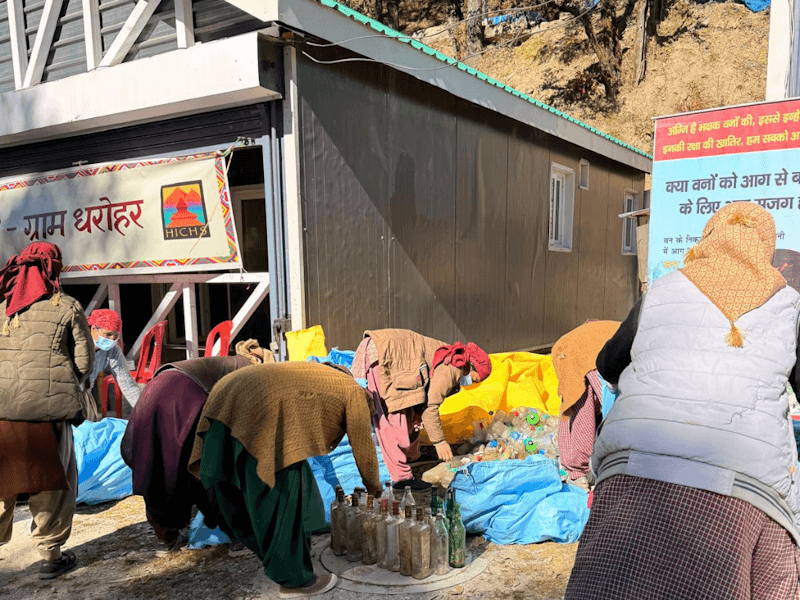
Photo: Sonali Gupta
“As an anthropologist, I feel the space and how you use it also plays out on how information is exchanged. For example, when people come from cities, they use a table-and-chair while the locals sit on the floor. You create a difference right there. These subtle cues impact the kind of information that will be exchanged because, in a short time, gaining trust is difficult. With social media, researchers have created impact because locals have become very aware; they hear podcasts and watch videos. That power has empowered the movements.
“Local women are active and aware about panchayats and Zilla Parishads. In Chamba, for instance, Gaddi women opposing the Bajoli–Holi hydropower project sat in a 24×7 vigil because they had seen what tunnels and blasting did downstream to oak forests, water sources and grazing routes.[12] They documented oak loss, reduced flows, leakages from earlier tunnels, and carried Gram Sabha resolutions and Forest Rights Act provisions into negotiations and protests. Their knowledge of the slope was deeply embodied. That combination of lived knowledge plus documentation gave their movement its strength. Locals say that Environment Impact Assessments are nonsense, so they took things in their own hands.”
“The Chipko movement in Uttarakhand has become a reference point. People remember that. Coming from there, the movement is not a dharna anymore. Knowledge has become the differentiator now. People are more aware, get mobilised fast, use RTI applications and file writ petitions. Wherever the landscape is threatened, people have intervened to say ‘no means no’. They are aware that they have to do something about it. People want us academics and researchers to be a part of the system, not come to write about them and go away. Trust is important. Breaking down boundaries is the first thing required for people who are in movements to join hands with researchers. My research will matter only if it’s a part of their movement; that’s why I left UCLA to come here.”
Cover photo: Anoop Nautiyal