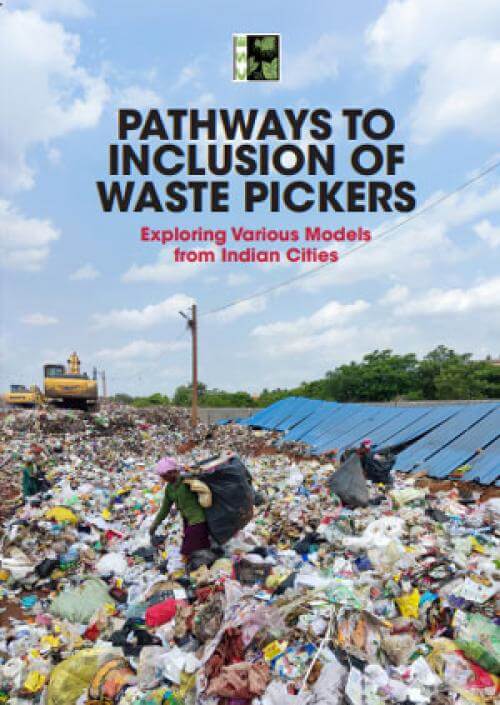
Pathways to inclusion of waste pickers: Exploring various models from Indian cities
Summary
The report, Pathways to inclusion of waste pickers: Experiencing various models from Indian cities, published in August 2025 by the Centre for Science and Environment (CSE) offers an in-depth exploration of diverse models for the inclusion of informal waste pickers in urban solid waste management systems across Indian cities, capturing a broad spectrum ranging from cooperative-led systems to Self Help Groups-operated units and formalised roles within the municipal system. Its key insights are that legal mandates under the Solid Waste Management Rules 2016 have not translated into actionable city-level policies. Identification of waste pickers remains inconsistent, and the most critical aspect for their livelihood—access to waste—continues to be denied.
The contribution of informal waste workers to global recycling efforts is often overlooked although they are responsible for recycling approximately 60 percent of all plastic materials worldwide. In 2016 alone, it was estimated that they collected around 27 million metric tonnes of plastic waste, diverting it from landfills and oceans. The study highlights that effective inclusion goes beyond formalisation, emphasising the need to preserve existing livelihoods while providing social security, dignity, and agency. Examining the current landscape, existing policies, and gaps within the system, the study highlights the scope and need for reforms, and presents practical and replicable examples that can serve as a reference for stakeholders, including urban local bodies and private practitioners.