
‘They can’t tolerate protests…don’t see our pain’
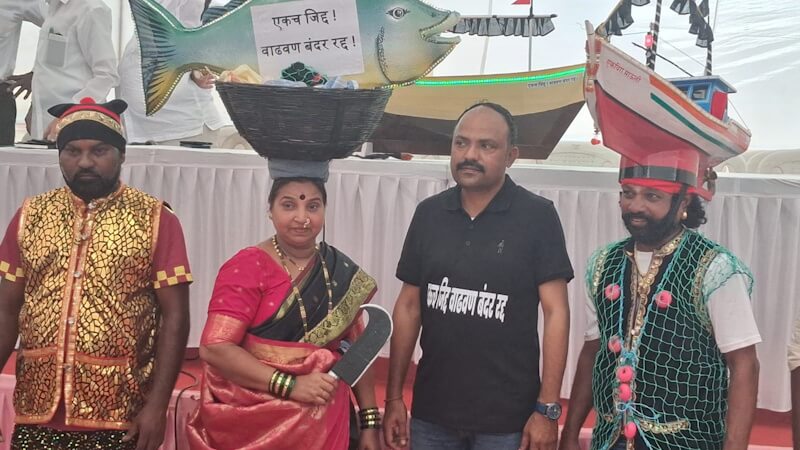
Vinit Pratibha Prabhakar Patil
Resident of Varor, Palghar. Member, Vadhavan Bunder Virodhi Sangharsh
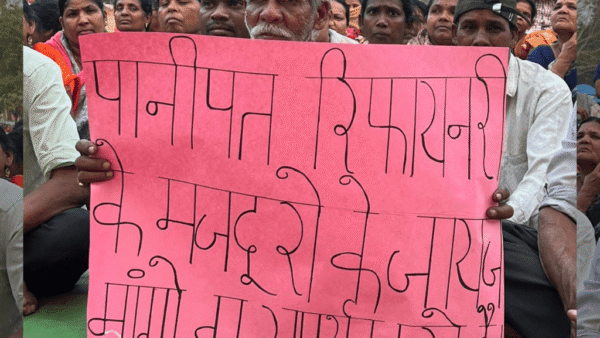
“In 1991, Dahanu was declared a ‘Green Zone’. At that time, Justice C S Dharmadhikari rejected the port project and declared support to the people protesting it. When it got a green signal in August 2024, our protests resumed.[1] The protest on March 15 in Dahanu had around 25,000 people. On March 23, we held a big protest in Mumbai, at Azad Maidan. Around 30,000 people joined the protest on January 19 in Palghar. The Vadhavan Bunder Virodhi Sangharsh Samiti has been working for 30 years. It’s a collective of 12 organisations and 22 other organisations support it. Kashtari Sangathana, Bhumi Sena, Ekta Parishad, The National Fishworkers’ Forum (NFF) are some who came together under its banner. No political party or NGOs are involved.”
“Six communities live here including the Kolis and Devkar Bhandaris. Our main occupation is fishing but we also make dyes. As the Varor village grew, people also started farming, extracting tadi from the tadgolas. After all this, a person earns about Rs 2,500-3,000 a day. We are very happy with our life here. The port will destroy everything. It is said to be 8 kilometres in the sea with a depth of 21 metres but that’s not true. We have mountain ranges stretching all across because of which we rarely face flooding. There are ecological treasures where fishermen from Gujarat and Maharashtra fish — crabs, lobsters lay their eggs here, corals, mangrove forests. The port project will destroy this entire golden belt. Fishermen will lose their livelihoods. Some 15,000 acres will be used for parking ships from Mumbai. There will be no space for Kolis. This is the government’s tactic to employ them in the companies that work in the deep sea.”[2]
“Vadhavan-Dahanu is the only green zone between Gujarat and Mumbai. Vasai-Virar was green; that’s gone. In Dahanu, 96 villages are planned as Fourth Mumbai.[3] Why is this being forced on us? Are they merging Palghar with Gujarat because Gujarat was not able to break Mumbai? The bullet train (Mumbai-Ahmedabad High-Speed Rail corridor) and the Vadodara Expressway pass through Palghar. Those who were displaced and those living there cannot afford these modes of transport.[4] All those who were compensated are now without the money or livelihood. Sthanikancha vikaasamadhye sthaan kay ahe? (What is the place of the locals in the development?) This applies to the Vadhavan port as well. What is our place in it? After the port comes up, nothing will be left. There are no rehabilitation talks, officials have not even come to Vadhavan but falsely claim that they have support from the communities. Our appeal and demands were refused by the Chief Minister.[5] If we move the court, we will never get a favourable ruling because this is ‘against’ development.”
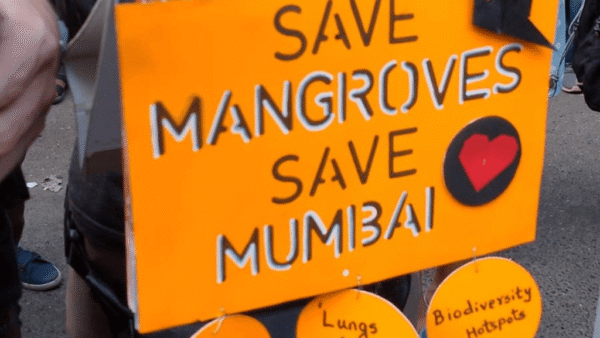
“We have support from other movements. On March 23, when we protested at Azad Maidan, movements in Mumbai — Sanjay Gandhi National Park, Aarey and mangroves — came together. We supported each other. The mangroves cut for the Navi Mumbai airport were apparently planted in Dahanu but we can say they were not. The protesters sat with us. But the government is undemocratic. We have now decided to take the fight to the streets. Our question is: Whose Mumbai is it, is it of workers and labourers or we do not have permission to even march there? Several demonstrations are held in Mumbai every year. If the government can’t tolerate protests for 20 days, how will they understand our pain and hardships? If the government pays attention to the 500 people who approach it, there may be no need to hold rallies and demonstrations. The country does not need the working class anymore, only needs votes. Can a farmer farm 10-12 kilometres away from his house? Is there no life for the Adivasis? We will have to bring the fight to the streets.”
‘We decided to reclaim parks and footpaths in Panjim as protest’
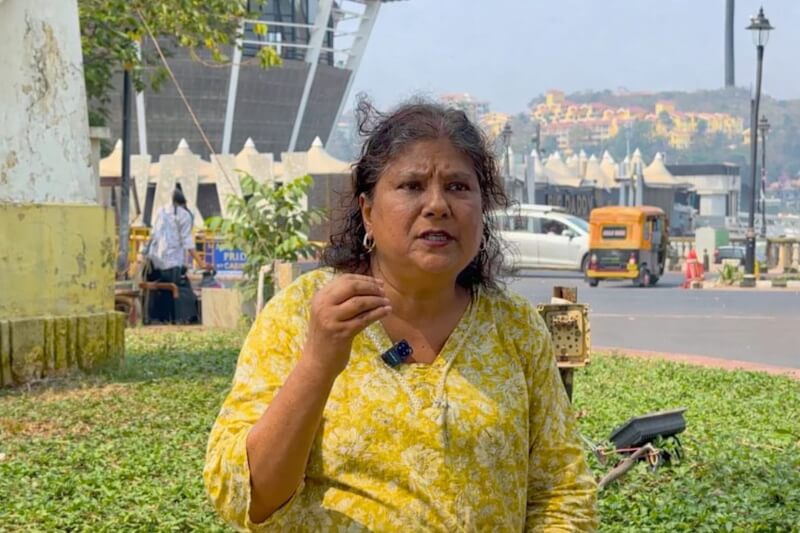
Sabina Martins
Activist, Panjim, Goa
“We have been protesting against casinos as a women’s organisation; now newer networks have been formed. When we started protesting, we were part of Bailancho Saad, a women’s organisation formed in 1986. In 1992 the government brought in an amendment in the Goa Gambling Act, permitting slot machines.[6] We opposed it then; the government then brought in an amendment to permit gambling on offshore vessels but without defining an offshore vessel. We were already grappling with matka gambling fallouts when casinos were brought here. The government assured that casinos will not be allowed but did not revoke the amendments permitting them. In about three years, suddenly, the first boat arrived in River Sal in South Goa. We all, including the villagers, opposed it. The boat was shifted to Mandovi river but, slowly, they started giving licences to other casinos. We demanded that the licences be stopped and those given revoked.”
“As time went by, our organisation network broadened. We formed an umbrella organisation, Aam Aadmi Aurat Against Gambling, including all women’s organisations, other civil society organisations, and individuals. We opposed all amendments that facilitated casinos. As more offshore casinos entered the Mandovi river and onshore in five-star hotels all over Goa, removing them also became an election issue.
Successive governments did not stop the casinos, because it would send wrong signals to investors. Over the last 20 years, they have raked in crores. The current issue is the huge vessel with the capacity of 2,000 passengers. Licences are not being given perhaps but the capacity is being officially increased. The vessel now allowed is 112 metres long and 28 metres high; it’s like a 9-floor building that’s going to block the sizeable part of the river. What it will do to Panjim has not been thought through.”
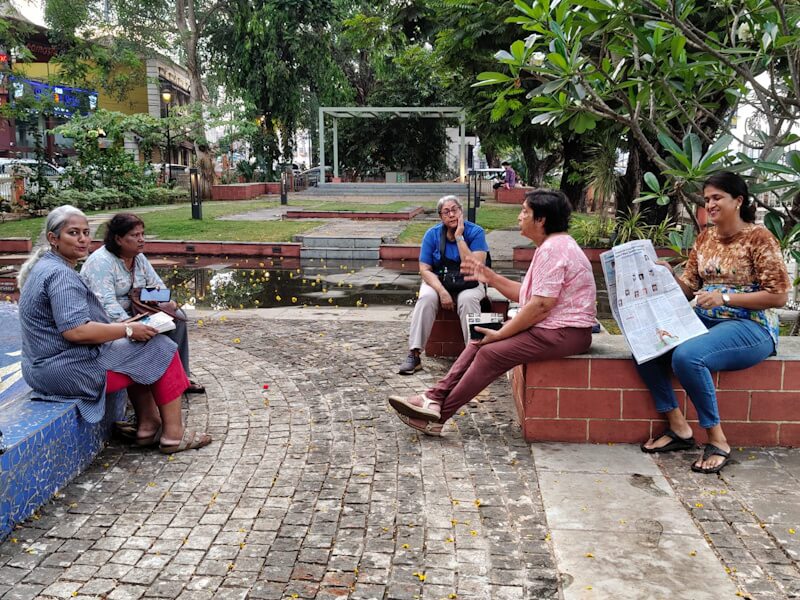
Photo: Sabina Martins
“Panjim’s roads are a mess, residents have lost parking spaces.[7] Buses, taxis, and cars coming in are congesting the roads, making it difficult even for ambulances. In the evenings, one can’t navigate these roads; tourists drink, vomit, urinate, fight and make so much noise. Residents are very disturbed, the impact on Panjim is huge. Mandovi River is completely clogged by casinos; there is construction in the river for feeder boats to come in. The platform from the road to the river is covered and the view of the river is blocked to the public, privatising public spaces.
Through RTIs, we found that from 2023 to 2025, none of the casino boats even had licences. The boats dump their sewage in the river. Mandovi stinks; riverine health is a big concern to us. Panjim had open gardens, parks, and the river. Our recent protests have been to reclaim our city, our river.”
“We, including the fisherfolk, formed the ‘Ponjekar against Casinos’ group and decided to reclaim our city as a protest.[8] We had a lifestyle based on local sustainable development, not this highly commercialised money-making on addictions. Social ills have increased. Our Goa doesn’t look like Goa. We kept a watch on the casino vessel, we took over public spaces starting with Mermaid Garden along the river. During my student days, we staged plays in this park; now people drink and sleep there. Like this, other parks too have become intimidating but we need to reclaim our spaces. We hold meetings there. We organised evening walks along the Mandovi footpath. We had children and adults come to the park and read. We object to casino ads and will remove them. These are ways to reclaim the city. The minute we use placards, the authorities say it’s a protest and we need permission or, then, detain us. Reclaiming our Panjim is itself our protest.”
‘Small wins are people joining the movement, a few trees saved’
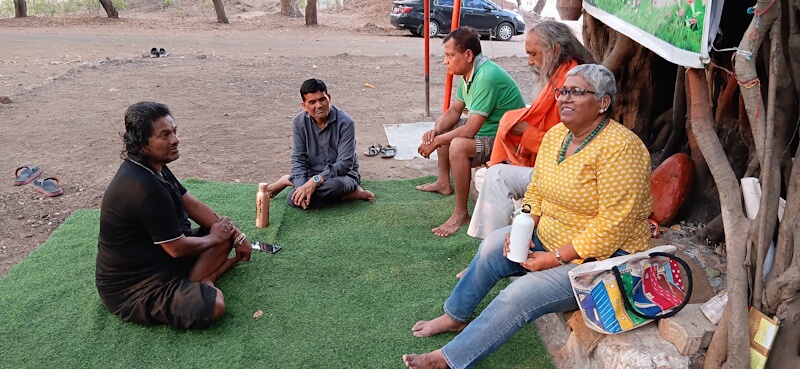
Bharati Jadhav, Tapovan
CEO, Manav UTTAN Manch, Nashik
“Twelve years ago, trees were planted for the Kumbh along the Kapila river. But, trees will be axed for building ghats on the Godavari; there will be constructions in the riparian zone too. We raise objections but no one cares. It is possible to build a ghat and keep it natural without concretising it. Ahilyabai Holkar had constructed ghats at the Ramkund using beautiful local stone but they have been removed and replaced with some tiles. I take a walk at Tapovan every morning and keep an eye out because I know that the Kumbh Mela is around the corner and Sadhugram has been announced. That’s how I saw the first notice on one of the trees.”
“After we protested, they painted over the notices with green paint. Roshan Kedar, one of the young people in our group, made a video and posted it on Instagram. I made one for Facebook. We started making videos regularly and had more people join us. On November 22 last year, we had the first hearing for Tapovan.[9] Many people joined after seeing the videos and our work. Some like Vishal Patil, Ganesh Gomse, Rajesh Pandit, Devang Jani and many others have been coming here almost everyday. The 370 acres of land is for Sadhugram; of its 70 sectors, ten are for Sadhugram but of these eight will be for a commercial project MICE (Meetings, Incentives, Conferences and Exhibitions) Hub which is a permanent construction. We dug up this information; nothing was made public. In the name of Kumbh Mela, the authorities are doing this as no one will object.”
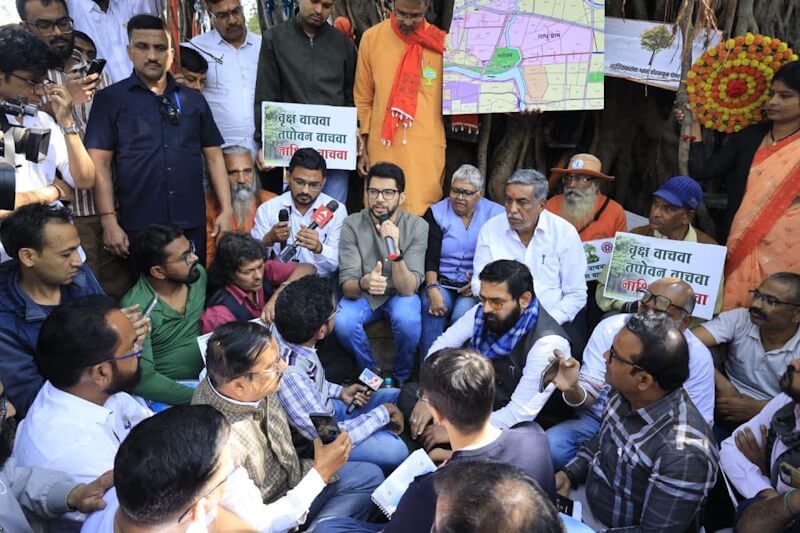
Photo: Tapovan Ex Press group
“Initially, our objective was to conserve the trees. This is ‘Tap-ovan’, where sadhus performed tapasya (penance). The importance of Nashik is through the forest, through Dandakaranya where Ram, Sita and Lakshman lived for 14 years. This place should be conserved. After the people’s hearing, when the authorities saw people’s power, the MICE Hub was rejected.[10] Two organisations actively worked – Naagrik Kruti Samiti and Maanav UTTAN Manch. In the petition, the Bombay High Court gave the judgment that no tree should be touched in the name of development. There are trees like the 400-year-old tree at Gangapur Road.”
“The narrative now is that people like us are against the Kumbh Mela, but that’s not the case. We all live in Nashik. Sadhus want to live in the forest. There are ways in which Sadhugram can be built without sacrificing trees. We filed RTIs asking for data of trees; the authorities did not respond or shrugged it off. They don’t say how many trees will be cut, they don’t have a plan. Right now, 60 drains open in the Godavari river and a new STP has been built by cutting several trees. We approached the National Green Tribunal and the HC, but during this time they cut trees. There used to be dialogues with previous governments but this government is relentless.”
“Cutting trees makes it hotter by 6 degrees Celsius. Earlier, Nashik was cool, we slept with a blanket even in May. Hills and forests have been cut down – largely for warehouses and godowns of industrialists and politicians. A small number of people keep fighting. We focus on Nashik Zilla, not just Tapovan. While the attention is on Tapovan, they cut trees, including ficus, in the rest of Nashik. The ring road is planned to pass through villages, damaging farms and trees. There’s road-widening everywhere.[11] For every project, trees are cut and they say they will transplant 10 times more trees though the court order refused transplantation. They call it ‘Harith Kumbh’ but where is the green? Our slogan is ‘Tapovan Vadhava’ (Increase Tapovan) not ‘Tapovan Vachava’ (Save Tapovan). There are small wins like more people joining, more signatures, and a few trees being saved.”
‘Listen to us: This is the point we want to make’
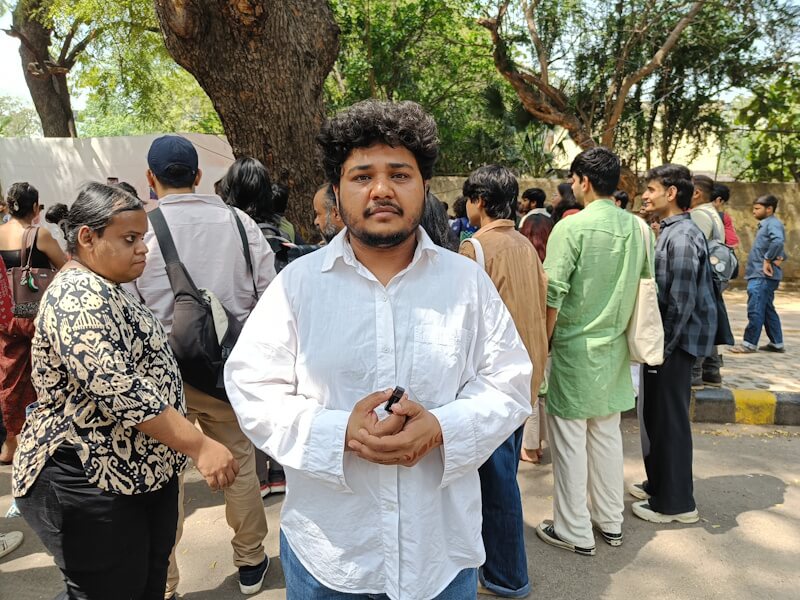
Kabir
Dalit trans man, Delhi
“I am an educator, qualifying to be a school teacher. A primary and a special teacher because I am in both. My brothers and sisters, my relatives and friends, the people around me, do not have to fight for their basic rights like their Aadhaar card, PAN card, ID card. But I and many thousands like me have to fight while the government is continuously refusing, stopping us, and trying to get rid of us without reason. Ten years ago, they gave us a decision – the whole society, the government, the courts – that they apologised to us for harassing us for so many lifetimes, ignoring us, denying us rights. Today, the same government says that it made a mistake and wants to set up a Medical Board to say who we are?”
“We gathered in Delhi to protest because Virendra Kumar, Minister of Social Justice and Empowerment, said that the amendment to the Transgender Act made in 2019 will be changed.[12] Within two days, this amendment for this was passed in both Lok Sabha and Rajya Sabha, without asking transgender people at all. Decisions are being made for me and others like me, but we are part of it, not even told. The government is not listening to me. They do not want me, us, to talk even though we are at their doorstep. We are repeatedly handing them petitions and letters saying ‘talk to us, tell us why you want to do this’ but they are not listening to us. So, we have no option but to come out in protest. We are not creating a ruckus; we are not disturbing anyone; we are doing this with permission to convey our point. We are saying: Listen to us.”
“In 2014, the National Legal Services Authorities (NALSA) judgment[13] gave clear definitions of gender identity, sexual identity, orientation, and how one can decide their own gender identity. Then, the Transgender Act and the rule came in 2019 which gave clear definitions of identity and included a large spectrum; non-binary communities have been mentioned. We non-binaries – jogta, aravani – talk about many such cultural identities but this amendment has no place for any of this. How will a Medical Board determine such identities? If we are one of 100, then we don’t understand the rest 99. We know you, the government, never thought about gender this way. So, we had to raise our voice.”
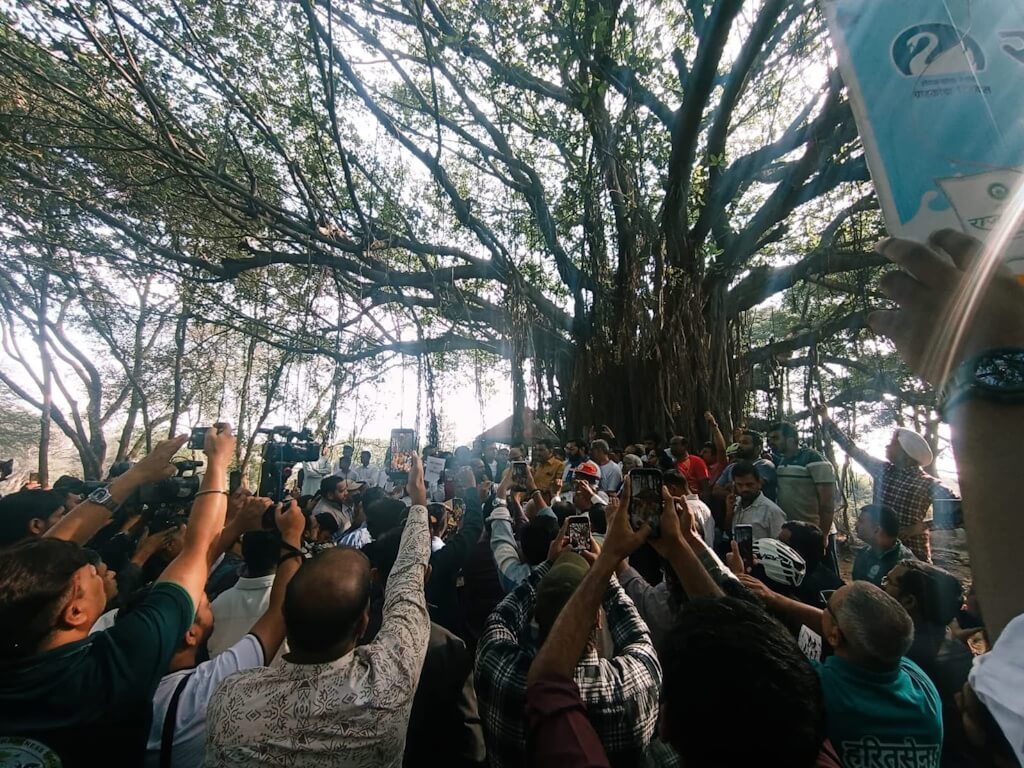
Cover photo: Citizens come together to protect Tapovan. Credit: Bharati Jadhav