
The world of short films about cities and local film festivals is springing to life. This year too, as in the past few, grassroots filmmakers pushed back on the narrow perspective of mainstream cinema about cities that flattens complexities and lived experience. The films chosen for this list are about streets, lakes, sites of labour, makeshift homes, informal infrastructures, and, of course, people who make these spaces their own. These films are unique, perhaps uneven and raw, but shaped by those who belong there. Read about them and watch in the links we provide.
Govandi Arts Festival, Mumbai
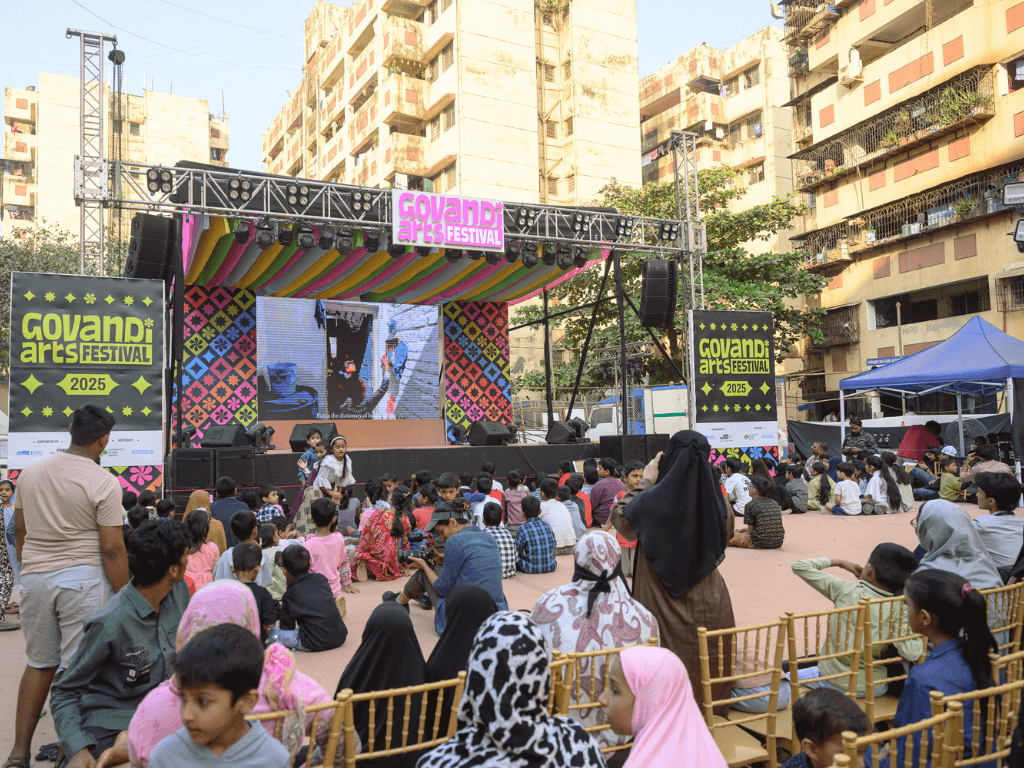
The Govandi Arts Festival, 2025 curated by Natasha Sharma and Parveen Shaikh was a five-day event that came to life through the voices of the resettlement community here. Along with workshops and exhibitions, the film screening Pehchaan brought forth a sense of belonging and identity.[1] Govandi has a number of tightly-packed decrepit buildings that were constructed to house the poor people of Mumbai displaced by infrastructure projects and migrants who cannot afford anything better. Govandi is an address no one wants.
Amid the squalor, the Arts Festival, which saw its first edition in 2023, showcased work of young makers aged between 13 and 21 years. Asiya Shaikh, Afsar Mirza, Insha Shaikh, Ifra Khan, Jyoti Kharwa and Sakina Khan used film, however tentatively, to challenge dominant narratives and explore themes of aspiration, identity, gendered violence, the relationship between the spaces they inhabit and more with mentors guiding them. Here are two films from the festival.
Govandi Ke Ghar by Sakina Khan
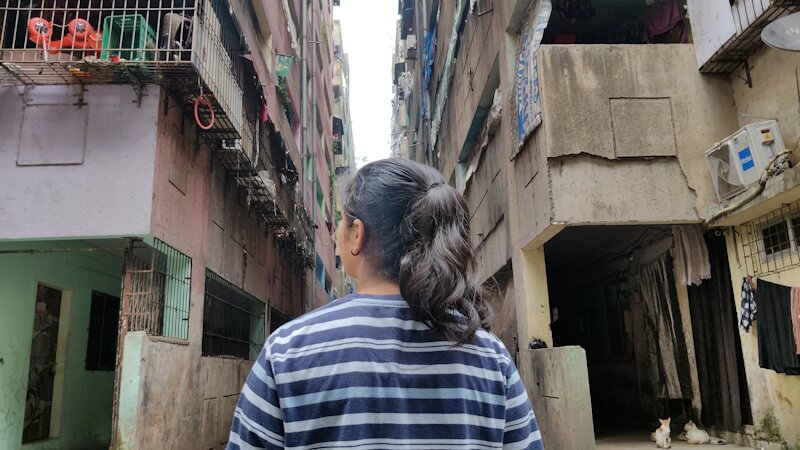
In this, Khan wanders through her neighbourhood, capturing the uniqueness and details that make each home here alive and personal. “Main dekhti hu ki jo chote-chote ghar hote hai usme log apna saaman kaise rakhte hai, kaise rehte hai. Maine socha ki uspe hi film banau. (I see small houses, how people keep their belongings, how they live. I thought I would make a film about this),” says Khan, 18, a college student pursuing media. Her filmmaking journey started with a college assignment and learning how to handle the camera.
Govandi Ke Rang by Asiya Shaikh
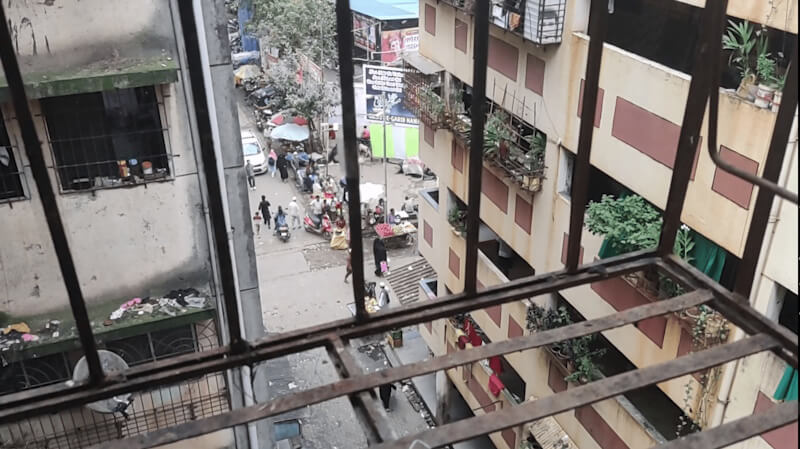
Challenging the outside gaze that reduces her community to struggle, Asiya captures the joy, colour, and everyday happiness in it. “Maine bohot notice kiya hai ki bahar ke log MHADA ko aur Govandi ko thik se nahi samjhte. Logo ko lagta hai ki yaha sirf burai hai par ache aur bure log toh sab jagah hote hai. (I noticed that people have a perception about MHADA and Govandi. They assume that it’s a bad place but there are good and bad people everywhere),” says Khan, 14, eager to continue making films and learn more about the craft.
Asanjo Film Festival, Bhuj
The city shifts when young people see it in ways not imagined before. In Kutchi, asanjo means ours. A group of young people in Bhuj have been asking and trying to understand what it really means to belong to a place. The Asanjo Film Festival, organised for the first time in Bhuj by AABHAT, Centre for Urban Commons, and Homes in the City, has worked with the youth to ask questions of belonging and more. It is about filmmaking as much as learning to see.
Kutch Kono? by Ashwin Ahir
Ahir boldly questions whose Kutch is it, really; who truly belongs to this land, its animals, its people, or both; and in the rush of “progress” who pauses to listen. He journeys through the fragile ties between village and city, tracing the highways where life and loss collide. He talks about the highways built in the name of progress which are killing cattle in accidents every day.
Tarti Gaal by Vishal Maheshwari
The film traces the evolving socio-ecological relationship between Ningalsar Lake, the adjacent village of Ningal, and its people. Historically, villagers extracted lake soil for crop cultivation, harvested aquatic fruits, and dug wells during droughts, amid landscapes dotted with migratory birds and babul trees. Contemporary transformations mean the young seek privacy here while households tap into the lake, marking a subtle shift and rift in human-ecological ties.
Nagari short films
Nagari, the annual short film competition by the Charles Correa Foundation (CCF)[2], now in its sixth year, develops and funds 7-minute films that capture and decode urban dynamics and crises from Indian cities. The films remain a visual documentation of contemporary Indian urbanism. For 2025, the theme was ‘Public Realm in Urban India’ exploring public spaces as open and accessible spaces to their layered uses, scales and activities. The themes for previous years include Housing Adequacy In Urban India (2020), People and Livelihoods in Urban India (2021), Water in Urban India (2022), Reclaiming the Urban Commons (2023), Mobility in Urban India (2024) making the Nagari collection an archive of life and transformation in India’s cities.
Through the Dappled Light by Puneet Raj Singh, Nikita Sharma & Apoorva Sharma
Mentored by Jabeen Merchant
In the rigidly planned city of Chandigarh, trees offer shade and shelter to informal workers. Do trees adhere to planning norms? The testimonials of people seeking space and belonging beneath them in a city that barely planned for their presence shows the comfort that trees offer. “The message is subtle. The love for trees doesn’t arise in a preachy manner, it arises with an experiential feeling,” says Puneet Raj Singh. Adds Apoorva Sharma, “The film is different from other films because Chandigarh is different from other cities. It’s important because it looks at ecology and equity together. Chandigarh is seen for its architecture and Le Corbusier; the film gives a different perspective through its trees.”
Mauj ni Khoj (Seeking Fun) by Aishwarya Gupta, Badal Maheshwari, Drashti Agrawal, Isha Thakkar, Mumtaaz, Sajida, & Soumyadeep Das
The film follows two young Muslims in the small city of Bhuj, Gujarat, as they negotiate between societal constraints and personal agency. They step over invisible boundaries as they enjoy fleeting moments of mauj (fun). It is a story of restrictions but more of finding laughter, friendships as a sanctuary, and the possibility of fun. “Dreams of loitering remain distant for many young, marginalised women in Bhuj. Surveillance is far more intimate. The city restricts their presence in public, their private lives are circumscribed by the gaze of family and community. Amidst this surveillance, pani puri emerges as a quick, socially acceptable street food that offers women a culturally sanctioned pretext to access public spaces,” says Aishwarya Gupta.
Hissa by Siddharth Kar & Susmita Talukdar
Mentored by Pankaj Rishi Kumar
The film follows two migrant barber brothers working Mumbai’s Dhobi Talao, their setup precariously claiming public space. While one dreams of returning home, the other has made the city his own. Narrated by the elder’s daughter, who recalls her grandfather’s fable, Hissa is about inheritance and a claim to space in the contested public realm. “This film is about men who work in public, dream in private, and inherit a city that never fully accepts them,” Susmita Talukdar says.
Phool Gari (Scent of Nocturnal Flowers) by Anamoy Bera, Ritam Chakrabarty, Saptarshi Ghosh & Sukanya Saha
Mentored by Bina Paul
The film explores the quiet transformation of a liminal space beside Barasat railway station in West Bengal, shifting from a night flower market to an auto stand in the morning. It follows the occupants’ rhythms, the balance between labour and survival, and their struggle for legitimacy as the construction of the metro claims the little space they call their own. “Although I have lived in this city for nearly 27 years, this world remained unknown to me until one sleepless night led to tea and an unexpected discovery. The place I knew as an auto stand revealed a completely different life after dark which compelled me to make this film. It is about the changing identity of the place, erasing lives and livelihoods. The film asks who this place truly belongs to. The answer: as long as we are here, it is ours; when we are gone, it’s the Railways,” explains Anamoy Bera.
Beyond Borders Feminist Film Festival
This film festival, organised by the Kriti Film Club in Delhi, brings together films by first-time and seasoned filmmakers as part of the global 16 Days of Activism against Gender-Based Violence (observed from November 25 to December 10). Initiated by Aanchal Kapur, founder of the Film Club, in 2020 following a conversation with the legendary feminist writer and activist Kamla Bhasin, to celebrate feminist friendships within and across South Asia, it has hosted three in-person editions and five online editions.
This year, the festival screened 50 films across two venues in Delhi, Alliance Française de Delhi and the India Habitat Centre. Kapur told Question of Cities that the stories include those of working class leisure and aspiration as well as homelessness, young women negotiating safety and visibility in Ajmer, queer and trans-led spaces of care in Kolkata, and the lives of migrant women workers who sustain Bengaluru’s global garment industry.
Bandra Christmas by Alankrita Shrivastava
This is a story of two young ingenious working class girls in Mumbai out for a night of fun on Christmas Eve. Their morally ambiguous means to claw their way into a fancy party, and an after-party at a hotel, are a critique of the class divide but also the joy of sisterhood within the working class. The city is classed spaces, where access is temporary, conditional, and always negotiated. Kapur says the film makes space for life beyond class divides in a metro city, and reflects the aspirations and struggles of working class women with real life filters.
Ajmer Ki Ladkiya Kahan Hain by Santra, Renu and Nameera
In this bustling city, young women are present yet unseen; walking to school, rushing to tuition but rarely occupying public spaces after dark. The film follows the young – Santra, Renu, and Nameera, also the makers of this film, as they explore how public spaces in their city are out of reach for girls. There’s observation, there’s also action, sparking dialogue, reclaiming spaces – and a challenge to Ajmer to listen to the voices of its young women. Kapur says the film looks at the city of Ajmer through the safety lens of young women from low income households, as they navigate its streets and public spaces.
Garment Kelsa – Women and Work by Cividep India
In the export clothing units, women from Bengaluru’s outskirts and faraway towns work relentlessly, braving their supervisors who call them ‘darling’ as the hours and dream that their children will skip the factory floor to work at a computer. The working women have agency but are also exhausted. The film shows a slice of the reality behind global fashion.
The Lake that Raised Bhopalis by Pranjal Joshi
This short film was not in the festival but is a Kapur favourite. It winds through the lakes of Bhopal and how they are woven intricately into people’s lives. It captures the social relationship between the city, its lakes, and the people living around them to reveal how deeply climate, especially natural landscapes, shape human lives. “Each city’s ecosystem is critical to its sustenance both as natural heritage as well as its people’s bonding to belonging,” Kapur explains. The film was made with assistance from INHERIT by Ashoka and The Helen Hamlyn Trust
All Living Things Environmental Film Festival (ALT EFF)
The ALT EFF, an environmental film festival[3] that unfolds every December, in its sixth edition this year presented 86 films from 39 countries. These films span genres, languages and formats but keep the focus on environmental concerns and human relationships with the natural world. ALT EFF follows a hybrid model combining in-person screenings along with an online offering. The films showcased in this edition were about the everyday textures of Indian cities and their margins, waste and water, climate and infrastructure, labour and memory, and the fragile negotiations. “The films represent many different approaches to narratives on climate change, environment, livelihoods. There’s documentary, speculative fiction, mixed media docu-fiction. They give us a place to start a conversation to understand why it’s urgent and necessary that we take action to better our spaces, systems and infrastructures” says Anaka Kaundinya, Programming Director at ALT EFF.
Tainted Waters by Amitha Balachandra
Set in Maharashtra’s Tarapur, one of India’s most polluted industrial zones, the film focuses on fishermen locked in decades-long battle against industries accused of poisoning their creeks and livelihoods. It follows the fisherfolk whose fight has reached the Supreme Court, even as dead fish, contaminated water, and rising health problems haunt them. The documentary uncovers the clash between industrial growth and community survival — and the resilience of villagers determined to keep their waters alive. “I wanted to tell the story beyond the churn of breaking news. I am grateful to Mongabay India and ALT EFF for giving me a platform,” says Balachandra.
Down The Drain by Nitya Misra
Set in Bengaluru’s underground sewage network, this documentary unfolds through the eyes of a woman who accidentally flushes her watch down the toilet. As it moves through the city’s pipes, it shows the hidden labour and infrastructure that keep the city running. Commissioned by Science Gallery Bengaluru and supported by Rohini Nilekani Philanthropies, the film relies on mixed media and narrative forms to trace the many human and material layers of the city’s sewage system. Misra writes that she observed something she always looked away from, met people who make up this faceless system, and got the chance to collaborate with some really cool people.
Genesis by Moon
The film imagines a future Mumbai pushed to the edge by climate collapse and inequality. New mothers stop lactating, human milk becomes scarce, regulated by the state and accessible largely to the wealthy. Urvashi, a young fisherwoman who has lost her husband to the storm, donates her milk to survive in a neighbourhood sinking deeper into poverty and loss. The film lays bare a Mumbai where crisis sharpens existing class divides, and turns care, survival and the female body into sites of control. “Through Urvashi’s story, I wanted to explore how grief, motherhood, and resistance intersect in dystopian realities already visible around us,” says Moon.
Lost Songs of Sundari by Sudarshan Sawant
Mumbai is being steadily remade through bridges and land reclamation, which is pushing the lives of the Kolis, the city’s indigenous fishing community, to the margins. This film weaves together the myth of a legendary ferry and its ferrywoman, an ageing operator, and a child. As everyday practices tied to the sea recede, Sundari lingers only in memory and storytelling, and points to the fragile future of the Kolis in a rapidly transforming city. “Lost Songs of Sundari is my attempt to explore forgotten narratives about relationships that are slowly dissolving amidst the city’s rapid transformation.
I wanted to narrate this story as if a family were telling it to us, weaving together the past, present, and future,” says Sawant.
Waste and The City – The Mavallipura Story by Karishma Rao, Vishwesh Bhagirathi Shivaprasad
This film traces the long fight of Mavallipura, a village on the outskirts of Bengaluru, against its conversion into a dumping ground for the city’s waste. It follows years of community resistance and legal contestation, situating the struggle within a wider urban waste crisis, and showing how citizen action challenges entrenched systems of power.
Urban Tiger Volunteers of Bhopal by Choulesh Chachane, Akash Eveny
Set in Bhopal, this documentary follows TINSA’s Urban Tiger Volunteer Program, where local residents are trained to track and protect 96 tigers through camera traps, pugmark tracking and night patrols. The film centres citizen-led conservation and asks what coexistence with big cats can look like in India’s urban and peri urban landscapes.
Cover Photo: Films being screened at the Govandi Arts Festival.
Credit: Prashin Jagger