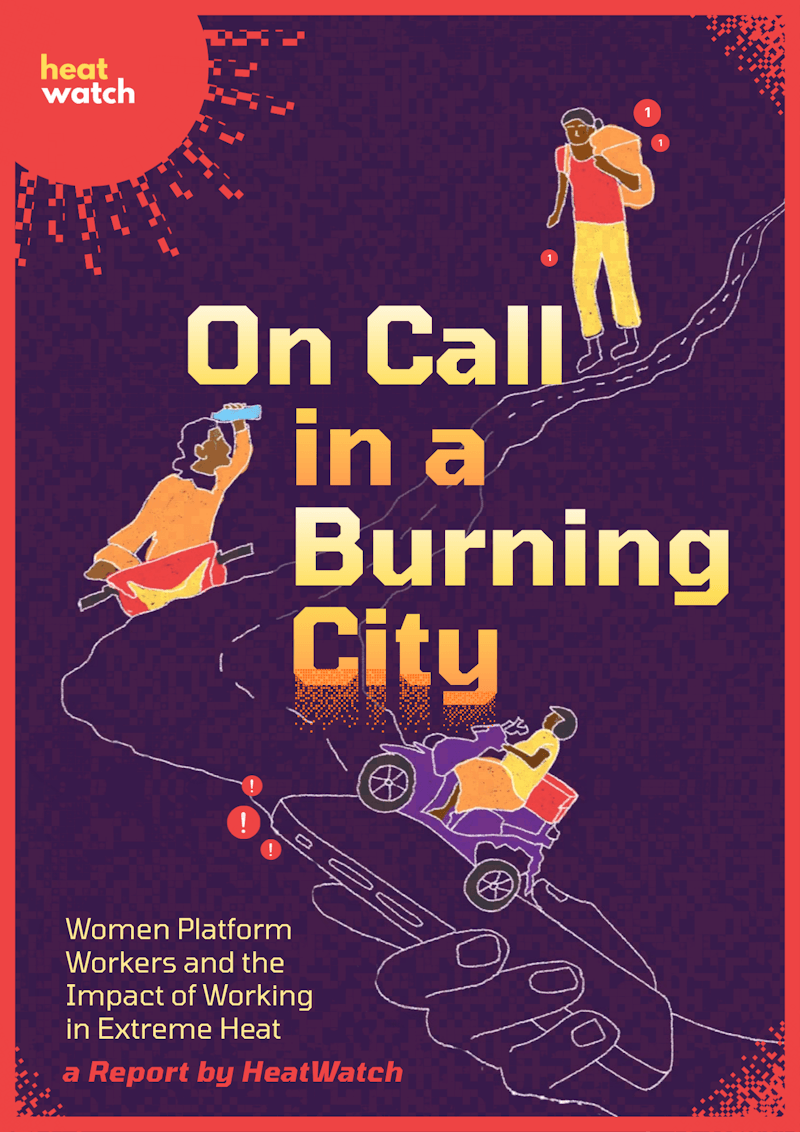
Delhi’s summers have grown longer, hotter, and more hazardous with each passing year. While everyone feels its brunt, outdoor workers are the most affected. Among them, women platform workers absorb the costs of extreme heat while being on the road, with little to no amenities to support their needs for water, rest or sanitation and no institutional protection. On Call in a Burning City, a new report by HeatWatch in July 2026, brings home the point that for women in beauty services, domestic work, food delivery, e-commerce, and ride-hailing, heat is not just a climate issue but also a major labour rights, gender, health, and urban infrastructure crisis.
The methodology and report findings reflect on consultations with researchers, practitioners, and worker representatives, a baseline survey of 26 women before peak summer, a focus group discussion with beauty-platform workers, and a summer survey of 100 women across Delhi-NCR. While heat is at its peak during noon, the report captures heat exposure across the full working day, including travel between jobs, waiting for bookings, carrying equipment, and working inside customers’ homes where ventilation, water, cooling, and toilet access are uncertain. Along with these risks, there are also additional concerns over customer misbehavior, heating up of the phones, unpaid care responsibilities, mandatory synthetic or dark uniforms that worsen sweating, discomfort, and skin irritation, compounded by unsafe waiting spaces and limited access to toilets.
The findings pointed out how platforms work, usually projected to be flexible, are actually quite the opposite. App-based systems of booking allocation, ratings, incentives, cancellation rules, and customer expectations restrict workers’ ability to slow down, take a break, reject a distant task, or stop when they feel unwell. Basic facilities are also frequently unavailable – 27 percent of respondents said clean drinking water was hardly ever or never available, 43 percent said the same for toilets, 48 percent for rest spaces, and 51 percent for shaded seating.
As high as 71 percent women worked all seven days of the week during summer, an equal percentage reported a fall in income during summer, and 89 percent reported borrowing or delaying payment or cutting household expenditure to cope with summer-related financial pressures. The report has recommendations for governments and platforms for safer and more comfortable experiences of working like recognising heat as an occupational hazard, rolling back the “service in seven minutes”, and establishing gender-sensitive platform-worker hubs among others.
The report can be found here.